
California's Department of Housing and Community Development estimates that the state will need to plan for more than 2.5 million new homes over the next 8 years to meet demand because residential construction has climbed every year for 6 years running. In 2023 alone, California reached 112,076 completed units.
That rate of growth means more active jobsites across the state. Each one brings valuable equipment and materials staged on-site, often alongside new infrastructure that sits exposed before permanent security is installed.
Copper theft has become significant enough that California lawmakers passed new legislation in 2025 to address it, and catalytic converter theft continues to hit the state harder than anywhere else in the country.
In this article, we'll cover 7 of the biggest security challenges affecting California's growing communities and commercial sites, and the modern security strategies that reduce exposure at every stage of a project.
1. Construction Site Theft
Every phase of a development, from grading to final fit-out, leaves expensive equipment and materials staged on-site overnight and on weekends. The National Insurance Crime Bureau and the National Equipment Register recorded over 11,600 heavy equipment thefts reported to law enforcement in a single year, and fewer than 1 in 4 machines were ever recovered.
Additionally, theft is more common in states with heavy construction activity, with California ranking among the highest in the country.
Skid steers, generators, and compressors are especially vulnerable because they're small enough to load onto a trailer in minutes and rarely carry a title or license plate that makes them traceable once they're gone. Criminal activity at construction jobsites frequently increases after business hours, when a jobsite sits empty with no one on hand to notice a truck backing up to a laydown yard.
Deterring theft with mobile surveillance
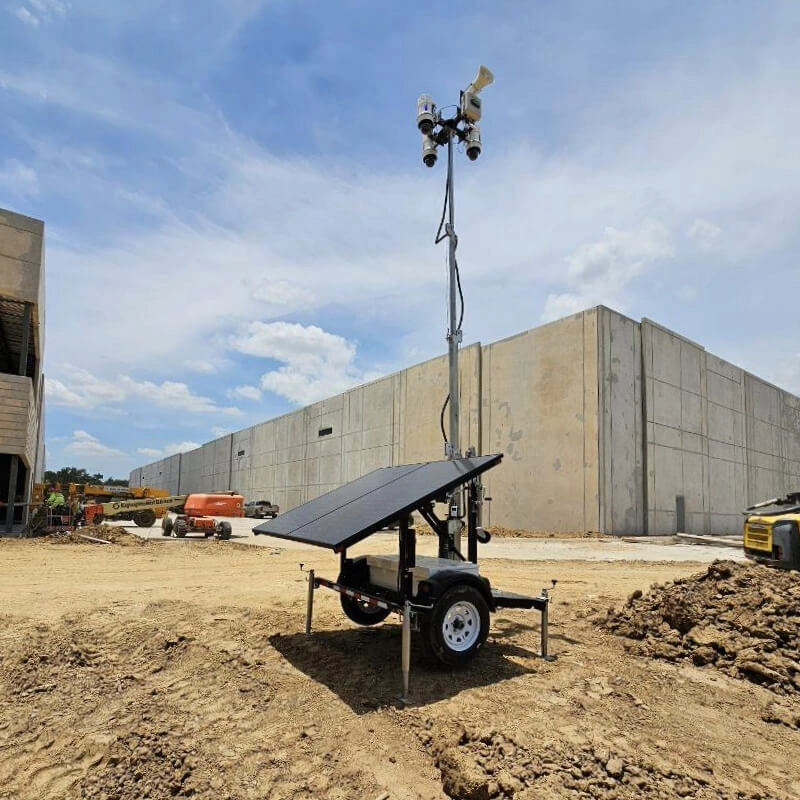
Staged equipment and materials are most exposed overnight and over weekends, when a site sits empty for 60 hours or more at a stretch. Our Solar Surveillance Trailers give continuous coverage without needing a power connection or finished fencing and can be deployed in as little as 20-minutes for basic setups.
Positioned around staging areas and equipment yards, they combine Live Video Monitoring with near-360° camera coverage, so blind spots around a laydown yard don't become a gap that thieves exploit. The units run independently of the site's own power and utility connections, which matters for equipment theft since most incidents happen when a site is unattended and unpowered.
A visible, monitored trailer changes the perceived risk for an opportunistic thief scouting a jobsite, and most will move on to an easier target. Because construction environments are temporary by nature, mobile surveillance trailer rental gives project teams coverage that fits the life of the build.
Units can be repositioned as the project moves, so the highest-value zone stays the most watched from groundbreaking through to handover.
Read more:
- Construction Jobsite Theft in California: How Big Is the Problem?
- How to Prevent Construction Site Theft in California
- Types of Construction Theft and How to Prevent Them
2. Copper and Metal Theft
Copper is one of the most consistently targeted materials on a growing development, and California lawmakers have responded quickly to the prevalence of the problem. Governor Newsom signed AB 476 in October 2025, tightening scrap-yard reporting requirements and increasing penalties for metal theft statewide.
AT&T alone reported over 2,200 copper theft incidents across California in 2024, up from just 71 in 2021, and California and Texas together accounted for more than half of the over 15,000 destructive attacks recorded nationwide on domestic communications networks between June 2024 and June 2025.
The bill's supporting materials reference a specific incident where thieves stripped 7 miles of copper wire from downtown Los Angeles's Sixth Street Bridge, and the resulting repairs are projected to cover over $2.5 million.
For developers, this makes metal theft prevention a core part of site planning rather than an afterthought, since copper wiring and fittings are staged on-site for weeks before installation.
Catching activity before the wire disappears
Copper theft happens quickly, and often in the narrow window between wiring being staged and being installed. This is why a fixed camera that is checked the following day isn't enough. AI-video analytics distinguishes a person lingering near a staged materials pile from routine site traffic and sends an alert the moment unusual activity starts.
All of our trailers and cameras are fitted with this AI technology. When it's paired with live monitoring, trained operators can review the alert immediately and issue a live audio warning, which stops most attempts before any material leaves the site. If the activity continues, operators can escalate it to local law enforcement while it's still happening.
Every alert is also recorded as timestamped, high-quality footage. That gives police usable evidence to act on and gives project owners clear documentation to support an insurance claim, rather than an empty materials yard and no record of what happened.
Read more:
- Copper Theft in California: Why It’s Rising and Who It Impacts Most
- 8 Types of Theft Affecting California Businesses and Jobsites
- Understanding Metal Theft: The Costs, Impact, and Tips to Prevent It
3. Unauthorized Access and Trespassing
A development under construction rarely has finished perimeter fencing, gated entry, or a staffed guard post from day one. This makes access point control one of the hardest problems to solve early, especially since unauthorized visitors can range from opportunistic trespassers looking for shelter to organized criminal crews scouting a site before a planned theft.
California's unhoused population grew by more than 20%, which is an increase of roughly 36,000 people, between 2019 and 2024. Additionally, vacant lots and under-construction properties are among the spaces most likely to see unauthorized access.
Relying on a fast response from police also carries its own risk, since California averages just 2 officers for every 1,000 residents. This is nearly half of the national average, and researchers have found staffing levels to be the single strongest predictor of how quickly law enforcement can respond to a call.
Controlling entry as the jobsite changes
Unfinished fencing and no staffed entry point mean a development has no reliable way to know who's been on-site, which is a core problem behind trespassing. Intrusion Detection addresses this issue directly, triggering an alert the moment someone enters a defined detection zone. That zone can extend beyond the immediate perimeter, so activity is flagged before anyone reaches equipment or materials.
This is one of the most effective surveillance solutions to prevent trespass, since the risk doesn't fade once fencing goes up. Gates are left open during deliveries, fence panels get moved, and new phases open fresh access points throughout the build.
License Plate Recognition (LPR) works as an add-on to this coverage, logging every vehicle entering or exiting the site and flagging any that don't belong to a contractor or delivery. Together, they give a timestamped record of who was on-site and when, which supports both stopping an incident in progress and any police report that follows.
Read more:
- How Crime Trends Are Changing Across California Industries
- How to Monitor Remote and Off-Grid Locations Across California
4. Vandalism and Property Damage
Partially built structures and paused-phase sites are some of the most exposed targets on a development, since they can sit unoccupied and unattended for extended stretches while later phases catch up.
Generally, vandalism tends to concentrate in vacant, unoccupied buildings. A development between phases fits that profile closely, since partially built structures can sit untouched for weeks while crews and budgets move to other parts of the project.
Under California Penal Code 594, any vandalism causing $400 or more in damage can be charged as a felony, which is a threshold that a single broken window, damaged fixture, or graffiti-covered wall can clear quickly once cleanup and materials are factored in.
These incidents can also add unplanned repair costs for property owners on top of a project's existing costs, and repeated incidents can also affect a development's insurance terms.
Making the jobsite an unattractive target
Vandalism depends on anonymity, and a partially built structure sitting unoccupied for weeks between phases gives someone that. A visible security presence, through surveillance trailers and cameras, removes this, since active and obvious cameras are often enough on their own to push most opportunistic vandalism toward an easier, unmonitored target instead.
Live monitoring adds the layer a passive camera can't provide, since a trained operator watching the feed can flag suspicious activity in real-time, activate deterrents, and alert local authorities, when necessary, before damage happens rather than only reviewing the footage after a property has been damaged.
Lighting strengthens this further. A well-lit structure removes the cover of darkness that most vandalism relies on, and when it's combined with visible cameras and live monitoring, a site between phases is perceived as being monitored 24/7 rather than assumed to be abandoned after dark.
Read more:
5. Vehicle-Related Crime Around the Jobsite
The vehicles most at risk on a development aren't usually cars. They're the excavators, skid steers, contractor trucks, and equipment trailers left on-site overnight, which are targets for fuel siphoning, catalytic converter theft, and outright theft of the machine itself. The risk rises further when jobsites sit near communities with higher crime rates.
Nearly two-thirds of the catalytic converter theft claims the National Insurance Crime Bureau recorded in 2024 came from California, making the state the single most affected in the country and a prime target for anyone with a vehicle parked in commercial environments and industrial sites alike.
Watching the fleet as closely as the build
Because these thefts happen so quickly, a vehicle left unattended overnight is often gone or stripped before anyone on-site notices. LPR logs every vehicle that enters or leaves the jobsite, so a truck arriving after hours or a trailer leaving with plant that should still be on-site is flagged straight away.
Over time, that log builds a documented pattern that helps identify repeat crews targeting the same site. On a development where machinery stays on-site for months, that pattern is often the difference between catching a crew and absorbing the loss every few weeks.
Pairing LPR with Solar Surveillance Trailers positioned over equipment storage areas adds a visible deterrent, making it clear before anyone reaches the machinery that the area is monitored.
Read more:
6. Large or Changing Perimeters
A development's footprint rarely stays the same for long. Grading and earthworks open up new access points, staging areas move as phases finish, and a perimeter that made sense at groundbreaking can leave whole sections exposed 6 months later. Fixed security infrastructure struggles to keep up with that pace of change, and a gap in coverage often isn't obvious until it's already been exploited.
California's fastest-growing regions compound this problem, since the same wildland-urban interface areas driving much of the state's new housing growth are also flagged by the U.S. Forest Service as the fastest-growing land use type in the country. This means perimeters often extend into terrain that's harder to fence, light, and monitor with fixed infrastructure in the first place.
Coverage that moves with the project
A fixed perimeter drawn at groundbreaking can't account for earthworks that open new access points or staging areas that shift between phases.
Redeployable surveillance trailers solve this, since they can be moved quickly without new trenching or permanent mounts every time the jobsite layout changes. Some surveillance trailers can also be repositioned by the site team themselves, so there's no need to wait on a call-out when coverage needs to shift.
That flexibility means coverage follows the active work zone and closes security gaps as soon as they open. For a development spanning several phases, maintaining security oversight as the site changes is just as important as being able to reposition surveillance. A cloud-based management platform helps project teams monitor cameras and trailers across different areas of the jobsite from a single dashboard, making it easier to maintain visibility as work progresses.
The platform also extends beyond security, supporting site safety, environmental monitoring, and overall project overview from the same login. For developments spanning several phases and locations, that centralized view gives teams one consistent record of everything happening in one place, rather than piecing together information from separate systems on a site-by-site level.
7. Protecting a Site Before Permanent Security Exists
Every development goes through a window where permanent alarm systems, fencing, and access control haven't been installed yet, but there's already enough value on-site to attract attention. This gap is often the most vulnerable point in a project's lifecycle, since it can stretch across multiple phases before permanent infrastructure catches up.
Development timelines in California have been getting faster, and the average time from application to entitlement dropped from 145 days in 2018 to 64 days in 2023, and the construction phase itself has shortened by a third over the same period.
Although this is good news for developers, it also means more projects are moving through their most exposed early phase at any given time, with permanent security still waiting to be installed behind faster-moving construction schedules.
Bridging the gap with temporary surveillance
The stretch before permanent security is installed creates the most exposure for a jobsite. Rental surveillance covers this phase with a solution shaped around the project's length, so coverage starts with the earliest work and ends at handover without any long-term hardware investment.
Rental also keeps costs predictable. Project teams pay for the coverage they need for as long as they need it, with no installation, maintenance, or removal costs. Compared with manned guarding, mobile surveillance can deliver up to 88% cost savings, freeing budget for the build itself.
Read more:
Staying Ahead of the Risk as California Keeps Building
The challenges facing California's developments rarely show up in isolation. A site hit by copper theft often has gaps in its wider security, which leaves it exposed to unauthorized access, vandalism, and equipment theft as well. The cost of those gaps shows up in repair bills, insurance premiums, and delayed timelines long before the build is finished.
The cost of leaving a jobsite unprotected during its most vulnerable phase adds up quickly, in repair bills, insurance premiums, replacement costs, and delayed timelines alike.
Mobile and rapidly deployable surveillance gives project teams a way to secure their jobsite without the need for permanent infrastructure. And a centralized cloud-based platform brings multiple sites into one dashboard, giving teams a clearer view of everything that happens in real-time.
If you want to find out what surveillance solutions suit your development's next phase, talk to our team about our recommendations today.

