If you've recently dealt with unauthorized access, stolen equipment, or repeated vandalism at a commercial property, you may be considering temporary surveillance to help prevent further incidents.
But with so many options available, choosing the right solution (and knowing which features actually matter) can be challenging. Before investing in a deployable surveillance system, you need to consider several things: the size of your site, camera technology, power, connectivity, monitoring, and the level of oversight you need to protect your assets and people effectively.
This article compares WCCTV's Solar Surveillance Trailers and Alert 360's Mobile Surveillance Units (MSU), helping businesses understand how the 2 solutions differ so they can make more informed decisions based on their operational and security needs.
Overview: WCCTV vs Alert 360
Let's take a closer look at WCCTV's Solar Surveillance Trailers and Alert 360's Mobile Surveillance Units to see how they measure up across capabilities, integrations, and scalability:
|
Feature
|
WCCTV Solar Surveillance Trailer
|
Alert 360 Mobile Surveillance Unit
|
|
Deployment speed
|
Installed in under 20 minutes (basic setups) by trained professionals as part of fully-managed service |
1-2 day deployment, installed by professional technicians
|
|
Height
|
Up to 20 feet
|
Not publicly specified
|
|
Relocatable
|
[[YES]]
|
[[YES]]
|
|
Power
|
Solar panels with battery backups
(no fixed infrastructure needed)
|
Solar panels with battery backup
(no fixed infrastructure needed)
|
|
Connectivity
|
Built-in 5G connectivity
|
Wireless cellular connectivity
|
|
Camera coverage
|
Near-360° coverage
|
360-view
|
|
Camera technology
|
High-definition PTZ (Pan-Tilt-Zoom) infrared (IR) night vision
|
4D low-light camera
|
|
AI-detection
|
[[YES]]
|
[[YES]]
|
|
24/7 recording
|
[[YES]]
|
[[YES]]
|
|
Live video monitoring
|
Yes, self- and professional monitoring via 24/7 Interactive Surveillance Operations Center (ISOC) monitoring center.
All included in fully-managed service. |
Yes, self- and professional monitoring via UL-approved Alert 360 Tulsa monitoring center.
Video Shield included.
|
|
Real-time alerts
|
[[YES]]
|
[[YES]]
|
|
Integration capabilities
(add-ons)
|
License Plate Recognition (LPR), Smart Detection Systems for intrusions, PPE monitoring, and smoke/fire detection, as well as Environmental Monitoring for noise, air quality, and weather
|
Intrusion Detection; Access Control; Energy Management; Multi-Location Business Management
|
|
Evidence collection
|
Yes, with timestamped audit trail and automated incident reporting
|
[[YES]]
|
|
Scalability
|
[[YES]]
|
[[YES]]
|
|
Cloud-based management (add-on)
|
Yes, multi-site, unified cloud-based management
|
[[YES]]
|
|
Remote access
|
Desktop, phone, and tablet
|
Desktop, phone, and tablet
|
|
Security
|
NDAA-compliant; add-on AES-256 encrypted cloud platform
|
AES-256 encryption
|
|
Costs
|
Flexible rental packages
|
Rental packages
|
|
Typical use cases:
|
Construction Jobsites, law enforcement, government, critical infrastructure, education, vacant sites, parking lots, events, traffic and highways
|
Remote locations, construction sites, retail parking lots, events, apartment complexes, temporary business environments
|
Read more:
Feature Comparison: WCCTV vs Alert 360
Below, we discuss the features that actually matter to keep assets, property, and people safe:
1. Product offering and camera coverage
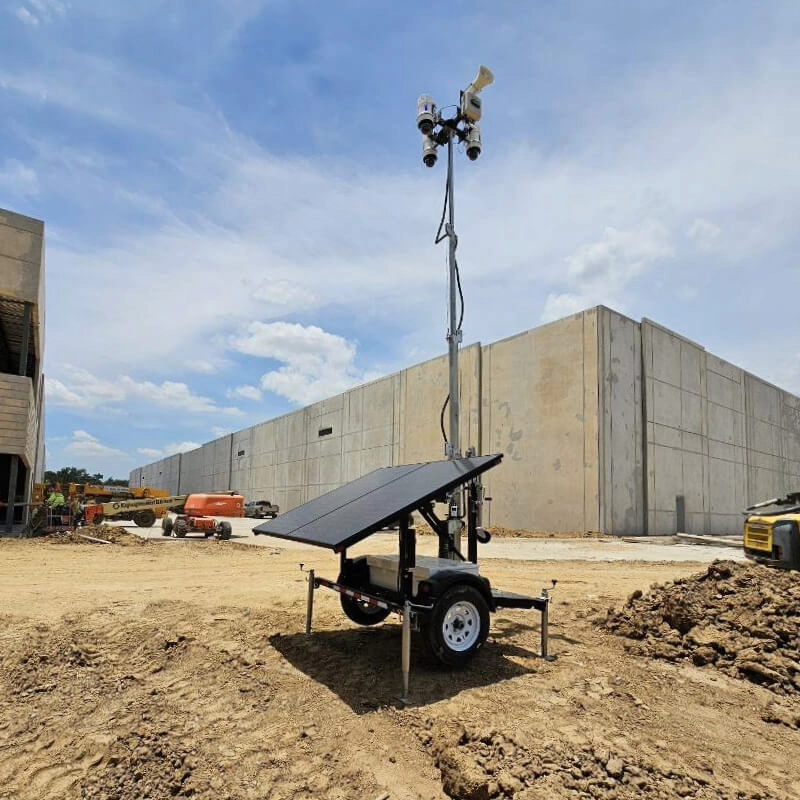
WCCTV offers various surveillance products and integrations, including the Solar Surveillance Trailer. This rapidly deployable, almost 20-foot solar-powered unit is designed to provide temporary security at locations without fixed infrastructure. It's well suited to large construction sites, industrial properties, parking lots, events, traffic environments, and virtually any remote location.
Each Trailer carries up to 3 high-definition PTZ cameras with infrared night vision, providing near-360° coverage and detection up to ~650 feet in complete darkness, dust, fog, and adverse weather. Systems operate 24/7 and connect to professional remote monitoring centers as standard, helping keep assets, property, and people safe both day and night.
WCCTV's Trailers also support easy integration with IoT-based environment sensors, smart detection systems for PPE monitoring and intrusion alerts, License Plate Recognition (LPR) cameras, as well as Time Lapse Video.
Alert 360 also offers several surveillance options, but its Mobile Surveillance Unit is the closest match to WCCTV. It works well on construction sites, retail parking lots, events, and temporary business environments.
Mobile Surveillance Units are solar-powered and use 4D low-light cameras to provide 360-view surveillance. Smart integrations, such as Intruder Detection and Access Control, can be added to these security systems, but at the time of writing, there doesn't seem to be any PPE or environmental monitoring like WCCTV.
Verdict
Both security companies offer power autonomy, near-360° surveillance, integration options, and flexible protection where and when it's needed.
WCCTV has better overall versatility, with a 20-foot mast, support for up to 3 PTZ security cameras, and a wider range of additional integrations. Alert 360's Mobile Surveillance Unit doesn't list mast height specifications online and, at the time of writing, doesn't appear to offer integrations such as environmental monitoring or dedicated PPE capabilities that are available with WCCTV.
2. Surveillance features
WCCTV's Trailers combine flashing lights, sirens, and live audio video-down challenges to deter incidents in real-time. Built-in AI-video analytics continuously analyze behavioral patterns and filter false alarms caused by swaying branches, wildlife, or passing traffic.
Trailers can also be configured to meet your exact security needs. Whether you're looking to prevent trespassing, squatting, theft, vandalism, or illegal dumping, WCCTV offers a security solution for the risks you are facing.
24/7 professional remote monitoring through ISOC centers comes standard with WCCTV's fully-managed service. Live footage is sent over secure 5G networks to its AES-256 encrypted cloud-based monitoring platform, which can be accessed from any connected device. Every incident is timestamped and logged, creating a complete audit trail for later review, investigations, or insurance claims.
The cloud platform also brings together security, safety, environmental monitoring, and operational insight into one place. This allows users to manage site security, identify safety risks through PPE monitoring, track air quality, noise, and weather conditions for compliance purposes, and monitor multiple locations remotely.
Alert 360's Mobile Surveillance Units are a fair contender to WCCTV, with good deterrence and monitoring capabilities. LED strobes and built-in speakers with audio warnings help deter incidents before they escalate. Live camera feeds are streamed through AES-256 encrypted wireless connections, allowing users to access and review feeds remotely.
Through Alert 360's Video Shield feature, 24/7 professional monitoring is also available. Trained security professionals monitor sites remotely and respond to potential incidents, providing a similar active-monitoring service to WCCTV's ISOC offering.
Verdict
Both providers combine active deterrents with AI-assisted and professional monitoring to support rapid response. WCCTV also allows users to access live camera feeds and review site activity remotely through its cloud platform, with every incident securely timestamped and logged. The cloud software also consolidates footage and alerts from every deployment, making portfolio-wide management much easier, as everything is in one place.
While Alert 360 also offers remote access to camera feeds, it isn't clear if the platform offers the same incident logging and audit trail capabilities as WCCTV. You'll also need the Multi-Location Business Management add-on when needing to monitor multiple sites across a portfolio.
3. Integration capabilities
WCCTV's surveillance solutions integrate with numerous add-on features:
- Smart Detection Systems: For PPE Monitoring, Intrusion Detection, and Smoke/Fire Detection.
- Environmental Monitoring: Air Quality Sensors, Noise Sensors, and Weather Sensors
- License Plate Recognition (LPR): For vehicle tracking and access control.
Data and alerts from these systems are consolidated and accessible within the same cloud-based platform, bringing security, safety, environmental monitoring, and project oversight into a single dashboard. This reduces vendor sprawl, provides greater oversight, and makes managing commercial portfolios through one provider far easier.
Alert 360 also offers a range of business security integrations, including intrusion detection, access control, energy management, and multi-location business management. These features are managed through its cloud-based platform for remote access and monitoring.
Energy management is an area where Alert 360 has an advantage. However, WCCTV offers a broader range of features designed to meet the needs of more industries, including construction and critical infrastructure environments, with capabilities such as environmental monitoring, PPE monitoring, and smoke/fire detection.
Verdict
Both WCCTV and Alert 360 offer integrations for intrusion detection and access control, with data managed through cloud-based platforms. WCCTV has the edge for construction and critical infrastructure applications, with additional capabilities such as environmental monitoring, PPE monitoring, and smoke/fire detection, which do not appear to be offered by Alert 360.
4. Mobility and scalability
WCCTV's Trailers are solar-powered with battery backup, operate off-grid, and can be self-relocated as site risks shift. Because systems are fully autonomous and provide weeks of reliable coverage, businesses can deploy them virtually anywhere security is needed, including isolated locations lacking fixed infrastructure.
Its cloud dashboard consolidates up to 81 camera feeds, allowing businesses to monitor activity across multiple units in a single view.
Alert 360 markets its Mobile Surveillance Units as repositionable as operations, access points, and high-value zones change. Like WCCTV, units are also solar-powered with battery backup, making them suitable for remote locations or areas without fixed infrastructure. Users will need the Multi-Location Business Management add-on to monitor activity across several sites.
Verdict
Both security solutions offer solar-powered, infrastructure-free coverage for temporary deployments and can adapt to changing site layouts. WCCTV and Alert 360's systems can be self-moved to areas with the highest security risks, while footage and data can be accessed remotely through the cloud.
WCCTV supports up to 81 camera feeds in a single dashboard, making it well suited to larger, multi-site deployments. Alert 360 doesn't specify an equivalent camera-feed capacity online, so it's difficult to make a direct comparison on scalability.
5. Connectivity and setup
WCCTV's rapidly deployable Solar Surveillance Trailers use built-in 5G connectivity, so there's no dependency on Wi-Fi or permanent landline infrastructure. Professional installation is handled end-to-end by US-based technicians (as part of its fully-managed service), with basic systems up and running in around 20 minutes.
Alert 360's Mobile Surveillance Units use solar power and wireless connectivity to transmit site activity to its cloud platform, benefiting operations in remote locations. Installation is handled by US-based professionals with setup typically taking 1-2 days.
Verdict
Both solutions are installed by professional US-based technicians and provide reliable off-grid security via secure wireless networks without fixed infrastructure. Alert 360's deployments are set up in 1-2 days, whereas WCCTV's basic setups are installed in roughly 20- minutes.
6. Use cases
WCCTV's Trailers are purpose-built for a wide range of sectors, including construction, critical infrastructure, vacant properties, traffic and highway projects, campuses, retail centers, and large-scale events.
Advanced PTZ cameras, smart detection, 24/7 remote monitoring, and cloud-based video history provide visibility across large or complex sites. This makes them particularly suitable for properties with multiple entry points, remote locations, and organizations managing several sites that need centralized monitoring and reporting.
Alert 360's Mobile Surveillance Units are commonly used on jobsites, equipment yards, parking lots, events, and temporary business environments. Real-time notifications, AI-driven analytics, remote monitoring, and cloud-based management provide similar professional-grade security capabilities.
Verdict
WCCTV supports a broader range of industries, making it a stronger option for larger or higher-risk sites that require continuous oversight and detailed reporting. Alert 360 is more focused on construction, events, and other temporary environments.
7. Cost
WCCTV's Solar Surveillance Trailers are available to rent, giving businesses the flexibility to increase/decrease security as site requirements change. A single monthly fee includes hardware, installation, monitoring, maintenance, and technical support, so there's no need to juggle multiple vendors. It's been noted that using WCCTV can reduce security costs by up to 88% compared to full-time manned security.
Alert 360 also offers hire agreements for its Mobile Surveillance Units. While Video Shield remote monitoring comes with the hardware, it appears there's an additional fee for management, maintenance, and monitoring.
Verdict
WCCTV's rental model is more cost-effective than 24/7 manned security, with hardware, monitoring, and maintenance included in the monthly fee. With Alert 360, however, monitoring is charged separately from the rental cost, so businesses need to factor this additional expense into the overall price.
5 Factors to Look For in A Mobile Surveillance Provider
The right mobile surveillance solution will depend on your site's security, operational, and infrastructure requirements. When comparing providers, consider these 5 factors:
- Rapid deployment: Setup times vary significantly between providers, from systems installed in under an hour to units taking 1-2 days to become fully operational. If you're addressing an immediate security concern, opt for a provider that can get coverage in place as quickly as possible.
- Site-specific needs: Surveillance systems for a construction site might not necessarily suit a retail parking lot or fully off-grid location. Consider whether the solution has the right capabilities for your site, including solar power, battery autonomy, 5G connectivity, and mobility.
- 24/7 Remote monitoring: Some providers include professional monitoring in base rental packages, while charge for it separately. Check exactly what's included and factor monitoring costs into your comparison when reviewing quotes.
- AI-analytics and smart integrations: AI-powered motion detection and false alarm filtering are common features, but add-ons vary widely between providers. Depending on your needs, look for features such as vehicle recognition, PPE monitoring, and environmental sensors. On construction sites, environmental monitoring helps support air quality, noise, and weather monitoring compliance before they lead to complaints.
- Cloud-based oversight: A centralized cloud platform lets you monitor incidents and review activity across multiple sites from one place, making portfolio management easier. It can also reduce vendor sprawl by bringing security, safety, and other monitoring requirements into a single platform.
Matching a mobile surveillance provider to your site's size, infrastructure, connectivity, security risks, and monitoring requirements can help ensure your assets and people are protected from day one, and make an informed decision based on their operational needs rather than marketing claims.
If you're interested in rapid deployment, infrastructure-free smart surveillance with 24/7 remote monitoring included in one rental price, WCCTV might be the more suitable option.