
To choose a deployable surveillance solution, you need to consider the technology, power setup, monitoring, and level of oversight you need to keep your sites secure.
Get it right, and you deter crime, protect valuable assets, maintain clear visibility, and reduce liability across your site. Get it wrong, and you could be left with blind spots, unreliable coverage, mismatched equipment, financial losses, or a service that doesn't scale with your business.
With so many surveillance options available, understanding which features actually matter for your operational requirements and long-term security strategy can make a big difference.
This blog provides a side-by-side comparison of WCCTV's Solar Surveillance Trailer and Amazon's Ring Mobile Security Towers to help businesses weigh up their options and determine which solution is the better fit for their security needs.
Quick WCCTV vs Ring Overview
Before we dive into the details, here's a quick comparison of WCCTV's Solar Surveillance Trailers and Ring's Mobile Security Towers as 2 main offerings within their broader range of solutions, integrations, and solutions:
|
Feature |
WCCTV Solar Surveillance Trailer |
Ring Mobile Security Tower (Plug-In) |
|
Deployment speed |
Easy installation in under 20 minutes (basic setups) by trained professionals |
Set up by you, the customer |
|
Installation cost |
Included in fully-managed service |
Professional installation starting from $499 per unit |
|
Height |
Up to 20 feet |
12 feet |
|
Mobility |
Relocatable as site needs change |
Requires add-on Trailer Kit from a third-party supplier |
|
Power |
Solar-powered with battery backup (no fixed infrastructure needed) |
Mains power with battery backup |
|
Connectivity |
Built-in 4G/5G connectivity |
Requires Wi-Fi/ethernet or LTE connection via Ring subscription |
|
Camera coverage |
Near-360° coverage |
360 panoramic coverage |
|
Camera technology |
High-definition PTZ (Pan-Tilt-Zoom) infrared (IR) night vision |
Multi-lens Retinal 4K Night Vision |
|
AI-detection |
Built-in AI-video analytics that reduce false alarms |
AI Active Warnings (subscription required) |
|
24/7 recording |
[[YES]] |
Only records when motion is detected |
|
Live video monitoring |
Yes, self- and professional monitoring available |
Yes, self-monitoring via Ring app |
|
Real-time alerts |
Yes, AI detection alerts verified through monitoring center operators (included in WCCTV's fully-managed service) |
Yes, through Virtual Security Guard service (add-on) |
|
Integration capabilities |
Add-on License Plate Recognition (LPR), Smart Detection Systems for intrusions, PPE monitoring, and smoke/fire detection, as well as Environmental Monitoring for noise, air quality, and weather |
Custom apps available through the Ring Appstore |
|
Compatible accessories/add-ons |
Smart Detection; Environmental Monitoring; LPR; Time Lapse Video; cloud-based consolidation platform |
Ring Solar Panel Kit; Ring Battery Pack; Trailer Kit |
|
Evidence collection |
Yes, with timestamped audit trail and automated incident reporting |
Yes, default video storage up to 30 days |
|
Scalability |
[[YES]] |
[[YES]] |
|
Cloud-based management |
Unified cloud-based platform consolidates all footage, alerts, and vehicle data from multiple sites in one place |
Single site management via cloud-based Ring App |
|
Security |
NDAA-compliant; add-on AES-256 encrypted cloud platform |
Video end-to-end encryption (E2EE) (optional security feature) |
|
Costs |
Flexible rental packages |
Starts at $4,999 (with 1-year warranty) |
|
Typical use cases: |
Construction, law enforcement, government, critical infrastructure, education, vacant sites, parking lots, events, traffic and highways |
Construction, parking lots, retail spaces, event venues |
Read more:
Feature-by-Feature Comparison: WCCTV vs Ring
Below, we break down 7 features that set these 2 surveillance solutions apart:
1. Product offering and camera coverage
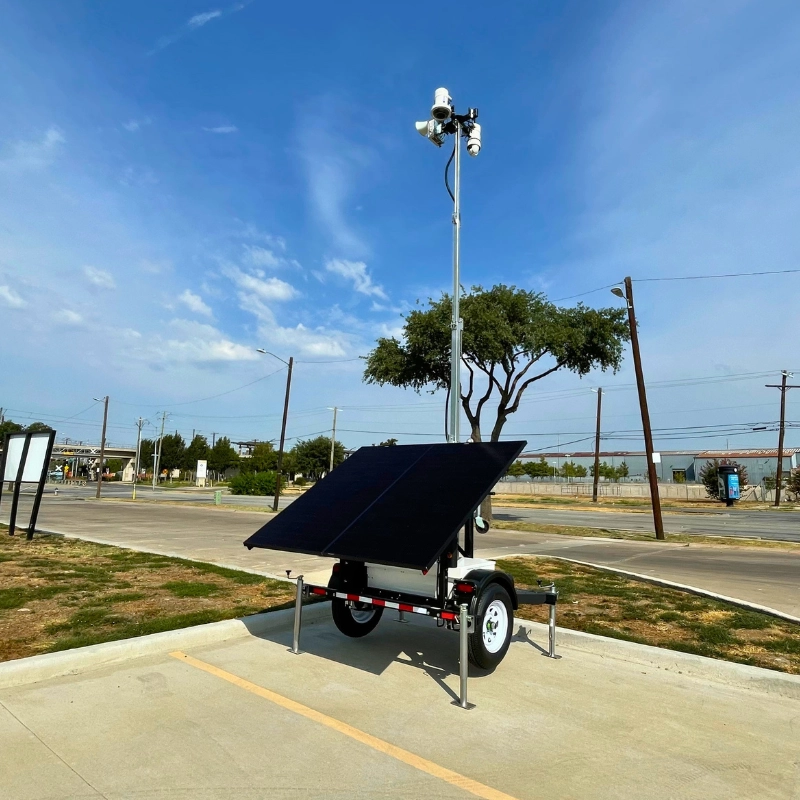
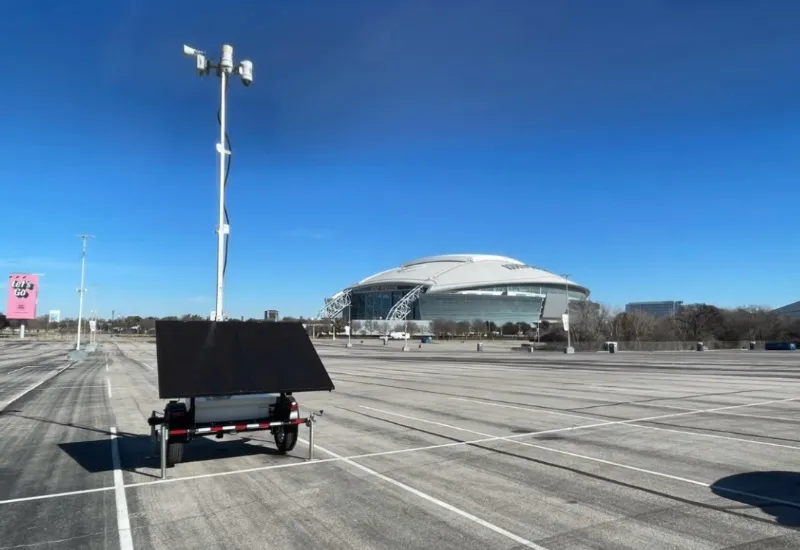
WCCTV's core offering is the Solar Surveillance Trailer. It's a near-20-foot, rapidly deployable, autonomous mobile surveillance unit specifically designed for temporary security and problem-specific applications across any environment that lacks fixed infrastructure or where site conditions evolve quickly.
Equipped with up to 3 high-definition PTZ night vision Pole Cameras, it gives you near-360° coverage plus the ability to zoom in and track activity in detail, at up to 650 feet in complete darkness, dust, and harsh weather conditions.
The Solar Surveillance Trailer also seamlessly integrates with other add-on features, such as IoT-based environmental sensors, smart detection systems, License Plate Recognition (LPR) cameras (for monitoring all vehicle movements as well as details such as make, model, and color), and Time Lapse Video.
Ring offers several Mobile Security Towers, including the base model (Ring Mobile Security Tower Plug-In) used in the comparison above. Other versions add features onto this model, such as iLOQ smart locks and off-grid functionality with solar panels and 1 or 2 battery backups.
The full Ring range includes:
- Ring Mobile Security Tower Plug-In
- Ring Mobile Security Tower with iLOQ - Plug-In
- Ring Mobile Security Tower with iLOQ - Solar Panel Kit + 1x Battery
- Ring Mobile Security Tower with iLOQ - Solar Panel Kit + 2 Battery
- Ring Mobile Security Tower - Solar Panel Kit + 2x Battery
- Ring Mobile Security Tower - Solar Panel Kit + 1 Battery
Ring's Mobile Security Towers take a simpler, camera approach, using a single multi-lens Ring Elite 360 camera with Retinal 4K resolution on a 12-foot collapsible mast, which is shorter than WCCTV's. The 4K image quality is strong, and for a small site where one clear viewpoint is enough, it makes a good solution.
Verdict
At first glance, Ring appears to offer a wider range of products than WCCTV. However, when you look at the configurations more closely, the Ring Mobile Security Tower with iLOQ - Solar Panel Kit + 1x Battery is the closest match to WCCTV's Solar Surveillance Trailer. Both offer off-grid functionality, but WCCTV has the edge in coverage and versatility.
With up to 3 PTZ Pole Cameras, a near-20-foot mast, and support for additional integrations, WCCTV is better suited to larger, open, or higher-risk sites when you need to monitor and track activity across a wider area or portfolio.
Ring's 4K panorama cameras deliver excellent image detail from a single viewpoint, making it a good fit for smaller, more contained sites where single-point coverage is sufficient.
2. Surveillance features
WCCTV's near-20-foot Solar Surveillance Trailers provide a highly visible deterrent against crime, trespassing, and other unlawful behavior like illegal dumping.
Alongside HD PTZ cameras, each trailer combines flashing lights, sirens, and live audio-voice challenges to deter incidents as they happen, not after the fact. Built-in AI analytics help filter false alarms caused by weather or debris, while footage is transmitted over 4G/5G networks to a secure centralized platform for remote viewing from any mobile device.
24/7 live video monitoring is also included as part of WCCTV's fully-managed service. Trained operators monitor sites and verify genuine threats in real-time, rather than simply sending alerts when motion is detected.
The Solar Surveillance Trailers can also integrate with LPR technology, Environmental Sensors, and other Smart Detection Systems, giving businesses additional security, safety, and compliance monitoring.
Ring takes a simpler approach compared to WCCTV. Its Mobile Security Tower uses a single Ring Elite 360 camera on a 12-foot mast and records when motion is detected, rather than providing continuous monitoring. Its 4K image quality is a real strength for capturing clear detail, and AI-powered warnings and motion-activated LED lights help deter intruders.
However, Ring's AI Active Warnings feature, which uses a two-way voice system, is sold separately and requires ongoing subscription fees to the Ring app. Real-time alerts are sent directly to the owner's phone, but they aren't verified by a professional monitoring center unless you add Ring's Virtual Security Guard service.
Verdict
Both solutions are designed to deter crime, but they take different approaches. WCCTV has the stronger active security offering, combining a taller mast, multiple PTZ cameras, visible deterrents, and 24/7 professional monitoring. This makes it better suited to large construction jobsites, public spaces, traffic environments, and expansive critical infrastructure sites where continuous oversight matters most.
Ring's motion-activated lighting and alerts provide a useful deterrent, but some of its more advanced features require additional subscription fees, including AI Active Warnings and Virtual Security Guard.
3. Integration capabilities
WCCTV's Solar Surveillance Trailers can easily integrate with Smart Detection Systems (for intruders, PPE monitoring, and/or smoke/fire detection), as well as Environmental Monitoring (for air quality, noise, and weather). LPR technology can be added too, with relevant alerts and data visible within the same cloud-based software platform. This gives you full visibility and makes it easier to manage everything from one place.
Ring's Mobile Security Towers also offer integration options through the Ring Appstore, which allows users to build or add apps tailored to their security and operational requirements. However, Ring's public documentation doesn't detail how these third-party integrations work in practice, or how they compare to WCCTV's built-in monitoring and detection capabilities.
Verdict
At the time of writing, WCCTV has more clearly defined integration capabilities compared to Ring. Viewing security, environmental, safety, and vehicle-related data in one platform provides a more comprehensive oversight of site activity.
4. Mobility and scalability
WCCTV's Solar Surveillance Trailers can be deployed, repositioned, and relocated as site risks and requirements change. With the fully-managed service, WCCTV handles installation, repositioning, and decommissioning, while the cloud-based monitoring platform brings video feeds and alerts from multiple units into a single dashboard. This makes it easier to expand coverage across multiple sites without managing each unit separately.
Because the trailers are solar powered, they can also operate in remote and off-grid locations without relying on mains power or fixed internet infrastructure, giving businesses more flexibility over where they deploy them.
Ring's Mobile Security Towers are also movable, but the plug-in model requires a Trailer Kit, sold separately through a third-party distributor, to make it mobile. It also needs a nearby 120V AC outlet for continuous operation, limiting where it can be deployed and making it less suitable for remote or off-grid locations.
Ring Towers can be managed through the Ring app, allowing users to view cameras and receive alerts across their deployments from one place. However, this relies on the Ring ecosystem and doesn't offer the same broader integration and centralized monitoring capabilities as WCCTV's platform.
Verdict
WCCTV offers greater mobility and scalability. Its solar-powered design allows surveillance to move easily between temporary, remote, and changing sites, while centralized monitoring makes it straightforward to manage multiple units. Ring can also be scaled and managed through its app, but its reliance on mains power in the plug-in configuration limits deployment flexibility.
5. Connectivity and setup
WCCTV units combine solar power, battery backup, and 4G/5G connectivity, allowing them to operate without fixed infrastructure. Professional installation is handled by WCCTV from start to finish, with basic setups deployed in under 20 minutes. Once installed, remote monitoring access and cloud storage are ready to use.
Ring Mobile Security Towers can connect via Wi-Fi, Ethernet, or LTE connection, although LTE requires a compatible Ring subscription through a third-party carrier. Unless you pay the ~$499 installation fee, you'll need to install the unit yourself.
Verdict
WCCTV offers a simpler, hands-off installation approach. Using professional installation ensures consistent performance and cloud recording from day one for your peace of mind. Ring offers several connectivity options (plug-in and solar), but some units require a power source, and installation is entirely the owner's responsibility.
6. Use cases
WCCTV's surveillance solutions are built for a wide range of commercial sectors, including construction jobsites, law enforcement, government, critical infrastructure, parking lots, retail centers, events, traffic/highways, and vacant properties.
The combination of PTZ security cameras, smart features, cloud systems, continuous recording, and video history provides complete coverage and ongoing visibility. This makes trailers well-suited to larger properties or more complex sites where multiple entry points need to be monitored.
Ring's Mobile Security Towers are best suited to construction, parking lots, retail spaces, and event venues. The multi-lens camera provides wide-area coverage from a single installation point, while app-based monitoring and motion alerts give users visibility when activity is detected.
Verdict
WCCTV caters to a wider range of environments than Ring, making it a stronger fit for larger or higher-risk sites where continuous oversight and detailed video history are important. Ring is a good option for lower-risk environments where wide-area coverage and motion-based alerts provide sufficient security.
7. Cost
WCCTV offers flexible rental agreements, allowing you to scale security up (or down) as risks shift. One predictable monthly fee eliminates vendor sprawl, covering equipment, installation, monitoring, maintenance, and technical support with no large capital outlay for hardware or maintenance of multiple systems. It's been noted that using WCCTV's Surveillance Trailers can reduce security costs by up to 88% compared to manned security.
Ring's Mobile Security Towers range from $4,999 to around $9,700, giving you outright ownership from day one. Apart from the hardware, key features like AI Active Warnings and Virtual Security Guard monitoring run on separate subscription plans, so it's worth factoring these into the total cost.
Verdict
WCCTV's rentals tend to work out far more cost-effective for multi-site operations, especially when compared to the cost of 24/7 security guards. Ring's ownership model works well for permanent installations on a smaller scale.
Make the Smarter Surveillance Choice
Both WCCTV and Ring offer deployable security systems designed to discourage crime, safeguard equipment and assets, and maintain clear oversight across your site. The key difference is how much coverage, monitoring, and flexibility you need.
WCCTV's surveillance solutions are designed for larger, more complex, or remote sites where continuous oversight matters. Its broader offering covers 4 key areas: security, safety, environmental monitoring, and project oversight, helping businesses address a range of site-specific risks and operational needs through a single provider.
Solar power and 4G/5G connectivity enable solutions to operate without fixed infrastructure, while PTZ cameras provide near-360° coverage and 24/7 professional monitoring allows potential threats to be verified in real-time. The centralized cloud platform consolidates footage, alerts, and data from multiple units together in one place, giving businesses a clearer overview across their sites.
Ring offers a simpler approach, with 4K panoramic cameras, motion-based recording, app alerts, and optional AI warnings and professional monitoring. They're better suited to smaller, more contained sites where wide-area coverage from a single tower and self-monitoring are sufficient.
Ultimately, WCCTV is the stronger choice for businesses that need continuous monitoring, wider coverage, audit trails, complete visibility, and the flexibility to protect multiple or changing sites. Ring is a good fit for smaller, lower-risk locations with existing infrastructure where a simpler, self-managed surveillance solution meets your security needs.
