
If you've recently dealt with trespassing, stolen equipment, vandalism, loitering, or smash-and-grab thefts in a commercial parking lot, you're probably already looking into temporary surveillance solutions to stop it from happening again.
But with so many options out there, choosing the right setup isn't always straightforward. Before investing in mobile surveillance systems, it's worth thinking through a few things: the size of your site, camera technology, power, connectivity, and how much protection is actually needed to keep your property and people safe.
This article compares WCCTV's mobile Solar Surveillance Trailer with LotWitness's fixed parking lot security solutions to help businesses work out which option aligns best with their operational and security needs.
WCCTV vs LotWitness: Quick Comparison
Let's take a closer look at how WCCTV's Solar Surveillance Trailers and LotWitness's parking lot surveillance cameras detect and deter crime:
|
Feature |
WCCTV Solar Surveillance Trailer |
LotWitness |
|
Professional installation |
[[YES]] Basic systems operational within 20-minutes |
[[YES]] Deployment timeframe not publicly specified |
|
Relocatable |
[[YES]] |
[[NO]] |
|
Power |
Solar panels with battery backups (no fixed infrastructure needed) |
Mains power/existing electrical infrastructure; no solar panels |
|
Connectivity |
Built-in 4G/5G cellular connectivity |
Not publicly specified |
|
Camera coverage |
Near-360° |
360° |
|
Camera technology |
High-definition PTZ (Pan-Tilt-Zoom) infrared (IR) night vision |
High-definition PTZ with 25X zoom |
|
AI-detection |
[[YES]] |
[[YES]] |
|
24/7 recording |
[[YES]] |
[[YES]] |
|
Live video monitoring |
Yes, self- and professional monitoring via 24/7, UL-Listed, 5 Diamond Certified, Interactive Surveillance Operations Center (ISOC) monitoring center
|
Yes, through LotView remote monitoring and a dedicated video investigation team Included in all-inclusive service |
|
Real-time alerts |
[[YES]] |
[[YES]] |
|
Integration capabilities (add-ons) |
License Plate Recognition (LPR), Smart Detection Systems for intrusions, PPE monitoring, and smoke/fire detection, as well as Environmental Monitoring for noise, air quality, and weather |
None publicly listed |
|
Evidence collection |
Yes, with timestamped audit trail and automated incident reporting |
Yes, from a dedicated video investigation team |
|
Scalability |
[[YES]] |
[[YES]] |
|
Cloud-based management (add-on) |
Yes, multi-site, unified cloud-based management |
Not publicly specified |
|
Remote access |
Desktop, phone, app, and tablet |
Remote property view via LotView |
|
Security |
NDAA-compliant; add-on AES-256 encrypted cloud platform |
Not publicly specified |
|
Costs |
Flexible rental packages |
Month-to-month rentals |
|
Typical use cases: |
Construction, law enforcement, government, critical infrastructure, education, vacant sites, parking lots, events, traffic and highways |
Retail properties (bars, restaurants, grocery stores, shopping centers, etc.) |
Read more:
- What is a Solar Surveillance Trailer?
- What To Look for In a Mobile Surveillance Trailer
- Most Asked Questions About Solar Surveillance Trailers
WCCTV vs LotWitness: Feature Comparison
Here we discuss the 5 features most worth comparing between these 2 surveillance solutions:
1. Product offering and setup
WCCTV has a wide product range, including:
- Solar Surveillance Trailers
- Pole Cameras
- License Plate Recognition (LPR) cameras
- Smart Detection Systems
- Environmental Monitoring Solutions
- Time Lapse Video
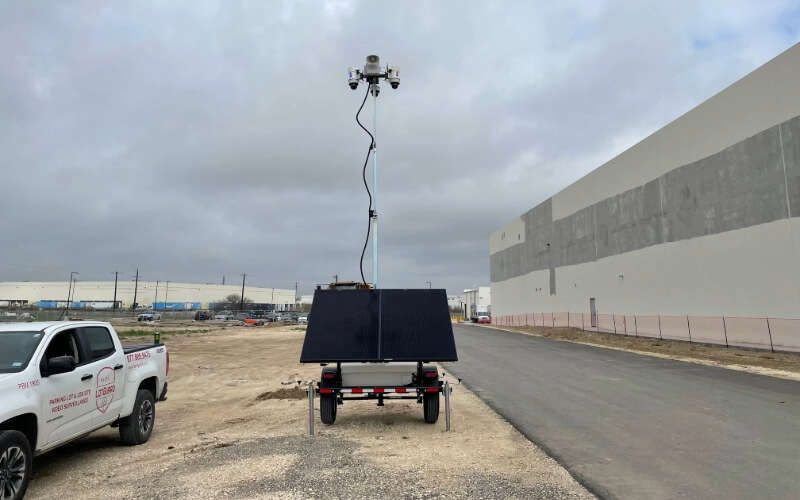
For this comparison, though, we'll focus on the mobile Solar Surveillance Trailer. Standing nearly 20-feet tall, the unit is solar-powered with battery backup, with basic setups operational in around 20 minutes. WCCTV provides a fully-managed service that covers installation, maintenance, monitoring, and ongoing technical support.
Because the Trailers don't rely on mains power or Wi-Fi, they can be deployed in virtually any location. This makes them well-suited to an array of sectors, including construction, critical infrastructure, traffic and highway environments, parking lots, and any other commercial site with changing layouts and no permanent infrastructure.
WCCTV also offers portable Pole Cameras, which can be mounted onto existing structures such as utility poles or buildings. They operate autonomously without fixed power and can be used across a wide range of sectors, including construction and retail parking areas.
LotWitness works differently. Its systems are installed on a property's existing light poles or structures and run on the site's existing electrical infrastructure. This means each unit requires a dedicated mains power source and cannot operate off-grid. By comparison, WCCTV's Trailers and Pole Cameras can operate independently of mains power, making them suitable for temporary deployments and remote locations.
Like WCCTV, LotWitness offers an all-inclusive service covering professional installation, proactive system monitoring, and complimentary video investigation. The catch, however, is that LotWitness's product range is more specialized. Systems are designed specifically for retail parking lots, making it less suitable for businesses and sites outside the retail sector.
Verdict
WCCTV has the clear advantage here, with an extensive range of mobile surveillance solutions designed for construction, logistics, and critical infrastructure, as well as retail parking lots and events. Because both its Trailers and Pole Cameras operate autonomously, they're the right call for temporary, remote, or sites with changing layouts.
LotWitness offers pole cameras that provide a fixed surveillance solution for retail parking areas where existing power and light poles are already in place. This can be an appealing option as they don't take up much space in a parking lot in the way trailers do. However, WCCTV also has Pole Cameras in its range, with advanced technology and off-grid functionality for locations without existing power infrastructure.
2. Surveillance features and camera coverage
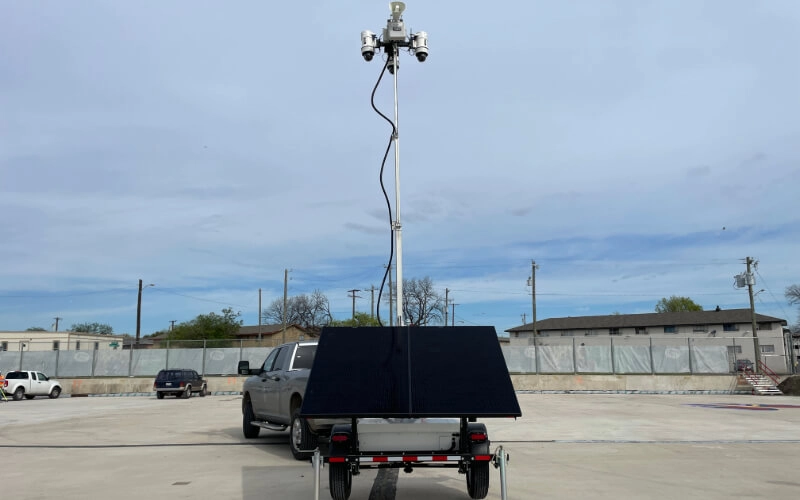
WCCTV's Solar Surveillance Trailers stand nearly 20-foot tall and are designed to detect and deter criminal activity before it escalates. Their PTZ surveillance cameras provide near-360° coverage, which allows commercial sites to be monitored 24/7 while unusual activity is flagged in real-time.
With AI-powered analytics and an IR detection range of ~650 feet, systems can distinguish genuine threats from harmless activity, helping to reduce false alarms and unnecessary responses.
Trailers also feature active deterrents like blue strobe lights and sirens that are triggered when systems detect something suspicious. 24/7 remote monitoring adds another layer of protection, with trained operators verifying alerts as they happen and initiating various response actions near-instantly. This can include issuing live audio voice-down challenges through integrated on-site speakers or contacting law enforcement if/when needed.
Video footage is securely transmitted over 4G/5G networks to an AES-256 encrypted cloud monitoring platform. Every incident is timestamped and logged, creating an audit trail that can support investigations and insurance claims. Property managers can also generate reports in just a few clicks, making it easier to document security events across single sites or large portfolios.
LotWitness provides what it calls "multisensory customer awareness", using live, customizable audio announcements to engage shoppers in retail parking lots.
The company explains that these announcements can help prevent smash-and-grab incidents by reminding customers to secure valuable items before leaving their cars. When suspicious activity is caught on camera, LotWitness states that high-intensity strobe lights are activated to deter potential intruders.
Paired with LotView, its remote property management software, 360° PTZ cameras with 25x zoom help detect and deter criminal activity from a distance. Based on publicly available information, LotWitness also provides video investigation as part of its all-inclusive service, with a dedicated team supplying video evidence and full reports so users can see exactly what happened and when.
However, it's unclear whether LotWitness offers proactive professional remote monitoring or whether its customizable audio warnings are intended solely for shoppers.
Verdict
Both security providers offer active deterrents and 360° PTZ coverage, AI-powered alerts, and remote verification, but the difference comes down to what level of oversight is required.
WCCTV's mobile surveillance solutions can detect unusual activity up to ~650 feet away while timestamping every incident and storing it in the cloud for later review. Users can also access this remotely and generate reports on demand, whereas you'll need to wait for LotWitness's video investigation team to send incident details.
3. Integration capabilities
WCCTV's surveillance solutions can support various integration add-ons, including Smart Detection Systems for Smoke/Fire Detection, PPE Monitoring, and Intrusion Detection.
There are also IoT-based Environmental Monitoring options, which can be useful on construction, critical infrastructure, or demolition sites where air quality and noise levels need to be recorded to remain compliant. Weather Sensors track conditions such as wind speed, rainfall, and temperature, which can also help justify any weather-related delays during roadwork or building projects.
For sites that need access controls, License Plate Recognition (LPR) cameras automatically capture vehicle details (make, model, color) at entry/exit points. These systems can also identify repeat visits and create timestamped logs of all car movements.
All of this is consolidated and managed through WCCTV's cloud-based platform, bringing security, safety, environmental, and project oversight together in one place.
LotWitness doesn't currently offer any comparable range of integrations.
Verdict
WCCTV has the advantage over LotWitness here, particularly for sites that need more than basic security monitoring. Its range of additional features covers intrusion detection, PPE monitoring, vehicle tracking, and more. Environmental monitoring is especially helpful for those in construction, where accurate noise and air quality levels help prove due diligence and compliance should disputes arise.
4. Mobility and scalability
WCCTV's mobile surveillance solutions are specifically designed to be repositioned and relocated as security needs change or as construction projects move through phases. Powered by solar energy and battery backup, these surveillance units can be scaled up or down in line with your requirements, making it possible to deploy them in virtually any location.
Scalability is also easy through WCCTV's cloud-based software, which consolidates up to 81 cameras in a single dashboard. The platform can be accessed remotely from a desktop, phone, or tablet, so property owners can monitor multiple sites from one place.
LotWitness' surveillance products don't offer the same level of flexibility as WCCTV. Its units are installed on existing light poles and rely on a property's current electrical infrastructure, so relocating coverage isn't an option. LotView does provide remote property management, but it's not clear if users can manage sites or connect multiple units through a single dashboard.
Verdict
WCCTV's infrastructure-free setup means systems can be installed quickly, moved between projects as security needs change, and repositioned around a site as needed. LotWitness doesn't offer the same flexibility.
5. Costs and use cases
WCCTV's Trailers are available on a rental program and can potentially reduce security costs by up to 88% compared to full-time security personnel. They're used across various sectors, including:
- Construction and demolition
- Law enforcement and government
- Logistics, warehousing, and distribution
- Critical infrastructure (data centers, telecoms, solar farms, substations, water facilities, and more)
- Retail, parking lots, and vacant properties
- Traffic/highways
- Events
LotWitness also offers a rental option, with risk-free, month-to-month contracts. However, its systems are designed specifically for retail properties, including bars, restaurants, grocery stores, and shopping centers. This makes it a more specialized option compared to WCCTV's broader range of use cases.
Verdict
While both providers offer hired options, WCCTV has the edge because its Solar Surveillance Trailers can be used across a broader range of industries, from construction and retail to events and vacant sites.
LotWitness makes sense if you need fixed surveillance for a retail parking lot. But if rapid-deployable, temporary security is a priority, WCCTV might be the more appropriate option.
Factors to Prioritize When Choosing a Mobile Surveillance Provider
Choosing the right mobile surveillance system isn't about picking a camera with the longest detection range or the one with the most features. The right solution depends on your site's layout, the risks you're dealing with, and how you need the system to work daily.
That said, no 2 properties are the same, so there's no "one size fits all" approach. An off-grid construction site will have very different requirements from a retail parking lot with mains power. The same applies when a site needs temporary security during a 6-month project, which may not need the same setup as a property looking for permanent surveillance.
Before comparing security providers, start by asking yourself these questions:
|
Question |
Why it matters |
|
Where is my site located and what are my site-specific needs? |
Think about the size of your property, its layout, access points, lighting, available power, and cellular connectivity. Remote or off-grid locations may need solar-powered systems, while sites with permanent infrastructure may go with fixed systems. |
|
Do I need permanent or temporary security? |
If security is needed for a construction project, event, vacant site, or a period of short-term risk exposure, a mobile surveillance system makes the most sense. If security is ongoing and permanent, a fixed system may be more practical. |
|
What issue am I trying to solve? |
Be specific about what you want the system to do or prevent (e.g., after-hours trespassing, vandalism, parking lot theft, etc.). This will help determine the type of camera/s, analytics, and response you need. Consider if access control and/or vehicle tracking is required, or perhaps timestamped logs or environmental records for insurance and compliance purposes |
|
Does my property have blind spots and unsecured perimeters? |
Walk your entire property and conduct a risk assessment to identify poorly lit, unsecured areas. These vulnerabilities are where security resources and systems should focus first. |
|
Do I need access control? |
Cameras can show you what happened, but they don't necessarily control who gains access to a site. If unauthorized access is a concern, you may need automated gates and/or LPR cameras alongside surveillance cameras. |
|
Is someone on-site 24/7? |
If nobody is regularly on-site, think about what happens when cameras detect unusual behavior or if intruders gain entry. Remote monitoring, with alerts verified by trained operators, can enable quicker action, rather than piecing together events once damage is done. |
|
Can the security system scale with my operations? |
If your site constantly changes, you may need a system that can be repositioned without cabling or other infrastructure. It's also worth considering whether you can add, adjust, or remove site security in line with your operations, and whether camera feeds are consolidated in a single dashboard. |
|
What happens after an incident? |
Consider security systems that log every event with precise timestamps and an audit trail. Cloud-based software makes it easier to retrieve past (and present) footage for easy evidence sharing during investigations and insurance claims. |
Ultimately, the right security setup comes down to your property's size, power availability, risk profile, and operational needs. Decide what you need the system to do, then work backwards to the cameras and additional features required to achieve it.
If you're looking for rapid deployment, infrastructure-free surveillance with 24/7 remote monitoring, it might be worth contacting WCCTV's security specialist for a quotation.

