
Before choosing a mobile surveillance provider, it helps to be clear on what you actually need from a surveillance solution. Has your site experienced theft, trespassing, vandalism, or illegal dumping? Are suspicious vehicles frequently accessing the site after-hours? Or have traditional monitoring solutions not kept pace with your operational and security needs?
Once you've answered these questions, you're in a much better position to start comparing providers. Whether you're in construction, logistics, or commercial real estate (CRE), the principle of temporary surveillance is the same: to give you control. This means having a system that deploys quickly, detects crime reliably, and gives your team a clear view of what's happening on-site.
With that in mind, this blog compares WCCTV’s Solar Surveillance Trailers and SentriForce's Solar Powered Video Surveillance Systems. We'll look at deployment options, AI detection, cloud-based management, reporting capabilities, mobility, and more to help businesses make a more informed decision.
Quick Overview: WCCTV vs SentriForce
Below, we compare WCCTV's Solar Surveillance Trailers and SentriForce's Solar Powered Video Surveillance Systems to see how they fare across capabilities, integrations, and scalability:
|
Feature |
WCCTV Solar Surveillance Trailer |
SentriForce Solar Powered Video Surveillance Systems |
|
Deployment speed |
Installed in under 20 minutes (basic setups) by trained professionals as part of fully-managed service |
"Quick installation," as part of an all-inclusive service. No timeframe is publicly specified |
|
Relocatable |
[[YES]] |
[[NO]] |
|
Power |
Solar panels with battery backups. Minimum 10 days of battery autonomy without sunlight. (No fixed infrastructure needed) |
Solar energy with long-lasting batteries. Can operate for several days without solar input. (No fixed infrastructure needed) |
|
Connectivity |
Built-in 5G connectivity |
4G/LTE connectivity |
|
Camera coverage |
Near-360° camera coverage |
Not publicly specified |
|
Camera technology |
High-definition PTZ (Pan-Tilt-Zoom) infrared (IR) night vision |
High-definition optical cameras with thermal detection |
|
AI-detection |
[[YES]] |
[[YES]] |
|
24/7 recording |
[[YES]] |
[[YES]] |
|
Live video monitoring |
Yes, via 24/7 Interactive Surveillance Operations Center (ISOC) monitoring center. UL-listed and 5 Diamond Certified.
|
Yes, via SentriForce's "Video as a Service" Add-on service |
|
Real-time alerts |
[[YES]] |
[[YES]] |
|
Integration capabilities (add-ons) |
License Plate Recognition (LPR), Smart Detection Systems for intrusions, PPE monitoring, and smoke/fire detection, as well as IoT-based Environmental Monitoring for noise, air quality, and weather |
Live Video Monitoring, Intrusion Response and Dispatch, Video Investigation, Remote Jobsite Management, License Plate Recognition (depending on the system) |
|
Evidence collection |
Yes, with timestamped audit trail and automated incident reporting |
Yes, real-time evidence recording |
|
Scalability |
[[YES]] |
Yes; scalable by adding more units. Limited, on positioning. |
|
Cloud-based management (add-on) |
Yes. Multi-site, unified cloud-based management via an app. |
Yes. Remote viewing via the app |
|
Remote access |
Desktop, phone, app, and tablet |
Phone (app) access |
|
Security |
NDAA-compliant; add-on AES-256 encrypted cloud platform |
Not publicly specified |
|
Costs |
Flexible rental packages |
Rental packages |
|
Typical use cases: |
Construction, law enforcement, government, critical infrastructure, education, commercial, retail, vacant sites, parking lots, events, traffic and highways |
Construction, apartments, homeowners association, municipal infrastructure, retail |
*Information correct as of September 2026
Read more:
- What is a Solar Surveillance Trailer?
- What To Look for In a Mobile Surveillance Trailer
- 5 Key Benefits of Solar Powered Surveillance Units
6 Feature Comparison: WCCTV vs SentriForce
Here's a closer look at how these 2 providers stack up across the capabilities that actually matter when weighing up mobile surveillance solutions:
1. Product offering and setup
WCCTV has a wide product range, including:
- Solar Surveillance Trailers
- Pole Cameras
- License Plate Recognition (LPR) cameras
- Smart Detection Systems
- Environmental Monitoring Solutions
- Time Lapse Video
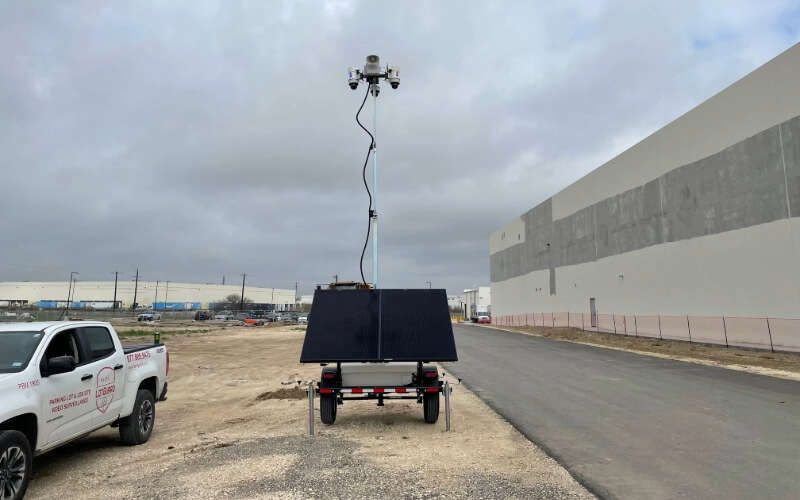
For this comparison, we’ll focus on WCCTV’s mobile Solar Surveillance Trailer. The near-20-foot, self-contained unit is purpose-built for temporary deployments, with basic setups operational in around 20 minutes. WCCTV’s fully-managed service covers installation, monitoring, maintenance, and ongoing support.
The systems run on solar power with battery backup, providing up to 10 days of battery autonomy without sunlight. This makes them suitable for a range of environments, including construction sites, traffic and highway settings, and critical infrastructure facilities, as well as locations without fixed infrastructure, mains power, or Wi-Fi.
WCCTV also provides Pole Cameras that can be installed onto existing structures and/or integrated with surveillance trailers.
SentriForce provides pole-mounted surveillance systems, with both mains- and solar-powered options available. Its systems are installed on ground-mounted poles and can be moved when needed, although they offer less flexibility than WCCTV’s portable units. SentriForce’s core offering is video surveillance for a range of industries. For this comparison, we’ll focus on the solar-powered systems, which use solar panels with long-lasting batteries to provide surveillance for several days without direct sunlight.
There is less publicly available information about the installation process, although SentriForce describes its systems as “quick and easy to install”. Installation, equipment, system health management, and maintenance are included as part of its all-inclusive service.
Verdict
Both systems run on solar power and operate without mains power, making them suitable for off-grid sites. The main difference, though, is flexibility. WCCTV’s Trailers (and Pole Cameras) can be repositioned as site conditions change or moved to areas where the risk is highest.
SentriForce’s pole-mounted units are better suited to sites where surveillance needs remain in fixed locations, but offer less flexibility if/when those needs change. WCCTV also has Pole Camera alternatives to cover hard-to-reach spaces.
2. Camera technology and coverage
WCCTV's Trailers combine visible surveillance with camera technology designed to detect and deter crime before it escalates. Systems have high-definition, near-360° PTZ cameras with infrared (IR) night vision, with detection ranges of up to ~650 feet in darkness, dust, fog, and harsh weather. PTZ means each camera can pan, tilt, and zoom, allowing a single unit to cover a wide area and still zoom in to follow a person or vehicle.
SentriForce pairs high-definition optical cameras with thermal detection. Because thermal picks up heat, cameras can still function in complete darkness without any site lighting. At the time of writing, we couldn't find enough publicly available information on SentriForce's detection range, zoom capabilities, field of view, or overall coverage to make a direct comparison.
Verdict
Both surveillance options offer nighttime functionality, making them suitable for monitoring after-hours activity. Because there's limited information about SentriForce's camera coverage and zoom capabilities, making a direct comparison is difficult. Based on the specifications available, WCCTV has the clearer advantage here.
3. Surveillance and AI features
WCCTV's near-360° cameras provide continuous site coverage, both day and night. Systems can actively deter criminals with features such as blue strobe lights and sirens, which trigger when suspicious activity is detected. This can help address issues like trespassing, metal theft, squatting, and vandalism before damage is done.
Built-in AI analytics help distinguish genuine threats from harmless activity, such as swaying bushes or passing traffic. This is particularly helpful in reducing false alarms and avoiding unnecessary responses.
As part of WCCTV's fully-managed service, Trailers include 24/7 remote monitoring as standard. Trained operators verify alerts in real-time and take near-immediate action to deter intruders and thieves. Responses can include issuing live audio voice-down challenges or dispatching law enforcement when needed.
Surveillance footage and site data are transmitted over secure 5G networks to an AES-256-encrypted cloud platform. Every incident is timestamped and logged, creating a clear audit trail that can support police investigations and insurance claims. Users can also generate reports on demand, making it easier to manage security and project oversight across multiple locations.
For sites that need additional monitoring solutions, WCCTV Trailers can integrate with IoT-based environmental sensors to monitor air quality, noise, and weather. License Plate Recognition (LPR) cameras can be integrated, too, supporting smarter access control at key entry/exit points across a site.
SentriForce is a fair match to WCCTV when it comes to crime deterrence, utilizing a combination of thermal detection and high-definition optical cameras to provide reliable coverage in all lighting and weather conditions. Its units feature built-in sirens, flashing strobes, and bi-lingual talk-down messaging, which can be activated remotely when criminal activity is detected.
Video surveillance can help identify and respond to safety and security incidents in real-time, while footage is timestamped to provide accurate documentation for legal or insurance purposes.
Site data is transmitted via 4G/LTE connections to the company’s app platform. With SentriForce’s “Video as a Service” (Live Video Monitoring), its trained Video Review and Forensic Analysis team can review footage on your behalf when evidence is required, but it's unclear how self-monitoring works.
It also appears that SentriForce's License Plate Recognition technology tends to integrate only with certain configurations (such as residential and retail installations), and they don't offer any environmental monitoring equivalent.
Verdict
Both providers offer active crime prevention features, including strobe lights, audio voice-down challenges, and built-in sirens. They also have similar connectivity options and live monitoring.
The main difference is their approach to remote monitoring services. WCCTV includes 24/7 remote monitoring as standard within its fully-managed service, while SentriForce offers Live Video Monitoring at an additional cost. In both cases, trained professionals can remotely verify alerts, assess footage, and respond quickly when suspicious activity is detected, adding an extra layer of protection beyond the technology itself.
4. Integration capabilities
Several add-ons that can integrate onto WCCTV's Solar Surveillance Trailers include:
- Smart Detection Systems for PPE Monitoring, Intrusion Detection, and Smoke/Fire Detection.
- Environmental monitoring sensors to monitor air quality, noise, and weather.
- License Plate Recognition (LPR) for accurate vehicle tracking and timestamped entry/exit logs.
WCCTV’s cloud software manages these capabilities, bringing all site activity into a single dashboard. This approach minimizes vendor sprawl as users can review security, safety, environmental, and project insights in one place.
SentriForce's add-on features include:
- Live Video Monitoring
- Intrusion Response and Dispatch
- Video Investigation
- Remote Site Safety and Project Management
Verdict
The breadth of WCCTV's and SentriForce's additional services differs considerably. SentriForce offers features such as Remote Site Safety and Project Management and Live Video Monitoring as add-ons, while equivalent features are included as part of WCCTV's fully-managed service.
WCCTV also offers a broader range of integrations, including PPE and Environmental Monitoring, for which we couldn't find equivalent offerings from SentriForce. For industries such as construction and demolition, where monitoring airborne pollutants and noise are necessary for compliance, this broader functionality may make WCCTV the more suitable option.
Read more:
- The Benefits of Smart Compliance Monitoring for Construction Jobsites
- Jobsite Security: From Environmental Monitoring to Smart Detection Systems
5. Mobility and scalability
WCCTV's Trailers move with a project and can be repositioned and self-moved as site layouts change. They operate off-grid on solar energy, and basic systems can be deployed within 20-minutes. The cloud platform can also pull feeds and alerts from up to 81 cameras into one dashboard. With nationwide U.S. coverage, that makes it straightforward to manage multiple sites from a single view.
SentriForce scales by adding more units. While its pole-mounted systems can be moved, they require professional handling, which can make relocation more complex. It's also unclear from the available information how many systems can be connected or whether multiple units can be managed together through its cloud-based app. SentriForce does have an established network across the U.S., with coverage in major metros across Texas, Florida, and Georgia, to name a few.
Verdict
Both surveillance options are specifically designed for off-grid operation. WCCTV stands out for its 20-minute deployment time (basic setups) and being able to consolidate up to 81 camera feeds into a single dashboard. Trailers are also self-moving, which works well when site risks evolve.
SentriForce doesn't publicly specify deployment times, making it difficult to draw a like-for-like comparison. While their pole-mounted systems can be relocated, moving them takes longer and requires a professional.
6. Use cases and costs
WCCTV's surveillance solutions are available on a rental basis and can potentially reduce security costs by up to 88% compared to full-time security guards. They're deployed in various settings, including:
- Construction sites
- Logistics, warehousing, and distribution
- Critical infrastructure (substations, solar farms, oil and gas facilities, telecoms, etc.)
- Law enforcement and government agencies
- Retail and commercial properties
- Education (schools, universities, campuses)
- Parking lots and vacant properties
- Traffic/highway environments
- Events
SentriForce offers both long- and short-term rental packages, depending on the surveillance configuration you choose. The company caters to fewer industries than WCCTV, including:
- Construction
- Apartments
- Homeowners association
- Municipal infrastructure
- Retail
Verdict
While both providers offer flexible rental packages with deployments suited to jobsite security, retail properties, and municipal/critical infrastructure, WCCTV serves a broader range of sectors overall.
SentriForce may work for businesses that need more targeted surveillance within the above-mentioned industries. However, if temporary security and mobility are a priority, WCCTV is likely the better option.
How to Select a Scalable Surveillance Solution for Temporary Sites
These are the factors worth considering when comparing scalable surveillance solutions:
|
Feature |
Why it matters |
Which fits best |
|
Deployment speed |
When there's immediate risk exposure, quick installation matters |
WCCTV Basic systems can be deployed in ~20-minutes |
|
Low-light/thermal detection |
Most criminal activity occurs under the cover of darkness, making night vision essential |
Both WCCTV and SentriForce both have high-definition, thermal cameras |
|
Camera coverage |
Wide-angle cameras cover more ground and reduce blind spots |
WCCTV Near-360° PTZ coverage from a single unit |
|
Remote monitoring services |
Having alerts and footage verified in real-time reduces false alarms and enables faster response |
WCCTV 24/7 remote monitoring services included in its fully-managed service |
|
Safety and environmental monitoring |
Essential for noise and air quality, and PPE compliance, especially on active construction jobsites |
WCCTV Add-on Smart Detection Systems for PPE, and IoT-based environmental sensors for air, noise, and weather |
|
Flexible rentals |
Having the ability to add, remove, and scale security measures in line with security and operational needs |
Both WCCTV and SentriForce offer rental packages |
WCCTV and SentriForce both give sites visible, monitored, off-grid coverage without fixed infrastructure or lengthy contracts. WCCTV is well-suited to large, complex operations where PTZ coverage, environmental and safety monitoring, and self-moveable security are a priority. SentriForce can be a good option for sites where security risks are concentrated in specific hotspots, particularly where frequent repositioning isn't required.
Make the Smart Surveillance Choice
Choosing between WCCTV and SentriForce completely depends on how your site operates and the type of coverage you need. WCCTV is well-suited to temporary or changing sites, with self-moving mobile trailers and pole cameras, live monitoring included in its fully-managed service, and a wider range of safety and environmental monitoring integrations. SentriForce may be a good fit for sites where security concerns are limited to certain areas and only occasional system repositioning is needed.
If you're looking for fast, infrastructure-free surveillance with 24/7 remote monitoring as standard, it might be worth contacting WCCTV's security specialist for a quotation.

