
Many contractors still rely on multiple disconnected systems to manage safety and security systems across their projects. Surveillance cameras might cover one location while security guards patrol another. Meanwhile, environmental monitoring and safety reporting rely on outdated processes like sporadic, inconsistent spot checks.
If you're trying to manage one or more projects using disconnected tools and relying on manual processes and time-consuming jobsite visits, it’s easy to feel like you’re always reacting to problems rather than staying ahead of them.
The alternative is to unify those responsibilities into a single smart platform, which gives you greater visibility and helps you feel more in control of what's happening across your sites. Modern technology now makes that possible by connecting security, environmental, and safety monitoring into a unified system. Instead of switching between separate tools, you can oversee all operations from a single platform with real-time insights and standardized reporting.
Our article explores how integrated monitoring solutions help leaders manage safety, security, and environmental compliance more effectively across every location.
Fully Integrated Intelligent Jobsites Explained
The modern smart jobsite integrates security solutions with safety and environmental monitoring tools to achieve near-360° visibility of project risk areas. These systems include automation and cutting-edge AI tools that provide real-time, reliable data to strengthen and simplify oversight across multiple builds.
Let's take a closer look at the core elements of a connected safety and security strategy.
Video surveillance
The foundation of multi-site security monitoring is a video surveillance network. Intelligent surveillance uses advanced cameras that record high-resolution images of activity on and around every location. Whether you need temporary targeted surveillance or longer-term site coverage, this system delivers 24/7 surveillance for a few days or from the commencement date right through to project completion.
Modern security cameras often have built-in AI video analytics that use machine learning to identify risks based on motion patterns, behavior analysis, and specific indicators the AI is trained to recognize.
Surveillance setups operate continuously across shifts and lighting conditions to keep managers informed in real-time of emerging threats, enabling proactive risk prevention. To demonstrate safety compliance and for investigation purposes, the system retains a video-supported record of events for extended periods of time.
The main features of video surveillance are:
-
Infrared (IR) illumination and night vision technology for clear image capture in low-light or nighttime conditions.
-
Machine learning that filters out false alarms such as animals, weather, and debris.
-
AI-powered analytics to detect issues without human involvement.
-
Immediate automated alerts of security threats or unsafe activity.
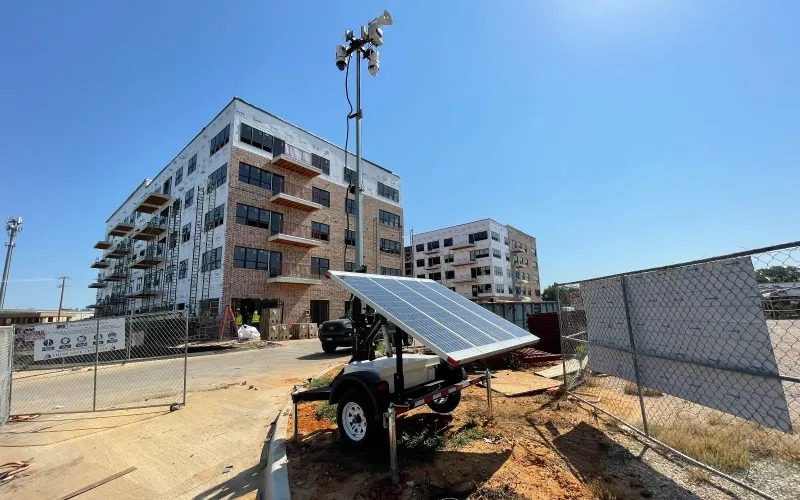
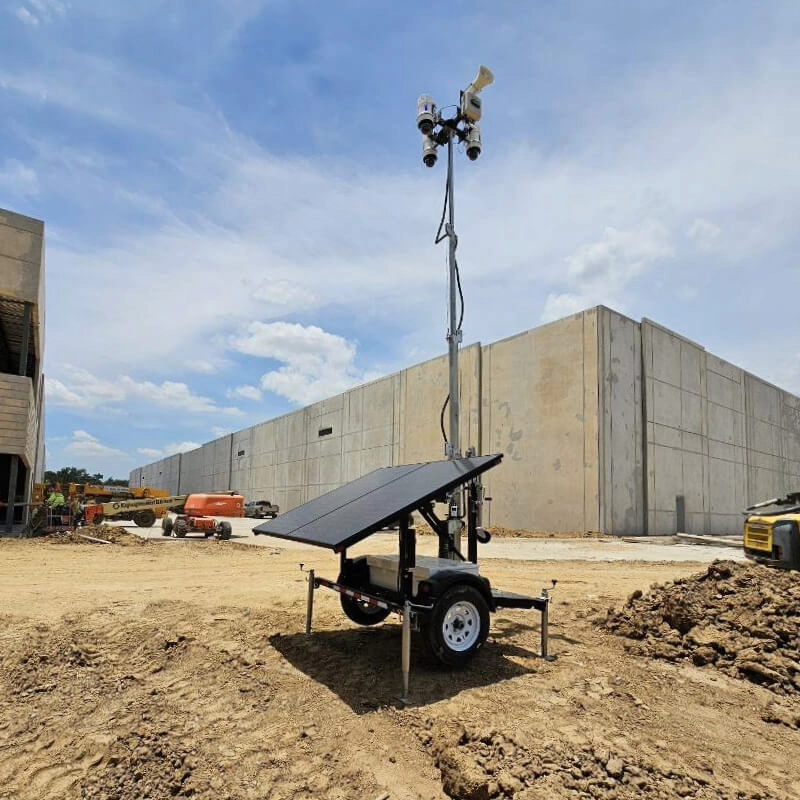
Cameras can be quickly deployed on mobile platforms, such as our Mobile Solar Surveillance Trailers, which are built to support construction security and site access control. Trusted by law enforcement and NDAA-compliant, these fully-contained trailers require no power or internet connection. Instead, they operate through solar and cellular technology:
- Renewable solar power with battery backup makes them suitable for locations with limited grid infrastructure.
- Cellular connectivity (4G/5G) transmits the video feed in areas with poor or no Wi-Fi.
- Rapid deployment and convenient mobility allow you to reposition trailers around the site as the project develops.
AI-powered safety analytics
Continuous jobsite surveillance collects a large amount of raw data. AI-powered analytics uses machine learning algorithms to transform this data into insights that leaders use to make crucial decisions and boost performance.
AI analytics applied to surveillance feeds recognize and highlight risks more quickly and consistently than human monitoring alone. Trained on tens of thousands of video examples, analytics identify the following with near pinpoint accuracy:
-
Perimeter breaches and unauthorized access
-
Unsafe behaviors, such as PPE non-compliance
-
Unsafe vehicle and equipment movement
-
Smoke and fire indicators
To avoid unnecessary callouts, the analytics reduces potential false alarms, such as harmless disturbances from weather, machinery emissions, shadows, debris, and blowing tarps or branches.
When a genuine threat is pinpointed, an immediate alert is sent to your designated manager and monitoring partners, allowing them to view the video and respond appropriately to protect your property. Some deterrents can be activated by the system even prior to human intervention.
Environmental monitoring
Environmental monitoring is becoming an increasingly important aspect of construction project management, due to:
-
The growing focus on environmental impact
-
ESG and corporate social responsibility commitments
-
Worker safety responsibilities
-
A range of regulatory requirements
-
The need to maintain good relations with the community surrounding your jobsites
To support these objectives, construction companies use IoT (Internet of Things) sensors to continuously track air quality, noise levels, dust, temperature, and other weather-related variables that affect crews, local communities, and regulatory compliance.
Monitoring sensors often connect cameras to provide an extra layer of intel:
-
Cameras can help confirm that dust suppression measures are working, avoiding complaints from nearby residents.
-
Video footage helps link sensor data to specific equipment or activities causing excessive noise.
Live environmental tracking captures a wealth of data that is used for trend analysis and adding evidentiary value to reporting and decision-making.
A 2021 McKinsey report projects IoT devices could unlock up to $12.6 trillion in value by 2030. IoT-based monitoring sensors on construction sites are a good example of this value unlock. The technology improves the risk assessment process while eliminating cost-inefficient physical readings, manual data logging, and spreadsheet reporting that eat up hours of your team's time each week.
Unified platform control
Today's smart project management tools work through central cloud platforms, facilitating professional monitoring and control from any connected mobile device.
Our cloud-based platform brings every security, safety, and environmental feed into a user-friendly interface where clear dashboards show real-time jobsite activity without requiring hours of manual checking. With mobile and web access, you can track every corner of every jobsite from your phone and act quickly to tackle problems.
The platform stores timestamped incident records with video evidence, making audits and stakeholder reports more reliable than traditional daily logs.
To protect project data, reports, and video footage, the platform uses enterprise-grade, end-to-end AES-256 encryption.
A Multi-Layered Construction Site Security Plan: The Future of Project Safeguarding
Modern construction site security services have evolved beyond a team of patrolling guards reporting periodically into a control room (with no eyes on the location), and slow, often inaccurate paper reports.
Today's tech-enabled security measures encompass:
-
24/7 surveillance that never loses focus and isn't prone to the human error associated with security guards.
-
Human oversight is supported by accurate AI threat verification for additional reassurance.
-
Fast, automated video-verified alarms/ alerts
-
Live remote monitoring with rapid response capabilities
To combat rising theft from project sites and safeguard your valuable assets and increasingly expensive materials, our market-leading surveillance networks allow you to connect our managed security solutions. Live Video Monitoring is part of all our security offerings, and you can enhance protection with specific Intrusion Detection and License Plate Recognition systems.
Intrusion Detection System
Cameras with built-in analytics detect suspicious activity in real-time, deterring theft, unauthorized access, vandalism, loitering, and other suspicious activity around your perimeter. The system sends immediate alerts to your designated contact and a live monitoring partner when it identifies a threat and supplies detailed documentation for subsequent investigations and security plan reviews.
License Plate Recognition (LPR)
License Plate Recognition (LPR) is an automated system that records all vehicles entering and exiting your access points. 24/7 monitoring of vehicle movement tightens access control while also encouraging better operator behavior and driving down theft.
Read more:
What is a Smart Detection System for Construction Sites?
Smart detection systems for jobsites use AI-powered video analytics to identify safety and regulatory risks, including PPE non-compliance, smoke, fire, and intrusion in real time. They automatically trigger near-immediate warnings of potential threats, enabling rapid intervention to prevent minor incidents from becoming major problems.
Smoke and Fire Detection
Cameras with video analytics catch fire risks early by quickly identifying indicators such as faint smoke trails, flickering light, and subtle color changes. The smart system eliminates false positives (dust, diesel emissions, steam) and is highly effective in large, open, or dusty environments where conventional fire sensors often struggle or trigger false alarms.
When smoke or fire is spotted, a near-immediate alert is sent to your team or emergency services, if required. The notification includes a video clip, helping responders to precisely locate and understand the extent of the danger.
With over 4,400 construction site blazes every year, proactive jobsite fire detection and prevention are critical to protect crews, valuable assets, materials, timelines, and completed buildings.
PPE Detection and Monitoring
Ensuring consistent use of protective gear such as eye and ear protection, safety boots, hard hats, gloves, respiratory masks, and high-vis vests is an ongoing challenge in the US construction industry.
Our PPE monitoring systems use analytics to alert managers when crew members fail to wear appropriate personal protective equipment as required by OSHA's PPE standards. The system can also issue live voice warnings to workers not following safety gear protocols.
Proactive PPE enforcement reduces preventable accidents and injuries, limiting consequences such as work stoppages, compensation claims, and regulatory fines. The system logs all PPE incidents, so you can easily retrieve records for reviews with crews/subcontractors, OSHA inspections, executive reporting, and insurance claims.
Results from thousands of construction sites and scientific research highlight the growing effectiveness of AI PPE detection systems for improving jobsite safety standards.
What is an Environmental Monitoring System in Construction?
Jobsite environmental tracking systems use IoT devices with connected cameras to collect and transmit real-time data about construction site conditions. Our field-ready environmental monitoring tools deliver precise, continuous measurements of:
-
Air quality (pollutants and contaminants)
-
Jobsite noise levels
-
Weather conditions
As with fire and PPE monitoring, all environmental data is unified in our dedicated cloud platform and presented in organized dashboards for easy remote viewing from any device with an internet connection.
Weather Monitoring Stations
Unpredictable weather, from unseasonal heat to heavy downpours, lightning strikes, and howling winds, is a major disruptive force on US construction sites.
To help teams work around and respond more effectively to weather risks, our Weather Monitoring Stations with connected cameras track the climate conditions affecting your site, including:
-
Wind speed and direction (0–110mph)
-
Rainfall
-
Humidity (10% to 99%),
-
Temperature (-4° F to 122° F)
-
Dewpoint
Live, site-specific data is more reliable than local or regional weather forecasts, which may not reflect the conditions on the ground at the time. To protect crews and equipment, the system triggers alerts when conditions get close to exceeding safety thresholds. For example, when water and rest breaks must be taken to avoid heat-related illnesses in line with OSHA's Heat NEP.
Noise Monitoring Sensors
While noise is a given in a construction environment, excessive exposure poses health risks to workers, including temporary deafness, tinnitus, and long-term hearing loss. For this reason, OSHA sets occupational noise exposure thresholds. Contractors are also expected to comply with the Noise Control Act of 1972, enacted to protect the general public from harmful and distressing sound levels.
To help control jobsite noise, our IoT noise tracking sensors and cameras monitor location sound 24/7 across ranges of:
- 30-130 Decibels
- 20Hz to 12.5kHz Frequency
These devices track decibel levels on your jobsites against set limits, generating alerts within seconds if thresholds are approached. Near-immediate warning allows you to take corrective action before issues escalate into safety risks or complaints.
Recording every fluctuation in real-time provides a comprehensive view of exposure patterns and problem areas, e.g., spikes from blasting or heavy machinery operations outside permitted hours. Video views point out potential issues, such as steel cutting and heavy drilling occurring simultaneously in the same zone, which compounds noise exposure for nearby workers.
Air Quality Monitoring Sensors
Various airborne hazards cause construction crews short-term discomfort (headaches, fatigue) and long-term health complications (lung damage in particular). To help you mitigate these risks and comply with OSHA's permissible exposure limits and Clean Air Act (CAA) laws, our air tracking sensors continuously measure:
-
Dust and particulate matter (PM1, PM2, PM10)
-
Carbon monoxide (CO)
-
Volatile organic compounds (VOCs) from industrial solvents and adhesives
-
Carbon dioxide (CO₂)
-
Other fumes and gases from hazardous materials
Detecting hazards more quickly and accurately than human senses or manual processes, the automated setup alerts you before site pollutants reach allowable limits or endanger workers and nearby residents.
Timestamped data and incident reports are stored in our centralized platform so you can quickly retrieve the necessary records for compliance audits, reviews, and ESG purposes.
The Advantages of Unified Security, Smart Detection, and Environmental Tracking
We've seen that leading construction companies have unified jobsite environmental monitoring, security, and safety detection into one user-friendly platform for intelligent oversight of multiple projects.
Here's a matrix of a smartly integrated detection and monitoring system for complete project visibility.
|
Monitoring Tool |
What It Does |
|
Intrusion Detection |
Monitors perimeters and restricted zones to protect valuable materials, equipment, and other assets. Filters out false alarms and stores logs/video for review. |
|
License Plate Recognition |
Logs all vehicle entries/exits, strengthens access control, and maintains audit trails. |
|
Smoke and Fire Detection |
AI cameras detect and warn of early smoke and flame signatures. Generates timestamped images and video to provide evidence for responders. |
|
PPE Detection |
Scans sites and checks crews for required protective gear (hard hats, vests, goggles, etc.), logs incidents, and sends breach alerts that managers can view via remote access. |
|
Weather Monitoring |
Tracks temperature, wind, humidity, and rainfall; alerts managers when unsafe conditions develop. |
|
Noise Monitoring |
IoT sensors measure sound levels, trigger alerts, and document compliance for inspections. |
|
Air Quality Monitoring |
Sensors track dust, VOCs, fumes, CO, and CO₂. Triggers alerts before limit violations and logs all incidents. |
Let's explore the clear benefits this unified approach to safety and security offers compared to disconnected, cumbersome legacy systems.
Improved operational efficiencies
Single-platform management combines multiple systems into one smart interface, reducing the frustrations and inefficiencies of vendor sprawl and tool toggling. It brings operational, safety, and security teams into the same workspace and streamlines communication and information sharing.
This streamlining allows contractors to manage multiple locations with fewer compliance and security personnel. Some firms have reported security cost savings of up to 88% with this approach.
AI can unlock further efficiencies and value, with a recent report showing that well-organized information and AI insights improve team speed and efficiency by 39%.
Real-time visibility
Smart detection, surveillance, and environmental monitoring systems provide instant access to project data across your entire jobsite (or several sites). Instead of waiting days or weeks for safety reports or reviewing hours of grainy footage after incidents occur, you can view and react to events on the ground as they unfold.
Live surveillance and cloud connectivity ensure you're always in the loop, whether you're traveling, visiting the head office, or preparing a new site across the state.
Less travel time and cost
Unified monitoring and real-time reporting reduce the need for project leaders to visit jobsites to check on performance and PPE compliance or verify security and environmental reports.
When you have complete visibility and up-to-date information on your phone, you can quickly assess and address problems from wherever you are. Cutting down on travel allows you to focus on your core objective: executing the project plan successfully. It also saves thousands of dollars in fuel and labor hours.
Clearer stakeholder reporting
There are several classes of stakeholders who have an interest in project safety and security: owners, clients, funders, insurers, and regulators, to name a few.
Accurate, automated reports allow you to communicate confidently and transparently with these interested parties. Environmental data and security updates are available at the push of a button, so no more panicked hunting for information in boxes and scattered files.
When you can provide an owner or inspector with detailed digital records and video footage of a safety/ regulatory issue within minutes, it builds trust that you run a professional, tightly-managed operation.
Reduced admin burden
By automating detection, data capture/logging, alerts, reporting, and compliance documentation, a smart platform relieves a tremendous administrative burden. It frees you from physical checks, email threads, spreadsheets, and manual reports; instead, you can focus on higher-value goals such as shutting down critical risk areas and optimizing material usage.
A site manager's role is demanding and stressful enough without constantly chasing updates and worrying about human error in reports. Central dashboards provide the peace of mind that key project information is available, current, and can be relied on when making important decisions.
More predictability on the site
Every day, projects face unexpected obstacles and disruptions: materials theft, an OSHA PPE investigation, a social media campaign about excessive jobsite air pollution...any one of these can derail your week and send your team into firefighting mode.
Proactive platform-based management helps you anticipate and intercept these problems before they become costly disruptions and cause unnecessary stress. Successful construction professionals agree that the key to less daily stress is maintaining predictable workflows and outcomes.
Live monitoring with AI insights helps to identify trends and guide corrective actions to create predictability. For example, surveillance can highlight a poorly-lit work zone that attracts suspicious individuals. This intel allows you to install proper lighting or other site security solutions to prevent theft and vandalism from disrupting your carefully planned schedules.
Stronger compliance and fewer incidents
A comprehensive security solution with integrated safety and environmental monitoring helps keep your jobsites safe and compliant. Active, consistent enforcement tells everyone on site that leadership takes safety seriously. Workplace behaviors change for the better, incident and accident rates fall, and over time, a healthier safety culture develops.
When OSHA or local inspectors arrive at your site, you're ready for them, with comprehensive reports on environmental compliance, PPE adherence, and security checks at your fingertips. This defensible digital documentation can cut compliance audit times by half. Professional regulatory reporting creates a favorable impression with authorities and makes you a less likely target for inspector visits.
Improve Jobsite Safety and Security with Unified Control
The best modern construction practices emphasize integrating site security with environmental and safety monitoring for stronger project oversight and control.
By managing these critical functions from a central platform, leaders build safe, secure environments everywhere they work. On top of that, companies gain operational efficiencies and a competitive edge.
From air quality to noise control, PPE adherence and access control, a unified strategy provides the real-time insights you need to protect crews, assets, and the company's reputation, while meeting all your compliance obligations.
If you're looking to get eyes on every site and make fully-informed safety and security decisions that drive project success, contact us before you break ground on your next undertaking.
