
WCCTV (Wireless CCTV) and LVT (LiveView Technologies) are both established names in mobile video surveillance, offering smart, solar-powered units built for construction sites, retail properties, government facilities, and critical infrastructure across the U.S.
Both providers offer a wide range of products, integrations, and solutions designed to prevent theft, trespassing, vandalism, and other kinds of crimes. WCCTV's core offering combines mobile surveillance with monitoring and project oversight, providing an all-in-one solution for securing and managing sites through a single provider.
For this comparison, we'll take a look at WCCTV's Solar Surveillance Trailer and LVT's Mobile Security Units (MSUs). In August 2026, LVT launched its Essentials unit, an entry-level option that is worth understanding on its own terms.
We'll compare WCCTV and LVT across camera technology, AI-video analytics, monitoring, deterrence, power, deployment, platform capabilities, and overall security functionality, while also discussing what we know about LVT's new Essentials unit.
Feature Comparison: WCCTV vs LVT
Camera technology, AI analytics, deterrence, and cost all shape whether a mobile surveillance unit actually meets your site's security needs.
Here's how the 2 providers compare across the areas that matter most:
Power and connectivity
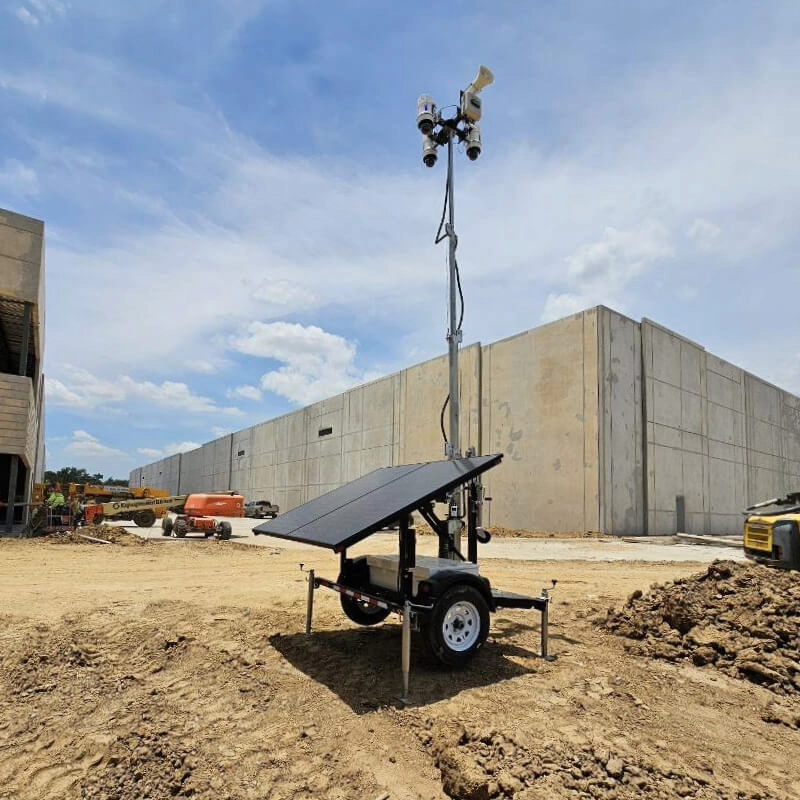
WCCTV's Solar Surveillance Trailer runs solely on solar power with battery backup, offering a minimum of 10 days of autonomy without sunlight, backed by battery capacity built for extended low-light periods, and no reliance on fixed infrastructure. Connectivity is built-in 4G/5G networks, secured through private VPNs and encrypted data pathways rather than open public networks.
LVT's Mobile Surveillance Units also use solar power and battery backup, with an optional eco-friendly smart generator available to provide additional power during extended periods of low sunlight. LVT offers private network protection, along with multi-cellular and satellite connectivity.
Deployment and mobility
WCCTV's trailers are installed by trained US-based professionals as part of its fully-managed service. Basic setups are typically completed within 20-minutes, depending on site complexity. Units can also be repositioned or relocated as site risks evolve, with self-moving capabilities available for added flexibility.
LVT describes its units as deployable in "minutes, not days", although it doesn't publish a specific setup timeframe. Systems can be moved as site requirements change, with setup handled by a technical team to ensure the system is operating effectively from the outset. Compared to WCCTV, LVT uses third-party partner companies for installation and servicing, which can lead to inconsistency in service.
Camera technology
WCCTV's mobile surveillance trailers come with up to 3 HD infrared (IR) PTZ (Pan-Tilt-Zoom) cameras as standard. Thermal cameras, drop-down cameras, License Plate Recognition (LPR), and Time Lapse video are also available as add-on customizations. The cameras provide near-360° coverage with detection ranges of up to 650 feet in complete darkness, fog, and harsh weather, capturing usable evidence even in difficult conditions.
LVT's security units can be configured with different camera types, including IR PTZ, thermal PTZ, fixed thermal, and 360-degree panoramic cameras. It also offers pole-, building-, and parapet-mounted camera system configurations. LVT doesn't publish a specific detection range in feet for comparison.
AI analytics and integrations
WCCTV systems use advanced AI-video analytics to scan sites 24/7, filter false alarms, and flag genuine threats in real-time. This allows them to distinguish unlawful activity from normal site behavior as it happens, rather than after the event.
When suspicious activity is detected, systems send near-instant alerts, while U.S.-based monitoring centers can respond with various actions, such as issuing live audio voice-down challenges, activating sirens and blue strobe lights, and contacting law enforcement if/when needed.
On top of this, WCCTV's Trailers support 4 operational areas: security, safety, environmental monitoring, and project insights, with smart integrations including:
- Smart Detection Systems for intrusion detection, PPE monitoring, and smoke and fire detection
- IoT-based Environmental sensors for air quality, noise, and weather condition monitoring
- License Plate Recognition (LPR) for vehicle tracking at entry/exit points
LVT's security solutions use Agentic AI with object, behavioral, and contextual recognition to identify potential threats and trigger automated responses. These can include strobe lights, floodlights, PT spotlights, and AI Audio Talk Down with personalized messages to deter criminals and unwanted behaviour. LVT also integrates with platforms including:
- Genetec
- Insight LPR
- Fusus
- Immix
Deterrence and response times
WCCTV combines flashing lights, sirens, and live audio voice-down challenges with human-verified response. Unlike LVT, live video monitoring through a 24/7 monitoring center is included as standard with its fully-managed service. This enables operators to identify unusual activity in real-time and respond quickly, with deterrent measures activated as soon as a genuine threat is verified.
Footage is transmitted over secure 4G/5G networks to WCCTV's AES-256 encrypted cloud-based monitoring platform, where users can remotely review activity and generate reports from any connected device. System software can connect up to 81 cameras, giving users a unified platform for video, AI analytics, environmental data, compliance reporting, and remote access in one place.
LVT's surveillance units use strobe lights, floodlights, PT spotlights, and AI Audio Talk Down to deter crime as it unfolds. Its AI can trigger these responses automatically when suspicious activity is detected, reducing the need for human intervention. Live video and system data feed into a central cloud platform for remote monitoring, analysis, reporting, and access to live streams.
Product range and use cases
WCCTV's product range includes Mobile Surveillance Trailers, Pole Cameras, Temporary Security Cameras, Environmental Monitoring, Smart Detection Systems, Live Video Monitoring, Time Lapse Video, and LPR solutions. These solutions are designed to work together to seamlessly connect security, safety, monitoring, and project oversight from a single system.
Solar Surveillance Trailers are used across various key industries, such as:
- Construction (residential, commercial, demolition, etc)
- Government (ports of entry, public works, border security, etc)
- Law enforcement
- Education (campuses, schools, universities)
- Vacant properties, parking lots, and events
- Traffic and highways environments
- Critical infrastructure (solar farms, substations, utility facilities, etc)
LVT's hardware range includes Mobile Security Units (MSUs), including the latest Essential variant, along with pole-, building-, and parapet-mounted cameras. Its MSUs are commonly used in the following sectors:
- Construction and critical infrastructure
- Property management and retail parking lots
- Freight, logistics, manufacturing
- Federal, state, local government, law enforcement
- Healthcare and education
Costs
WCCTV's surveillance solutions are available on a rental basis, giving businesses the flexibility to scale security coverage up or down as site risks change. A single monthly fee covers the hardware, installation, monitoring, maintenance, and technical support, reducing the cost and administrative hassle of managing multiple vendors. WCCTV also reports that its Surveillance Trailers can reduce security costs by up to 88% compared with on-site security guards.
LVT's security solutions are also available to hire, although at the time of writing, it isn't clear what is included in the monthly price beyond the hardware.
What We Know About LVT's Essential Unit
LVT introduced Essentials in August 2026 as a lower-cost entry point to its range.
Here's all we know about the mobile security unit so far:
- Equipped with a 20MP Axis NDAA-compliant multi-sensor panoramic camera
- Solar-powered with private cellular connectivity
- Includes blue strobe lights for deterrence, live video streaming, and 14 days of recorded video storage
- Excludes: Agentic AI and more advanced intelligent site-management features
- Availability: Limited offer, subject to pre-qualified LVT accounts
- Cost: $1,000/month
Essentials could suit sites that need baseline visible deterrence and video recording without the more advanced AI-driven capabilities of a fully featured system. For larger or more complex sites with broader security and operational requirements, its limited features may not provide the same level of coverage or functionality.
What's more, given that the unit has only recently launched and there's not much information available online, availability is currently limited to accounts that have been pre-qualified by an authorized LVT representative.
The lower price point may make Essentials appealing, but its reduced feature set and limited availability warrant careful consideration when security is at stake. Buyers should weigh what they are giving up compared with LVT's more advanced solutions, including Agentic AI capabilities, which is a key of LVT's wider offering.
While a low-cost system may look attractive upfront, gaps in AI detection and other security features could reduce its effectiveness, costing more in the long run than the initial saving suggests. A solution like WCCTV's Solar Surveillance Trailers, which combines advanced technology, AI, and smart integrations, may provide greater value in almost any environment where proactive protection is needed.
What Sets WCCTV Apart From LVT
At WCCTV, we remain focused on delivering transparency and staying driven in our core purpose: protecting people, projects, and property.
That shows up in how our service is structured. Live monitoring through ISOC centers is included as standard in every fully-managed rental, not sold as a separate service.
Our cloud-based platform brings security, safety, environmental monitoring, and project oversight into a single dashboard, so users aren't left managing multiple vendors to cover PPE compliance, air quality, or fire risk alongside surveillance.
We also believe buyers deserve accurate, like-for-like information when comparing providers, not specs pulled from a different market or an older product line. For more on how we've addressed inaccuracies in some third-party comparisons, see our full response to LVT's marketing claims.
With 25+ years in the security industry, NDAA-compliant, AES-256-encrypted infrastructure, and a US-based team supporting every deployment, WCCTV's blend of services and systems helps organizations reduce risk, protect people, and make faster decisions across the places, projects, and properties they manage.
How to Choose a Mobile Surveillance Provider
These are the factors worth evaluating when choosing a surveillance provider:
|
Feature |
Description |
|
Rapid deployment |
Choose a provider that can deploy surveillance quickly, with minimal disruption to your site or operations. |
|
Camera coverage and detection range |
Look for cameras that provide the coverage and detection range needed to monitor your entire site, including in low-light or challenging conditions. |
|
Power autonomy |
Check how long systems can operate without sunlight or mains power to ensure continuous coverage during outages or poor weather. |
|
AI analytics |
Prioritize intelligent analytics that can distinguish genuine threats from routine activity and reduce false alarms in real-time. |
|
Remote monitoring |
Choose a provider that offers 24/7 remote monitoring, preferably through a monitoring center. |
|
Industry experience |
Look for proven experience securing sites similar to yours and a track record of success. |
|
Cost |
Compare total costs on a like-for-like basis, including service, installation, monitoring, maintenance, and support rather than assuming that a lower entry price automatically represents better value. |
The best way to compare security providers is to look past headline features and work out what you'll actually get day to day. A lower price point might tick basic security boxes, but if it has limited coverage, weaker analytics, no remote monitoring, or requires you to manage everything yourself, the savings may not amount to much.
If you're evaluating mobile surveillance for your site, whether you're in construction, retail, government, or events, WCCTV's Solar Surveillance Trailers combine security with monitoring and project oversight through one connected platform, giving you broader coverage with the complexity.
Choose the Right Mobile Surveillance Solution
Choosing between WCCTV and LVT ultimately comes down to the level of coverage, monitoring, and oversight your site requires. Both offer solar-powered mobile surveillance, PTZ camera technology, and active deterrents, but differ in areas such as AI capabilities, deployment, and integration functionality.
LVT offers mobile, off-grid surveillance with AI-driven detection and automated deterrence, while its Essentials unit provides a lower-cost option with a more limited feature set.
WCCTV's Solar Surveillance Trailers combine mobile surveillance with 24/7 monitoring, cloud-based management, and additional safety, environmental, and project oversight capabilities, making them a good option for organizations looking for a more fully-managed, proactive approach.

