When your site is dealing with trespassing, theft, vandalism, illegal dumping, or other security issues, choosing a mobile surveillance provider is about more than simply putting cameras on-site. You need to know how quickly a solution can be deployed, whether it can operate without mains power, how reliably it detects threats, and how much oversight your team will need.
You’ll also want to understand what’s included beyond the cameras themselves. Does the provider offer AI-powered detection? How are alerts and incidents managed? Can you monitor multiple sites from one cloud-based platform? And what kind of reporting can you expect?
This blog compares WCCTV’s Solar Surveillance Trailers and Zedcor’s MobileyeZ Towers, 2 mobile surveillance solutions within each provider’s broader product and technology range. We’ll compare the features and capabilities that matter when evaluating security for construction sites, commercial properties, industrial facilities, and critical infrastructure projects, helping you determine which provider best fits your security requirements and long-term needs.
Quick WCCTV vs Zedcor Overview
WCCTV's Solar Surveillance Trailers and Zedcor's Solar/Electric MobileyeZ Mobile Surveillance Towers are both designed for temporary and remote site security. Let's see how they measure up*:
|
Feature
|
WCCTV Solar Surveillance Trailer
|
Zedcor Solar/Electric MobileyeZ Mobile Surveillance Tower
|
|
Deployment speed
|
Installed in under 20 minutes (basic setups) by trained professionals as part of fully-managed service
|
Not publicly specified
|
|
Height
|
Up to 20 feet
|
25 feet
|
|
Relocatable
|
[[YES]]
|
[[YES]]
|
|
Power
|
Solar panels with battery backups. Minimum 10 days of battery autonomy without sunlight.
(no fixed infrastructure needed)
|
Solar panels with battery backup. Up to 7 days of runtime without sunlight. Optional 120V plug-in during limited sunlight.
|
|
Connectivity
|
Built-in 4G/5G connectivity
|
Built-in cellular and satellite data networks
|
|
Camera/radar coverage
|
Near-360° camera coverage
|
Radar coverage 180º
|
|
Camera technology
|
High-definition PTZ (Pan-Tilt-Zoom) infrared (IR) night vision
|
2 high-speed Axis PTZ cameras; 1 radar
|
|
AI-detection
|
[[YES]]
|
[[YES]]
|
|
24/7 recording
|
[[YES]]
|
[[YES]]
|
|
Live video monitoring
|
Yes, via 24/7, UL-Listed, 5 Diamond Certified, Interactive Surveillance Operations Center (ISOC) monitoring center.
Included in fully-managed service. |
Yes, managed by ex-law enforcement professionals at 24/7 Verified Live Monitoring™ centers
Included in service
|
|
Real-time alerts
|
[[YES]]
|
[[YES]]
|
|
Integration capabilities
(add-ons)
|
License Plate Recognition (LPR), Smart Detection Systems for intrusions, PPE monitoring, and smoke/fire detection, as well as IoT-based Environmental Monitoring Sensors for noise, air quality, and weather
|
Optional AI-based radar detection technology (~240 feet detection)
|
|
Evidence collection
|
Yes, with timestamped audit trail and automated incident reporting
|
Yes, with 30-day video storage and Incident Reports generated from its Command Center
|
|
Scalability
|
[[YES]]
|
[[YES]]
|
|
Cloud-based management (add-on)
|
Multi-site, unified cloud-based management
|
Cloud-based app
|
|
Remote access
|
Desktop, phone, app, and tablet
|
App
|
|
Security
|
NDAA-compliant; add-on AES-256 encrypted cloud platform
|
Not specified
|
|
Costs
|
Flexible rental packages
|
Monthly rentals
|
|
Industry experience
|
25+ years
|
15 years
|
|
Typical use cases:
|
Construction, law enforcement, government, critical infrastructure, education, commercial, retail, vacant sites, parking lots, events, traffic and highways
|
Construction, mining, energy sector, pipeline construction, office, retail, industrial, warehousing, commercial
|
*Information correct as of September 2026
Read more:
WCCTV vs Zedcor: 6 Feature Comparison
Let's take a closer look at how these 2 providers compare across the key capabilities that matter when choosing a mobile surveillance solution:
1. Product offering and camera coverage
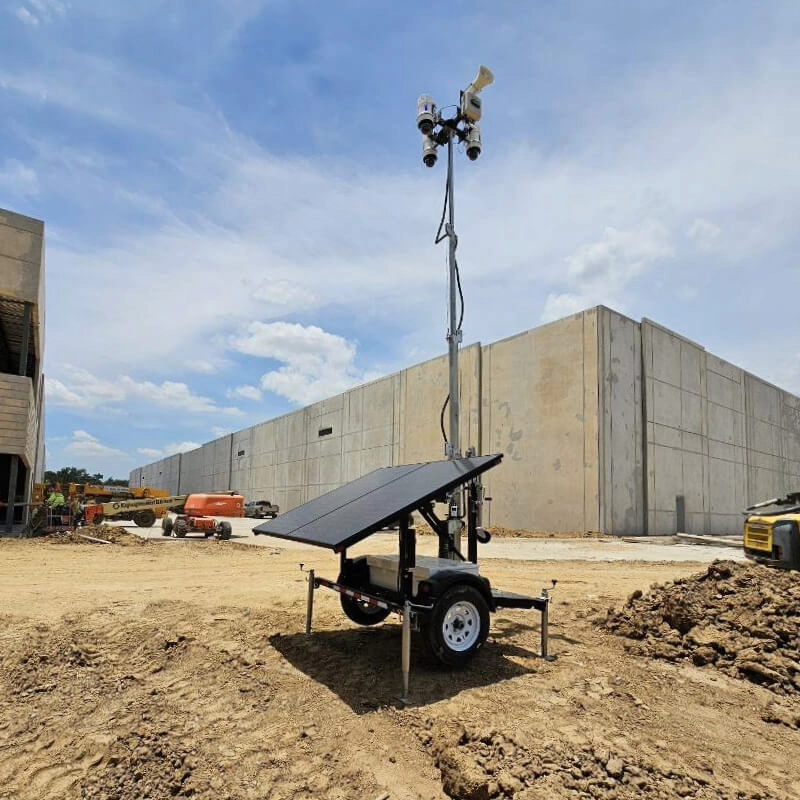
WCCTV’s core offering is the Solar Surveillance Trailer, one solution within its wider range of smart surveillance products. The Trailer stands at around 20-feet tall and can be rapidly deployed wherever security is needed, including remote sites without permanent infrastructure. These mobile units are suited to high-risk environments, critical infrastructure developments, and construction sites.
The system carries 3 high-definition PTZ cameras with infrared (IR) night vision, providing near-360° coverage with detection ranges of up to 650 feet in darkness and harsh weather. The units can also integrate with Smart Detection Systems, Licence Plate Recognition (LPR) cameras, and IoT-based environmental sensors. The latter can be particularly useful on construction sites and critical infrastructure developments, where factors such as noise and airborne pollutants may need to be monitored consistently for compliance purposes.
Zedcor's 25-foot Solar/Electric MobileyeZ Tower is the closest comparison to WCCTV, offering reliable coverage in urban and remote locations. While deployment time isn't specified online, the company states units are "quick to install". Towers carry 2 high-speed Axis PTZ cameras (with 31X zoom) and a radar with 180° coverage and AI analytics.
The full MobileyeZ range includes:
- Solar MobileyeZ: The tower in this comparison
- Hybrid MobileyeZ: Solar-powered with diesel engine/generator
- Battery Electric MobileyeZ: Mains-powered unit with battery backup
- Diesel MobileyeZ: Diesel generator-powered unit
Verdict
Both providers offer surveillance solutions for urban and remote locations, with PTZ camera technology suited to construction and infrastructure environments. Zedcor’s towers have a taller mast than WCCTV’s with hybrid, battery, and diesel-powered options. WCCTV’s Trailers run autonomously on solar and battery backup and have advanced cameras with a near-360° field of view and detection range of up to ~650 feet, which is roughly twice that of Zedcor.
2. Surveillance features
At up to 20-feet tall, WCCTV’s Solar Surveillance Trailers are designed to be highly visible deterrents, helping discourage issues such as trespassing, metal theft, squatting, vandalism, and illegal dumping.
They offer custom security solutions, but most trailers use a combination of cameras, AI analytics, flashing lights, sirens, and live audio warnings to identify and deter potential incidents while they are happening. Intelligent analytics help distinguish genuine threats from everyday activity, such as passing vehicles or moving vegetation, which is a leading cause of false alarms.
Video footage is sent over secure 4G/5G networks to a central monitoring platform, where users can access live and recorded footage in real-time. All site activity and incidents are timestamped and logged for a clear audit trail, which is particularly useful for teams managing multiple assets across many sites.
WCCTV also offers 24/7 live monitoring, which is included as standard with its fully-managed service. This means there is real-time intervention from trained ISOC monitoring operators who review activity, verify potential incidents, and take action on the customer’s behalf, including dispatching emergency services where appropriate.
For sites with more specific monitoring requirements, WCCTV's Trailers support add-on integrations such as environmental sensors (to monitor noise, air, and weather) and LPR technology (for access control security needs).
Zedcor’s Solar Mobile Surveillance Towers also provide a visible deterrent alongside remote monitoring to help protect site assets and infrastructure. The towers use loudspeakers, motion detection, and object analytics to identify activity and help deter incidents before they escalate, while filtering false alarms. Video footage is retained for 30 days, allowing it to be reviewed later if needed.
Zedcor's cloud-based app allows clients to access video footage and safety incidents directly. And its Verified Live Monitoring™ center generates incident and activity reports with detailed descriptions, photos, and video, giving clients a record of what happened on-site.
Verdict
Both providers are fairly evenly matched here, as they offer live verified monitoring, continuous recording with human verification, and loudspeakers to deter criminals before an incident escalates.
WCCTV’s remote monitoring is handled through an ISOC monitoring center, and users also have remote access to its cloud-based platform to check site activity from a phone or browser, while being able to generate reports on demand. Zedcor’s monitoring centers generate incident reports, and customers have direct remote access to its app.
3. Integration capabilities
WCCTV's Solar Surveillance Trailers can integrate with Smart Detection Systems for capabilities such as smoke and fire detection, intrusion detection, and PPE monitoring. They can also connect to IoT-based sensors to monitor environmental conditions, including air quality, noise, and weather.
For larger or more complex sites, add-on LPR technology can provide vehicle tracking at entry and exit points, along with timestamped records that are useful for investigations, internal reviews, and insurance claims.
All of this is managed through WCCTV’s cloud-based software, giving users a single dashboard for site activity. Security, safety, environmental data, and project oversight is brought together in one place, including incidents, vehicle activity, and weather readings, making it an established "all-in-one" system.
At the time of writing, the only integration we could confirm for Zedcor’s Solar MobileyeZ Tower is optional AI-based radar detection, with a detection range of ~240 feet. Zedcor also lists optional environmental sensors for its Hybrid MobileyeZ Tower, which provide additional monitoring and alerts. However, it’s unclear whether these sensors are also available for the Solar MobileyeZ Tower.
Verdict
WCCTV has the edge here, mainly because it offers a wider (publicly available) range of integration options. These include PPE monitoring and smoke and fire detection, which we couldn’t find equivalent options for with Zedcor.
Zedcor does offer AI-based camera technology that sends real-time alerts when vehicles or intruders enter designated red zones. However, beyond this, there appear to be fewer overlapping integration and detection capabilities between the 2 solutions.
4. Setup, mobility and connectivity
WCCTV’s solutions are designed for temporary security needs, so they can be moved and repositioned as site conditions change or a construction project moves into a new phase. WCCTV’s US-based engineers handle installation, repositioning, and decommissioning, with basic setups typically deployed in around 20-minutes as part of its fully-managed service.
Once deployed, the units use secure 4G/5G networks to transmit footage to WCCTV’s cloud platform. This gives businesses managing multiple sites a central view of activity, with up to 81 surveillance camera feeds from different deployments available through a single dashboard. It also means teams can scale security across several locations without managing each deployment separately through multiple vendors.
Zedcor’s solar/electric towers can also be moved as projects progress, with the company highlighting "local deployment, servicing, and quick moves" as part of its offering. However, it’s unclear how quickly the towers can actually be deployed. Like WCCTV, Zedcor’s towers operate without fixed infrastructure, using solar power and battery backup, and built-in cellular and satellite connectivity allows real-time alerts to be sent to Zedcor’s live verified monitoring centre.
Verdict
Both providers offer mobile, off-grid surveillance that can be repositioned as site requirements change. WCCTV has the advantage when it comes to setup, with basic deployments taking around 20-minutes while handled by professional technicians as part of a fully-managed service. The ability to consolidate up to 81 camera feeds into one dashboard is another benefit for businesses managing multiple sites.
Zedcor offers similar mobility, but there’s less information available about deployment times and how easily multiple towers can be managed at scale.
5. Use cases
WCCTV's mobile surveillance solutions are commonly deployed in the following sectors:
- Construction Jobsites
- Logistics, warehousing, and distribution
- Critical infrastructure (solar farms, oil and gas facilities, substations, water facilities, and more)
- Law enforcement and government
- Parking lots and vacant properties
- Events
- Traffic/highways environments
Zedcor's mobile security can be used in the following industries:
- Construction and mining
- Energy and pipeline construction
- Office, commercial, and retail
- Industrial, manufacturing, and warehousing
- Automotive dealerships
Verdict
WCCTV supports a broader range of sectors, including construction, critical infrastructure, government, solar/wind farms, highways, and vacant properties. If you need reliable surveillance for higher-risk or more complex sites, WCCTV may be the better fit. Zedcor focuses mainly on construction, industrial, and energy sites, making them suitable for these kinds of projects.
6. Cost
WCCTV rents its surveillance solutions, giving businesses the flexibility to scale coverage up or down as site risks change. The monthly fee includes hardware, installation, monitoring, maintenance, and technical support, as part of a fully-managed service. It does state that its solutions can potentially reduce security costs by up to 88% compared with on-site security guards.
Zedcor’s mobile surveillance towers are also available to rent, with pricing starting at around $2,500 per month (as of June 2026). The company estimates that its towers can cost 25-60% less than using manned security guards.
Verdict
Both providers offer rental packages that can be more flexible and cost-effective than traditional security guards. Pricing is based on each unit's level of customization, so it's best to speak with the providers directly for a final price.
How to Choose a Mobile Surveillance Provider
Here's a quick recap on the key features to look for when choosing a mobile surveillance provider:
- Rapid deployment systems: Look for solutions that can be installed quickly and moved as site conditions change. This is particularly important for temporary sites or projects where security needs may change over time or on sites lacking permanent infrastructure.
- Advanced camera technology: High-resolution cameras, PTZ functionality, night vision, and wide-area coverage can help provide clearer visibility across larger sites. Consider the camera's detection range as well as its ability to capture footage in low-light or poor weather conditions.
- Remote, cloud monitoring: A cloud-based platform lets your team view footage, receive alerts, and manage security remotely. This can be particularly useful when overseeing multiple sites or when on-site staff isn't available 24/7.
- Intelligent analytics: AI-powered analytics can help identify potential threats and distinguish them from routine activity. Look for features such as intrusion detection, object recognition, and automated alerts that can reduce false alarms.
- Smart integration support: The ability to integrate with other security and site monitoring technologies can extend what a mobile surveillance system can do. Depending on your needs, this could include LPR, PPE detection, environmental sensors, or smoke and fire detection.
- Secure equipment: Security equipment should protect both your site and the data it collects. Look for solutions that use NDAA-compliant equipment and AES-256 encryption to help protect video and other sensitive information.
- Portfolio-wide overview: If you're managing multiple sites, look for a platform that brings everything together in one place. A central dashboard can make it easier to monitor activity, review incidents, and manage security across your entire portfolio.
Choose Smarter Surveillance
There's no "one size fits all" solution when it comes to choosing a surveillance provider. The right option depends on factors, such as the size of your site, power availability, level of oversight needed, and site-specific security and operational needs.
WCCTV and Zedcor both offer mobile, off-grid surveillance with remote monitoring, AI detection, and flexible rental models, making them well-suited to temporary and remote sites across industries such as construction and commercial real estate. However, WCCTV has the edge for businesses looking for broader camera coverage, faster deployment, more integration options, and a centralized platform for managing multiple sites from one dashboard.
If you're looking for fast, infrastructure-free mobile surveillance backed by 24/7 remote monitoring, consider WCCTV's Solar Surveillance Trailers. Chat to one of our security specialists today.