
Vehicle-related crime is a growing problem for businesses across the Golden State. A vehicle is stolen roughly every 3 minutes, according to the California Highway Patrol (CHP), with fleet vehicles, cargo shipments, and equipment stored at industrial sites accounting for a large share of that total.
Fleet theft, catalytic converter removal, forced entry, and cargo diversion are affecting logistics operators and commercial property owners on a regular basis. Every stolen vehicle or hijacked shipment carries a ripple effect that reaches past the initial loss, rolling over into insurance rates, delivery schedules, repair costs, and the day-to-day confidence of the people working on site.
This article looks at how vehicle crime is affecting California's businesses, the legal changes aimed at holding offenders accountable, which industries are most vulnerable, and the practical steps businesses can take to reduce their exposure at commercial and industrial sites.
The Scale of Vehicle Crime Across California
California recorded 176,230 stolen vehicles in 2024, which was a decline of more than 13% from 2023. However, those thefts still carried an estimated total value of $1.56 billion, with Southern California accounting for roughly half of all of the incidents statewide. Additionally, Los Angeles County remained the area with the highest number of thefts.
Vehicle theft methods are changing to keep up with stricter state regulations around the problem, and criminals are using more advanced tactics.
A February 2026 analysis tied to NICB data linked the slower decline in vehicle theft across high-theft states like California to relay attacks and keyless entry exploitation. This lets criminals bypass a vehicle's locking system without needing to break a window. As a result, visible damage is no longer a reliable early warning sign for businesses checking their lots in the morning.
How Vehicle Crime Disrupts Business Operations in California
A stolen fleet vehicle costs more than the cost of the vehicle itself. Businesses also lose access to the tools or equipment stored inside it, and that gap can stall a project or delivery route until a replacement is sourced.
Lost productivity and downtime
Operational downtime compounds quickly. Staff who would normally be running routes or managing a jobsite instead spend hours filing police reports or coordinating with insurers. They may also have to rearrange schedules around a missing vehicle with that diverted time coming directly out of revenue-generating work.
Rising insurance costs
Insurance costs follow a similar pattern. Businesses that operate in higher-theft parts of California are often subject to higher premiums or added conditions tied to on-site security. Repeat incidents can push these costs even higher, regardless of whether a claim is ever filed.
The toll on employees
Research on employees who experience workplace theft and robbery has linked these incidents to measurable effects on wellbeing and job satisfaction, on top of the added stress of tighter security procedures and follow-up investigations.
Delays
Logistical delays add yet another layer of cost. When a delivery vehicle or piece of equipment goes missing, it creates a domino effect that carries over to every downstream commitment a business has made. For example, clients may be left waiting on a shipment, while subcontractors are forced to delay work because essential machinery never showed up.
Rescheduling these commitments takes time, and vehicle and equipment loss is one of the common causes of delays on active jobsites rather than just a logistics problem. In industries that run on tight margins, a single missed delivery window can affect a business's standing with a customer for months afterward.
Repair and replacement costs
Businesses also absorb the cost of repairing what theft leaves behind. For instance, damaged gates, cut fencing, forced locks, and broken security infrastructure all need replacing. Those repair bills tend to stack on top of the already stolen property.
For businesses that are already managing tight operating budgets, that combination of direct loss and infrastructure repair can add up faster than most owners expect.
Cargo Theft Across California's Logistics Corridors
For businesses moving freight, the exposure to crime is deeper than stolen vehicles. California remained the most heavily targeted state for cargo theft in 2025, with 1,218 recorded incidents. Nationally, the estimated cargo theft losses spiked to nearly $725 million in 2025, which was a 60% jump from the year before, as organized groups have changed to fewer but higher-value hits rather than opportunistic theft.
This change is reflected in the numbers, with the average value per cargo theft incident climbing to $273,990 in 2025, which was up by 36% from the previous year. Businesses that manage high-value assets across large industrial sites or logistics hubs are especially impacted by this, as the statistics represent a serious and growing line item on their balance sheets.
The items that are being targeted for theft are typically high-value, and include electronics, specialty food and beverage shipments, and materials and metals with a strong resale demand. This means that even though there are fewer incidents, there's still a major financial impact. As a result, more businesses have started treating cargo theft as an ongoing operational risk rather than occasional loss.
Not every business carries the risk equally, though. Logistics and warehousing operators are consistently among the industries facing the highest crime risk, and vehicles and cargo are still some of the most targeted assets in property crimes.
Read more:
Catalytic Converter Theft is a Persistent Risk for Fleets
Catalytic converter theft has dwindled since its national peak in 2022, but California still accounts for a disproportionate share of it. Nearly two-thirds of all catalytic converter thefts reported to the National Insurance Crime Bureau (NICB) in 2024 happened in California, even as the national total fell 68% from the year before.
For any businesses that run fleets, the disruption matters more than the part. A stolen converter typically costs between $2,177 and $2,506 to replace, and a vehicle can't be driven safely or legally until it's fixed. Pulling even one vehicle out of rotation for a week is enough to throw off a delivery schedule or service route that took months to build.
Fleet vehicles that are parked overnight in shared lots or staging areas are particularly exposed, since converter theft only takes a couple of minutes. Continuous monitoring across a lot, rather than a handful of fixed cameras pointed at entrances, gives a business the best chance of catching that activity while it's happening.
New Legal Tools for Prosecuting Vehicle Crime in California
California's existing law defines burglary to include "entering a locked vehicle with intent to commit grand or petit larceny or a felony", and the law makes that burglary of a vehicle punishable as either a misdemeanor or a felony. Senate Bill 905, which came into effect in January, 2025, added to that law.
Penal Code Section 465
Under Penal Code Section 465, forcibly entering a vehicle with intent to commit a theft or any felony inside it is now its own crime, punishable by up to 1 year in county jail as a misdemeanor or 16 months to 3 years as a felony.
Existing law prohibits:
- The taking of another person's personal property
- Removing any part of a vehicle without the owner's consent
- The possession or receipt of stolen goods
However, SB 905 closes what had been known as the "locked door loophole", where prosecutors previously had to prove a vehicle was locked at the time of entry.
Penal Code Section 496.5
The second new crime, under Penal Code Section 496.5, targets the resale side of vehicle crime. Possessing property acquired through one or more acts of theft from a vehicle, unlawful entry, or vehicle tampering is now a crime punishable as a misdemeanor or a felony if that property isn't held for personal use, the person intends to sell or exchange it, and the value of the possessed property exceeds $950.
To meet that felony threshold, prosecutors can aggregate the value of other illegally obtained property possessed within the past 2 years. This is a rule that's designed to impose harsher penalties on repeat offenders and organized resale operations rather than one-off incidents involving auto thieves working alone.
Because it creates a new crime, the bill also triggers a state-mandated local program, meaning local law enforcement agencies now carry the added cost of enforcing it.
What this means for California businesses
These legal changes matter most for businesses that may have had a clear-cut case fall apart on a technicality. A documented pattern of forcibly entering a vehicle, backed by video evidence, now gives law enforcement a stronger basis to pursue felony charges without the hurdle of proving whether a vehicle was locked or not at the time of the incident.
Although stronger legal tools help after the fact, they don't replace the need for a business to reduce its own crime exposure before an incident happens.
Reducing Vehicle Vulnerability With Better Site Visibility
Plenty of vehicle crime relies on one thing: a lack of visibility. Businesses that are trying to reduce property crime risk across the board usually know that closing the visibility gap isn't about a single solution. Instead, multiple solutions are needed to cover more than one part of the problem at once.
On the ground
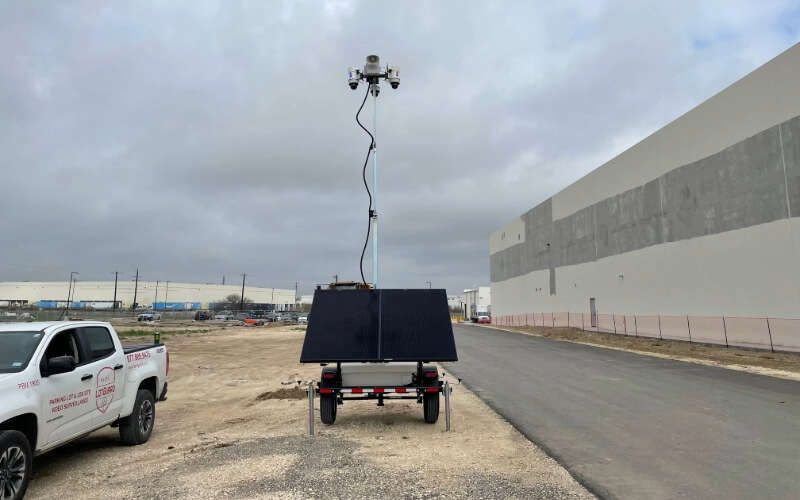
Our Solar Surveillance Trailers cover large lots, staging areas, and jobsites without relying on fixed power or wiring, running instead on solar with battery backup. That way, coverage doesn't lapse overnight when thefts are most likely.
These Trailers act as a visible deterrent on their own, and record continuously in full HD with night vision, support remote PTZ (Pan-Tilt-Zoom) control so an operator can track a vehicle across a wide area. They can also be repositioned quickly as a fleet layout or project footprint changes.
Additionally, our add-on License Plate Recognition (LPR) solutions work with our Trailers, capturing and logging every plate entering or leaving a site. They also check each plate against stolen vehicles and watchlist databases in real-time, and build a searchable record that holds up well after an incident or during an insurance claim.
Watching and responding
Live Video Monitoring services ensure a site is covered by trained operators 24/7. These operators monitor site cameras and can use live audio challenges to deter someone from approaching a vehicle before things escalate, coordinating with law enforcement when needed. They can also keep a verified record of exactly what happened and when.
Integrated Smart Detection Systems help to back this up with automated alerts, including Intrusion Detection at fencing and vehicle access points that flag breaches the moment they happen and push notifications before vehicles are ever touched by potential offenders. This active monitoring helps to prevent crime rather than leaving businesses to review their footage after the fact.
Bringing it all together
Our cloud-based management platform ties video feeds, alerts, plate records, and more from every site into one dashboard. This gives managers overseeing several locations a live view of each site and instant access to recorded footage when it's needed for a police report or insurance claim. Additionally, the platform creates reporting trails that hold up for compliance purposes.
Building a Long-Term Response to California Vehicle Crime
Protecting your high-value assets means thinking beyond just protecting a vehicle. Our approach to asset protection covers the equipment, materials, tools, and cargo that a stolen or compromised vehicle puts at risk in the first place.
Vehicle crime in California is still an expensive problem for local businesses, but the ones that manage it best have stopped treating it as just another cost of doing business. If you want a site assessment to see where your vehicles and cargo are most exposed, and what kind of security you need to close those gaps, talk to us today.
