California is one of the most economically productive states in the country, but that positive output comes with a significant downside: substantial exposure to crime. From the logistics hubs of Southern California to active construction jobsites in the Bay Area, the industries that keep the state moving are also the ones that experience the most crime.
The California Department of Justice recorded 2,082.7 property crimes alone per 100,000 residents in 2024, and the value of stolen goods rose from $2.9 billion in 2018 to $5.1 billion in 2023. This shows that criminal activity has become more targeted and more costly per incident, despite the seemingly positive crime trends.
This article breaks down the industries that consistently face the highest crime exposure in California and dissects the operational and environmental factors that make each one vulnerable. It also discusses how mobile surveillance can help to mitigate risk in certain industries.
High-Risk Industries in California
Property crime remains one of the largest categories of crime in California, covering offenses such as burglary, larceny-theft, auto theft, arson, and vandalism. According to the FBI's Crime Data Explorer, over 500,000 property crime offenses were recorded between March 2025 and March 2026. But despite the surge in property crime, the rate of property crime arrests declined by 5.1% in 2024.
Given that arrest rates remain lower than in previous years, targeted industries are at a loss after incidents occur. This places the responsibility on owners and managers to improve their security measures to avoid becoming a target.
Construction jobsites
The construction industry has one of the biggest instances of crime of any industry in California. Data from the National Insurance Crime Bureau (NICB) and the National Equipment Register (NER) shows that construction crime costs the U.S. industry up to $1 billion every year, with California consistently ranking among the worst-affected states alongside Texas and Florida.
California accounts for around 25% of all construction theft incidents in the U.S., with the average theft incident costing approximately $45,000 in 2022.
The majority of the exposure for this industry is structural. A construction jobsite is an open and constantly changing environment with multiple access points, limited or no permanent infrastructure, rotating crews, and high-value equipment left on-site overnight. This creates ideal conditions for organized theft networks that actively target jobsites to exploit these vulnerabilities.
Common targets on jobsites include copper wiring, generators, power tools, lumber, and heavy machinery, with fewer than 20% of stolen equipment ever being recovered.
This results in significant financial losses for the industry, as stolen materials delay project timelines and inflate insurance premiums. Additionally, contractors are forced to absorb costs that were never built into the project budget.
Read more: The Most Common Thefts from Construction Sites
Retail and commercial premises
Retail crime in California has become a serious public safety issue over the past decade.
According to the Public Policy Institute of California, shoplifting targeting brick-and-mortar retailers was more than a quarter higher in 2023 than pre-pandemic levels.
By 2024, the overall crime rate for commercial burglaries had climbed even higher, with shoplifting up by 47.5% statewide compared to 2019. Los Angeles alone accounted for roughly 55% of the increase in retail theft between 2019 and 2023.
The exposure for the retail industry isn't limited to opportunistic shoplifting. Organized retail crime (ORC) involves coordinated groups that accumulate high volumes of stolen merchandise (usually from big box retailers) before reselling it through secondary markets like online marketplaces.
Its prevalence has even prompted state-wide intervention through local law enforcement agencies and law enforcement partners such as the California Highway Patrol to combat organized retail crime.
California's Organized Retail Crime Task Force conducted 879 investigations in 2024, leading to 1,707 arrests and the recovery of goods valued at around $13.5 million. According to the National Retail Federation, Los Angeles and San Francisco rank as the top 2 metro areas in the U.S for organized retail crime activity.
The cost of these incidents also compounds for retail operators, with 73% of retailers reporting a rise in violent crime, including confrontational and violent behavior, such as aggravated assaults, from shoplifters. As a result, insurance costs increase, which has caused some retail stores in high-risk areas to close locations or reduce hours.
Read more: The Rise of Organized Retail Crime in California
Logistics and transportation
California is the undisputed center of cargo theft in the United States, accounting for around 38% of all recorded cargo theft nationwide in 2025. This reflects the same trajectory recorded between 2023 and 2024, when California reported a 33% rise in cargo theft incidents year-over-year. Los Angeles County alone recorded a 50% increase.
The Southern California Red Zone, which is the first 200 miles of travel for shipments leaving from LA, made up 36% of all U.S. cargo thefts during the first 6 months of 2024, averaging nearly 2 incidents per day.
The reason for these sharp increases comes down to criminal tactics that have grown far more sophisticated over time. Fake pickups, where criminals steal the identity of legitimate carriers to redirect loads, have grown alongside facility-based theft and full trailer disappearances.
The average loss per cargo theft in the first half of 2024 reached $115,230, which is an 83% increase over the same period the year before.
Electronics, home and garden products, and food and beverage items are among the most targeted cargo categories. Warehouses and staging areas are particularly vulnerable overnight and over holiday periods, when fewer employees are on-site, and there's a drop in active site monitoring.
Read more: Cargo Theft in California: Why Logistics Sites Are High-Risk
Vacant properties
Vacant properties in California are at a unique risk of crime. Without active personnel or visible security measures, these sites attract trespassing, metal theft, illegal dumping, and arson. California's high volume of real estate that's in a transition phase means this exposure affects a major portion of the state's property portfolio.
Copper theft has become a particularly serious problem in California. AT&T reported 2,200 copper theft incidents in the state in 2024, a dramatic increase from just 71 offenses in 2021. In Los Angeles, copper wire theft contributed to more than 37,000 streetlight repair requests in a single year, and individual businesses reported losses exceeding $100,000 from a single incident.
Illegal dumping increases liability exposure for owners of vacant land. California counties collectively spend over $17 million annually responding to the problem, with vacant lots among the most frequently targeted sites. Property owners are responsible for cleanup costs and may face regulatory penalties, along with the expense of environmental remediation if hazardous materials are involved.
Critical infrastructure and government assets
Another risk category is both public-sector and critical infrastructure assets. Utility corridors and government facilities face a combination of copper theft, sabotage, unauthorized access, and threats to public safety that differs from the commercially driven crime that affects other sectors. The disruption caused by a single infrastructure incident can affect multiple services for thousands of residents.
These sites often span large or remote areas and operate with minimal on-site security personnel. Additionally, they carry high-value assets that are difficult to replace quickly. This combination makes them more attractive to organized theft groups and difficult to secure through traditional patrol-based systems.
Mobile Surveillance Solutions for California's High-Risk Industries
Each of California's high-risk industries faces a different combination of site conditions and threat patterns. The mobile surveillance solutions that work best match those specifics directly, meaning the right surveillance technology needs to be deployed for the right environment rather than relying on standardized or fixed systems across every industry.
Construction jobsites
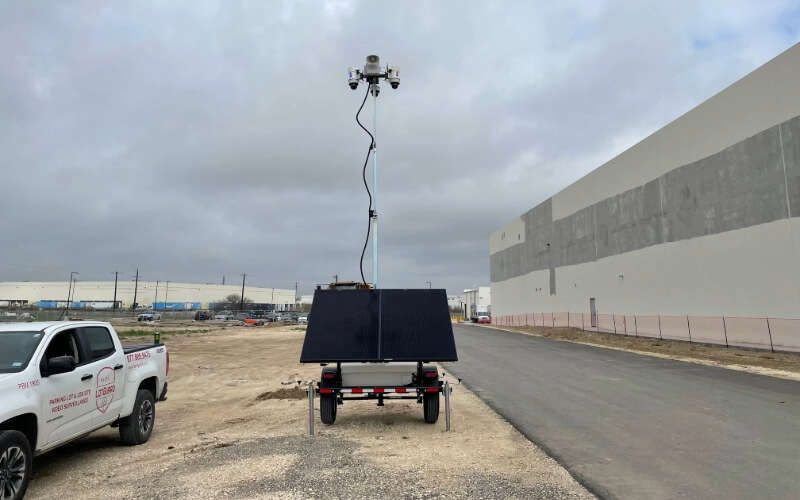
Solar surveillance trailers are designed for the changing layout and infrastructure constraints of active jobsites. They operate entirely off-grid using solar and battery power and deploy in 20 minutes without any infrastructure (basic setups). They can also be repositioned as construction phases progress through a project.
Each unit is equipped with PTZ (Pan-Tilt-Zoom) cameras that deliver near-360° coverage and AI-video analytics that distinguish between authorized personnel and intruders. This eliminates false alarms while ensuring any genuine threats are flagged immediately.
Intrusion Detection triggers automated real-time alerts the moment unauthorized access is detected, especially after-hours when the risk of theft peaks.
These alerts are fed through to Live Video Monitoring services, where trained operators can verify incidents and issue live audio warnings through integrated speakers. If necessary, operators can coordinate with law enforcement agencies without requiring anyone to be physically present on the jobsite.
Retail premises
Our License Plate Recognition (LPR) Cameras automatically capture and log vehicle license plates, cross-referencing them across designated monitoring points to create an audit trail that supports law enforcement investigations and helps to identify repeat offenders before losses can accumulate.
For retail environments dealing with organized theft groups, our Smart Detection Systems use AI-powered video analytics to identify suspicious activity in real-time, including loitering and perimeter breaches, and trigger alerts before an incident escalates.
Pairing these with video monitoring services means that verified alerts reach trained operators within seconds, enabling verbal deterrence through live on-site audio. The visible presence of surveillance solutions also acts as a standalone deterrent, reducing the likelihood of a site being targeted in the first place.
Logistics and transport facilities
Our Pole Cameras deliver near-360 PTZ coverage across sites with larger footprints, including loading bays, staging areas, yard perimeters, and access roads. With optical zoom and AI-video analytics built in, they provide detailed footage at range, which is critical in environments where a single camera needs to cover more ground.
Smart detection systems layer on real-time behavioral analytics, flagging after-hours access attempts and abnormal activity at loading dock areas where fake pickup schemes are more likely to occur.
Vacant properties
For property owners with irregular acquisition times or project-based coverage needs, our Temporary Surveillance Camera and Solar Surveillance Trailer rentals provide flexible, scalable coverage without the cost of purchased equipment.
Rental options also mean coverage can scale up or down as a site transitions between phases, and is useful where ownership or development timeles are subject to change.
Critical infrastructure and government assets
For sites where copper theft and unauthorized perimeter access are concerns, our metal theft prevention solutions and asset protection surveillance deploy targeted coverage that's calibrated to those specific threats. For remote or bigger sites that require flexible, repositionable coverage, solar surveillance trailers provide off-grid deployment without any dependence on fixed infrastructure.
Our cloud-based platform works across all these deployments to give teams a consolidated view of surveillance and safety data in one dashboard. Live video, recorded footage, and reporting can be accessed remotely from any device, with automated alerts and remote viewing built in.
California's Highest-Risk Industries Need More Than Standard Security
Construction, retail, logistics, vacant property, and infrastructure all face heightened risks of becoming targets of crime, specifically because of how each industry operates. Recognizing these vulnerabilities early allows site managers and property owners to move from traditional reactive security measures to more proactive solutions like mobile surveillance.
If your industry is at risk and you want to transition from passive to active surveillance measures, contact our professional security team today. We'll help you to identify where you're most at risk and find the ideal solutions to meet your needs.