
California sees more cargo theft than any other state in the country, and the numbers keep climbing year after year. In 2025, California accounted for 38% of all recorded cargo theft incidents in the U.S., up 6% from 2024.
Warehouses and distribution centers were the most targeted locations in 2025, accounting for 36% of the total incidents. That same year, the U.S. reported 7.16 cargo thefts per day, compared to 6.07 per day in 2024, and analysts have projected a further 13% increase in 2026.
With the numbers climbing at a concerning rate, it's worth questioning what specific conditions make California's logistics and distribution sites so exposed. In this article, we'll break down the key vulnerabilities and what operators can do to reduce their risk of being targeted.
California's Freight Network Gives Cargo Thieves Plenty of Opportunity
The Ports of Los Angeles and Long Beach handle around 31% of all containerized imports in the U.S., making Southern California the country's biggest freight corridor.
That means high-value goods are constantly being moved through staging yards and warehouses before being taken to distribution hubs. It's during those stationary periods, when cargo is sitting at a location waiting to be moved, that the window for theft opens up.
Several cities sit on or near the primary freight corridors that connect the ports to inland distribution networks, including Fontana, LA, Ontario, and San Bernardino.
Unsurprisingly, when thousands of trailers and containers move through a corridor every day, finding a vulnerable moment isn't particularly difficult for organized criminal networks that have studied the operations.
Site Layouts Create Structural Vulnerabilities
The physical design and layout of logistics sites introduce risks that can't be eliminated through scheduling or policy. Across targeted facilities, several factors create vulnerabilities that increase exposure.
Large perimeters with multiple access points
Warehouses and distribution centers consistently rank among the most targeted locations for cargo theft in the U.S., and the way these sites are built is a major reason why.
Maintaining continuous visibility across large footprints with multiple entry points, exit points, loading docks, and roadway connections is an operational challenge, and criminal groups know that. They scout layouts in advance, identifying the access points and timing windows where they're least likely to face resistance or risk of getting caught.
Freight staged during off-peak hours
According to the FBI, most cargo thefts occur on Fridays, because stolen trailers often go unnoticed until Monday morning. That weekend window gives organized criminal groups multiple days to move the cargo before incidents are even reported. Freight staged overnight at a truck stop or yard is, predictably, the most common target.
Staging areas with limited oversight
The Express Carriers Association (ECA) has stated that freight moving between the first and middle miles of the entire supply chain passes through multiple hands and is stored in facilities with variable security standards.
Each transition between the supplier, the warehouse, the cross-dock, and the carrier is a point where criminals have learned to look for easy targets.
The Most Targeted Cargo Goods Moving Through California
California's logistics network handles a large portion of the commodity categories most prone to theft nationwide. Electronics, food and beverage, pharmaceuticals, copper, and construction materials all move through the state in high volumes and regularly feature in theft reports.
Electronics represented 22% of all cargo theft incidents in 2025, and food and beverage followed at 15%. Both of these categories are attractive to criminals for different reasons. Electronics have high resale value, while consumable goods are difficult to trace once they've been distributed. This makes recovery of stolen property far less likely and prosecution considerably harder.
Although these are the most reportedly stolen goods, other goods are also being increasingly targeted.
Metal theft increased by 77% year-over-year in 2025, caused primarily by the high demand for copper in construction and infrastructure. The price of copper is higher than ever, reaching $14,500 per metric ton in January 2026.
In 2024, businesses lost nearly half a million dollars just from 2 cases of copper theft alone, showing how popular this metal is among both organized and opportunistic criminals and how devastating it can be to certain industries.
Pharmaceuticals are a growing target for organized theft groups. Pharma freight is especially attractive because it's portable, easy to move, and difficult to trace once it's dispersed, and has a high value-to-weight ratio. There are also established black market networks where pharmaceuticals can be resold, making them easy to fence soon after the theft has taken place.
Hardware for cryptocurrency mining (like GPUs) and enterprise computer components have also become top-tier targets. CargoNet's 2025 annual analysis confirmed that these categories were popular among organized crime groups, stating that shipments are often transported as standard dry goods despite their values running into the millions.
The same analysis from CargoNet suggested that the average value per cargo theft rose to $273,990, which is a 36% increase from $202,364 in 2024. This reflects how selectively organized theft groups operate.
There are well-funded criminal enterprises that operate across state borders and return to sites they have successfully targeted before. Although these groups are the primary focus of multi-agency task force operations, logistics sites that have been hit before are likely to see repeat offenses unless they improve their visible security and surveillance systems.
These risks aren't limited to logistics operations. Construction sites storing valuable materials and equipment face many of the same vulnerabilities, making construction jobsite security strategies essential for protecting high-value assets.
Supply Chain Complexity Makes Losses Harder to Prevent and Track
A single shipment can pass through shippers, brokers, 3PLs, carriers, and warehouse operators before it reaches its destination. Each piece of that chain handles a portion of the accountability, which means gaps open up wherever handoffs aren't tightly managed.
When multiple companies are involved in freight movement, pinpointing responsibility for a loss becomes harder. At the freight volumes California handles, missing shipments can go unnoticed for hours or sometimes days, which gives theft groups a significant advantage before law enforcement agencies are notified.
Strategic theft, where criminals impersonate legitimate carriers or brokers, is also common.
Strategic theft accounted for 8% of cargo crime in 2020, and by the end of 2024, it made up about one-third of all incidents. It has quickly spread across the trucking industry as criminals have gotten better at exploiting the gap between digital freight platforms and physical verification. Deceptive pickup schemes also rose a further 35% year-over-year in 2025.
In April 2026, California Highway Patrol and federal agencies, including the FBI, issued a public service announcement confirming that cyber threat actors are gaining access to broker and carrier systems by using spoofed emails and fake URLs to redirect freight to criminal pickup points.
California's position as the country's main entry point for cargo makes its operators a consistent target for these kinds of schemes.
The True Cost of California's Cargo Theft
Cargo theft statistics tend to focus on incident counts and financial losses, but rarely capture what those incidents mean for the people running the sites or for the operators who carry commercial consequences long after the stolen property has been taken.
Worker and staff safety
Drivers and other transportation workers face the highest physical risk. Coercion incidents, where drivers are followed from distribution centers and forced to hand over vehicles or cargo, have increased as organized criminal operations have become more professional. In California's freight corridors, driving alone on overnight runs carries both personal and cargo risks.
For site operations staff, the aftermath of a theft incident has its own pressures. Inventory reconciliation, liaison with law enforcement, insurance documentation, and explaining losses to shippers all fall on the same teams already responsible for keeping day-to-day operations running. Repeat incidents also erode morale and make employee retention difficult.
Additionally, security guards working on understaffed or under-equipped sites are expected to deter well-resourced criminal groups with insufficient tools. When incidents occur, there's usually a gap between what surveillance infrastructure was supposed to capture and what it actually recorded, which makes incident response and insurance claims much harder.
Addressing site security isn't just a financial decision; it's about protecting the health and safety of workers and staff on the ground.
Read more: Safety Compliance Monitoring Solutions
Financial and commercial exposure
The average incident value is around $273,990, but this actually underestimates the true cost of a cargo theft for a logistics site operator, since the financial damage goes beyond just the immediate loss of goods.
Insurance recovery isn't typically straightforward, since cargo insurance policies often include deductibles and exclusions for incidents that can be attributed to a lack of adequate security measures.
Operators who can't prove they had reasonable security measures in place at the time of a crime may find their claims being rejected. Regardless of the outcome, a reported incident can also trigger premium increases when it's time to renew.
Shipper relationships also carry a cost. A warehouse or distribution center with a known history of theft will face harder negotiations on storage and handling rates and risk losing contracts to competing facilities with better security.
How to Reduce Risk at California Logistics Sites
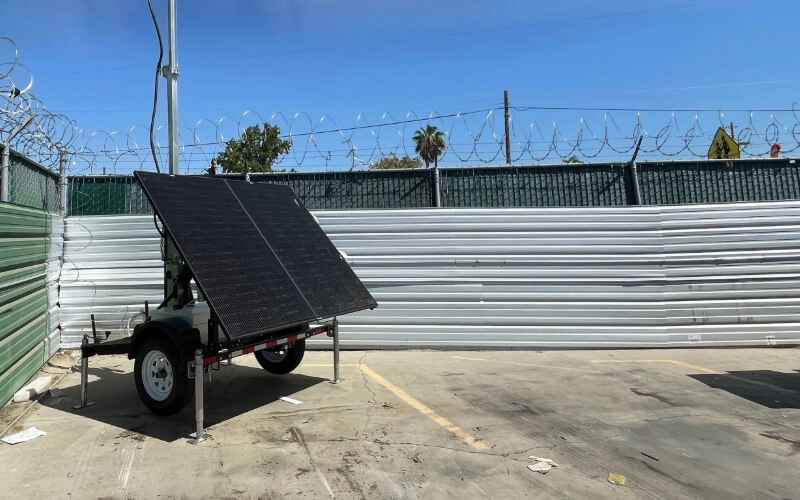
Protecting California logistics sites means choosing a surveillance strategy that keeps pace with how freight operations work. Fixed security systems may be adequate in a permanent, controlled environment, but for active freight yards, distribution centers, staging areas, and overflow lots, rapid-deployment mobile solutions that don't depend on existing infrastructure have a practical advantage.
|
Solution |
Key Features |
Best For |
|
What it does: Rapid-deploy, self-contained mobile units. No fixed power or infrastructure required. |
|
|
|
What it does: Automated license plate recognition (LPR) add-on that logs and verifies all vehicle movement. |
|
|
|
What it does: 24/7 Monitoring by trained operators who verify alerts and intervene in real-time. |
|
|
|
What it does: AI-powered analytics that add intelligent security to any camera with no additional hardware needed. |
|
|
Managing security across multiple California sites means dealing with data from a lot of locations at once. It is able to consolidate surveillance feeds, LPR data, AI-generated alerts, operator notifications, and compliance records into a single dashboard. It's remotely accessible from any device, with one secure login.
- Respond faster to intrusions by consolidating real-time alerts from every site into one place, so nothing gets missed across multiple locations.
- Build a stronger evidence trail with auditable incident reports and timestamped historical footage, which is critical for insurance claims and law enforcement referrals.
- Access your full surveillance operation from any device at any time, with no software to install.
- Deter repeat offenders using vehicle watchlists and LPR data that flag known threats before an incident escalates.
- Stay ahead of compliance requirements by configuring custom detection zones and pulling audit-ready reports without leaving your desk.
Don't Become a Target of California's Cargo Theft
With a projected 13% increase in cargo theft incidents in 2026, operators have no choice but to address the vulnerabilities on their sites to avoid becoming a target. Additionally, the sophistication of organizing theft groups means that site managers need to be one step ahead with smart security systems rather than fixed or passive surveillance plans.
Our mobile surveillance solutions are designed for the conditions that California logistics sites actually face, with smarter detection and real-time intervention to de-escalate incidents before criminals can complete a theft.
Contact one of our security experts today to discuss the best coverage option for your operation and get the perfect setup deployed to your site.
