California is one of the busiest economic hubs in the country, with large construction jobsites and high-traffic retail areas. For business owners and construction managers, this kind of activity comes with one major concern: crime.
The good news is that crime rates across the state have been steadily decreasing, with the California Department of Justice confirming declines in major crime categories in 2024, including violent and property crimes.
The bad news, however, is that specific crimes like larceny-theft remain a serious threat, with 353,739 offenses reported between March 2025 and March 2026. As a result, industries like construction and retail continue to face higher exposure regardless of what broader statewide trends might suggest.
In this article, we'll break down the most common crimes in California, explain what the data means for businesses, and outline how mobile surveillance can reduce your risk of becoming another statistic.
Crime in California: An Overview
California's crime patterns have changed considerably since the pandemic years. The state's property crime rates reached 2,084 per 100,000 residents in 2024, an almost 10% decrease from the previous year, while the incident rate of violent crimes dropped from 508 incidents per 100,000 residents in 2023 to 481 in 2024.
Although these kinds of downward trends are meaningful, their context matters, since aggravated assaults (categorized under violent crimes) are still 22% above their pre-pandemic level despite declining in 2024.
According to the Public Policy Institute of California (PPIC), grand theft auto crimes (a type of property crime) dropped 16.8% from 2023 to 2024, but it's still almost 20% higher than its 2019 numbers. Shoplifting has also trended upward, sitting 48% higher than pre-pandemic levels.
California vs the rest of the United States
When you look at how California compares to national averages, the bigger picture becomes a lot clearer. The state's violent crime rate was 35.3% higher than the US average in 2024, and its property crime rate rose by 18.1%. California also ranked number 6 among all 50 states for violent crime offenses.
For businesses in California, these numbers show that the state's crime rates are technically improving but still remain an outlier in comparison to the rest of the country. The crime categories most relevant to commercial businesses, like property crime, remain relatively high.
The most common crimes in California include:
-
Larceny-theft
-
Motor vehicle theft
-
Burglary
-
Organized retail crime
-
Robbery
-
Aggravated assault
Most of these crimes carry real and measurable risk for commercial properties and construction jobsites, making investments in better surveillance systems a necessity to protect against potential threats.
Read more:
6 Most Common Types of Crime in California
Some of the most frequently reported California crimes are also the most relevant to business owners, commercial property owners, jobsite managers, and real estate investors. For example, business owners may be more exposed to certain crimes, such as organized retail crime (ORC), while jobsites are more at risk of larceny-theft.
Here's a quick overview of just how prevalent these crimes actually are:
|
Crime Type |
California (per 100K) |
US Average (per 100K) |
VS. National Average |
|
Overall Violent Crime |
486 |
359 |
+35.3% |
|
Robbery |
119 |
61 |
+95.1% |
|
Aggravated assault |
326 |
256 |
+27.3% |
|
Overall Property Crime |
2,078 |
1,760 |
+18.1% |
|
Motor vehicle theft |
428 |
259 |
+65.3% |
|
Burglary |
306 |
229 |
+33.6% |
|
Larceny-theft |
1,345 |
1,272 |
+5.7% |
Note: Organized retail crime is not a standalone category in FBI UCR reporting.
Sources: FBI UCR 2024 via USA Facts; FBI Reported Crimes in the Nation 2024
1. Larceny-theft
Larceny-theft is the unlawful taking of property without force, and includes shoplifting and opportunistic jobsite crimes like tool theft. It's by far the most common property crime in California, making up 65% of all reported property offenses in 2023.
For businesses, this type of crime goes beyond retail and into jobsites and logistics operations that experience larceny-theft from the theft of high-value materials like copper wiring and equipment that's left unsecured after hours.
Jobsites with minimal perimeter control and no active monitoring are easy targets, since a lack of visible surveillance and unsecured access points sends the message that there's ample opportunity to commit a crime without being caught.
Explore Our Theft Prevention Solutions
2. Motor vehicle theft
Motor vehicle theft dropped 16.8% from 2023 to 2024, marking the first year-over-year decline since 2019. Even so, California is still one of the top 3 states nationally for auto theft. Vehicle thefts made up 20.6% of all property crimes committed in the state in 2024.
Southern California, particularly Los Angeles and Fresno, consistently makes up the majority of statewide car theft crimes, mostly because of the amount of cargo that passes through their freight corridors.
Statistics from the California Highway Patrol show that Los Angeles alone had just under 58,000 vehicle theft cases in 2024, of which 6% were commercial trucks and trailers, and another 6.4% were construction and farm equipment. This means that 7,190 vehicles stolen in 2024 had a direct impact on local businesses and construction jobsites.
According to the National Insurance Crime Bureau, cargo theft is becoming more popular among organized criminals, with the cost of a single incident averaging around $202,000. This is a major concern for security on construction jobsites in particular, since building materials and heavy equipment are commonly stolen goods.
3. Burglary
Burglary is the unlawful entry (trespassing) into a building or structure with the intent to commit a felony or theft, and it has a direct commercial impact. According to the PPIC, commercial burglaries increased in 14 of California's 15 biggest counties between 2019 and 2022, with Fresno, Alameda, and Orange Counties all having more than a 50% increase, and Santa Clara following closely at 44%.
Properties like commercial businesses and jobsites are the most vulnerable targets, since the premises are usually empty or partially-staffed after hours. When there is a lack of surveillance or visible security, criminals can enter a property and leave with stolen goods completely undetected.
4. Organized retail crime (ORC)
Organized retail crime is different from shoplifting and refers to large-scale, coordinated thefts carried out by criminal networks or groups that resell stolen goods.
California, in particular, has invested in combating ORC with the state's CHP-led Organized Retail Crime Task Force. The Task Force conducted 879 investigations in 2024, resulting in 1,707 arrests and the recovery of over 676,000 stolen items, valued at around $13.5 million.
These figures, combined with those from law enforcement agencies, showcase the scale of ORC in the state. The National Retail Federation has estimated that ORC costs the US retail industry tens of billions of dollars every year, with criminals working across states and targeting distribution points and loading docks.
5. Robbery
According to U.S law, robbery involves the use of force or threat to take property from a person who is present at the time. California saw a 7.5% drop in robberies in 2024 compared to 2023, and robberies involving firearms were also 13.9% lower in 2024 compared to 2019.
Despite this, commercial robbery is still a major concern, especially for sites with cash transactions or high-value goods like construction equipment on-site. The risk climbs further at locations with thin after-hours security coverage and no visible surveillance infrastructure, especially if workers are unable to defend themselves against armed or aggressive criminals.
6. Aggravated assault
Although aggravated assault offenses decreased by 4.8% in 2024 from 2023, the rates are still 22% above pre-pandemic levels. Assault and battery incidents involving firearms and deadly weapons have declined since their peak in 2021, though they remain 33.6% above 2019 figures.
For construction teams and jobsite supervisors, this raises concerns over both security and worker safety. In fact, the Occupational Safety and Health Administration (OSHA) has noted that construction environments and commercial properties after hours are higher-risk settings for workplace violence. That includes a spectrum of offenses, from simple assault to aggravated assault with a weapon.
If offenses are committed against workers and cause physical harm, this may result in legal and regulatory compliance issues/penalties, which are costly problems. In addition to this, lawsuits or investigations into aggravated assault and battery cases can cause a delay in project timelines, adding yet another layer of financial damage on top of the human toll.
Read more: 10 Safety Hazards Facing Construction Jobsites
Which Crimes Pose the Biggest Risk to Businesses in California?
Certain crimes are more likely to affect commercial and public works operations, particularly those with large, open sites with high-value assets. But the common denominator across each of these risk areas is environmental vulnerability, such as sites lacking perimeter visibility or active monitoring.
High-value equipment theft
Theft is one of the most consistent risks to construction jobsite security in California. The National Insurance Crime Bureau and National Equipment Register estimate annual losses from construction and farm equipment theft in the US at between $300 million and $1 billion.
What makes the problem worse is that project delays, insurance claims, law enforcement investigations, and the operational disruption that follow a major theft all pile up. Asset loss is also a major cost, considering that less than 25% of stolen equipment is ever recovered.
Although this is a major threat to jobsites, retail businesses are also at risk, as it has been reported that power tools are one of the most commonly stolen items across the board. If a business sells any high-value equipment or other goods you would usually find on a construction site (including standard tools), they may become a target of ORC or opportunistic burglary.
Read more: Construction Site Theft Statistics
Metal and copper theft
Metal-related crimes affect multiple industries, from construction and utilities to critical infrastructure. The U.S Department of Energy has stated that copper theft alone costs U.S businesses around $1 billion each year.
Retail properties may be at risk when HVAC equipment or electrical systems are targeted, since this can cause costly downtime or store closures when repairs are taking place. Further than that, businesses risk reputational damage when customers hear about repeat incidents, as they may begin to question their safety when on the premises.
With the amount of valuable metals and copper wiring on construction jobsites, this makes them a prime target, leading to a greater need for perimeter monitoring and full-coverage surveillance.
Read more: Metal Theft Prevention Solutions
Cargo and vehicle theft
Cargo theft is a significant concern for logistics and transport operations in Southern California. CargoNet, which tracks cargo theft incidents across the United States, has consistently found that California's freight corridors are among the highest-risk in the country, with Los Angeles County and the I-5 corridor often coming up in reported crimes.
Organized retail crime
In 2023, California gave $267 million to law enforcement agencies across the state to help combat organized retail crime. However, ORC is still a major threat to California's commercial sector. In 2024, the National Retail Federation reported that ORC costs U.S businesses over $100 billion every year.
So, despite ongoing efforts to decrease the amount of ORC theft-related crimes, this is still a prevalent threat for any industry that sells or uses high-value goods or equipment, including the construction industry.
Read more: Organized Retail Crime Prevention Solutions
How Mobile Surveillance Helps Reduce Crime Risk
The best way to prevent crimes from happening on your commercial property or jobsite is to have a good mobile surveillance security system in place.
Visible deterrence
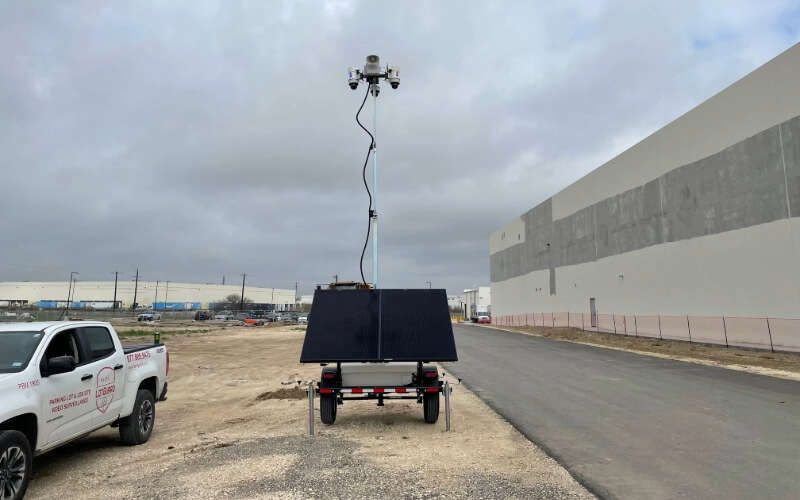
Our Solar Surveillance Trailers are the most visible deterrent, standing up to 20-feet tall and deployable within hours. They're well-suited to the larceny-theft and auto-theft risks that businesses and construction sites face after hours, when assets are still on-site, but your employees aren't.
The built-in PTZ (Pan-Tilt-Zoom) cameras provide near-360° coverage, and AI-video analytics detect real threats and perimeter breaches as they happen. Our Temporary Security Camera Rentals offer the same capabilities with the flexibility of a rental model, which is a practical choice for jobsites, businesses, and commercial properties where targeted coverage is required or security needs change over time.
If you want fixed, high-definition coverage at entry points and across high-risk zones, our Pole Cameras are ideal and don't require any on-site power, making them a practical option for burglary prevention at remote retail properties or partially-developed properties where perimeter control is limited.
24/7 monitoring and active response
All of our solutions include 24/7, fully-managed live video monitoring services, where trained operators review live footage to verify alerts and coordinate real-time responses as needed.
Operators can issue a live audio warning directly to anyone on-site, while flashing lights and sirens connected to our Surveillance Trailers provide additional visible and audible deterrents. Together, these active response capabilities stop criminals in their tracks and reduce the need for law enforcement intervention.
This kind of active presence helps deter organized retail crime in retail stores and lowers the chance of aggravated assaults or other confrontations on isolated sites, while timestamping every incident for investigations and insurance claims.
Our optional License Plate Recognition (LPR) solutions give business owners and jobsite managers an added layer of protection against vehicle and cargo theft. The system actively logs every plate that enters or exits your site perimeter and flags unauthorized access in real-time, whether during operational retail hours or when your property is unmanned.
Unified site visibility
All of our mobile surveillance solutions connect seamlessly with our cloud-based software. This platform consolidates all your surveillance, safety, and compliance data in one place so that your entire operation is visible from a single, comprehensive interface, completely remotely.
Rather than managing each location on its own, you can now access your reports, monitor, manage, and receive alerts from any business or property in your portfolio.
Key features for business owners and site managers include:
-
Multi-site monitoring: View and manage every location across your portfolio from one dashboard
-
Real-time alerts: Receive instant notifications for perimeter breaches and incidents
-
Automated reporting: Access timestamped incident logs for insurance claims and investigations
-
Compliance and safety data: Centralize your records to support regulatory requirements and OSHA documentation
-
Remote live viewing: Access live or recorded footage from any device, so site managers and business owners can check in on any location without being on-site
-
System health monitoring: Receive automatic alerts if a camera goes offline so coverage gaps are flagged immediately
Stay Ahead of Crime in California
Mobile surveillance gives California businesses a practical and scalable solution to the crime risks that come with operating in the state. Rapid deployment and 24/7 monitoring mean you're covered from day one, with protection that grows alongside your operation.
The right security infrastructure doesn't only respond to crime after it happens, it completely changes the conditions that make your business a target in the first place. That's why more and more businesses in California are turning to WCCTV for their surveillance requirements.
Contact our team today to find out which solution is the right fit for your business.