
Construction jobsite theft is a national problem, but California ranks in the top 3 most affected states in the U.S, alongside Florida and Texas. This is partly due to the size of the Golden State's construction industry and the specific conditions that make active jobsites so exposed.
Construction alone contributed $160 billion to California's GDP in 2024, with more than 93,600 construction jobsites operating across the state. Those numbers mean more active jobsites and unattended equipment across locations, and therefore, more opportunities for criminals to exploit.
Understanding the real weight of the problem is the first step to addressing it as a jobsite manager. With mobile surveillance, California contractors can build more targeted security plans designed around the specific conditions driving theft on active projects.
Why California Jobsites Face a Higher Theft Risk
California's exposure to construction theft comes down to certain operational realities and criminal activity patterns that create constant vulnerabilities on jobsites across the state.
Organized criminal networks operating across Southern California
The majority of states deal with opportunistic theft, where someone spots an unguarded site and takes what they can carry, such as smaller, handheld power tools. California also deals with this type of theft, but because it's much more exposed to organized criminal activity, thefts are usually carried out more intentionally.
According to federal prosecutors, there are multiple documented cases of sophisticated and well-coordinated theft rings working across Los Angeles, Ventura, Orange Counties, and other areas.
In 2024, the US Attorney for the Central District of California indicted a group that was accused of instructing foreign nationals to commit theft across multiple counties before fencing the proceeds through a vehicle rental business in the San Fernando Valley.
These criminal networks have a level of planning that exceeds opportunistic theft. They scout sites in advance and move quickly to hit multiple locations at once. Therefore, a site without active deterrence is an easy target.
Copper theft and rebuilding after the 2025 wildfires
California has more copper theft than any other U.S. state, with AT&T reporting more than 7,300 copper theft incidents in 2025, with losses exceeding $54 million.
Most incidents are concentrated in LA and San Diego counties, where there are plenty of active construction sites, and wiring is exposed before permanent finishes go in. This is the highest-risk point of any project's lifecycle, and is particularly worrisome in the context of the 2025 wildfires.
The 2025 Palisades and Eaton wildfires were some of the most destructive wildfires in years and have added an additional layer to California's construction theft problem. Projects that were started to rebuild in the affected areas are still being completed, meaning partially developed sites in neighborhoods where the number of residents is lower than before.
These sites have been specifically targeted for theft because reduced activity in the surrounding area means longer windows where no one is watching.
Additionally, since exposed wiring is standard during reconstruction, and the price of copper is at an all-time high, there is more financial gain for thieves who successfully steal and resell this high-value metal. The National Insurance Crime Bureau (NICB) and the U.S Department of Energy have estimated that copper theft costs U.S businesses around $1 billion each year.
High-value materials and equipment left on-site overnight during predictable windows
Nationally, around 12,000 construction equipment theft incidents are reported annually, with the National Equipment Register (NER) estimating the average incident cost at around $30,000.
In California specifically, the average cost of a single stolen equipment incident reached $45,000 in 2022, showing just how impactful copper and metal thefts are and how they inflate per-incident losses compared to the national average. The state also makes up around 20% of the total construction equipment theft in the U.S.
Equipment like skid steers and excavators, and materials like copper wiring, HVAC components, and power tools are among the most frequently targeted items on any jobsite. Cordless drills and similar tools alone account for around 40% of U.S construction theft incidents, and California's large, multi-crew sites mean bigger tool inventories that sit unattended every night.
The window between when workers leave a jobsite and when they return is when most theft occurs. The NER has also documented consistent theft spikes over long weekends and holidays, when reduced site activity during off-hours creates longer unmonitored gaps that criminals exploit.
The earliest phases of a project, when materials are delivered and staged, are when exposure peaks. August sees the highest construction theft rates across the nation, which coincides with the most construction activity. Since California builds year-round, that window of exposure never fully closes.
The Cost of Construction Jobsite Theft in California
The replacement value of what's stolen is rarely the full cost that construction projects will incur. For California contractors and supervisors managing tight margins and deadline pressure, the consequences of a single incident can affect an entire project budget.
Across the construction industry, theft-related expenses are estimated to add between 1% and 5% to overall project costs when replacements, delays, deductibles, and insurance claims (or premium increases) are factored in together.
On a large commercial project in California, that range represents a significant unplanned expense. For smaller contractors, one costly incident can mean the difference between profit and loss.
When key materials or equipment go missing, work also stops. Subcontractors may have to stand down, with one-third of all construction projects experiencing serious delays caused directly by criminal activity.
For California developers who have taken out construction loans, every day of delay adds interest charges on top of replacement costs. Similarly, on commercial projects with contractual completion deadlines, those delays can end up triggering penalty clauses that overshadow the value of what was originally taken.
Poor recovery rates make the problem even worse. The NICB reports that fewer than 20% of stolen construction equipment pieces are ever recovered, and for tools and smaller equipment, the rate drops below 7%.
In California, where organized criminal networks move stolen materials more quickly, most of these losses are permanent from the moment they happen.
Filing claims afterward is also rarely straightforward, since insurers need detailed police reports of evidence that a jobsite has reasonable security measures in place to prevent crime. Each claim made can also increase premiums over time, compounding the financial damage well beyond the initial loss.
Read more: How Jobsite Security Saves You Money
How Mobile Surveillance Helps Protect California Construction Jobsites
The conditions that encourage theft on California jobsites are exactly what our mobile surveillance solutions are designed to address. Our solutions cover the hours and access points that fixed, passive security often leaves wide open.
Flexible perimeter coverage
A lot of California jobsites have cameras and still get hit.
The highest-risk zone this week may change as phases progress, and a fixed camera position locked in at groundbreaking might not cover the right area by month 3.
The average theft incident on a California construction jobsite can run up to $45,000 in direct losses, which doesn't include project delays, insurance implications, repair costs, or the replacement timeline for specialist equipment that needs to be ordered.
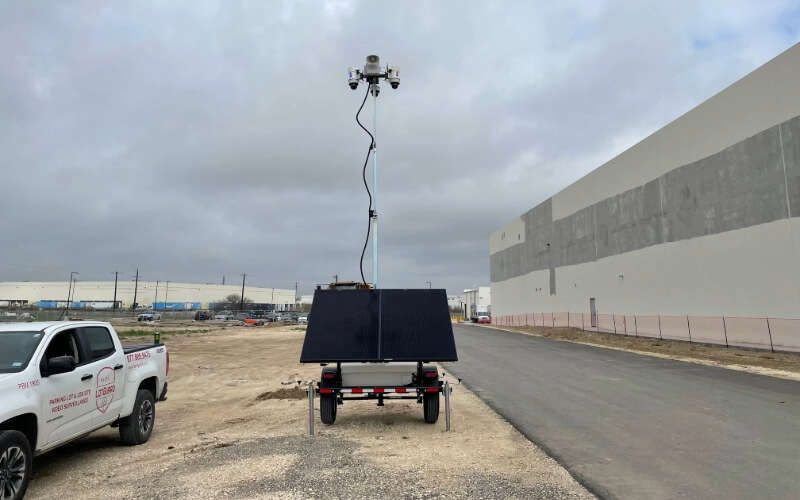
Our Solar Surveillance Trailers deploy without fixed electrical infrastructure or WiFi and run on solar and battery power, transmitting over 4G/5G cellular networks. They're built to reposition as your jobsite changes, with continuous monitoring through PTZ (Pan-Tilt-Zoom) cameras with near-360° coverage, along with integrated lighting and live audio deterrents for real-time intervention.
As your site phases evolve, our trailers reposition with them. Our Temporary Surveillance Camera and Solar Surveillance Trailer rentals also give contractors a cost-effective option that scales from the start of a project through to handover with no long-term infrastructure commitment.
Real-time detection
A camera that records a theft doesn't actively prevent it from happening. Our intrusion detection technology uses AI-video analytics to analyze footage in real-time rather than archiving it for review in the morning.
The moment any suspicious activity or unauthorized personnel are detected on-site within a configured zone, the system flags it immediately.
Detection zones are set around your highest-risk areas, with the AI filtering out false triggers caused by weather, floating debris, wildlife, or passing cars so that the alerts reflect genuine intrusion attempts every time.
Active 24/7 monitoring
Detection has the most value when it triggers a real response rather than passively recording an incident. Our Live Video Monitoring services connect jobsite cameras to monitoring centers with trained operators who respond to verified alerts the moment they come in.
When an intrusion is confirmed, operators can issue a live audio challenge directly to the site, complete with sirens and flashing lights for more effective deterrence. When criminals know they are actively being watched, they're more likely to flee than take the risk of getting caught.
The operators will also notify site management immediately once a threat is verified and escalate incidents to law enforcement when necessary, with documentation that's ready to hand over.
Vehicle access control
Vehicles are the foundation of large-scale theft on California jobsites, since criminals use vans and trucks to tow equipment away and load materials into the back during shift changes or overnight.
Our License Plate Recognition (LPR) solutions help capture and verify license plate data at every entry and exit point on your jobsite. This additional service automatically flags plates that appear suspicious or that are blacklisted to build a complete, time-stamped access record.
On California jobsites where subcontractors, delivery vehicles, employees, and other authorized personnel rotate almost daily, automated LPR gives you a level of access control that manual checks by security guards can't match.
Centralized visibility across multiple sites
California contractors managing concurrent projects have the additional challenge of monitoring assets at locations where they cannot be physically present.
Our cloud-based surveillance platform, consolidates live feeds, intrusion alerts, access logs, and compliance records into a single interface that's remotely accessible from any device.
Project managers can monitor footage, review incidents, pull documentation for insurance claims, and compile evidence for law enforcement from anywhere, all without setting foot on-site.
Securing California Jobsites with WCCTV
In a state that accounts for some of the highest rates of construction jobsite theft in the country, has the worst copper theft crisis of any state, and is home to organized criminal networks that deliberately target jobsites, you can't rely on fencing and passive cameras. The theft conditions in California are active and adapt quickly, so your security needs to keep up.
Our mobile surveillance solutions deploy quickly without permanent infrastructure and are actively monitored 24/7. If you need security that moves as quickly as your projects do, our professional security team can advise you on the right combination of solutions for any jobsite.
Contact us today to start building your ideal security plan.

