Property crime continues to challenge businesses across California, from retail stores and construction jobsites to logistics yards and vacant commercial properties. Although overall property crime in the state has recently fallen to its lowest level since 1985, shoplifting increased by 14.2% in 2024 and now sits almost 48% higher than pre-pandemic levels.
For business owners, this creates a mixed picture. Some risks are easing, while others, like retail theft, continue to grow. Crimes such as theft, burglary, trespass, and vandalism can disrupt operations and damage a company's reputation. Over time, these incidents create ongoing financial strain regardless of statewide crime trends.
Reducing exposure to property crime starts with understanding the specific risk factors tied to a business's location and assets. Taking proactive steps can significantly improve protection for employees, customers, property, and the entire community alike.
In this article, we outline practical strategies California businesses can use to reduce property crime exposure. These include environmental design, improved lighting and surveillance, smarter inventory management, and the legal tools available to address repeat offenders.
Understanding Property Crime Risk for California Businesses
California businesses face property crime risks that are determined by their location, asset visibility, and layout. Businesses with poor sightlines, dim lighting, cluttered storefronts, or anything that impedes the ability to maintain clear visibility, often become easier targets as criminals tend to exploit sites where they're less likely to be seen or stopped.
In 2024, shoplifting incidents reported across California reached 132,076 (the highest figure on record), highlighting that retail theft remains a serious concern even as overall property crime trends downward.
Businesses that keep cash or display high-value merchandise, such as electronics or construction equipment, within clear view are particularly attractive to opportunistic thieves. Operational gaps, including inconsistent business hours or closing procedures and unmonitored entry points, can also increase vulnerability.
Retail isn't the only target, however. Construction jobsites face steady losses of tools, generators, fuel, and building materials once crews leave for the day, since unsecured perimeters and empty laydown areas create easy access overnight.
Logistics and cargo operations carry their own exposure, too, with freight staged overnight in yards or at distribution hubs proving a frequent target for organized theft rings working across the state. Vacant commercial buildings are also at risk, since empty spaces with no regular foot traffic or staff presence can go unmonitored for weeks or months at a time.
Recognizing these risks is the first step toward building a layered approach to crime prevention.
Read more:
- The Most Common Types of Crime in California
- Which Industries Face the Highest Crime Risk in California?
- How Crime Trends Are Changing Across California Industries
How Crime Prevention Through Environmental Design Reduces Risk for California's Business Owners
Crime Prevention Through Environmental Design (CPTED) is a strategy that focuses on the layout and design of a business to reduce criminal behavior and improve overall safety. The approach centers on preventive measures such as natural surveillance, access control, and territorial reinforcement, which help business owners reduce their security risk without relying solely on staff or technology.
CPTED principles encourage businesses to design their layouts in ways to improve visibility and discourage criminal behavior, which can help deter burglars before they attempt a break-in.
Practical applications for preventing crime include positioning workstations and storage areas so staff and cameras have clear sightlines, and ensuring entrances and access routes are visible to the public where possible.
Natural surveillance can also be improved by keeping storefront windows free from excessive signage or advertisements, which allows people inside and outside the business to see each other clearly. Whether the premises are an office, shopping center, distribution facility, or jobsite, this level of visibility works in multiple ways:
-
Customers, contractors, tenants, and non-employees feel safer when they can see into a well-lit, open building or site
-
Employees feel safer at work, meaning there is an overall increase in the perception of public safety on the business premises
-
Potential offenders are less likely to act when they know that suspicious activities can be seen from the street or by staff and passers-by
-
Insurance providers may also view well-monitored, visible locations as lower-risk, which can support more favorable policy terms
Lighting, visibility, and property maintenance
Maintaining bright, motion-activated exterior lighting helps eliminate dark areas that criminals might use as hiding spots, particularly around entrances, storage areas, loading docks, and parking areas.
Well-lit exteriors make it harder for anyone to approach a building unnoticed, and motion-activated lights add an extra layer of deterrence by drawing attention to movement after hours. This matters even more for vacant properties, which often sit unlit and unattended for long stretches, making them an easy target after-hours.
Placing the cash register in a visible location and keeping the surrounding area well-lit and free of clutter can also significantly reduce the risk of burglary, since these spaces are common targets for break-ins.
Maintaining the property is just as important as lighting and layout, and that responsibility doesn't stop once a building sits empty.
A well-kept site, especially when vacant, can deter criminals, while a neglected, run-down exterior can suggest that the property, and by extension its owner or property manager, is an easier target. This matters for property managers especially, since a vacant or poorly maintained site can also lower the perceived security of neighboring businesses, not just the property itself.
Simple steps, such as repairing damaged siding and clearing overgrown landscaping, all contribute to a stronger first impression and a safer site for business owners and property managers alike.
Securing entry points and protecting assets
Using solid-core doors with deadbolt locks is one of the most effective security measures against forced entry. Standard hollow-core doors and basic locks can be broken into fairly quickly, while reinforced doors and quality deadbolts add more resistance for anyone attempting to break in after-hours.
Windows and secondary entrances deserve the same attention as the front door, since criminals often look for the weakest point of entry rather than the most obvious one.
For businesses managing valuable equipment, high-value stock, fleet vehicles, or property across larger sites, protecting assets often requires a combination of physical barriers and active monitoring. This is particularly true for outdoor storage or multiple access points that are difficult to secure with doors and locks alone.
These include areas such as construction laydown areas or vacant properties with several points of entry. Sites like these carry higher vulnerability simply because there's no one on-site day-to-day to notice when something's wrong, which is exactly why they tend to need additional monitoring layered on top of standard locks and barriers.
The Role of Video Surveillance in California Crime Prevention
Installing high-definition cameras alongside alarm systems helps to deter theft for many businesses by making it clear that activity is being recorded and monitored. Visible cameras alone can discourage opportunistic theft, while integrated active monitoring services provide an added layer of response when something does go wrong.
Video surveillance systems play a critical role in supporting investigations into incidents such as robbery or theft, since clear footage of suspects can directly support law enforcement, giving investigators far more to work with than vague or partial images.
However, many businesses operate with surveillance systems that fall short during an active investigation, often because of poor picture quality, cameras positioned at angles that don't capture useful detail, or systems that simply weren't matched to the specific needs and layout of the site in the first place.
Reliable surveillance technology should deliver strong uptime as standard, but regular property inspections still add value alongside this.
A visible inspection routine signals that an owner or manager is actively present and engaged with the site, adding a further layer of deterrence on top of the technology itself, while also offering a natural opportunity to confirm lenses stay clear and footage is being stored correctly.
Inventory Management and Loss Tracking
Keeping an up-to-date inventory of merchandise and property, with a copy stored in a secure off-site location, helps businesses manage losses effectively if theft or damage occurs. Without accurate records, it becomes difficult to quantify losses for insurance claims or to provide law enforcement with a clear list of stolen goods.
This record-keeping also supports prosecution efforts, since California prosecutors can now aggregate the value of stolen property across multiple incidents, including across different victims and counties, to help meet felony grand theft thresholds.
Currently, organized theft rings generally plan for individual thefts to fall below $950. Under California law, theft of items worth $950 or less is generally treated as a misdemeanor, which carries lighter penalties than a felony grand theft charge.
By keeping each individual haul under that line, members of organized criminal groups can spread a much larger theft across several businesses, with each person facing only a minor charge if they're caught. This pattern isn't unique to retail, either.
Construction sites see a similar dynamic, where tools, materials, and equipment are picked off in smaller amounts across multiple visits or sites, rather than in one large, easily flagged event, and items like copper and lumber are particularly easy to move quickly once stolen.
As a result, this makes detailed inventory records especially valuable in cases involving organized retail crime and equipment or materials theft on construction sites alike.
Other Ways to Reduce Property Crime for California Businesses
Design choices and video surveillance help prevent crime for businesses in certain areas. However, a more comprehensive approach to property crime risk also includes additional measures, such as how a business screens and structures its own staff, as well as the legal options available once an offender has been identified.
Internal theft prevention
Implementing strong hiring practices, such as requiring detailed applications and checking references thoroughly, can help reduce the risk of internal theft and fraud. Employees with access to cash and inventory or sensitive information represent a different category of risk than external criminals, and screening helps to reduce that exposure from the outset.
This isn't limited to retail staff, either. Construction businesses face similar exposure from employees and subcontractors who have legitimate, everyday access to tools, materials, and equipment.
Maintaining separate functions within the business, so that no single employee controls an entire process from start to finish, adds another layer of protection. Splitting responsibilities such as ordering, receiving, cash handling, and reconciliation across different staff members makes it harder for losses to go unnoticed.
Identity-based access control adds a further layer here, limiting entry to cash offices, stockrooms, or equipment yards to specific, verified individuals rather than anyone holding a general key or code, so access can be tracked and reviewed if something does go missing.
Legal tools
California businesses now have additional legal tools to help them address repeat offenders. Under AB 3209, courts can issue retail theft restraining orders that prohibit individuals convicted of certain retail crimes from entering the affected store or other locations within the same chain or franchise for up to 2 years.
For losses that cross into more serious territory, AB 1960 applies stronger sentencing whenever stolen or destroyed property exceeds $50,000 during a felony, regardless of industry, which gives construction and logistics operators a path to harsher penalties when equipment or freight losses run high.
Cargo-specific incidents have also gained some much-needed attention under AB 1972, which expanded the California Highway Patrol's regional property crimes task forces to address rising cargo theft.
This gives businesses a way to address habitual offenders directly, rather than relying solely on repeated arrests and prosecutions. Combined with strong documentation and surveillance evidence, these tools give businesses a much clearer path toward long-term crime mitigation and resolution.
Security Technology That Strengthens Crime Prevention for California Businesses
Environmental design and physical prevention work best when they're paired with technology that can watch a site continuously and respond in real-time.
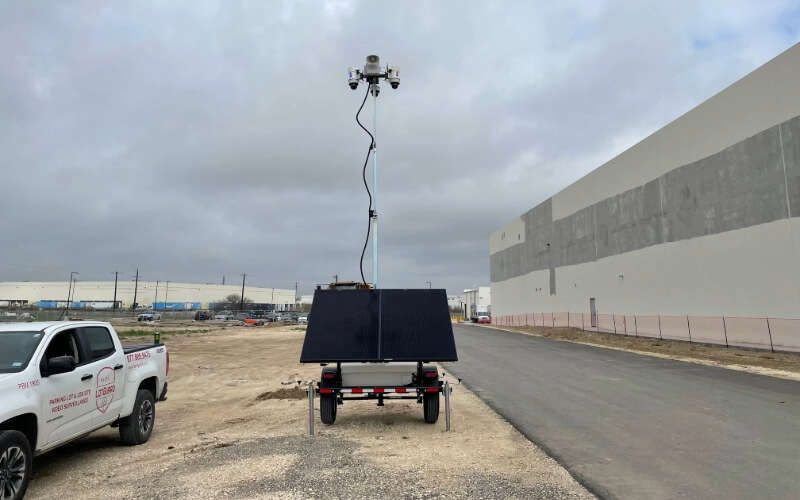
With the increase in organized theft across California, a traditional alarm system or fixed, record-only video surveillance isn't enough to deter crime or mitigate the risk for businesses. Instead, smart mobile surveillance is best suited to add visible deterrence and active monitoring to almost any location.
|
Solution |
Key Features |
Best For |
|
Independently powered, mobile surveillance units that can be set up anywhere, with no internet connection or mains power required. Built for visible deterrence and active monitoring. |
|
|
|
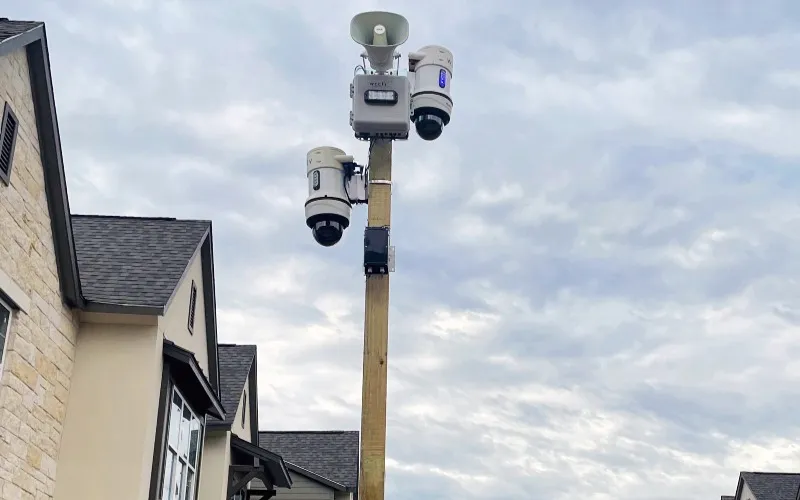
What it does: Compact, rapidly deployable cameras designed for precise coverage of entry points, boundaries, and other vulnerable areas. |
|
|
|
What it does: Trained security operators verify alerts in real-time, issue live audio warnings through on-site speakers, and contact law enforcement directly when needed. |
|
All business types, particularly:
|
|
License Plate Recognition (LPR) What it does: LPR cameras record and store vehicle data at key entry and exit points, building an evidence trail that aids investigations and helps to identify repeat offenders. |
|
|
|
What it does: An AI-powered system designed to identify and respond to perimeter breaches. |
|
|
Every one of these solutions can connect directly to our cloud-based management platform, bringing all surveillance units and sensors together under one interface. This makes it straightforward to oversee security and safety across multiple sites without switching between systems.
Our platform is able to combine live and recorded video surveillance, AI-powered intrusion detection, equipment health monitoring, and more. Everything is remotely accessible via browser or our mobile app, designed to be simple and easy to use, however you choose to manage your sites. Every unit we deploy connects over 4G/5G directly to our dedicated platform.
For the California businesses operating across multiple sites, or in areas where conditions and risk levels are high and can change without warning, our solutions eliminate the need for juggling multiple systems and security providers at once.
Read more:
Building a Layered Security Approach for California Businesses
Reducing property crime risk in California involves combining physical target hardening, such as access control, secure doors, and proper lighting, with strategic environmental design. No single security approach can address every risk, but layering these approaches, together with smart mobile surveillance systems, creates multiple points where potential crime can be detected and deterred.
If you want to improve your business site security and prevent crime from occurring in the first place, contact our security team today. Our experts will help you assess what measures your site needs and guide you through the deployment process from start to finish.