
California is America's most populous state, with 39.4 million residents and accounting for around 11.5% of the entire country's population. Due to the high population density, there are naturally more reported incidents of crime per 100,000 residents than in most other states.
California sits above the national average on violent crime and ranks among the worst performers nationally for motor vehicle theft. While the state recorded consistent improvement across multiple crime categories in 2024 (with homicides and robberies following a downward trend), there is still a real and immediate risk to its residents and businesses.
In this article, we look at California's crime rates in relation to national benchmarks and identify the categories that pose the greatest risk. We also explore regional differences and outline how WCCTV's mobile surveillance can support businesses and agencies operating across the Golden State.
Understanding California's Crime Data
The FBI's Crime Data Explorer platform gathers and publishes crime data in the United States. Law enforcement agencies across the country submit their figures, which the FBI collects under its Uniform Crime Reporting program.
In recent years, the system has moved from a basic summary reporting format to a more detailed approach called the National Incident-Based Reporting System.
The new system captures far more context around each offense, but the transition is still ongoing. For instance, in 2022, crime numbers were reported by only 49% of California's local law enforcement agencies, while other populous states had much lower participation rates.
Violent crime rates
In 2024, California reported 481 incidents per 100,000 residents, ranking 6th among all states for violent crime. The FBI breaks violent crime into 4 specific offense types, including:
-
Murder and nonnegligent manslaughter
-
Rape
-
Robbery
-
Aggravated assault.
Of these 4 types, aggravated assault is the most prevalent in California, with the rates sitting 22% above their pre-pandemic levels.
Despite these numbers, the overall trend of violent crime is moving in the right direction, with the total offenses dropping by 5.3% from 2023 to 2024. Homicides fell by 13.5%, and robberies dropped by 7.5% over the same period. While this improvement may bring some relief to California residents, the volume of offenses that remain still demands vigilance.
Property crime and motor vehicle theft
Property crime refers to offences where money or personal property is taken without using force against a person. Common examples include burglary (defined by the FBI as unlawful entry into a structure to commit a felony or theft) and larceny-theft, which involves taking someone else’s property without their permission, even when it is not taken directly from them.
California's property crime rate in 2024 was 18.1% above the U.S. average, with auto theft accounting for 20.6% of all property crimes statewide.
Unsurprisingly, motor vehicle theft has been one of the most significant property-related challenges California has faced in recent years. The state recorded 463 such thefts per 100,000 inhabitants in 2024, meaning auto theft is 85% more likely in California than the rest of the country.
What's more, the state recorded 176,230 stolen vehicles valued at roughly $1.56 billion. One positive development is that this figure represented the first year-over-year decrease since 2019, following targeted law enforcement operations in high-theft areas.
How California's Crime Rates Compare to Other States
To put California's crime statistics in context, it helps to look at both ends of the spectrum, including the difference between the safest and most crime-affected states.
States with the lowest violent crime rates
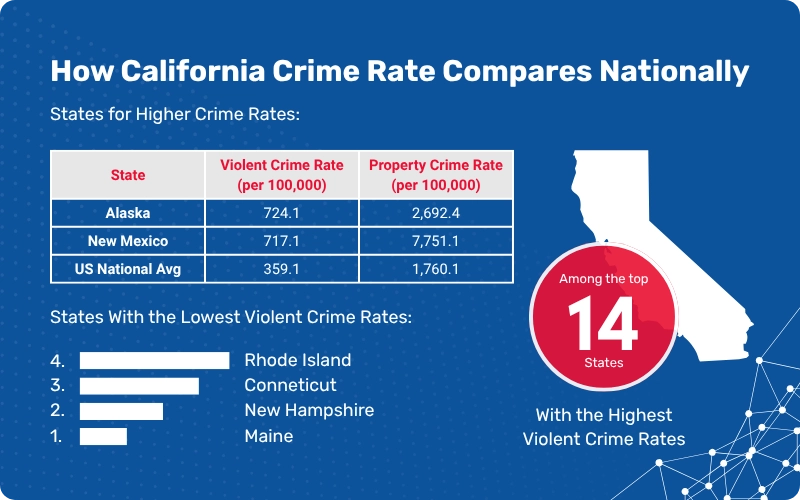
The states with the lowest violent crime rates per 100,000 residents in 2024 were:
|
State |
Crime rate per 100,000 residents |
|
Maine |
100.1 |
|
New Hampshire |
110.1 |
|
Connecticut |
136.0 |
|
Rhode Island |
153.6 |
New Hampshire, in particular, stands out since its motor vehicle theft rate was just 54 thefts per 100,000 inhabitants, which is 78% lower than the national average.
In 2024, some of the safest states were in the Northeast, with the lowest property crime and the lowest violent crime rates in 4 out of 5 states. That region benefits from lower population density and more stable economic conditions that appear to discourage criminal activity.
States with higher crime rates
|
State |
Violent crime rate (per 100,000) |
Property crime rate (per 100,000) |
|
Alaska |
724.1 |
2,692.4 |
|
New Mexico |
717.1 |
7,751.1 |
|
U.S National Average |
359.1 |
1,760.1 |
How California compares: California was among the top 14 states with violent crimes above the national average in 2024, alongside Tennessee and Arkansas. This ranking can be attributed to the state's urban concentration and large population. Its per-capita violent crime rate is still well below Alaska and New Mexico.
Regional Crime Differences Within California
Crime in California is mostly concentrated in its urban corridors, and the differences between regions are large enough that statewide figures alone aren't a reliable basis for operational planning.
The San Joaquin Valley recorded the highest violent crime rate in the state in 2024, at 603 incidents per 100,000 residents. The southern coast and border region, which covers Imperial, Orange, San Diego, and Ventura Counties, recorded the lowest at 331 per 100,000. That's a nearly 2-to-1 difference within a single state, which shows how much location matters when assessing real-world risk.
There is even more variation when you zoom in on certain cities. For instance, Oakland's violent crime rate was around 1,925 per 100,000 people, while cities like Glendale and Santa Clarita consistently rank among the safest cities in Los Angeles County based on low crime rates.
Between the Q4 of 2023 and the same period in 2024, violent crime in Los Angeles and San Francisco decreased by 13% and 20%, respectively, with San Francisco reaching its lowest levels in at least a decade. Oakland's violent crime rate fell around 19% over the same period, although it still remains 31% above pre-pandemic levels.
Southern California accounted for 53.21% of all vehicle thefts statewide in 2024, with Los Angeles County making up 61.83% of the Southern California total. The San Francisco Bay Area followed with 25.36% of statewide thefts.
For construction jobsites in California, the exposure goes well beyond vehicle theft. John Deere and Bobcat equipment topped theft lists in construction and farm equipment categories in 2024, largely because of their high resale value.
That kind of equipment theft carries a serious financial cost for contractors. Since construction theft is more commonplace in high-density urban areas, mobile surveillance trailer rental is a great option for project managers working in environments where permanent security infrastructure simply isn't practical.
What Drives Crime in California?
Several underlying factors explain why California's crime rates sit above the national average, even if its overall rates have improved over time.
Crime rates were highest in the West in 2024, with the region's violent crime rate 21% above the national figure and property crime 18.5% above. California's combination of large cities, economic inequality, and continuous development with high-value assets on active jobsites makes it a constant target for different types of crime.
California's crime rates are also affected by its socioeconomic conditions, with research identifying poverty and unemployment as major drivers of both violent and property crime. Additionally, rates of violence are highest in neighborhoods that are characterized by socioeconomic disadvantage and high income inequality, which explains patterns within California's most crime-affected urban corridors.
The state's high cost of living and wide wealth gap, combined with its pockets of deep poverty in all of its major cities, contribute to the conditions that make certain areas particularly vulnerable to crime.
In 2024, California residents experienced less than a third of the crimes per resident compared to records from 1980, and around two-thirds of the rate they experienced in 2006. This is a significant improvement over the decades, but it's not enough for citizens and businesses to drop their guard when it comes to safety measures.
How Businesses Can Respond to California's Crime Risk
For businesses working across the Golden State, the data makes a strong case for targeted security planning rather than a blanket response to the state's overall profile. For example, a logistics firm in a smaller inland city faces a different risk level compared to a construction contractor on a high-value project in Los Angeles.
Our Solar Surveillance Trailers and Pole Cameras can be deployed quickly for construction jobsites, commercial zones, events, and other public areas without any fixed infrastructure. This means coverage can be placed where the crime data indicates the greatest exposure.
Paired with professional Live Video Monitoring services, our solutions provide 24/7 oversight through monitoring centers, enabling real-time deterrence and faster response when it matters most.
Add-on Smart Detection Systems are available for all of our solutions that use AI-video analytics to catch unauthorized access and suspicious behavior before situations escalate. Other enhancements include our License Plate Recognition (LPR) Camera that mitigates the risk of auto theft at access points and high-value locations.
Our security solutions are designed to feed directly into our cloud-based consolidation dashboard. This platform pulls surveillance data from every trailer and camera, including site intelligence, into one, remotely accessible software platform that can be accessed on any device. This ensures that teams and security managers have real-time visibility across multiple locations.

What California's Crime Data Means for Your Security Strategy
California's crime profile presents a unique security challenge for operators and residents within the state. The Golden State is above the national average on several major metrics, and although its numbers are improving over time, the still-elevated figures are a consistent concern.
For anyone operating across the state, that means security planning can't afford to be passive. The data points clearly to where exposure is most clustered, and the gap between the safest and most at-risk parts of California is wide enough that a one-size-fits-all approach will always leave coverage gaps.
The most effective response is one that matches the data. Deploying targeted, scalable mobile surveillance gives you the best chance of protecting your assets and operations without over-committing resources where the risk doesn't justify it.
To explore what deployment could look like for you, speak to our security experts for a tailored assessment.

