
California's crime data is heading in the right direction. The California Department of Justice (DOJ) reported that the violent crime rate dropped by 6% in 2024, while the property crime rate fell by 8.4% to its lowest level since 1985. However, these statewide figures don't account for specific types of crime or city or county-specific trends.
The Public Policy Institute of California (PPIC) has noted that although property and violent crime categories fell in 2024, shoplifting continued to rise, and cargo theft reached record highs. Data from the Federal Bureau of Investigation and the California DOJ's Crimes and Clearances Files consistently show that crime trends vary considerably depending on the industry, location, and the type of asset involved.
For businesses in construction, retail, logistics, and commercial real estate, this variation matters. The risks each sector faces are shaped by how it functions and the environments in which it works.
This article breaks down what the data shows for each industry and why sector-specific awareness is crucial for effective risk and security management.
Statewide Crime Trends Across California
The PPIC reported the following statistics for 2024:
-
Violent crime includes homicide, robbery, rape, and aggravated assault. The homicide rate reached its second-lowest level since 1966.
-
Property crime includes burglary, larceny-theft (including non-felonious larceny-theft), and motor vehicle theft. The property crime rate of 2,082.7 per 100,000 residents was the lowest recorded in 4 decades.
-
Auto thefts fell by 16.8%, which was the first year-over-year decrease since 2019, but remain 19.1% above pre-pandemic levels.
-
Aggravated assault rates dropped from their pandemic peak but remain 22% above 2019 levels.
The regional differences are also worth noting. The San Francisco Bay Area recorded the highest property crime rate in the state at 2,678 per 100,000 residents. San Diego had the lowest violent crime rate at 331 per 100,000 residents, and Oakland's Alameda County recorded a 21.1% drop in property crime, one of the largest declines among California's major counties.
These figures give useful context, but they don't reflect how unevenly the risk falls across different industries.
How California Crime Trends Vary by Industry
Each of the industries most affected by California's crime rates faces a unique risk profile defined by the assets it holds and how it operates. Physical location increases exposure as well, with industries in high-crime areas being the most affected.
Construction
Construction is one of the most consistently targeted industries in California. Jobsites house high-value equipment and materials, often with limited after-hours access controls, and operate on changing footprints that make fixed security impractical.
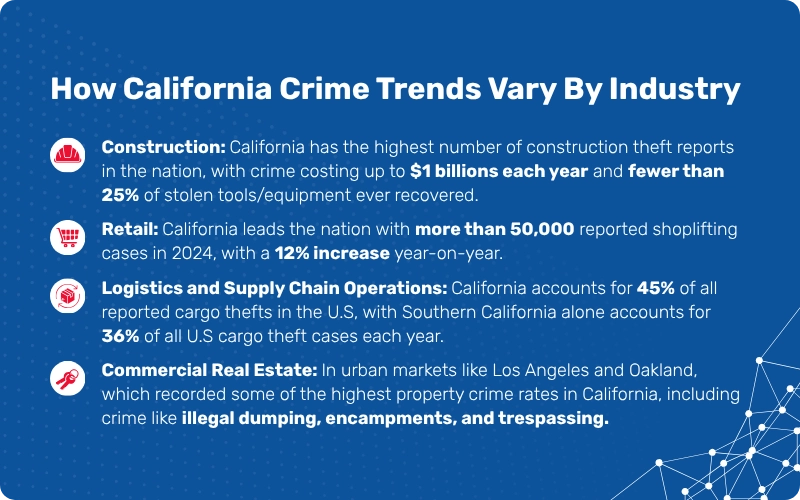
California has the highest number of construction theft reports in the nation, with crime costing up to $1 billions each year and fewer than 25% of stolen tools/equipment ever recovered. The most commonly targeted items are copper wiring, lumber, generators, power tools, and heavy machinery.
In 2022, the number of US construction thefts rose by 20%. The National Crime Information Center (NCIC) and National Equipment Register (NER) recorded over 11,500 reports of stolen construction equipment in a single year, averaging to around 31 incidents per day.
This theft isn't isolated to opportunistic incidents. Organized theft rings operate seamlessly with insider knowledge and coordinated logistics, especially around Los Angeles and San Francisco.
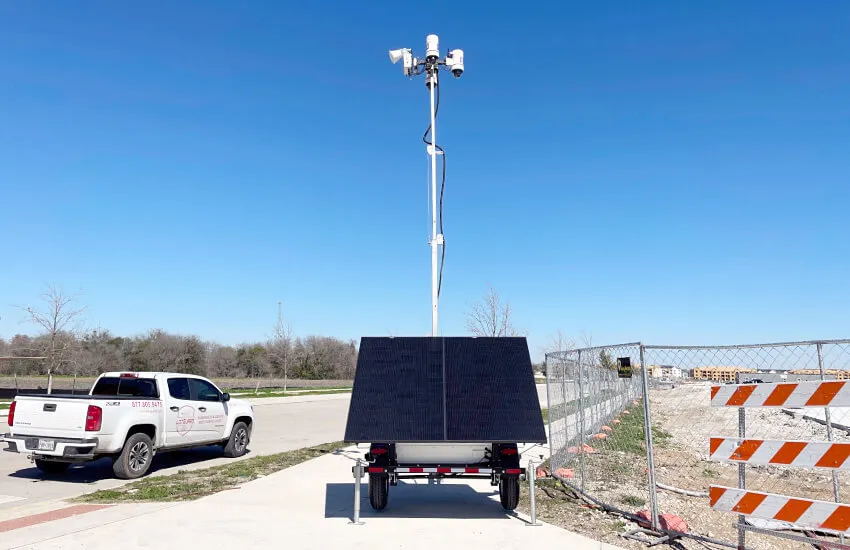
For California contractors, the main security challenge at active jobsites comes down to coverage and portability. Mobile surveillance trailer rentals can be repositioned as a project progresses, with no dependency on fixed infrastructure.
Rental also removes the capital commitment of purchasing equipment outright, giving you the flexibility to scale up or down as site conditions or project phases change.
Retail
Retail is where the gap between the statewide figures and the reality of location-specific crime data is most apparent. Although reported property crimes declined in 2024, shoplifting continued to climb and is now 48% above pre-pandemic levels. California also leads the nation with more than 50,000 reported shoplifting cases in 2024, with a 12% increase year-on-year.
The National Retail Federation reports that shoplifting incidents spiked by 93% between 2019 and 2023, with an additional 19% rise from 2023 to 2024. According to the Pacific Research Institute, the average value stolen per incident also increased from $3,071 in 2019 to $5,521 in 2024.
A significant driver of this increase in retail theft is Organized Retail Crime (ORC). The 2023 NRF Security Survey identified Los Angeles and San Francisco as the top 2 metro areas most affected by ORC, with Sacramento also among the most impacted.
These operations involve coordinated, multi-location thefts with merchandise moved through online marketplaces. As such, they aren't deterred by traditional store-level security measures without any supporting technology.
The California Highway Patrol's Organized Retail Crime Task Force conducted 879 investigations in 2024, resulting in 1,707 arrests and the recovery of 676,227 stolen items valued at $13.5 million.
In an attempt to mitigate these crimes, new legislation enacted in 2024 introduced retail theft restraining orders and felony charges for possessing more than $950 in stolen goods with the intent to sell. However, these measures have been largely unsuccessful, as criminals began stealing goods under the threshold but in larger numbers to avoid felony charges.
Logistics and supply chain operations
California accounts for 45% of all reported cargo thefts in the U.S, with the numbers growing dramatically in 2024. Southern California alone accounts for 36% of all U.S cargo theft cases each year, which is mainly due to port and distribution center density, as well as the concentration of interstate freight activity.
CargoNet documented 925 U.S cargo theft incidents in Q1 of 2024, which is a 46% increase from Q1 of the year before. During this period, California's year-over-year increase reached 72%.
For the full year, CargoNet also recorded 3,798 incidents nationally (a 26% increase over 2023), with reported losses exceeding $455 million. Industry experts put the actual losses closer to $1 billion a year, which includes unreported incidents as well.
The average loss per theft grew by 17% from 2023 to 2024, with the average stolen shipment value hitting $281,757 in Q1 of 2024, and electronics accounting for around 23-24% of all thefts. Unsurprisingly, 41% of these thefts occurred when cargo was in warehouse storage.
Read more: Cargo Theft in California: Why Logistics Sites Are High-Risk
Commercial real estate
Commercial real estate (CRE) faces a different type of risk from the other sectors. The main issues aren't organized theft targeting specific high-value assets. They're persistent, lower-level offenses like vandalism, trespassing, graffiti, and illegal dumping that accumulate over time and create real costs.
Vacant lots and transitional commercial properties are the most affected. Illegal dumping carries direct cleanup and enforcement costs; California's Penal Code Section 374.3 imposes mandatory fines up to $10,000 for repeat commercial offenders, but the cost of remediation still falls with the landowner.
In urban markets like Los Angeles and Oakland, which recorded some of the highest property crime rates in the state, unauthorized encampments and trespassing on commercial lots also generate secondary risks, including arson and structural damage.
Smoke and fire detection is becoming more important for operators managing multiple properties where unauthorized access raises fire risk. This is especially relevant across California's wildfire regions and urban locations with older buildings.
Smart Security Solutions for California Industries
The crime patterns across California call for security that matches how each sector operates. It should be flexible, deployable without fixed infrastructure, capable of active intervention, and have more smart integrations than traditional security setups.
|
Solution |
Key Features |
Best For |
|
Solar Surveillance Trailers Self-powered, mobile surveillance units that deploy rapidly to any location without internet or mains power. Provide visible deterrence and active monitoring. |
|
|
|
Pole Cameras Compact, rapidly deployable cameras for targeted coverage of specific access points, perimeters, areas, and other high-risk zones. |
|
|
|
What it does: Trained operators monitor verified alerts in real-time, issue live audio challenges through on-unit speakers, and escalate to law enforcement agencies when needed for active intervention. |
|
All industries, particularly high-value or high-risk sites, after hours. |
|
License Plate Recognition (LPR) solutions What it does: License Plate Recognition (LPR) cameras capture and log vehicle activity at certain points, supporting investigations through evidence gathering and repeat-offender identification. |
|
|
|
What it does: AI-powered detection covering both perimeter intrusion and early smoke or fire identification. |
|
|
All of these solutions feed directly into our in-house cloud platform. It connects every surveillance unit and sensor into a single interface, directly addressing the challenge of managing security, safety, and compliance across multiple sites from one place.
Our platform combines live and recorded video, AI-powered intrusion detection, environmental monitoring (air quality, noise, weather), smoke and fire alerts, and system diagnostics, which are all remotely accessible via browser or mobile app on any device, with no software to install. Each one of our deployed units connects over 4G/5G directly to our dedicated cloud-based platform.
For California businesses managing multiple sites or operating in locations where conditions can change quickly, our solutions remove the need for numerous systems and providers.
Match Your Security to Sector-Specific Risks with WCCTV
Crime data is often read as a verdict, but the industries covered in this article face extremely different crime profiles with unique security needs. Although California's 2024 data shows improvement at the state level, law enforcement agencies solved fewer than 10% of property crimes statewide. That puts the burden of prevention and effective deterrence on operators and owners across the state.
It's worth asking yourself whether the type of crime that affects your industry is rising or falling, and whether your current security setup is built around that reality. For most businesses across construction, retail, logistics, and commercial real estate, the "safe" option of traditional, fixed security setups isn't practical enough for long-term crime deterrence.
If you want to know what the right setup looks like for your sector and location, get in touch with our expert team today.

