
Not every business location in California carries the same level of crime exposure. High-risk locations like construction jobsites, unstaffed utility sites, logistics yards, and remote industrial facilities face risks that a typical office or storefront doesn't. This is largely because they're temporary locations, unstaffed, or missing the infrastructure that makes fixed security possible.
In construction alone, theft costs the industry between $300 million and $1 billion each year, and that's just one category of high-risk site.
In this article, we'll cover what makes a location high-risk, the features that separate a useful mobile surveillance system from one that just adds another camera to the site, and how WCCTV matches capabilities like AI-powered detection and centralized reporting to your site's risk profile.
What Counts as a High-Risk Location in California?
High-risk doesn't always mean high-crime. It often means a location that's temporary or missing the infrastructure that makes fixed security possible.
Construction sites fit this description throughout the life of a project. Equipment, materials, and partially completed structures remain valuable and exposed for the full build cycle, since permanent security measures are rarely finished until a project nears completion itself.
Critical infrastructure and utility sites, such as substations and transformer yards, are frequently remote and unstaffed by design. On the other hand, logistics hubs and distribution centers carry risk because high-value freight often sits in laydown areas or overflow yards for days at a time.
Remote industrial facilities complete the list, since they're typically located far from law enforcement response times and without the wired infrastructure that urban sites take for granted.
What connects all of these locations and environments is that traditional security cameras were never built to follow risk around. A jobsite often has no fixed power or internet connection to draw on, and utility substations in a remote part of Northern California may be miles from the nearest wired infrastructure altogether.
At WCCTV, we build our mobile surveillance systems specifically to close that gap, adapting to sites that traditional infrastructure was never designed to reach. The following sections break down exactly how we do that, starting with the specific features we prioritize in every deployment.
Read more:
- Construction Jobsite Theft in California: How Big Is the Problem?
- Cargo Theft, California: Why Logistics Sites Are High-Risk
- Which Industries Face the Highest Crime Risk in California?
Why Fixed Cameras Fall Short at High-Risk Locations
Fixed camera systems are built around permanence, like a wired power source, a hardwired or fixed wireless internet connection, and a mounting point that isn't expected to move. That works fine for a permanent office, but it breaks down at high-risk sites.
Installing fixed infrastructure means trenching for cabling, waiting on permits, and coordinating with a site's electrical setup before any cameras go live, which can take weeks on a project that may only run for a few months.
Once a fixed system is in, it's in. So, if a project's layout changes, a shipment moves to a different yard, or a crew relocates to a new phase of a site, fixed cameras are unable to move with them, unless an organization is willing to cover the cost and delay of a full repositioning.
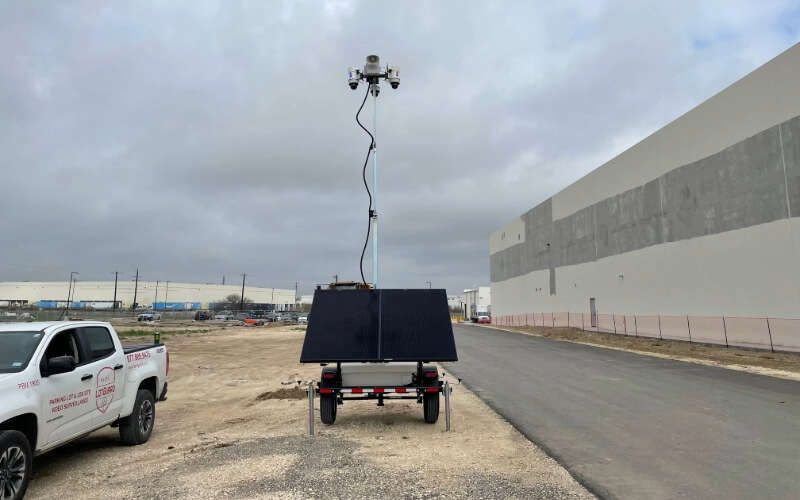
Our Solar Surveillance Trailers solve this by removing the dependency on fixed power and cabling altogether. These self-contained, solar-powered mobile security trailers offer movable units that can be deployed as needed. Each rental delivers continuous live video monitoring wherever a site requires it, without waiting on utility hookups or permanent construction.
For smaller vantage points, like a single access point or entrance rather than a full site perimeter, our Pole Cameras offer the same rapid, infrastructure-free deployment in a more compact format.
That flexibility is why we've become the go-to option for organizations managing multiple temporary or high-value locations across the Golden State. However, there are also 5 specific features that we prioritize in every deployment.
5 Features That Matter Most in a Mobile Surveillance System
Not every mobile surveillance setup on the market delivers the same value, even when the spec sheets look similar on paper. At WCCTV, we build 5 specific capabilities into every deployment.
1. Rapid deployment
A security system should be operational within hours of arriving on site, not days. We prioritize this because high-risk environments can't afford to wait for coverage to catch up. The longer a site goes without surveillance, the longer it remains exposed.
Delayed coverage carries a real cost. A peer-reviewed meta-analysis of 40 years of research, published by the Department of Justice's Office of Justice Programs, found that camera schemes generate meaningfully larger crime-reduction effects when they include active monitoring rather than sitting passive. But pairing cameras with other interventions produces even stronger results.
A system that takes weeks to arrive and configure isn't just slow; it's missing the window where active, monitored coverage does the most good.
2. Autonomous, off-grid operation
A system shouldn't depend on a site already having power or a wired internet connection. We build our deployments around this because high-risk locations are high-risk because they lack the infrastructure a fixed system needs. Additionally, a solution that requires power and connectivity can't always be placed at the sites that need it most.
This is particularly relevant for utility and infrastructure sites, where copper and metal theft has cost Los Angeles alone more than $100 million in repair costs since 2020. Much of this theft took place at unstaffed, off-grid locations that a wired system was never designed to reach.
3. Cloud connectivity and remote access
Footage, alerts, and camera settings should be accessible from any authorized device, not just from on-site hardware. We include this because organizations managing sites across a wide area can't send someone to physically check a camera every time something needs reviewing. With remote access, you can also turn a flagged event into a review-and-escalate task measured in minutes, not hours.
This matters most for organizations running multiple sites at once, since checking each location in person doesn't scale once a portfolio grows past a handful of deployments.
Our cloud-based management platform gives your team direct, self-serve access to footage, alerts, and system status across every deployed unit.
Backed by live monitoring, the platform also puts trained professionals on hand to verify activity and action incidents as they happen, with reports feeding straight into the same cloud dashboard your team already uses. That means genuine threats are caught and escalated 24/7, even when no one from your team is on site or watching the feeds.
4. AI-powered detection
Raw motion detection is unreliable and creates false alarms that use up valuable time and resources. We build AI-driven analytics into every deployment because a system that can't filter activity down to genuine risk trains site managers to ignore alerts altogether, which defeats the purpose of having detection at all.
Nationally, between 94% and 98% of burglar alarm calls police respond to turn out to be false, according to the Department of Justice. This is a rate that has held steady across jurisdictions for decades because it reflects how alarm systems work rather than a one-year anomaly.
The problem is also still visible across California, with the City of Los Angeles's Office of Finance reporting that LAPD officers handle 6,000 to 7,000 alarm calls a month, with over 90% determined to be false alarms.
Filtering out false positives is only half the job, though, since a system also needs to detect the right things. Our Smart Detection Systems can be added onto any deployment, with intrusion detection for perimeter breaches, PPE detection, and smoke and fire detection all layered onto the same AI analytics system.
This matters because falls, being struck by equipment, smoke inhalation, and electrocution together account for a majority of US construction fatalities, according to OSHA. These are known as the industry's "fatal four" hazards.
According to the National Fire Protection Association, fire departments also respond to an estimated 4,440 fires in structures under construction every year, causing $370 million in direct property damage annually. This is why PPE detection and smoke and fire detection matter just as much as intrusion detection in a system built for these types of high-risk sites.
5. Centralized reporting across sites
A single dashboard should show every deployed surveillance unit's live video, alerts, and reports, rather than requiring a separate login for each one. We build our platform around this because spotting a pattern, such as similar suspicious activity occurring across multiple sites in a short window, only works if a security manager can see every location at once rather than reviewing each one in isolation.
This is especially relevant for logistics operators and utility providers managing dozens of remote or temporary locations, where that kind of oversight breaks down fast without a centralized view.
Read more:
Matching Mobile Surveillance to California's Highest-Risk Sectors
Each of the high-risk locations comes with its own specific pressures, and the right deployment looks different depending on which one you're dealing with.
Here's how WCCTV approaches each one:
Construction jobsites
California is consistently ranked among the states with the highest concentration of construction site theft. Recovery odds are poor once a piece of equipment goes missing, with the National Insurance Crime Bureau reporting that fewer than 25% of stolen heavy equipment units are ever recovered.
We position our Mobile Surveillance Trailers at access points and material storage areas to give construction jobsite security teams visible deterrence during the exact phase when a site is most vulnerable.
As a project progresses, units can be repositioned, and additional capabilities, such as Environmental Monitoring for air quality, noise, or hazardous conditions, can be added depending on what a site needs at each stage.
Critical infrastructure and utilities
Utilities and public infrastructure face a persistent and specific threat in copper and metal theft. California Attorney General Rob Bonta held a statewide roundtable on the issue in 2025, citing a surge in copper wire theft that has left neighborhoods without power, disrupted telecommunications and utility service, and threatened public safety across the state.
Because these sites are often unstaffed, our systems provide oversight without requiring a permanent guard presence.
This is particularly valuable during critical infrastructure development and expansion projects, where fixed camera installation isn't practical given the location, project timeline, or the fact that the site itself is still being built out. Government agencies and utility operators rely on us to protect these projects from theft and unauthorized access throughout construction and commissioning.
Logistics hubs and distribution centersLogistics hubs and distribution centers
Cargo theft losses are climbing rapidly. California recorded 1,218 cargo theft incidents in 2025, which was more than any other state in the country. As a result, logistics operators are under growing pressure to secure yards, laydown areas, and distribution points.
Our systems combine high-definition video with cellular connectivity, giving logistics teams coverage that isn't dependent on a facility's existing infrastructure. This matters at temporary laydown locations or overflow yards, where a shipment may only sit for a few days but still represents significant financial exposure, considering that the average cargo theft loss reached $273,990 in 2025.
Many of our logistics clients also add License Plate Recognition (LPR) solutions to their trailers, giving them a record of vehicle activity at gated access points to support investigations if a load does go missing. And research from the National Institute of Justice has found that license plate reader technology increases both stolen vehicle recoveries and arrests for auto theft.
Remote industrial facilities
Remote sites present a unique challenge, since they're often far from law enforcement response times and lack the wired infrastructure that urban facilities usually have by default. Our Mobile Surveillance Trailers adapt to changing site layouts and can be deployed without fixed power or internet, making them one of the only practical security options for facilities in rural or underdeveloped parts of the state.
Combined with our remote video monitoring, these systems can detect suspicious activity and support faster intervention even at locations with no daily staff presence. From there, coverage can be scaled up or down as a project's footprint changes over time.
Read more:
- Industries That Should Use Solar Surveillance Trailers
- Cost Benefits of Deploying Solar Surveillance Trailers
- Top 8 Features of Solar Surveillance Trailers
Why Mobile Surveillance Setup Pays for Itself in California
Getting mobile surveillance wrong costs more than wasted rental. It's the equipment stolen from a jobsite because coverage arrived too late, or the shipment stolen from a yard because there were too many false alerts and the necessary one was ignored. Recovery odds are also poor once theft happens, so prevention matters more than response after the fact.
We built our systems around rapid deployment, autonomous power, cloud connectivity, AI-powered detection, and centralized reporting because these address the failure points that let theft happen in the first place.
For organizations managing jobsites, logistics yards, utilities, and remote facilities across California, that means fewer losses and one dashboard to manage it all. If you're ready to see what fits your site, get in touch with our security experts today, and we'll help you build coverage around your risk profile.

