
Construction jobsite theft is a costly problem across California. Contractors who wait until after an incident occurs to put a security plan in place often end up paying for it twice: once for the stolen materials and again for the project disruption that follows. Copper wire disappears from unfinished units, generators vanish overnight, fuel is siphoned from idle equipment, and power tools are stolen faster than crews can replace them.
A single incident on a U.S jobsite can cost anywhere from $6,000 to $30,000 once everything is replaced, costing the construction industry up to $1 billion in losses every year. In California, where development is constant across multiple large metro areas, $45,000 was the average cost per incident in 2022 alone, highlighting the importance of construction security in the Golden State.
In this article, we'll look at why California's jobsites attract this kind of activity, what construction site theft actually costs when it happens, and which surveillance technology makes the biggest difference in protecting equipment and active projects before losses occur.
Why California Construction Jobsites Are a Target for Theft
California jobsites often have the ideal combination of factors thieves look for: high-value equipment and open access points, making them a prime target for organized theft operations that continue to threaten the state.
Predictable work schedules across the entire site further increase the risk of crime, with organized theft groups and opportunistic criminals taking advantage of non-working hours. When a jobsite is left completely unattended overnight, over weekends, and during holidays, thieves are given a reliable window to operate. Once a location shows there's no active monitoring in place, it's likely to be targeted again.
Jobsites near major highways and interchanges face additional exposure, as materials stored close to an on-ramp can be loaded onto a truck and removed from the jobsite in minutes.
Foot traffic also plays a role, as jobsites in busy commercial corridors see more passers-by during the day, which can help with deterrence. However, that same activity is often used as a cover for reconnaissance ahead of an overnight theft.
Understanding construction site security across California means accounting for both the quiet, unattended hours and the busier periods when a jobsite is being scoped out.
Read more:
- Construction Jobsite Theft in California: How Big Is the Problem?
- The Most Targeted Assets in California Property Crime
- Construction Site Theft Statistics (And How to Avoid Becoming One)
What Construction Theft Actually Costs California Contractors
The financial impact of a single incident can run up to $45,000, depending on what's taken. Historical reporting from the National Insurance Crime Bureau (NICB) shows that fewer than a quarter of stolen heavy equipment is ever returned to a jobsite, which means the vast majority of losses become permanent rather than recoverable.
However, it's not only heavy machinery that is stolen, as materials such as copper wire, lumber, power tools, fuel, and small generators are taken just as often.
While some of these items, such as power tools, may be relatively inexpensive for larger operations, the post-incident cost can climb quickly if multiple smaller pieces of equipment are taken. When jobsites are targeted, the resultant losses are difficult to recover from, and after an incident, recovery of stolen equipment is unlikely.
These losses can be devastating for smaller projects or construction firms, as they can eat into an already tight budget. Beyond missing equipment, theft pushes up insurance claims, and a pattern of repeat claims can affect what an insurance carrier is willing to offer on future policies.
Project delays follow almost automatically, since replacing stolen materials takes time that most schedules don't have built in. For larger contractors, these costs add up across an entire portfolio of jobsites rather than just the one where the theft happened.
According to the Public Policy Institute of California (PPIC), larceny-theft, which covers most jobsite theft, is down 14.1% since 2019. However, construction jobsites remain an exception to the overall downward trend, mainly because of how they sit unguarded outside of work hours.
Read more:
California-Specific Risks Contractors Need to Plan For
Organized theft rings are an established part of Californian crime, and they don't only target retail stores or cargo trucks. In early 2026, the Los Angeles County Sheriff's Department dismantled a cargo theft ring responsible for stealing more than $7 million in goods from dozens of companies across Los Angeles and San Bernardino counties.
The same networks that move stolen freight often have the contacts and resale channels to move stolen construction equipment just as quickly, which is why organized groups tend to come back to the same areas repeatedly.
Site location matters as well, since jobsites in industrial corridors or close to rail lines tend to see more of this organized activity than projects in quieter residential areas. For Los Angeles construction sites in particular, their proximity to major routes can mean the difference between a jobsite that's scouted occasionally and one that's actively monitored by opportunistic criminals.
Not every loss comes from outside the fence line, either. Internal theft, where materials or tools go missing through employees or subcontractors rather than outside intruders, is harder to spot and often goes unreported.
Customized security plans for construction jobsites should include security measures to mitigate these incidents. They should also include keeping a record of who has access to high-value storage areas and limiting access control as crews rotate on and off a project.
Building Customized Security Plans for California Jobsites
Generic security measures rarely hold up against the kind of targeted theft California jobsites face. Customized security plans look at the site's layout and surrounding area, then adjust as the project moves through different phases, applying coverage where it matters most.
Securing the fence line and entry points
The fence line is usually the first thing worth checking, since gaps, bent panels, unlocked gates, or damaged sections give thieves an easy way in without drawing attention. Entry points should be limited to as few as possible and locked whenever the jobsite isn't active, with gates secured well enough that they can't be lifted off their hinges or forced open with basic tools.
Before any camera or monitoring system is deployed, it's necessary to conduct a perimeter review, since a surveillance unit covering a gap in the fence line is catching problems that a physical barrier should have prevented in the first place. Getting the fence line right first means surveillance can focus on detecting intruders rather than compensating for criminal access points that shouldn't exist.
Read more:
Camera placement and high-value storage areas
Camera placement should follow a jobsite's risk profile rather than a standard template. High-value storage areas need direct coverage, and material storage zones where copper wire and fixtures sit before installation deserve the same attention.
Cameras positioned at entry points and along the fence line catch activity as it emerges, rather than after equipment has already been loaded onto a truck. As a project moves from one phase to the next, the areas that need the most coverage will change, so camera placement will also need to be reviewed at each stage rather than set once and left in place.
Access control and site lighting
Access control doesn't mean having a full badge system on-site. For many contractors, it starts with keeping a log of who enters and exits a jobsite and restricting access to supervisors during off-hours. Tracking assets like materials and equipment with serial numbers and photographs can also make a real difference if something goes missing.
Registering your equipment with the National Equipment Register gives owners and law enforcement a way to match recovered items to their owners. The NICB also recommends marking assets with identifying numbers as part of standard theft prevention, since it makes them harder for thieves to steal.
Lighting is another important factor in construction jobsite security plans. Motion-activated, high-intensity lighting removes the shadows that thieves rely on to move around undetected and improves the quality of footage captured by cameras during nighttime incidents.
OSHA's construction safety standards address visibility and illumination on active jobsites, and applying that same principle to storage and equipment areas after hours can help prevent theft at very little added cost.
Surveillance cameras placed around storage areas and high-value equipment reinforce these measures. While lighting exposes movement and access logs record who was on-site, cameras provide the visual confirmation that ties an incident to a specific time, person, or vehicle.
Our cameras are equipped with infrared night vision to maintain that coverage after dark, and when motion is detected, built-in analytics can trigger an immediate alert to a live monitoring operator.
Choosing the Right Security Technology for Construction Theft Prevention
Physical security measures work best when they're paired with people and technology that can respond in real-time. The right combination, however, depends on the jobsite's size and location, and most California contractors benefit from using more than one of these approaches.
Mobile surveillance units
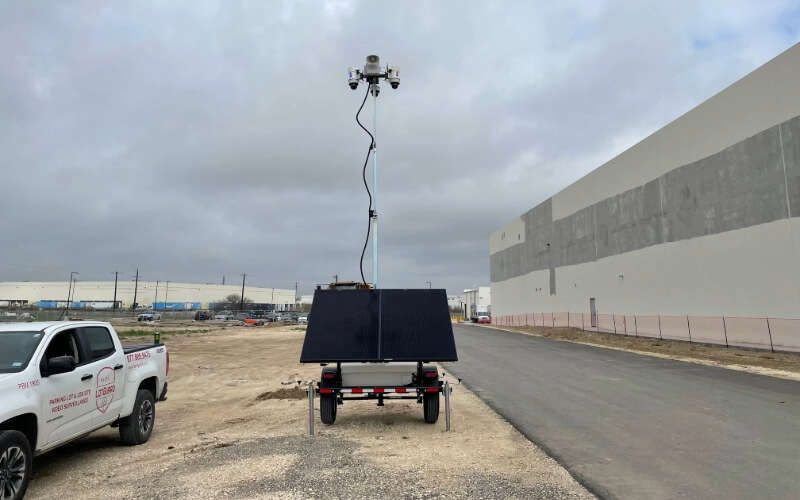
Our Solar Surveillance Trailers are ideal for jobsites of any size or remote jobsites where a fixed camera system isn't practical, and can be rented across California to make it easier to scale coverage up or down. They can also be deployed in under 20 minutes for basic setups and use solar and battery power to provide 24/7 monitoring.
Complete with PTZ (Pan-Tilt-Zoom) cameras, each unit provides near-360° coverage of a yard or staging area. Infrared and low-light capability means coverage doesn't drop off after dark, when after-hours theft risk is at its highest. Additionally, built-in video analytics flag movement and feed straight into live monitoring.
License Plate Recognition (LPR) software can be added to track vehicles entering and leaving the site as well, which is useful for spotting a vehicle that keeps returning to scope out a location or to flag unauthorized vehicles for an immediate follow-up by on-site employees.
Read more:
Pole cameras
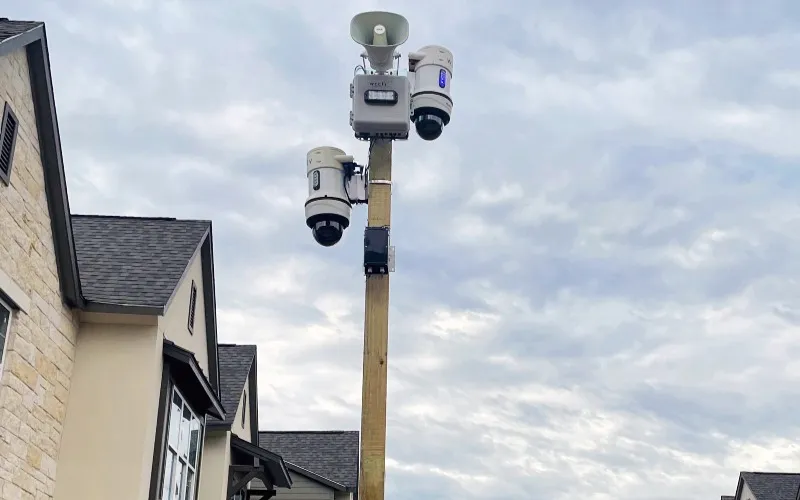
For jobsites with existing infrastructure, our Pole Cameras offer the same core surveillance capabilities as our trailers in a more compact form. They mount directly to existing poles or buildings and draw power from mains or streetlight connections, making them well-suited to locations where basic power is already established.
Each unit combines PTZ cameras, infrared night vision, AI analytics, and 4G/5G cellular connectivity into a single self-contained build with onboard recording capacity and remote access. This means that footage and alerts are accessible without anyone needing to be on-site.
Our Pole Cameras work well as a standalone solution, but they also complement our Surveillance Trailers, covering hard-to-reach locations and tight spaces where a trailer isn't practical. Both integrate fully with our live monitoring services and can be repositioned as a project develops.
Intrusion detection
While AI-video analytics can flag movement, our Smart Detection Systems offer intrusion detection, which goes a step further by defining specific zones and flagging suspicious behavior, such as slow-moving vehicles or repeated approaches to the fence line, triggering an alert the moment a threat is verified.
Detection zones can be configured around access points or restricted areas such as high-value equipment storage, whilst the system uses AI to filter out false triggers like passing vehicles. This means that operators only respond to genuine security threats.
When a genuine threat is confirmed, the system can take immediate automated action, activating on-site deterrents before a live operator even reviews the footage. Once confirmed, trained monitoring teams can issue a direct live audio warning or escalate an incident to law enforcement when needed.
Every incident is logged in our comprehensive cloud-based management platform with a timestamped video record, meaning you can keep a full audit trail without any manual input.
Live monitoring
Security personnel remain part of many traditional construction site security services, and the choice between unarmed security guards and armed guards usually comes down to the jobsite risk.
Our security systems come with Live Video Monitoring services that run 24/7, removing the need for staff to be physically present on-site after hours. When AI-video analytics detect movement in a restricted area, trained operators can review the footage immediately and issue a live audio warning or contact law enforcement directly.
Live audio challenges are an active deterrent for would-be offenders and can mitigate thefts and other crimes before they occur.
Our cloud-based management platform helps to bring footage, alerts, reporting, and incident logs together in one place. Jobsite operators can manage units and review activity across multiple sites simultaneously and remotely, without needing to be on location.
Incident reports are generated automatically from flagged events, giving operators a timestamped record that can support insurance claims or law enforcement investigations.
The strongest jobsite security setups don't treat these as separate tools. Each layer of coverage feeds into the next, so while fence line cameras catch activity early, surveillance trailers maintain a wide view over equipment yards, and intrusion detection locks down high-value storage zones.
Live monitoring ties it all together into a coordinated response, while our cloud-based management platform keeps every alert, log, and piece of footage in one place so nothing falls through the cracks.
As a project moves through phases, that coverage can be repositioned and reconfigured without starting from scratch.
Planning Ahead for a Safer California Jobsite
Every jobsite carries a different mix of risks, and the right balance of fencing, lighting, and other deterrence, coupled with active monitoring, depends on location, project phase, crew size, and what's being stored on-site at any given time. A security plan that gets reviewed and adjusted as a project moves forward holds up far better than one that's set once and left alone.
California jobsites vary in location, phase, infrastructure, and risk profile, and the right security plan needs to reflect these individual factors. If you'd like to walk through what coverage makes sense for your project, contact our team today.
