Across California, remote or off-grid sites like critical infrastructure locations and active construction projects often share the same vulnerability. They are usually fully active during the day, then empty and isolated overnight, often without a fixed power source or wired connection to fall back on.
That isolation makes a site more vulnerable to crime. For example, California is one of the states hit hardest by construction-related theft and vandalism, ranking among the top three nationally alongside Texas and Florida, and the ten worst-affected states account for more than 63% of all reported incidents nationwide.
When a property or site has no electricity or connectivity, traditional security camera systems won't function. That gap leaves remote sites exposed, and it helps explain why they are often targeted in the first place.
This guide looks at what makes remote and off-grid sites so hard for California businesses and property managers to protect, and which remote monitoring tools can help without requiring a permanent power hookup or a security team on standby.
Why Remote Sites in California Are Difficult to Protect
A remote site loses the natural deterrent that foot traffic and nearby neighbors normally provide, which is part of why outdoor sites and remote equipment yards across California are highly susceptible to theft and vandalism.
Traditional security struggles in areas like this, especially when on-site guards are sent to patrol these properties. But unpaved access roads and long distances between checkpoints make regular rounds impractical. Even when a guard can get in, one person can only watch one area at a time. On a large or scattered site, that leaves blind spots the moment attention shifts elsewhere.
Limited connectivity makes the problem even worse. Many rural California sites sit miles from the nearest fixed power line or wired internet connection, and a security system that depends on either isn't usually an option in these locations.
Moreover, copper and other scrap metal make the problem worse. Wiring and exposed fixtures at an unmonitored location are easy to strip and easy to sell, and hotspots stretch from Los Angeles County and the Inland Empire through the Central Valley, where the damage from removing them often costs more to repair than the metal was worth.
The numbers show how serious this issue has become. More than 11,000 pieces of construction equipment are stolen every year across the U.S., and less than 25% of it is ever recovered, according to National Insurance Crime Bureau and National Equipment Register data.
Vehicle break-ins and catalytic converter theft are also common on unattended lots and equipment yards, and insurance claims for both climb every year when a property has no camera coverage in place.
On a construction jobsite, the risk is much higher, since remote and unguarded jobsites are consistently the easiest targets. In fact, theft at U.S. construction sites is estimated to cost the industry between $300 million and $1 billion each year.
Solving Site Power Problems with Self-Contained Surveillance
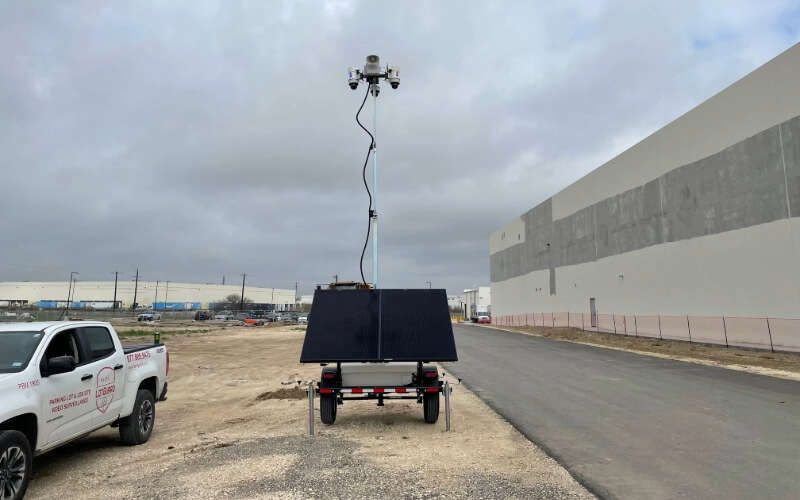
A site without power doesn't have to mean a site without cameras. Our Solar Surveillance Trailers use solar power and battery storage, so they run 24/7 without ever connecting to the grid.
These mobile surveillance units are often the only realistic option for a California property or site with no permanent power source nearby, whether it's a shuttered retail building, an empty lot awaiting development, a remote utility yard, or land held between phases of a project.
Each trailer can be towed into place and left to watch over a site for as long as it's needed, whether that's months on a vacant property or a few weeks on an active jobsite, then picked up and redeployed elsewhere.
Our units include:
-
High-definition camera with night vision for clear footage after dark
-
Near-360° Pan-Tilt-Zoom (PTZ) coverage, so a single unit can watch a wide area and be repositioned easily as requirements change
-
Built-in, on-site speakers that allow operators to issue a live warning the moment someone's spotted
-
Rapid deployment (under 20 minutes for basic setups) with no wiring run or permanent installation required
These units are available for rental, so you get the coverage a project needs without owning a fleet of hardware that sits idle between jobs. Because our trailers can be picked up and redeployed once a project wraps, teams that manage several remote sites over the course of a year tend to see cost savings of up to 88% compared to staffing each location with guards.
Read more:
Turning Remote Video Monitoring Into a Response
Recording an incident does little to reduce risk if no one sees it in real-time. Our Live Video Monitoring services connect on-site cameras to a professional monitoring center, where trained operators can flag suspicious activity the moment it happens instead of leaving footage to be reviewed the next morning.
Live Video Monitoring includes:
-
Trained operators watching the feed live, not reviewing video evidence after the fact
-
Rapid response with direct coordination with local law enforcement agencies and police dispatch when a response is warranted
-
Verified escalation, so a response is only triggered once activity has been confirmed as a genuine threat
AI-powered detection
Unlike traditional security cameras that record everything, our Intrusion Detection system applies AI-powered video analytics across a site, filtering out standard movement, like wildlife or blowing debris, to flag genuine intruders in real time. This works alongside Live Video Monitoring rather than replacing it, feeding operators the alerts and footage they need to respond quickly.
AI-powered cameras allow for:
-
Fewer false alarms, since the system tells the difference between a real threat and a passing animal
-
Instant alerts for faster operator response times
-
Works alongside live video monitoring rather than replacing it
-
Scales across multiple locations using our existing systems, so there's no requirement for additional units if not needed
Read more:
License plate recognition
Our License Plate Recognition (LPR) solutions are an add-on to a trailer or pole camera setup, automatically logging every vehicle that enters or exits an isolated gate so a manager can pull up the exact plate and timestamp for any unauthorized entry attempt instead of sifting through hours of general footage.
The cameras can be mounted on a Solar Surveillance Trailer or a pole-mounted unit, so a site doesn't need fixed power or a wired connection to get plate-level coverage, and the same hardware can move with the project as it progresses through different phases.
Because that log builds over time, it also surfaces patterns a single walk-through would miss, such as a vehicle that keeps showing up outside normal working hours that are worth flagging long before it becomes an incident.
Managers can also build a hotlist of vehicles of interest, so if a flagged plate is scanned again, the system sends an automatic alert instead of waiting for someone to notice it in the footage. Combined with our cloud-based platform, every plate read is tied to a timestamp and stored alongside the rest of a site's video and sensor data, giving teams a single, searchable record instead of a separate log to check.
Read more:
Coordinating Security Across Multiple Locations in California
A general contractor rarely has just one remote site to worry about. Managing multiple locations with a different login and a different vendor for each one creates the kind of vendor sprawl that makes it easy to miss things.
This is part of why aligning IT and safety teams on how remote sites get monitored matters as much as the hardware itself. For California clients managing several sites at once, that alignment is what decides whether a flagged incident gets a same-hour response or sits in an inbox until the next morning.
Our cloud-based platform is built to solve this problem. It pulls camera feeds, smart detection alerts, and environmental sensor readings from every site into one dashboard, so a team managing a construction jobsite, a vacant property, and a utility yard isn't switching between three different logins to see what's happening.
The benefits of our management platform include:
-
One login covering every remote site a team is responsible for
-
Camera feeds and detection alerts in a single view, with support for up to 81 camera feeds monitored simultaneously
-
Fewer missed alerts from sites that would otherwise be monitored on a separate system
-
Faster response times, since operators can see an incident the moment it happens
-
Historical data on demand, letting security teams pull up footage, incident reports, and alerts from any site to support insurance claims and compliance audits without digging through separate archives
Read more:
- The Importance of Aligning IT and Safety Leaders on Jobsites
- Integrating Environmental Monitoring Sensors on Construction Jobsites
What to Look for in a Remote Site Security Partner
Not every remote monitoring provider is built for California's mix of terrain, connectivity gaps, and site conditions. Before committing to a setup, it's worth checking your provider against a short list of essentials:
-
Off-grid power: Solar and battery-backed units that don't depend on a nearby grid connection or generator refueling schedule
-
Live, human-monitored response: Security professionals watching the feed in real time, not just a system that records footage for later review
-
AI-powered detection: Analytics that filter out false triggers like wildlife or weather, so alerts are worth acting on
-
A single management platform: One login and one dashboard across every site, rather than a different portal for each vendor or location
-
Rapid, flexible deployment: A unit that can be towed into place and redeployed as a project or property's needs change, without a lengthy install
-
A fully managed service: Installation, connectivity, maintenance, and support handled by the provider, not left to an in-house team
Our Solar Surveillance Trailers, Live Video Monitoring, and cloud-based management platform are built around to cover all of these essentials, giving California property managers, contractors, and utility teams one security company for the hardware, monitoring, and the reporting.
Getting the Right Setup for Your California Site
The real risk with a remote or off-grid location isn't necessarily the distance from city centers or other well-monitored spots. Instead, it's leaving that site without reliable security until an incident occurs. Every site has its own mix of power access and terrain constraints, on top of its own connectivity gaps, and the right setup depends on details that standard security systems don't account for.
If you're weighing options for a remote video surveillance setup for your California site, get in touch with us today. Our experts will help walk you through the right setup for your specific needs.