
California businesses saw reported shoplifting of merchandise worth up to $950 increase 28% over 5 years, according to the Public Policy Institute of California's 2024 analysis. But that's only one part of the theft problem facing businesses across the state.
From active construction jobsites to warehouses, cargo yards, and retail floors, theft takes different forms, and each one carries its own financial (and legal) weight.
In this article, we'll cover the 8 types of theft most commonly affecting California businesses and the laws that define and penalize each one. We'll also discuss why certain industries face higher exposure than others, and how layered security and modern monitoring technology help organizations reduce risk and respond faster when incidents occur.
8 Common Theft Types Putting California Businesses at Risk
Theft against California businesses rarely looks the same twice. It ranges from a single stolen tool to a coordinated, multi-location operation. And the type of theft a business faces often depends on its industry, its physical footprint, and how visible its assets are after hours.
Here are the 8 types that show up most often, and what makes each one unique:
1. Equipment theft
Heavy machinery, generators, power tools, and scaffolding left on unattended jobsites are prime targets for theft. Equipment theft hits construction and infrastructure projects the hardest, since jobsites often sit unmonitored overnight or across weekends.
A stolen excavator or generator doesn't just cost the replacement price; it delays the entire project timeline, pushes back inspections, drives up costs for replacement or rental equipment, and can trigger contractual penalties for missed deadlines.
Businesses that operate multiple jobsites in California often struggle to maintain consistent visibility across every location, which is the gap that most thieves look for. Equipment left near access points, roadways, or unfenced perimeters is particularly exposed, since it can be loaded onto a trailer and gone within minutes.
Read more:
2. Copper theft
Copper theft has become one of the costliest and fastest-growing categories of jobsite crime in California. AT&T alone reported 2,200 copper theft incidents across the state in 2024, which was up from just 71 in 2021.
Nationally, the U.S. Department of Energy estimates copper theft costs businesses roughly $1 billion a year across construction, utilities, telecommunications, and transportation infrastructure combined.
Half-built structures are particularly vulnerable, since copper wiring and piping are often exposed before final fixtures go in and before the building is energized, making it low-risk for a thief to strip.
Under California Penal Code 487j, stealing copper materials valued at more than $950 can be charged as grand theft, which is a wobbler offense that allows prosecutors to pursue either a misdemeanor or a felony depending on the circumstances.
California law also requires scrap dealers to observe a mandatory holding period before paying out for nonferrous metals like copper, giving local law enforcement a window to check for stolen material before cash changes hands.
Even with that safeguard in place, copper remains difficult to trace once it's stripped and melted down, which is why sites that get hit once are frequently targeted again unless visible security changes follow the first incident.
Read more:
- Copper Theft in California: Why It’s Rising and Who It Impacts Most
- Understanding Metal Theft: The Costs, Impact, and Tips to Prevent It
- The Most Common Thefts from Construction Sites
3. Cargo theft
Cargo theft covers any theft of freight moving through the supply chain, whether it's sitting in a truck, a trailer, a shipping container, or a rail car. This is often done through diversion, pilferage, cargo tampering, or straight-up hijacking, though a large share of it happens at fixed sites rather than on the open road.
California remained the most affected state for cargo theft in 2025, with 1,218 recorded incidents, and distribution centers, warehouses, ports, and rail yards all rank among the most common locations for cargo theft. Incidents at these sites tend to happen in a few specific spots:
- Loading bays and dock doors, where freight sits staged between trucks and storage
- Trailer drop yards, where loaded trailers wait unattended for a driver to collect them
- Truck and logistics yards, where fleet vehicles and loaded freight are left overnight
- Warehouse and distribution center perimeters, especially fence lines and side gates after hours
California's dense logistics corridors and ports make it a persistent target for organized theft rings that track shipments and strike during loading, transit, overnight stops, or drop-and-hook exchanges.
Under Assembly Bill 1972, signed in 2024, cargo theft was formally classified as a form of organized retail theft in California, extending the enhanced enforcement tools used against retail crime rings to freight and logistics operators.
This matters more for businesses because it means cargo theft cases can now draw on the same aggregation and enforcement provisions used to prosecute coordinated retail crews, rather than being treated as isolated incidents.
Read more:
- California Cargo Theft: Why Logistics Sites Are High-Risk
- Which Industries Face the Highest Crime Risk in California?
4. Vehicle theft
Fleet vehicles, company trucks, work vans, and equipment trailers are frequent targets, particularly when they're parked in unmonitored lots overnight.
Beyond the vehicle itself, thieves often target the tools and inventory stored inside, which means a single incident can result in two separate losses: The vehicle and everything it was carrying.
Businesses running fleets across multiple sites face a wider surface area to protect, which makes centralized monitoring more valuable than relying on physical locks or alarms alone.
Vehicle theft is also notoriously fast, meaning a parked truck can be gone in under a minute if there's no active deterrent on-site.
Read more:
5. Retail theft
Retail theft covers a wide range of conduct, from individual shoplifting to organized crews, and California law draws clear lines between these categories. Petty theft applies to property valued at $950 or less, under California Penal Code 490.2, while grand theft applies once that value is exceeded, under Penal Code 487.
Shoplifting laws are defined separately under Penal Code 459.5 as entering a building during regular business hours with intent to steal $950 or less. It's typically a misdemeanor, carrying up to 6 months in county jail and a fine of up to $1,000 under Penal Code 490, though repeat offenders now face felony penalties under Proposition 36, which took effect for shoplifters with 2 or more prior convictions.
Businesses also have a civil option: Under Penal Code 490.5, retailers can send a civil lawsuit letter seeking up to $500 in restitution, which is separate from any criminal case.
Organized retail theft
Retail theft becomes "organized" when multiple people act together to steal merchandise, often for resale online or through secondhand channels. It's treated differently because of its coordinated, repeat nature, and because it frequently spans multiple locations in one region.
California passed a package of 10 bills in 2024 to strengthen enforcement, including provisions letting prosecutors aggregate smaller thefts to meet felony thresholds, according to CalMatters' reporting.
For business owners, it's especially disruptive because it's rarely a one-time incident. The same crew often returns, scouting for gaps in coverage before striking again.
Read more:
6. Tool theft
Contractors and tradespeople regularly lose tools from job boxes, work trucks, storage containers, and open trailers. Unlike heavy equipment, tools are small enough to be removed quickly and quietly, often without anyone noticing until the next shift starts and someone reaches for a missing piece of equipment.
Industry estimates put the total U.S. construction theft losses, spanning equipment, materials, and tools combined, at $300 million to $1 billion annually, according to figures compiled by the National Equipment Register (NER) and National Insurance Crime Bureau (NICB).
Tool theft specifically tends to be undercounted within that range, since many contractors tend to absorb smaller losses out of pocket rather than filing a claim that could raise their insurance premiums. For subcontractors working on tight margins, a single break-in targeting a job box can still wipe out a meaningful chunk of a project's profit.
Read more:
- Construction Site Theft Statistics (And How to Avoid Becoming One)
- Types of Construction Theft and How to Prevent Them
7. Material theft
Beyond copper, lumber, steel, aluminum, and other raw materials are becoming more frequently targeted as commodity prices climb.
Lumber prices nearly tripled during the 2020-2021 surge before partially normalizing, according to the National Association of Home Builders, which made staged framing lumber a far more attractive target for organized theft crews than it had been a few years earlier.
Materials theft carries a different risk than equipment theft. Lumber, rebar, fixtures, and wiring are rarely serialized or individually tracked, so once they're off-site, there's little to connect recovered material back to the jobsite it came from.
That makes prevention, rather than recovery, the only realistic strategy. Sites in active build phases tend to see the highest exposure, since materials are staged in bulk and waiting for installation, often with no barrier between the stockpile and a public road or unfenced perimeter.
Read more:
8. Fuel theft
Fuel siphoning from parked equipment, generators, fleet vehicles, and idle machinery is a quieter form of theft, but it's a costly one when it happens repeatedly. Jobsites that run diesel-powered machinery overnight are especially exposed, since fuel tanks are rarely locked or monitored the way cash or inventory would be.
Because fuel theft often happens in small increments rather than all at once, it can go unnoticed for weeks, and only show up when a business reviews its fuel spend against expected usage and finds a gap that doesn't seem to add up.
Reducing Theft Risk for California Businesses and Jobsites
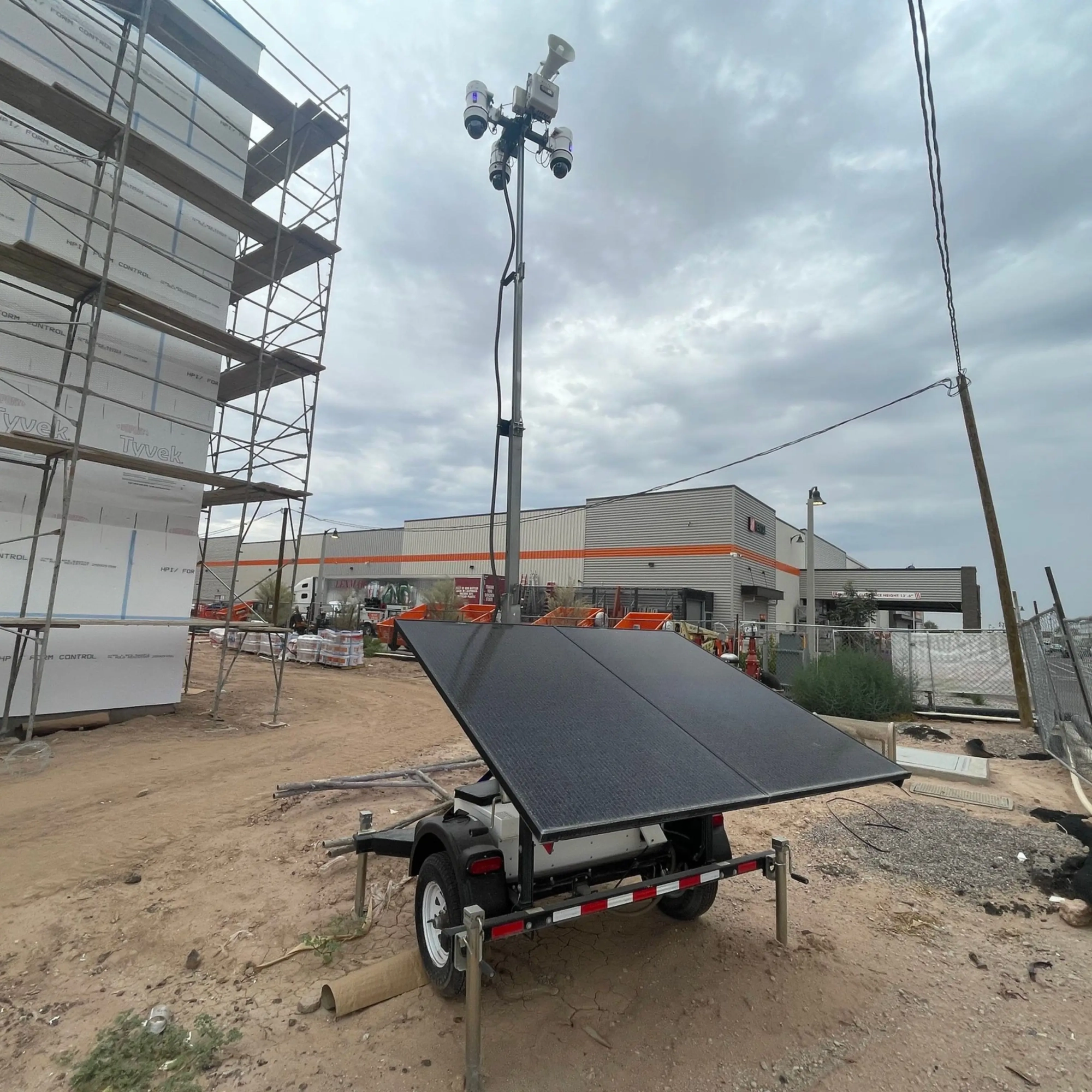
At WCCTV, we help California businesses and jobsites reduce theft exposure by combining visible deterrence with active monitoring, so incidents are caught in progress rather than discovered after the fact.
|
Product |
Key Benefits |
Use Case |
|
What it does: Self-powered mobile units that monitor a site without needing a fixed power source |
Deterring equipment, material, and vehicle theft on active jobsites, yards, cargo lots, retail strips, and business premises. |
|
|
What it does: Compact cameras mounted on existing poles or structures where a full trailer won't fit |
|
Watching specific checkpoints like gates, loading docks, or storage areas, either alongside a surveillance trailer or on their own where there's limited space. |
|
What it does: AI-driven analytics that layers onto trailers and pole cameras that recognize unauthorized entry |
|
Catches after-hours break-ins at fenced jobsites, yards, storage compounds, or retail stores before losses occur. |
|
License Plate Recognition (LPR) solutions What it does: An add-on to surveillance solutions that identifies and logs vehicles moving in and out of a determined detection range |
|
Tracking repeat visits from the same vehicle at cargo yards or in parking areas, which is useful for building a pattern of organized activity and linking vehicles to crimes. |
Underpinning all of WCCTV's surveillance solutions is our cloud-based management platform, which brings footage, alerts, device management, and user permissions into a single dashboard rather than forcing security teams to check each camera separately.
For a business managing theft risk across multiple jobsites, yards, or retail locations, that centralized view matters as much as the cameras themselves.
Here are a few ways it directly supports theft prevention and response:
- Multi-site visibility from one login: View live and recorded footage across multiple jobsites or store locations from a single platform.
- Faster incident response: Real-time alerts flag activity the moment it's detected, cutting down the time between an incident happening and someone reviewing it.
- Evidence retrieval for restitution and prosecution: Footage tied to a specific date, time, camera, and location makes it easier to support a civil demand letter, insurance claim, police report, or court proceeding with clear documentation.
- Scalable as operations grow: Cameras, trailers, sites, or business locations can be added without rebuilding the monitoring setup from scratch.
What Theft Really Costs a California Business
The dollar value of what's stolen is rarely the full story, since every incident brings hidden costs, too. Insurance premiums increase after a claim, which means hours lost to paperwork and reporting, schedules that slip while replacements are sourced, and the productivity lost while crews wait on new equipment to arrive.
Left unaddressed, theft tends to repeat, since an unmonitored gap that worked once will get tested again.
We work with California businesses across construction, logistics, retail, and warehousing to close the gaps with monitoring built around how each site operates. If theft has already become a pattern at your business, contact us today and let us assess where coverage is missing.
