
For the first time, Californians used more solar power than natural gas during the first half of 2026, with solar use up 22% over the same period in 2024, according to the California Energy Commission (CEC).
Grid power still isn't guaranteed for every site, though. During a single Public Safety Power Shutoff (PSPS) event in August 2025, Southern California Edison de-energized 6,853 customers across 8 counties to reduce wildfire risk.
Solar surveillance systems keep security running at temporary, remote, developing, and infrastructure-limited sites without waiting on a utility connection. In this article, we'll cover 10 reasons businesses and contractors use solar-powered surveillance across California, along with the site factors that decide whether solar power is the right choice.
10 Benefits of Solar-Powered Surveillance for California Businesses and Contractors
Solar-powered surveillance suits jobsites, remote infrastructure, vacant land, and developing properties across California where utility connections are limited or delayed. Solar-powered surveillance systems generate their own power, and those with battery backup store it for nights and cloudy days, so security keeps running when grid supply is unavailable, switched off, or not yet in place.
1. Less reliance on mains power
Solar-powered surveillance systems generate and store their own power, so security keeps running when grid supply is unavailable, switched off, or not yet in place. Outages can also last for hours, both in California and across the country. In the U.S., electricity customers averaged 11 hours of power interruptions in 2024, which was nearly twice the annual average of the decade before.
Powering sites without the grid
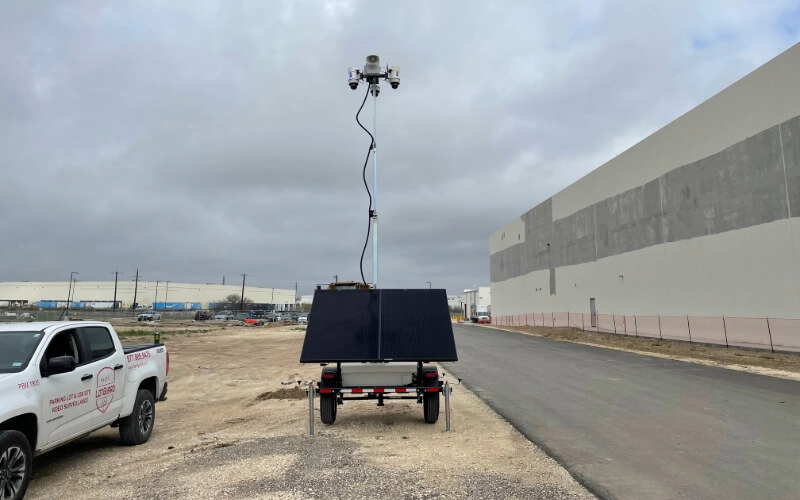
Our Solar Surveillance Trailers pair solar panels with onboard battery storage, delivering weeks of reliable coverage without a grid connection. Together, they keep the trailers running continuously, so cameras keep recording 24/7, including overnight and during utility shutoffs.
Each trailer also utilizes a 5G cellular connection, so it works as a complete security setup that doesn't need a power outlet or an internet line.
Read more:
2. Built for off-grid sites
Off-grid sites such as pipeline corridors, utility compounds, rural land parcels, and solar farm developments sit far from existing power and network infrastructure.
Solar farms make up a growing share of these sites in California, where utility-scale solar capacity in the area served by the California Independent System Operator (CAISO) grew 19% to 25 gigawatts (GW) between April 2024 and April 2026, according to the U.S. Energy Information Administration (EIA).
Each new project adds another remote site that needs protecting during construction, often before power and network connections are in place.
Watching remote sites from anywhere
Our Solar Surveillance Trailers run on solar energy and connect over cellular networks, making them a practical fit for solar farm security and other infrastructure projects where utilities haven't been connected. Live footage and alerts transmit securely over 4G/5G, so teams can check a remote site from their phone instead of driving out to it, while footage keeps recording when no one is on site.
Read more:
3. Fewer installation requirements
Solar surveillance removes the groundwork that permanent systems need, including trenching, cabling, electrical work, and network setup. Waiting on a permanent utility connection, on the other hand, can take more than a year.
In fact, Pacific Gas and Electric Company (PG&E) reports that projects needing both a distribution line extension and a service connection averaged 427 days from application to energization for requests that were filed between 2023 and 2025.
Going live without groundwork
Our Surveillance Trailers arrive fully assembled, and basic setups can be fully operational in under 20-minutes. As part of our fully-managed rental service, our technicians also deliver and install each unit and advise on the best placement for it, so the cameras cover the right access points or high-risk areas from the time they arrive.
4. Flexible deployment
Flexible deployment means security can go wherever the risk is, whether that's a new construction phase, a vacant property after an acquisition, a utility site during maintenance, or a public works project. Because solar-powered security cameras don't tie coverage to a fixed power source, the same equipment can protect different sites as business operations change or scale easily with minimal installation requirements and near-instant coverage.
Renting coverage for each requirement
Our Solar-Powered Surveillance Cameras and Trailers stay on-site for as long as each project needs them, with maintenance and support included throughout. This flexibility is especially useful during natural disasters, when sites need security quickly, and the usual infrastructure may be damaged.
California Department of Forestry and Fire Protection (CAL Fire) recorded 8,232 wildfires in California in 2025, which destroyed 16,627 structures. During events like these, our Trailers support disaster response by securing temporary command posts and damaged sites where power and connectivity are unavailable.
Read more:
- Industries That Should Use Solar Surveillance Trailers
- Best Mobile Surveillance Systems for High-Risk Locations Across California
5. Mobility across sites
Because solar-powered security systems aren't tied to a fixed power source, they can follow equipment and materials as they move around a site. This is important because thieves tend to go wherever valuable materials are stored, and copper is one of the most common targets.
AT&T alone recorded 4,300 copper theft incidents in California in 2025, with losses of more than $57 million, and it lists construction sites among the places copper thieves target.
Moving coverage with the work
Our Trailers can be repositioned by our team or by on-site crews as layouts change, which keeps coverage on entrances and laydown yards so teams can protect assets wherever they're stored.
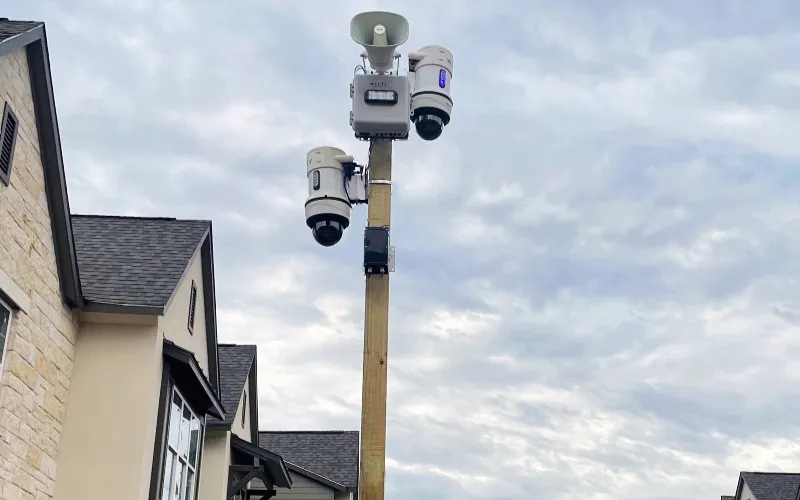
For tighter spaces, our Pole Cameras serve as a compact option. They mount to lighting columns or building structures and transmit over cellular networks, making them a good fit for entrances and storage areas.
Both our Trailers and Pole Cameras offer the mobility to customize coverage around each site’s layout, so teams can protect assets whatever type of location they’re working on.
Read more:
6. Scalable coverage
Every site is different, and so are its security requirements, which makes easily scalable systems vital for keeping a site protected as it grows and changes.
Solar-powered security can start with a single unit at an entrance and expand as more areas need coverage. Each unit carries its own power and connectivity, so adding cameras doesn’t call for trenching, cabling, extra electrical capacity, or a new installation schedule.
This flexibility suits California's construction sector well, which is made up of a large number of businesses that each have their own sites to protect. According to the Associated General Contractors of America (AGC), there were 93,600 construction establishments in California in 2024.
Managing every unit in one place
Our Solar Surveillance Trailers and Pole Cameras can be added or removed as a site grows or winds down, so security spending follows the level of risk rather than a fixed system size. Each new unit also feeds into our cloud-based management platform alongside the rest of the deployment, so expanding coverage doesn't mean adding another security system for teams to manage.
The platform brings live footage, alerts, recordings, and reports from up to 81 cameras into one dashboard, which can be accessed from a phone or laptop. This means project managers can check live activity across several sites, replay recorded footage, adjust settings, and generate audit-ready reports in just a few clicks, without having to travel between locations.
As the deployment grows from one site to several, the way teams oversee it stays the same.
7. Lower operating costs
Solar surveillance lowers security operating costs because the system doesn't draw from the power grid. This is a major advantage in California, where electricity costs are among the highest in the country.
According to the EIA, California's average retail electricity price was 27.04 cents per kilowatt-hour in 2024, which was the second highest in the nation.
Cutting utility and fuel costs
Our solar security cameras run on their own solar panels and onboard battery storage, so there are no utility bills or ongoing energy costs tied to keeping the cameras running. Because rental is a fully-managed service, maintenance and remote diagnostics are also included in one predictable monthly fee.
Mobile surveillance can also cost less than manned guards and can even reduce security costs by up to 88% while providing 24/7 coverage. Over the length of a project, this adds up to long-term cost savings.
8. Less reliance on fossil fuels
Replacing diesel generators with solar power cuts the fuel use and carbon emissions that come with site security. Diesel equipment is a major source of air pollution in California, and portable generators are now under closer scrutiny.
According to the California Air Resources Board (CARB), off-road diesel engines account for around 29% of the state's diesel particulate matter emissions and 11% of its nitrogen oxide emissions.
This attention is also starting to affect how construction projects are awarded. Under CARB's California Clean Construction program, public agencies can voluntarily incorporate zero-emission equipment requirements into project bid evaluation criteria. Where a project adopts the program, contractors may need to use eligible zero-emission equipment for specified categories of off-road machinery.
Our Solar Surveillance Trailers run on solar panels and onboard battery storage rather than diesel generators, so keeping a site secure adds no fuel deliveries or generator emissions. For contractors working to cut diesel use across a project, this removes one source from the site entirely while still providing 24/7 coverage, and every system supports ESG initiatives alongside wider emissions goals.
Read more:
9. Real-time monitoring
Real-time monitoring turns solar-powered surveillance into an active deterrent at sites with no mains power or internet, spotting would-be intruders and responding while an incident is unfolding.
Property crime has fallen in California overall, but it still affects unattended sites across the state. Even after a 14.3% drop, California's property crime rate stood at 1,785.8 per 100,000 residents in 2025, according to the California Department of Justice.
Detecting and responding in real time
Additionally, Intrusion Detection add-on integrates with our Solar Surveillance Trailers and uses AI-powered video analytics to spot unauthorized access around site perimeters or inside defined zones. Teams can set detection zones and active schedules within each camera's field of view, so the alerts match the site's layout and working hours.
Because the analytics run directly on the Trailer’s cameras, Intrusion Detection draws on the same solar power and cellular connection as the rest of the system, so it keeps working independently at off-grid sites without any added infrastructure.
Unlike basic motion sensors, the analytics are trained to ignore shadows, moving foliage, weather changes, and wildlife, which cuts down on false alarms and keeps attention on genuine threats. Every event is logged automatically with its location, date, time, and linked video evidence, which supports investigations and audits.
Live video monitoring then adds a human response, so when an alert comes in, trained operators connect to the live feed promptly and verify the activity. They can then issue live audio warnings through the unit's speakers to deter intruders and escalate to law enforcement when the site's response plan calls for it.
Read more
- How Do Solar Surveillance Trailers Deter Crime?
- How to Prevent Construction Site Theft in California
10. Continued coverage as projects evolve
Projects usually change shape from groundwork to handover, so security has to keep up with new entrances and storage areas at each phase. This is a constant challenge in California, where new developments are being planned and built across the state.
California authorized around 102,000 new private housing units in 2025, and the developments behind those homes will move through several phases before they're complete. On construction sites in the Golden State, from residential builds in San Diego to infrastructure work in Sacramento, solar units can be repositioned at every stage so that no part of the site goes unwatched.
Tracking vehicles at new entrances
Our team can adjust camera settings remotely and reposition units when layouts change, so coverage stays on the work through every phase. As site access moves, however, License Plate Recognition (LPR) solutions can also be added to trailers or pole-mounted units at new entrances.
They capture plate numbers along with vehicle make, model, and color, and connect to our cloud-based platform for real-time alerts and historical search. Watchlists also flag vehicles of interest as soon as they arrive, which gives teams a record of every vehicle that enters during each phase.
Read more
Is Solar Surveillance Right for Your California Site?
Solar surveillance works best when the site conditions support it, so the following factors are worth checking before deciding on a solar setup.
These include:
- Site conditions are assessed before every deployment, as panels need direct sunlight for optimal performance. We can advise on placement, and trailers can be repositioned if shade or wildfire smoke affects a site. In the first two weeks of September 2020, wildfire smoke left CAISO's solar generation 13.4% below the same period a year earlier.
- Power requirements are matched to each site’s camera, lighting, and analytics load. Our Trailers combine solar panels with onboard battery storage for weeks of reliable coverage, and remote diagnostics let our team monitor performance without a site visit.
- Camera configuration is tailored to the site, so solar security cameras cover the areas that matter most. Our Trailers raise their Pan-Tilt-Zoom (PTZ) cameras up to 20-feet for near-360° coverage, while Pole Cameras can focus on narrow entrances and blind spots.
- Connectivity is confirmed before setup, as live video relies on cellular networks. Our units transmit over 4G/5G, and placement is planned around real signal strength rather than coverage maps alone. This matters in a state where more than 1,000 recent wireless outages included 359 that lasted longer than 72 hours.
- System design depends on each site's power and timeline. Where solar isn't the best fit, such as dense urban builds with existing mains power, our Pole Cameras offer an alternative solution, and mixed deployments combine both.
Securing California Sites Without Waiting on Infrastructure
California's off-grid corridors and phased developments need security that doesn't depend on power lines or internet connections that aren't in place yet. Solar-powered security brings multiple benefits to these sites, starting with protection from day one, as long as sunlight and cellular coverage are checked before the first unit arrives.
Getting that assessment right is what makes the difference between coverage that holds through every phase and blind spots that open up during the times when a site is most exposed.
If you want to start planning a solar surveillance setup for your California site, speak with our team today.
