California's economy is one of the largest in the world, with the state's GDP of $4.3 trillion accounting for roughly 14% of the nation's overall GDP in 2025. What's driving this growth, however, can be attributed to a multitude of sectors, from technology and logistics to construction and events. But economic growth doesn't eliminate crime risk, and instead transfers the risk to new areas in different forms.
There's a definitive link between economic conditions and crime, with an analysis from the National Bureau of Economic Research (NBER) showing that when employment is strong and wages rise, property crime tends to fall. As economic hardship increases, crime rates typically rise as well.
California also has the highest poverty rate of any U.S state at 17.7% under the Supplemental Poverty Measure in 2024, according to U.S Census data, and ranks among the top 5 states for income inequality. As a result, that combination means growth and crime risk often exist side by side, creating one of the root causes of increased crime.
This article looks at how California's economic expansion is shaping crime patterns and what that means for businesses and property operators. It also explores how proactive security planning can help manage the risks that come with that growth.
California's Crime Trends
Despite recent increases in certain crime categories, California's crime trends show that crime rates have stayed relatively low in recent years and have declined over the past decades, with property crime falling steadily since the early 1980s.
According to the California Attorney General's 2024 crime report, the state's violent crime rate dropped 6% from 2023, falling to 480.3 incidents per 100,000 people. Projections for 2025 and 2026 suggest major crime rates will reach historically low levels, with some categories at their lowest since the 1950s or 60s.
However, the breakdown by crime type shows a much more complex overview of California crime rates. Low crime rates in one area don't necessarily reflect in other areas across the state.
In 2024, the Public Policy Institute of California (PPIC) stated that shoplifting increased by 14.2%, with the new rate now 48% higher than in 2019.
In the same year, auto theft declined for the first time since 2019, by 16.7%, but still remains nearly 20% above pre-pandemic levels.
The violent crime rate in California was 13% higher in 2022 compared to 2019, and was made up mostly of aggravated assaults, which remain 22% above 2019 levels.
The same data shows that the lowest violent crime rate in 2024 was on the Southern coast at 331 incidents per 100,000 residents, while the San Joaquin Valley recorded 603. San Francisco saw violent crime drop 12.6% in 2024, while Fresno saw a 13% spike. These are not statewide patterns, meaning they reflect local economic conditions as much as anything else.
What California's Growth Means for Crime Risk
As California's economy continues to grow, so does the value of what criminals can target; a major contributing factor to the rise in larceny-theft. Construction jobsites fill up with tools and equipment, retail corridors become denser, and high-value assets are concentrated in accessible locations. These trends create a more attractive environment for property crime, despite the statewide crime numbers.
For example, new developments in California are moving faster than security planning in high-risk environments. A specific site can be active and generating significant revenue before any permanent cameras or monitoring are installed. That gap between becoming operational and being properly secured is when many incidents occur.
Fixed security infrastructure takes time to specify and install, but on a construction jobsite or a new retail unit opening in a high-risk area, that process can take weeks or months. During that period, sites are exposed, stocked with high-value assets, and become attractive targets for criminals.
The risk doesn't stop at one sector, and crime categories like cargo and vehicle theft, as well as retail crime, have all grown alongside the industries they target. Rapid growth makes it difficult for law enforcement agencies to respond to incidents without timely notification.
Cargo theft
California accounts for a disproportionate share of cargo theft in the United States. According to the National Insurance Crime Bureau (NICB), California, Texas, and Florida made up 54% of all reported cargo thefts in 2024.
Cargo theft losses nationwide also increased by 27% in the same period, with the average value of an individual theft incident exceeding $202,000. These are not random smash-and-grabs, and the NICB reports that theft is at its peak around distribution centers and ports, all of which expand as California's logistics sector continues to grow.
For businesses operating warehouses and fleet yards near those hubs, cargo theft is an operational risk that needs to be considered when planning a comprehensive security setup.
Read more:
Vehicle theft
During the COVID-19 pandemic, California cities with the largest spikes in unemployment saw the most significant increases in motor vehicle theft. Although vehicle theft fell in California for the first time since 2019, the current numbers are still cause for concern.
Motor vehicle theft remains one of the most common crimes in California. The state led the nation in total thefts in 2023, with 208,668 vehicles stolen, according to the NICB, with commercial trucks and trailers making up 6% of those thefts.
The areas that were most frequently targeted also line up with the counties that see the most economic growth each year. This includes Southern California areas like Los Angeles-Long Beach-Anaheim and San Francisco-Oakland-Berkeley.
Businesses with vehicle-heavy operations, including construction companies and logistics firms, continue to face material exposure even when the overall state crime trend improves. This puts businesses at risk of major financial consequences without better security.
Retail crime
Not all of California's retail crime is improving, and although overall property crime has declined, PPIC data shows that shoplifting increased by 14.2% in 2024. This puts it 48% higher than pre-pandemic levels.
The increases are not evenly spread either, with incidents occurring more frequently in high-density urban areas, particularly the Bay Area, where commercial growth has been the strongest.
Additionally, San Mateo and San Francisco counties recorded the highest shoplifting rates of any other major California counties in 2024. This is because extreme income disparities and a high cost of living in areas like the San Francisco Bay Area are linked to higher rates of retail theft.
This matters for businesses opening new locations in high-growth areas. A new retail unit in a busy commercial area isn't entering a neutral security environment; it's entering a high crime risk zone where organized retail crime is actively targeting similar locations.
Read more:
The Business Cost of Crime in California
Crime doesn't just cost businesses the value of what is stolen. Instead, it changes how they operate and where they invest, as well as whether customers and staff feel safe enough to be on the premises.
A 2025 report from the Bay Area Council Economic Institute shows that, when interviewed, 72% of Oakland residents referenced public safety concerns as the reason for their reduced spending at local businesses. An additional 61% of East Bay voters reported visiting downtown Oakland restaurants less often due to crime and the fear around it.
The number of businesses filing taxes in Oakland fell nearly 14% during 2021-2022 and 2023-2024, while downtown commercial renting dropped by more than 20% since 2021.
Oakland is a well-documented case of how crime can affect businesses, but the pattern that it shows isn't unique to just one city. Across almost all of California's commercial centers, high crime rates raise operating costs and reduce foot traffic, making it harder to attract and keep staff.
As such, investments in public safety are seen as crucial to restore fiscal stability and reignite business investment in cities facing budget crises due to crime.
High crime rates can also halt economic growth, since the exposure to violence can inhibit effective schooling and other developmental outcomes, which leads to a diminished local economy. Growth and public safety aren't separate issues, and where one deteriorates, the other tends to follow.
Read more:
Sectors Most Exposed as California's Economy Grows
Not every industry carries the same crime exposure, but those with a higher risk are directly affected by California's current economic growth. Each sector with an elevated risk of exposure has specific security requirements that should match how and where the risk shows up.
Construction
California's construction sector is one of the most active in the country. Jobsites accumulate high-value equipment and material relatively quickly, often in locations without permanent power or security infrastructure during early phases. Overnight and after-hours exposure is high, and jobsite theft is a consistent problem across the state.
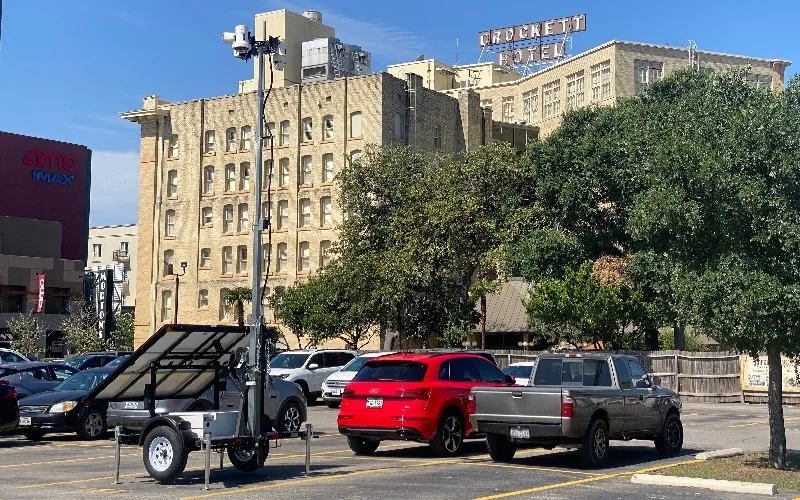
Solar surveillance trailers give operators deployable coverage that works without fixed infrastructure, and can be repositioned as project phases change. Each unit runs on solar power with battery backup, eliminating the need for grid connectivity during early-phase builds. Built-in PTZ (Pan-Tilt-Zoom) cameras provide near-360° coverage, enabling wide area, real-time monitoring from a single viewpoint.
Pole Cameras offer the same core surveillance capabilities in a more compact form, mounting directly to existing poles or buildings and drawing power from mains or streetlight connections. This makes them well-suited to locations with basic established infrastructure.
For jobsites in high-risk areas, mobile surveillance trailer rentals offer more flexibility than traditional surveillance camera setups, without the long-term investment.
Retail and commercial properties
Commercial properties in high-growth areas face an increasingly complex set of risks, from trespassing and vandalism to unauthorized vehicle access and after-hours break-ins. For many operators, the biggest security gap occurs in the period between a site opening for business and permanent cameras or monitoring systems being installed.
Our systems are designed to deploy to address this challenge, operating autonomously on solar power with built-in cellular connectivity, without the need for grid power or extensive installation. Additionally, all of our security solutions come with a fully-managed Live Video Monitoring service, where trained operators provide human verification for incoming alerts.
Once an incident is verified, operators can issue live audio challenges through integrated loudspeakers, along with sirens and flashing lights, to actively deter offenders. When necessary, they can also generate comprehensive reports for law enforcement agencies to aid in post-incident investigations.
As an additional layer of security, business owners can invest in License Plate Recognition (LPR) solutions. These help automate vehicle verification at entry points, cross-reference plates, and log every entry with a timestamp. That access record can support both incident investigation and insurance claims.
Managing Crime Risk in California's Growing Economy
The Golden State's economic growth brings opportunity, but it also creates security challenges that need to be well-managed to reduce crime risk.
While increased funding for police and community-based programs can help mitigate crime during periods of economic disparity, existing crime prevention programs are struggling to keep pace with the speed of development and the rise of growth-related crime.
The businesses and operators that manage these security challenges best are those who treat security as something that adapts alongside their operations rather than a once-off setup. This means regular reviews and coverage that is flexible and changeable as the local risk environment changes.
If you want a smarter security setup to meet all the requirements of your property, contact us today. Our security experts can assist you in selecting the best security solutions for your needs.