
According to the latest full-year data, Florida's overall crime rate fell by 6.4% in the space of a year, but that decline wasn't evenly distributed across crime categories. Property crime, which is the crime most likely to affect Florida businesses, rose over the same period.
For companies managing equipment, vehicles, inventory, or multiple Florida locations, the difference in crime figures that affect businesses is what helps them to plan their security strategy more effectively.
In this article, we'll cover 10 current Florida crime statistics on property crime, cargo theft, burglary, robbery, retail crime, and more. We'll also discuss what each one of these statistics means for security planning and overall crime mitigation.
10 Florida Crime Statistics Business Owners Should Track
These 10 statistics reflect the most recent full-year data available for Florida, and together show where crime is rising, where it's falling, and which categories carry the most direct financial and safety risk for businesses operating across Florida.
1. Florida's overall property crime rate
Florida's property crime rate increased by 6% in 2024, reaching 1,420 offenses per 100,000 people. The state reported 331,980 property crimes for the year, which included burglaries, larceny-thefts, and motor vehicle thefts. All of these crimes hit a business's bottom line directly through stolen equipment, damaged property, lost inventory, or costly downtime.
In contrast to Florida, the national property crime rate dropped in 2024, falling to 1,760.1 offenses per 100,000 people, which was down from 1,934.1 the year before.
This gap between a rising state figure and a falling national one is part of why relying on general crime statistics to gauge local risk can be misleading, even though Florida's property crime rate remains below the national average in absolute terms.
For any business that runs outdoor assets, jobsites, or multi-location operations, a spike in property crime means that physical security is more important than ever.
Read more:
- Common Property Crimes in Florida and How They Impact Businesses
- Understanding Property Crime in Florida (and Strategies to Prevent This)
2. Larceny-theft incidents make up the bulk of property crime
Larceny-theft made up 80.6% of Florida's property crime in 2024. Larceny covers the straightforward taking of property, tools, materials, or equipment without forced entry, making it the most common way businesses lose assets day-to-day.
Construction jobsites, outdoor storage yards, and equipment laydown areas carry the most exposure to this type of crime, since materials and equipment often sit unattended for extended periods.
Based on the state's 331,980 total property crimes, that share works out to roughly 267,600 larceny-theft incidents in 2024.
Nationally, shoplifting overtook theft from motor vehicles in 2023 as the most common specified type of larceny-theft, according to the FBI's Uniform Crime Reporting Program, which is a change that has serious implications for any Florida retailer deciding where to concentrate their security coverage.
Read more:
- How Property Crime Affects Businesses in Florida
- Which Florida City Has the Highest Property Crime Rates?
3. Motor vehicle theft is becoming more prevalent
Motor vehicle thefts accounted for 8.7% of Florida's property crime in 2024. Florida also ranks among the top 5 states nationally for total vehicle thefts by volume, according to the National Insurance Crime Bureau.
That 8.7% share translates to 28,741 motor vehicle thefts across Florida that year. Nationally, vehicle thefts fell by 17% in 2024 to 850,708, which was the largest single-year drop in 40 years. Vehicle thefts fell by 23% nationally in the first half of 2025 compared with the same period in 2024. Florida's decline outpaced the national rate, dropping 30% over the same window.
For businesses running company vehicles, work trucks, vans, or delivery fleets, that exposure extends past the vehicle itself, since parked fleet vehicles often store tools, electronics, paperwork, and other valuables overnight.
Read more:
- Understanding Vehicle Theft Trends Throughout Florida
- 8 Factors Behind the Surge in Motor Vehicle Theft Across Florida
4. Cargo theft incidents push Florida into the top 3 target states
California, Texas, and Florida together accounted for 54% of all reported cargo theft incidents nationwide in 2024, with Florida's ports in particular seeing a rise in incidents.
Cargo theft, which is the theft of goods in transit or at distribution points, is a growing risk for logistics companies, warehouses, distribution centers, and any business that relies on trucking to move inventory. Florida's concentration of ports and distribution hubs puts it squarely in that top tier of exposure.
Nationally, CargoNet recorded 3,625 cargo theft incidents in 2024, which was a 27% increase over 2023, with the average value per theft rising to $202,364. Electronics, food and beverage products, building materials, pharmaceuticals, and apparel rank among the most frequently targeted goods. These are all categories commonly held in Florida warehouses and distribution centers.
Read more:
5. Burglary remains a steady business risk
Burglary is defined as the unlawful entry into a building or structure to commit a felony or theft, and it made up 10.7% of Florida's property crime in 2024. This equates to around 35,500 burglaries reported across the state.
Unlike larceny, burglary involves forced or unauthorized entry, making it a particular concern for businesses with after-hours vulnerability. These include retail storefronts, warehouses, office buildings, and distribution centers left unattended overnight or on weekends.
Because burglary specifically requires unlawful entry, after-hours perimeter alerts and access monitoring tend to carry more weight for this offense type than larceny prevention alone, which is often more about visibility and deterrence in open, unsecured areas.
Read more:
6. Robbery is responsible for a major share of Florida's violent crime rate
Unlike theft and burglary, robbery is considered a violent crime and is defined as taking property from a person by force or threat of force. It accounted for 14.3% of Florida's violent crime data in 2024. Because robbery requires a victim to be present, it carries direct implications for cash-handling businesses, retail staff, delivery drivers, and any employee working alone or during closing hours.
Carjacking, which is a specific form of robbery involving a vehicle, is tracked separately and is an important risk for fleet-heavy businesses. The national carjacking rate declined from 7.5 to 6.6 incidents per 100,000 people between 2022 and 2023.
However, even with that decline, the figure is a reminder that robbery risk for delivery drivers and fleet operators doesn't stop in the distribution yard. It also extends to vehicle stops, pickups, drop-offs, and loading dock activity. This is why staff safety planning needs to cover every point where employees handle goods or cash away from the main building.
7. Organized retail crime (ORC) and shoplifting incidents are rising across Florida
Shoplifting rose 18% in 2024 compared with 2023, according to the National Retail Federation's Impact of Retail Theft and Violence 2025 report, based on a survey of senior loss prevention at major retailers. Florida's retail sector, which is one of the largest in the country given the state's population and tourism volume, sits in the crossfire of that national trend.
Organized retail crime differs from individual shoplifting in scale and coordination, often involving groups working across multiple locations, which makes consistent surveillance and real-time alerting more valuable than store-by-store spot checks.
The same 2025 NRF report found that threats or acts of violence during shoplifting incidents rose 17% from the year prior, prompting 91% of surveyed retailers to increase employee safety training in response. Additionally, a prior edition of the same NRF research published in 2024 had already found a 93% increase in shoplifting incidents between 2019 and 2023.
For multi-location retailers, that combination of rising frequency and violence is part of why organized retail crime increasingly gets budgeted alongside general loss prevention.
8. Aggravated assault and violent crimes in relation to Florida businesses
Florida's violent crime rate dropped 8.7% in 2024 to 267 offenses per 100,000 people, which was 25.6% lower than the national average. Even with that decline, 73.8% of the violent crime that did occur was aggravated assault.
For businesses, this matters for staff safety planning, since on-site personnel, security guards, customer-facing employees, and after-hours staff remain the most exposed to violent incidents even as overall rates are trending downward.
Murder made up 1.4% of Florida's violent crime in the same period. Nationally, that risk skews toward certain work settings. For example, according to the U.S. Bureau of Labor Statistics, 30% of workplace fatalities in the retail trade sector were homicides in 2023.
With robbery's 14.3% share factored in, aggravated assault alone still accounts for roughly 3 out of every 4 violent crimes reported statewide. This is why workplace violence prevention plans built around assault scenarios cover the large majority of realistic risk, even as retail-specific homicide exposure warrants its own dedicated protocols.
9. Tourism drives year-round crime exposure
The Sunshine State drew a record 143.3 million visitors in 2025, and tourism drove $133.6 billion in economic impact statewide in 2024, according to VISIT FLORIDA. High visitor volume concentrates foot traffic, cash transactions, unfamiliar surroundings, and distracted visitors in tourist corridors. These are conditions that opportunistic thieves tend to target.
Businesses operating in or near high-traffic tourist areas, including hotels, retail corridors, entertainment districts, and transit hubs, carry a different risk profile than those in residential or industrial zones, even when the surrounding city's overall crime rate is low.
Florida also held the #1 position for domestic market share (14.6%) and captured 27.2% of the overseas market in 2025. That scale of visitation sustains many of the retail, hospitality, entertainment, and transportation businesses most exposed to the opportunistic crime patterns in the state.
Read more:
- Security Considerations for Florida’s High-Traffic Destinations
- Tourism Growth in Florida: The Security Challenges for Cities and Businesses
10. Risk concentrations by Florida location
Statewide averages can understate risk in specific locations. Violent and property crime rates vary sharply by city and county across Florida, with some areas running well above the state's 267 per 100,000 violent crime figures and others well below it.
Population density, tourism traffic, local economic conditions, and seasonal patterns all factor into these figures, which is why 2 businesses in the same industry can face very different risk levels depending on which city or county they operate in. For multi-location businesses, that concentration means a single statewide risk score is less useful than location-specific data when planning security setups.
At the state level, Florida ranked 31st nationally for violent crime rates and 35th for property crime rates in 2024. Florida's position in the middle of national rankings emphasizes why local benchmarks matter most for site-level security decisions.
Read more:
- Highest Crime Cities in Florida: Rankings & Crime Statistics
- Which Florida City Has the Highest Property Crime Rates?
- Florida Crime Trends: What the Latest Data Shows
- Top 10 Cities with the Highest Crime Rates in Florida
Security Options for Florida Businesses
The strongest security setups layer several solutions together, with each one covering a gap the others leave open. The right combination depends on what your site holds, when it's most exposed, and how vehicles and people move through it. Below, we've set out how those layers come together for the business types most affected by the statistics above.
Construction jobsites and storage yards
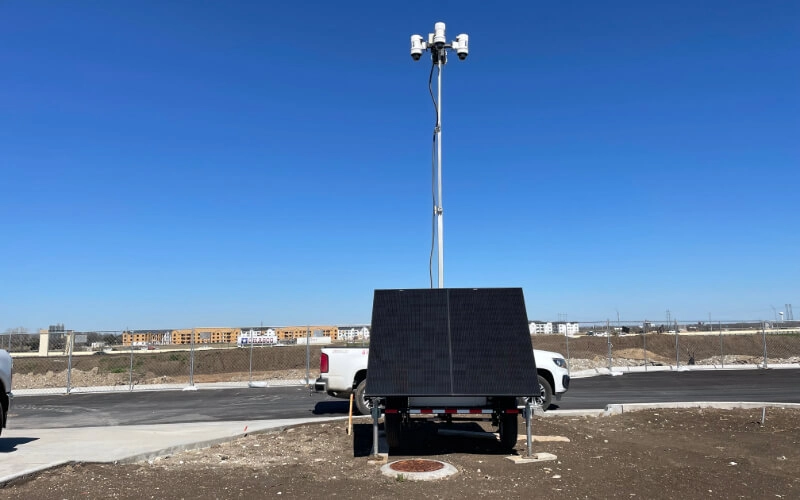
Larceny-theft is the biggest risk here, since tools, materials, and equipment sit in open areas after hours with no forced entry needed to take them. Our Solar Surveillance Trailers suit these sites well, giving a highly visible deterrent with near-360° coverage that runs on solar power, so they work on sites with no power connection. Basic setups can be fully operational in under 20-minutes, and flexible rental agreements let coverage match the life of the project rather than requiring a long-term investment.
Adding Intrusion Detection brings AI-video analytics into the setup, automatically flagging people or vehicles entering a detection zone after hours. The analytics filter out wildlife and debris that would trigger a motion-only system, so the alerts that come through reflect genuine activity rather than background movement.
Those alerts go straight to live video monitoring teams, where trained operators take over. They can assess what's happening on-site, issue a live audio warning, or escalate to law enforcement while an incident is still unfolding. For sites with a single main gate, LPR can be added to log every vehicle that comes and goes.
Warehouses and distribution centers
Burglary and cargo theft put the focus on entry points and staged freight. Pole Cameras mount onto existing lighting columns or building walls to cover doors, loading docks, and blind spots without any groundwork, and can be repositioned as storage areas change.
On larger yards, surveillance trailers add a highly visible deterrent across open ground, signaling from the moment someone approaches that the site is actively monitored. That visibility matters most around staged freight, where thieves often scout a yard before returning to take a load.
License Plate Recognition works as an add-on to our pole cameras and surveillance trailersrecording every vehicle entering or leaving and flagging watchlisted plates automatically. That log is particularly valuable against cargo theft, since it gives investigators and insurers a timestamped record of exactly which vehicles were on-site when goods went missing.
Intrusion Detection also covers the overnight window, alerting operators to after-hours entry before a burglary is completed.
Retail and tourist-corridor businesses
Organized retail crime and staff safety are the main concerns in busy retail and tourism areas, where repeat offenders often return to the same locations. Pole Cameras suit these spaces because their compact footprint gives discreet coverage of storefronts, entrances, and service areas without disrupting customer flow.
Footage from every camera feeds into our cloud-based management platform, where loss prevention teams can review incidents across multiple stores and build the record needed to link repeat visits to the same individuals or crews.
Routing alerts to live monitoring adds a human response to that coverage, so operators can intervene in real-time and support staff working alone or during closing hours. Where a retail site has open ground around it, a surveillance trailer adds a visible deterrent that signals the area is watched before anyone reaches the door.
Fleet and logistics operators
For fleet operators, the risk follows the vehicles, from overnight theft in the depot to robbery at stops and drop-offs. LPR builds a vehicle activity log for the depot, showing when each vehicle left and returned and flagging any unrecognized arrivals. Surveillance trailers positioned over parked fleets cover the overnight hours, when vehicles loaded with tools and stock are most exposed.
Intrusion Detection alerts operators the moment someone enters the vehicle storage area after hours. Those alerts reach live monitoring operators, who can respond while the vehicle is still on-site rather than leaving it to a report the next morning.
Beyond individual hardware, our cloud-based management platform brings coverage from every Florida location into a single view, supporting up to 81 camera feeds in one place. For multi-location businesses juggling separate systems at each site, that consolidation means alerts, footage, and incident records all sit in one dashboard instead of being spread across different providers.
The platform also extends beyond security into site safety, environmental monitoring, and project overview, so the same system that protects a site can support compliance reporting and day-to-day operational decisions, all accessible remotely.
Read more:
- How Can Businesses Reduce Property Crime Risk in Florida?
- Improving Business Security in Florida’s Commercial Areas
Using Florida Crime Data To Improve Business Security
Violent crime is falling in Florida, while property crime is rising, and national trends in cargo and retail theft point to continued exposure for Florida's ports, warehouses, and retail sector. That gap is what Florida businesses need to plan around in order to mitigate the risk of becoming a victim of business-specific crime.
Reporting is also changing under the Florida Incident-Based Reporting System (FIBRS), so recent, location-specific trends are worth more than historical averages right now. If you want to learn more about how to integrate a comprehensive security setup and cloud-based reporting into one secure platform, get in touch with WCCTV's professionals today.
