Theft continues to rank among Florida’s most reported crimes. In 2024, larceny-theft alone accounted for 80.6% of all property crime reported across the state, which had an overall property crime rate of 1,420 offenses per 100,000 residents.
For business owners and property managers, those numbers translate into stolen inventory and rising insurance premiums at sites that already carry a higher level of exposure. Florida's rapid population growth, record tourism, busy construction calendar, and dense freight network all keep feeding this trend, which is why theft shows no signs of slowing down even when other crime categories improve.
This article looks at why theft persists across Florida's businesses, construction jobsites, logistics routes, and public spaces, and what the underlying data says about where the risk is highest. We'll also discuss ways to mitigate theft using smart surveillance, even in high-risk environments.
Florida's Growth Creates New Theft Targets
Florida's population and visitor numbers have grown so quickly that security planning in many areas has struggled to keep up. This gap is a significant contributor to the persistence of theft across the state.
Population growth
Florida's population grew by 196,700 people between 2024 and 2025, which was the second-largest increase of any state. This means that over the last decade, the state's population grew by 16.5%, more than double the national growth rate over the same period.
Immigration drove most of that growth, with around 178,700 people arriving from other countries in the same year. Fast-growing counties bring new housing developments, retail centers, logistics facilities, and new construction jobsites, all of which need protecting long before permanent security systems are in place.
Record tourism
Florida welcomed 143.3 million visitors in 2025, which is another record year for the state's tourism industry. Domestic travelers made up 91.5% of that total, while the rest were international travelers from countries like Brazil, Argentina, the UK, and France.
That volume of foot traffic brings enormous economic benefit, but it also brings a seasonal surge of unattended vehicles and packed parking areas, high-traffic retail corridors, and short-staffed storefronts that thieves know how to target.
Hotels, attractions, restaurants, retail, and short-term rental properties all see a similar spike in exposure during peak travel months. This is when staff are already stretched thin, and guests are unfamiliar with local risks and areas, which makes them easier targets.
Read more:
- Security Considerations for Florida's High-Traffic Destinations
- How Economic Growth Impacts Crime Risk in California
Retail Theft Across Florida's Commercial Properties
Retailers nationwide reported an 18% increase in shoplifting incidents in 2024 compared to 2023, according to a joint study from the National Retail Federation and the Loss Prevention Research Council.
Threats and acts of violence tied to those incidents rose by 17% over the same period, and more than half of the surveyed retailers said organized retail crime (ORC) groups have expanded into cargo theft and digital fraud alongside traditional shoplifting.
Florida's dense retail corridors and year-round tourist traffic make it an attractive market for these groups. Organized retail crime rarely looks like a single shoplifter working alone. It typically involves coordinated teams that target specific products and move quickly, relying on resale networks to convert stolen goods into cash.
These theft rings often operate like a business, complete with dedicated buyers, storage locations, transportation networks, and online resale channels that move products out of state within days.
This change toward organized activity is why security solutions built for ORC focus on deterrence and evidence collection rather than reactive response alone. Visible cameras, live audio warnings, on-site signage, and rapid law enforcement agency coordination all reduce the appeal of a location before a theft ring ever commits to targeting it.
Motor Vehicle Theft Remains a Significant Problem Despite Recent Declines
Vehicle theft is one of the few crime categories where Florida has made positive progress. According to the National Insurance Crime Bureau (NICB), vehicle thefts fell by 23% nationwide in 2025 compared to 2024, reaching their lowest levels in several decades. Even with that improvement, Florida still ranks among the top 5 states with the highest total number of vehicle thefts by volume in 2025.
In 2024, motor vehicle theft accounted for 8.7% of all property crime reported across Florida, with burglaries making up around 10.7%. Florida's overall property crime rate that year was 19.3% lower than the national average.
Nationally, property crime decreased by an estimated 12.4% from 2024 to 2025, continuing a broader downward trend across most of the country. However, the raw volume of thefts still makes vehicles, heavy equipment, cargo, and other materials persistent targets for Florida businesses. This is especially true for those with fleets or storage lots that sit unattended overnight.
Read more:
Cargo Theft as an Additional Theft Risk in Florida
Florida's ports, distribution centers, rail yards, and interstate corridors make it one of the busiest freight states in the country. But that level of cargo movement has made it a consistent target for organized theft rings. California, Texas, and Florida together account for 54% of all reported cargo thefts nationwide, according to the NICB, with Florida ports specifically flagged as seeing a rise in incidents.
Cargo crews don't usually work alone either. These groups often include a driver, a logistics coordinator, a buyer to resell the goods, and lookouts who monitor a facility before a theft takes place. Electronics, food and beverage products, building materials, and metals such as copper are among the most frequently targeted categories.
Holiday weekends and the fourth-quarter shipping season see the sharpest spikes in activity, when facilities often operate with reduced staffing. For logistics operators and distribution sites across Florida, that pattern points to a clear vulnerability. Namely, unmonitored yards and parking areas during off-peak hours.
Florida Construction Jobsites Face Constant Exposure
Construction activity in Florida hasn't slowed down. In fact, Florida is currently going through a construction boom, and this has created more opportunities for construction jobsite theft.
The National Equipment Register (NER) has estimated that heavy equipment theft costs the U.S. construction industry up to $1 billion every year. However, this doesn't include stolen materials, tools, or the lost productivity that follows a theft. Moreover, less than 25% of stolen construction equipment is ever recovered, meaning most losses become a permanent cost rather than a temporary setback.
Jobsites are exposed for reasons that are easy to overlook until an incident occurs. Crews leave every evening, leaving machinery and materials unattended for hours at a time. Perimeter fencing is often temporary, and lighting is minimal compared to a finished building. When combined with Florida's near-constant building season, jobsites become one of the more predictable targets across the state.
Material theft compounds the problem even further. Copper wiring and other metals, plumbing fixtures, lumber, and HVAC components are all easy to resell and hard to trace back to a specific jobsite, which makes them attractive to opportunistic thieves and organized crews alike.
A jobsite that's targeted once is also more likely to be targeted again, since thieves tend to return to locations where they weren't caught the first time.
Read more:
- Crime in Florida: The Trends Construction Projects Need to Know About
- Why Theft and Burglary Continue to Target Florida Jobsites
- Why Construction Growth in Florida Is Increasing Security Risks
- Florida’s Construction Expansion: Security Challenges for Large-Scale Projects
How Mobile Surveillance Helps Reduce Theft Across Florida Sectors
Theft in Florida spans retail floors, jobsites, logistics yards, and commercial properties, and rather than treating each environment as a separate problem, we bring surveillance trailers, live monitoring, smart detection, and LPR together into one connected system.
Every camera, alert, and piece of footage feeds into a single cloud-based platform, giving businesses in high-risk locations like Florida a coordinated layer of protection instead of a patchwork of standalone tools.
Surveillance Trailers
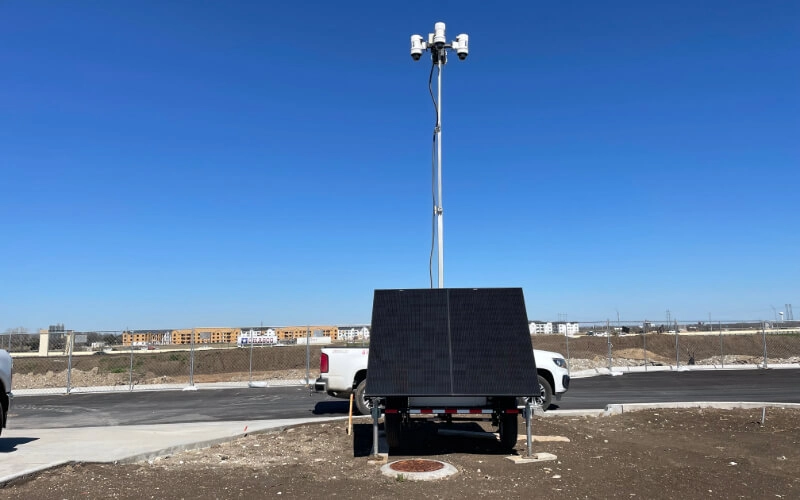
Our Solar Surveillance Trailers give businesses a fully mobile deterrent that can move wherever the risk is highest, whether that's a new construction phase or a remote laydown yard. Each unit deploys without a fixed power source, which makes it suited to jobsites and remote lots that lack permanent electrical infrastructure.
Built-in audio and visual deterrents allow our Trailers to warn off trespassers before a theft occurs, rather than simply recording the incident after the fact.
Because the Trailers sit on a movable base, they can be repositioned quickly, without needing a specialized engineer, so your team can shift them as a project progresses or a risk area moves to a different part of the site. They are available for rental across Florida, giving businesses flexibility without a long-term equipment commitment.
Read more:
- How Do Solar Surveillance Trailers Deter Crime?
- Cost Benefits of Deploying Solar Surveillance Trailers
- Top 8 Features of Solar Surveillance Trailers
Live Video Monitoring
Our Live Video Monitoring services pair our cameras with trained operators who can watch a site in real-time and respond the moment something looks wrong. Operators can then trigger live audio challenges and alert local authorities before a theft is completed rather than waiting for a review of footage after the fact, which rarely helps to recover stolen goods.
Because monitoring runs 24/7, it covers overnight and weekend hours when theft is most likely to occur. Every verified incident also generates reporting that supports insurance claims and follow-up from law enforcement agencies, giving businesses a documented record rather than a gap in the timeline.
Smart Detection Systems and AI-video analytics
Our Smart Detection Systems go beyond basic motion alerts and use AI-video analytics to process footage in real-time, covering everything from intrusion and perimeter breaches to loitering and restricted-area activity. This cuts down the time it takes for a monitoring team to notice a genuine threat within hours of routine footage.
Intrusion Detection identifies unauthorized entry into fenced or restricted zones. Perimeter analytics can distinguish between a person, a vehicle, wildlife, and wind-blown debris, reducing false alerts and allowing a monitoring team to focus on genuine intrusions instead of chasing every motion trigger.
Once someone gets too close to a set boundary, the system can trigger a live audio warning or alert a monitoring operator directly, giving them a chance to intervene before a theft is completed.
For sites with multiple entry points or an irregular perimeter, Intrusion Detection can also be zoned, so a business gets precise alerts on which section of a property was breached rather than a single blanket notification for the whole site.
License Plate Recognition
Our License Plate Recognition (LPR) solutions work as add-ons to any of our existing surveillance setups. When sites use LPR cameras, they can automatically log every vehicle that enters or exits a perimeter, which is particularly useful for logistics yards or parking facilities for fleet vehicles where vehicle-based and cargo thefts are most common.
Each logged plate is timestamped, so a business has an accurate record of exactly when a vehicle arrived or left. That level of detail helps to flag unusual activity as it happens. A vehicle that enters and leaves within minutes, or one that returns to a lot several times in a short period, stands out against normal patterns.
Stolen vehicles will also have a timestamped log of when they left a site, giving investigators a better starting point for exactly when a crime occurred.
Behind all of these security solutions is our cloud-based management platform, which brings live feeds, alerts, historical footage, incident reports, and system status data into a single view.
Rather than functioning as a standalone product, our platform ties together security and safety. That way, teams can manage every camera and sensor across a portfolio of sites from one screen, completely remotely, without switching between separate systems for each location.
Protecting Your Location Against Florida's Theft Trends
Theft in Florida is unlikely to ease soon, with the drivers behind it, including population growth and construction activity, keeping the risk of exposure high. Businesses and sites that reduce their risk most effectively are the ones that treat security as an ongoing investment rather than a reaction to a single incident.
If you want to protect your site against theft, contact our team today to discuss the right combination of mobile surveillance, live monitoring, smart detection, and more for your Florida location.