Florida ranks 35th in the country for total property offenses, with 1,420 offenses per 100,000 people. On its own, that number may not sound alarming. However, when you factor in a population of more than 23 million, it translates to over 326,000 property offenses per year. Commercial corridors, entertainment districts, tourist hotspots, and major public venues account for a significant number of these incidents.
The problem is that these locations are not easy to secure because they're designed for openness, movement, and constant activity. Conventional perimeter-based security models struggle in environments that don't have clear boundaries and rarely, if ever, fully close.
As a result, high-traffic destinations need a different approach, one built around visibility, situational awareness, and coordinated response across multiple locations.
This article explores Florida's high-traffic security considerations for busy destinations and outlines the ideal monitoring and technology approaches that can make a meaningful difference in complex, high-activity areas.
3 Vulnerabilities in Florida's Busiest Locations
High-traffic areas across Florida share several characteristics that directly influence how security measures need to be planned and delivered.
1. Crowd volume
High footfall tends to concentrate security risks. The National Institute of Justice (NIJ) identified pedestrian density combined with limited natural surveillance as a repeated cause of opportunistic crime.
In open retail zones, waterfront boardwalks, major event venues, and seasonal public hubs, the combination of pedestrian density and limited oversight creates significant exposure to theft, disorder, harassment, and crowd escalation.
Crowd density may also complicate emergency responses, as incidents in high-footfall areas make them difficult to identify. As a result, communication with the right personnel and accurate documentation may be subpar, which determines how effectively (or ineffectively) a situation is resolved.
Surveillance systems supported by live monitoring services help shorten that response window in ways that on-site staffing alone can't keep up with.
According to a meta-analysis of surveillance program outcomes reviewed by the NIJ, targeted surveillance reduced crime by an average of 16% across monitored locations. Similarly, higher reductions were recorded in areas with more consistent coverage and high visibility.
2. Extended operating hours
Florida's commercial and entertainment sectors never stop. In fact, most entertainment districts and venues remain active well into the evening and overnight. This creates windows where staffing is reduced and visibility is lower.
The Bureau of Justice Statistics' National Crime Victimization Survey has documented that a significant proportion of property crime and violent incidents occur during these hours, largely due to slower response times.
Security during these hours is essential for public safety and requires security technology that functions without a continuous human presence. Live monitoring, in particular, provides 24/7 oversight where trained operators identify alerts and coordinate responses in real-time.
3. Open-access design and its security implications
High-traffic commercial and entertainment destinations are designed to be welcoming. However, they have almost no perimeter checkpoints, controlled entry points, formal registration requirements, or natural bottlenecks to slow down the movement of large crowds.
A 2024 RAND Corporation landscape assessment of soft targets and crowded places makes it clear that open-access environments like these call for a security approach that's designed around deterrence, detection, rapid response, and structured escalation more than restriction.
This means that introducing perimeter checkpoints and controlled entry points doesn't work and often alienates the visitors you're trying to protect. Instead, visible security equipment and real-time monitoring are much better solutions because they manage risk across open public spaces without fundamentally changing the experience of being there.
Security Risks in Florida's High-Traffic Destinations
The Sunshine State's most popular destinations come with their own set of security risks. These are the most significant and most recorded risks in high-traffic areas:
Organized retail crime
Organized retail crime is a major concern for Florida's commercial and retail zones. The National Retail Federation's Retail Security Surveys report that organized retail crime costs U.S. retailers an average of $700,000 per $1 billion in sales, with total retail shrinkage reaching $112.1 billion in 2022.
Additionally, FBI crime data for Florida shows that larceny-theft accounts for the largest share of property crime across the state's commercial counties. Miami and Orlando are among the metropolitan areas recording the highest volumes of retail-related offenses.
Because most of these operations are carried out by organized theft rings, they're harder to address through traditional security measures. AI-video analytics, license plate recognition cameras, live monitoring services, and smart detection systems give operators the ability to identify suspicious behavioral patterns and flag known vehicles before incidents escalate.
Quality-of-life incidents
Quality-of-life crimes, including vandalism, public disorder, loitering, and harassment, are among the most frequently reported issues in Florida's high-traffic public spaces.
The Florida Department of Law Enforcement data, reported through the FBI's Crime Data Explorer, shows that these offense categories represent a major share of all reported incidents in the state's highest-footfall counties. These numbers tend to increase in line with seasonal activity peaks.
If left unaddressed, quality-of-life incidents can quickly erode customers' and visitors' confidence in businesses and entertainment locations. They can also create the ideal conditions for more serious crime.
Research published by the National Institute of Justice discusses how environments that are actively monitored typically experience lower rates of opportunistic crime. This reinforces the deterrence value of visible surveillance infrastructure.
Unauthorized access and illegal dumping
The areas around high-traffic destinations tend to get overlooked in security planning. These areas are usually away from the natural foot traffic of main public areas, making them ideal hotspots for unauthorized access and illegal dumping.
The Environmental Protection Agency's illegal dumping guidance notes that it threatens public health and affects property values, and may even degrade the quality of life in affected communities. Under the federal Superfund law, CERCLA, current owners and operators of a contaminated site can be held liable for full cleanup costs. This is true regardless of whether they caused the dumping themselves.
In Florida, where active construction activity runs alongside busy commercial corridors, the boundary between jobsites and public space is a vulnerability. Monitoring those edges required dedicated coverage that conventional perimeter security doesn't reliably deliver.
Severe weather and continuity of coverage
Florida's weather introduces a lot of operational difficulty for security teams that most other states don't face. According to the National Lightning Safety Council, Florida is the leading U.S state for lightning fatalities. It has also historically recorded the second-highest flash density in the country.
Hurricane season runs from June through November, and the National Oceanic and Atmospheric Administration's National Hurricane Center has identified Florida as the most frequently affected state in the continental U.S for landfalling storms.
For security operators, that means fixed surveillance infrastructure can go down when coverage matters most. Natural disaster response surveillance systems that run on solar power and operate independently of the grid maintain coverage when traditional setups fail. This is a practical requirement in a state where weather disruption is seasonal.
Security Strategies for Florida's High-Traffic Destinations
Florida’s busiest destinations face security challenges that can’t be solved with one approach. The scale, constant movement, and open layouts of these environments required thoughtful planning and the right technology.
The most effective strategies layer multiple elements together. They combine visible deterrents, smart detection, and reliable monitoring. Rather than managing a single measure, it’s this coordinated approach that gives security teams the awareness and response capability they need in places that never stop moving.
Visible surveillance as active deterrence
Visible surveillance equipment can change criminal behavior before an incident occurs.
According to a meta-analysis of CCTV Surveillance for Crime Prevention, cited by the U.S Department of Justice, surveillance programs reduced crime by an average of 16% in monitored areas. Some areas recorded drops of up to 50% where equipment was consistently visible, and monitoring was known to be active.
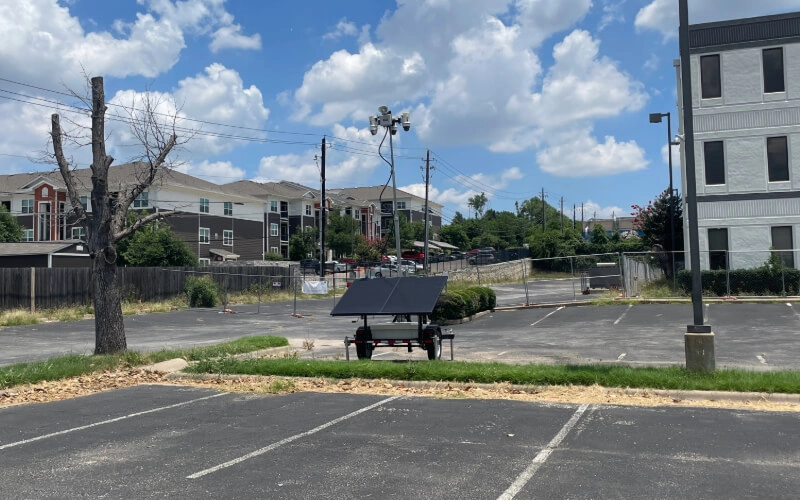
Our Solar Surveillance Trailers are ideal for open, busy environments because they deploy quickly without the need for fixed infrastructure. They're also equipped with PTZ (Pan-Tilt-Zoom) cameras that deliver near-360° coverage, live audio capabilities for real-time audio challenges, and AI-video analytics, making them capable of detection and deterrence across open spaces.
Our rental options make it even more straightforward for Florida security teams to scale coverage when demands change, whether it's a seasonal spike or a newly identified risk area.
AI-video analytics and Smart Detection
Our Smart Detection Systems move your security from reactive to proactive. AI-video analytics run continuously across live feeds and generate real-time alerts the moment something requires attention, such as loitering, perimeter breach, or suspicious behavior.
For retail-heavy areas, our add-on License Plate Recognition (LPR) solutions flag vehicles linked to known criminal activity. This is particularly effective against organized retail crime operations.
Environmental monitoring
Security and environmental compliance are closely linked. As a result, entertainment districts and large public venues may face challenges, like violations of the Clean Air Act, which carry penalties of up to $472,901 per day per violation.
Our Environmental Monitoring Solutions, including Noise Monitoring Sensors, Weather Sensors, and Air Quality Sensors, give you continuous visibility into site conditions. This allows for a threshold breach to be addressed before it becomes a formal complaint.
Unified oversight across multiple sites
When security involves multiple feeds, sensors, incident logs, and monitoring reports across several locations at once, fragmented tools can create gaps. Our cloud-based consolidation platform, brings surveillance, safety, compliance, and operational data into a single dashboard. Security teams have a complete overview that's remotely accessible from any device.
For government agencies and private operators in Florida, that centralized view helps to reduce missed alerts and can cut response times, making it easier to maintain consistent standards across a distributed operation.
Building a Better Security Strategy for Florida Destinations
Open-access design, longer operating hours, extreme weather, and a broad mix of risk profiles create a combination of security pressures that traditional systems can't cover.
The operators who manage these risks most effectively treat security as something that moves with operations. They adjust systems as footfall patterns change and as new threats emerge.
With our comprehensive security solutions and data fed into a unified platform, you can strengthen your security across all of Florida's high-traffic cities and destinations. To find out more about how we can support you and all your security needs, get in touch with our team today.