
46,213 vehicles were reported stolen in Florida in 2023, placing the Sunshine State third in the U.S by total theft offenses, behind California and Texas. That figure is driven by multiple contributing factors, including organized criminal networks, vulnerabilities in vehicle technology, economic conditions, and an interstate and port system that gives criminals a fast route out of the region.
In this article, we'll discuss the 8 main factors behind the increase in motor vehicle theft in Florida and what these trends mean for businesses and property owners with vehicles and other vulnerable assets. We'll also explore the best mobile surveillance solutions to help reduce exposure to these risks and deter motor vehicle-related crime altogether.
8 Reasons Why Motor Vehicle Theft is On the Rise (And What to Do About It)
Florida's vehicle theft problem doesn't have a single, isolated cause. Instead, several overlapping reasons create the perfect opportunities that organized criminals know how to exploit.
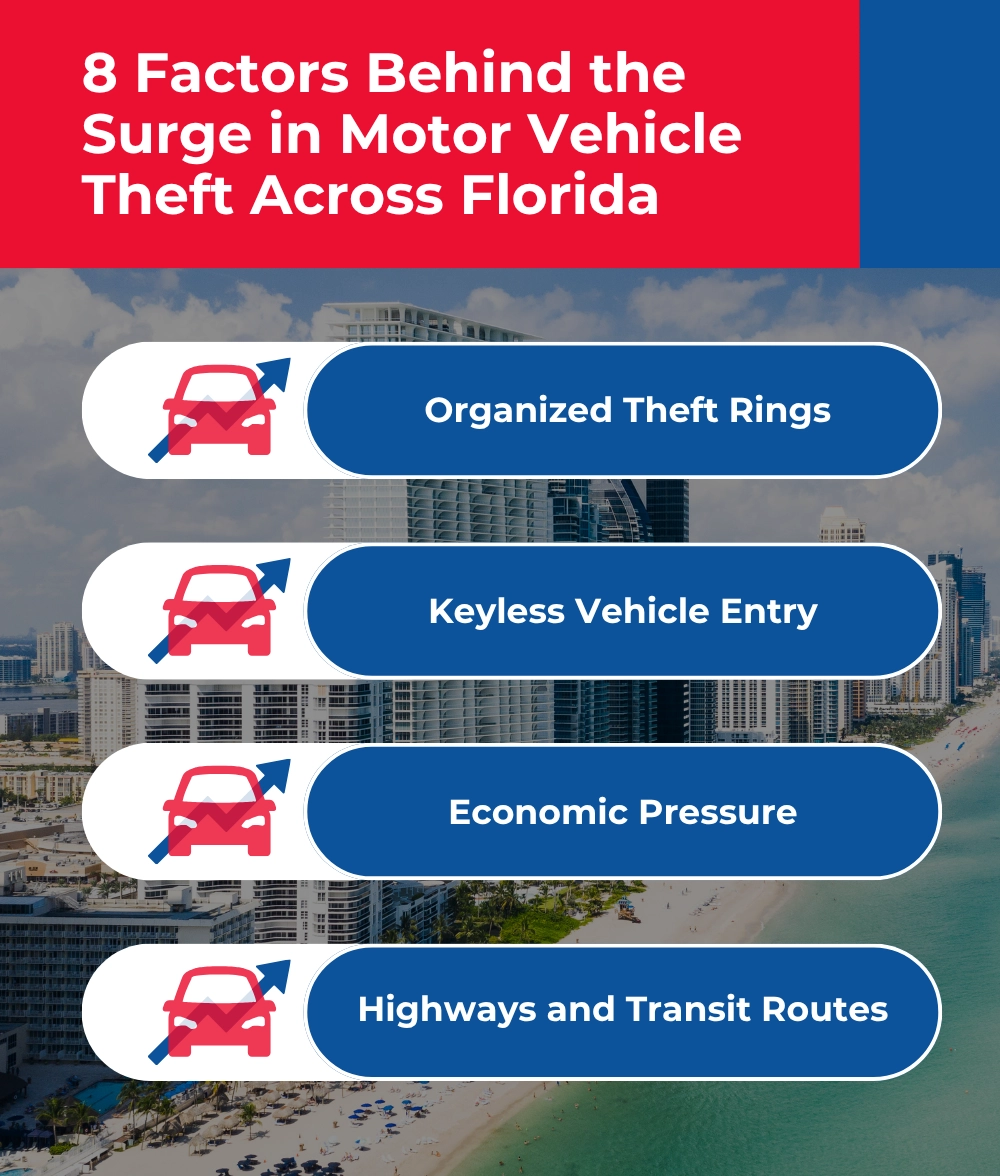
1. Organized theft rings behind motor vehicle theft
In 2023, the Florida Department of Law Enforcement's (FDLE) RICO investigation led to the arrest of 23 suspects in a single criminal ring targeting Porsche and Land Rover vehicles using fake identities and fraudulent VINs.
This is not uncommon, and once the vehicles are taken, they are then moved into one of 2 pipelines:
-
Chop shops strip them for parts
-
Export operations load them into shipping containers for international markets
In the 2024 Operation Family Affair case, a coordinated ring targeted more than 20 dealerships and 30 cars worth $2.5 million across Florida, with vehicles moved to storage units within a few hours of the theft occurring.
When theft is organized rather than opportunistic, it scales up fast. The gap between stealing a vehicle and disposing of it shrinks dramatically, which makes both recovery and prosecution far more difficult. A single criminal network can execute multiple vehicle thefts per week across different locations, with the geographic spread reducing their risk of detection.
Professional organized crime groups (OCGs) have changed the idea of motor vehicle theft in Florida. Targets are deliberately chosen, and theft rings coordinate across multiple counties, moving stolen vehicles out of the area faster than law enforcement can respond. Because of this, real-time security solutions are vital for any type of property that keeps fleet vehicles or high-value equipment on-site.
With Live Video Monitoring services included in all of our products, we keep watch of your vehicles 24/7. Using AI-video analysis that distinguishes between everyday movement and real threats, our Surveillance Trailers send alerts directly to trained operators who can issue live audio warnings or dispatch law enforcement in real-time, before a theft is completed.
2. Keyless vehicle entry
Modern vehicles are controlled by a network of interconnected computers called the Controller Area Network (CAN) bus. This is the internal communication system that links all of the electronic modules in a car, including the engine, the transmission, door locks, and even the infotainment systems. As a result, the CAN bus effectively gives access to the entire vehicle.
The On-Board Diagnostics (OBD) port also links directly to the CAN bus, which criminals exploit by connecting a programming device to the OBD port and reprogramming the vehicle's immobilizer to accept a new key fob that they control.
According to a 2026 report from Mercury Insurance, thieves across the U.S. are exploiting OBD port vulnerabilities to steal cars more quickly, with no smashed windows or hotwiring. They simply reprogram a vehicle and drive away, often in under 60 seconds.
Relay attacks work differently, but are just as invisible, with passive keyless entry systems used to unlock a vehicle when they detect a fob signal nearby. Criminals use 2 devices to exploit this: a device that's held close to a house to pick the fob signal up through the walls, and one near the car to rebroadcast it. The vehicle then detects a nearby fob and unlocks.
As Florida's vehicle fleet grows and more models begin to adopt keyless technology as a default, vehicles are becoming increasingly vulnerable.
Because keyless attacks happen silently (and fast), there's a very narrow opportunity for intervention. Our Temporary Security Camera Rentals offer a more flexible way to establish visible and monitored coverage around vehicle storage areas without any permanent infrastructure. Having a visible system in place, even temporarily, is often enough to deter criminals before they attempt an approach.
3. Economic pressure
The economic disruption brought on by the pandemic years triggered a surge in grand theft auto crimes as opportunistic criminals looked for ways to increase their profits. The numbers are still alarmingly high, with 27,142 motor vehicle thefts committed in 2025. In 2024, law enforcement cleared only 8.4% of auto theft offenses, meaning that more than 90% of thefts end without a single arrest.
For criminals who are under financial pressure, those statistics make repeat auto theft a low-risk calculation, and secondary markets only add further incentive.
Catalytic converters taken from popular vehicle models also have high resale value under Florida Statute §812.014, making vehicle theft for disassembly and parts resale more common than ever.
Clearance rates remain low largely because most incidents produce no usable evidence, like footage or verified records of who was present or when. Our Smart Detection Systems use AI-powered video analytics to detect and verify any unauthorized activity around your vehicles in real-time, generating timestamped alert footage that gives investigators and insurers something concrete to act on.
4. Highways and transit routes
Florida's interstates, such as I-95 and I-10, allow organized criminal rings to move stolen vehicles across county and state lines within hours, which complicates jurisdiction and shortens the viable recovery window. The vehicles are then containerized for export through Port Everglades and the Port of Miami.
U.S Customs and Border Protection (CBP) recovered 1,445 stolen vehicles nationally in 2024, valued at millions of dollars, which was a 9% increase from 2023. But with more than 850,000 vehicles stolen that year, the recovery rate is alarmingly low.
Transnational criminal organizations using highways as dedicated transit routes are extremely difficult to investigate because of their use of fraudulent documents and the speed at which vehicles are processed and shipped.
However, with our License Plate Recognition (LPR) solutions, every vehicle that enters (or exits) your premises will have its plate data captured and logged, even at high speeds and in low-light conditions. If your property requires more vehicle security, this add-on service can integrate seamlessly with any of our products to create a timestamped record without the need for staffed checkpoints.
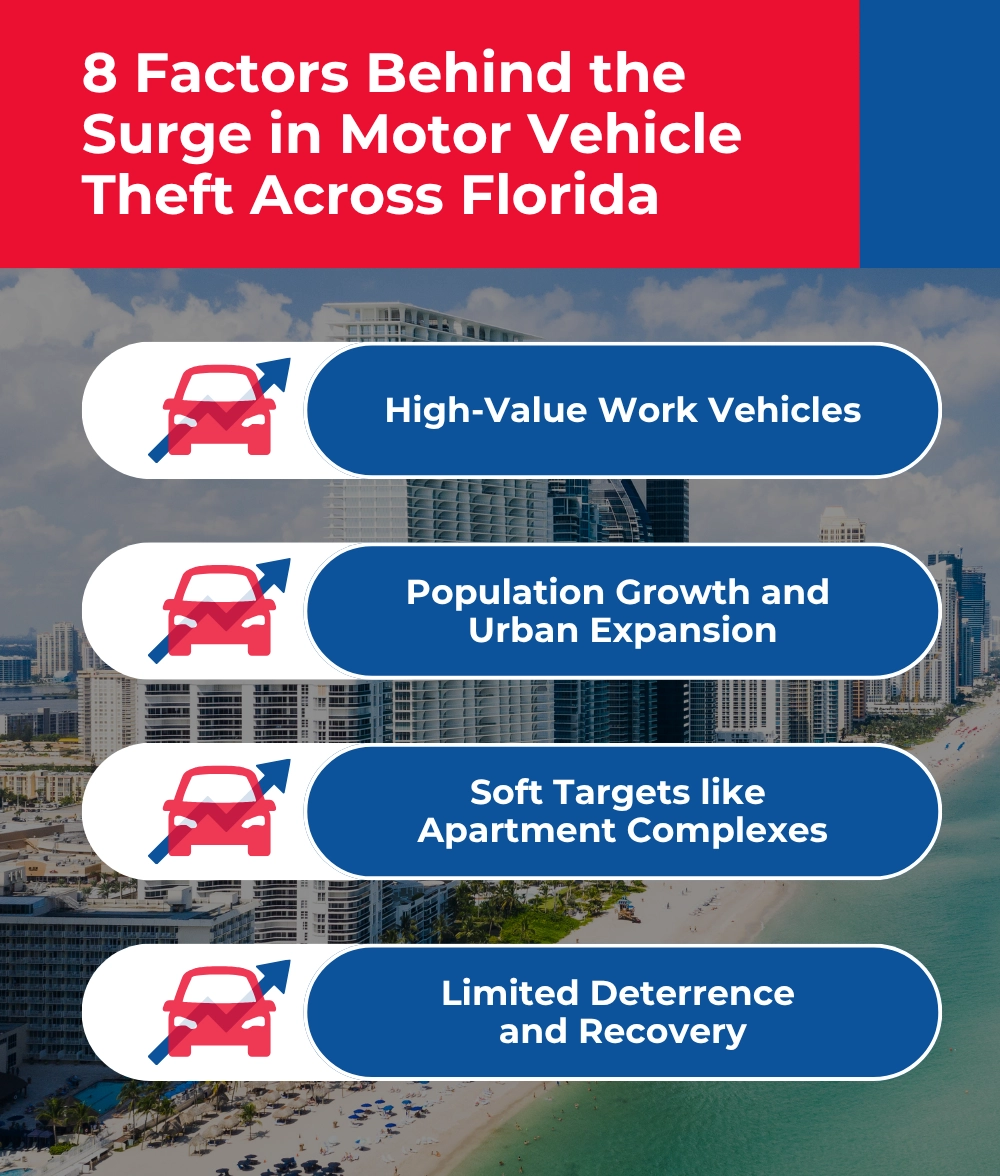
5. High-value work vehicles
Full-size pickups consistently rank among the most stolen vehicles in the U.S. According to the NICB, Chevrolet Pickups alone accounted for 49,903 thefts in 2022, placing them at the very top of the list for that year.
Fleet vehicles also face significant exposure since they are regularly left overnight in open yards during predictable low-activity times. The National Equipment Register's industry analysis states that heavy-equipment theft spikes during holidays like Memorial Day, Labor Day, and Thanksgiving when sites are unattended.
A single breach on a jobsite or any other premises with high-value work vehicles usually results in multiple assets being stolen, making effective construction jobsite security particularly important wherever vehicles and equipment are left unattended. Losses can be compounded by delays from insurance claims and law enforcement investigations.
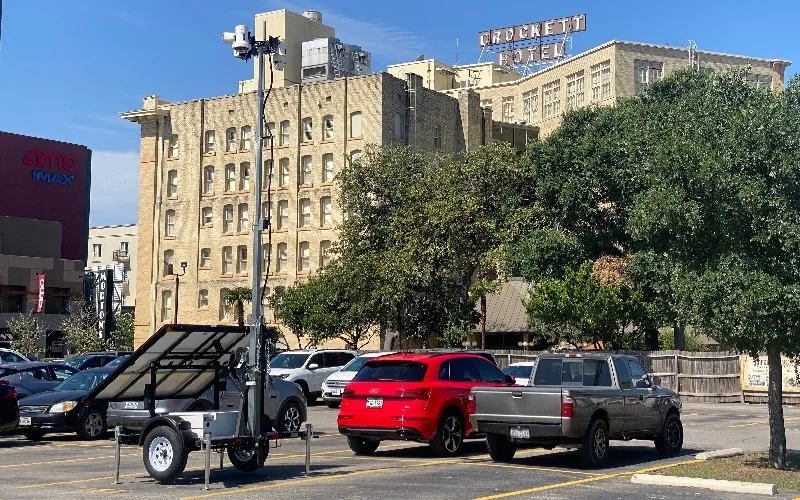
If you want to deter a theft before it happens, our Solar Surveillance Trailers are self-contained units that operate without any fixed power. You can position them at fleet compounds or jobsites where they'll be operational within 20 minutes (for basic setups) and cover the unattended hours when theft is most likely to occur.
Operators can also use the integrated audio and visual deterrence features, including flashing lights, sirens, and speakers for live audio voice-down instructions, to stop criminals in their tracks. Your vehicles are less likely to be targeted when offenders know there's a higher risk of being caught, especially when they're part of a larger organized network.
6. Population growth and urban expansion
Florida added 467,347 residents between 2023 and 2024, which was the second-highest population increase in the U.S. In 2026, the population is over 23.8 million, making it the most populous state in the country.
Florida's urban population has grown at an average of 11.12% per year, which makes surveillance coverage rollouts difficult, and Florida's tourism industry adds even more pressure with seasonal vehicle volume.
Our Pole Cameras are compact, all-in-one surveillance units that mount onto existing utility poles and buildings, and can be used on temporary structures without any dedicated infrastructure.
These cameras have been specifically designed for rapidly expanding properties and environments where permanent installation is challenging and impractical. Their rapid deployment and relocation capabilities also make them ideal for new developments.
7. Soft targets like apartment complexes and open parking areas
Open-access parking lots consistently have higher theft rates than their secured counterparts. A location without cameras, lighting, on-site security, or any other active monitoring offers minimal deterrence and evidence collection. Once they're targeted and a theft is completed successfully, a location is likely to be hit again.
Apartment complexes and open commercial lots also have structural weak spots, like uncontrolled access and no mechanism for identifying who is present on the premises.
As urban density continues to increase, vehicles are overflowing in apartment parking structures and shared lots, with more vehicles parked along streets with limited oversight. New developments are also frequently opening without any established security infrastructure, making parking areas a hotspot for criminal activity.
Read More: A Complete Guide to Parking Lot Security
8. Limited deterrence and recovery
According to the Council on Criminal Justice, motor vehicle theft clearance rates fell from 9% to 7% between 2018 and 2022, and although they increased to 8.4% in 2024, these numbers are still incredibly low.
For organized criminal theft rings, this is an operational risk calculation, since the likelihood of prosecution for any individual theft is statistically marginal without video evidence. The speed of detection matters as well, with the Insurance Information Institute (III) claiming that vehicles reported stolen within 24 hours had a 34% same-day recovery rate in 2023.
Surveillance solutions like visible cameras with motion-activated alerts and real-time monitoring raise the perceived risk of being caught, reducing the likelihood of the same location being targeted again.
To limit your exposure without any major investment in infrastructure, our cloud-based platform brings video footage, license plate data, and other analytics into a single, cloud-based system that can be managed remotely across multiple sites.
When suspicious behavior is detected, like loitering near vehicles or unusual movement after hours, it generates real-time alerts directly from our surveillance systems, allowing operators to act immediately.
If you manage several lots or buildings at once, this kind of centralized visibility makes it easier to respond to incidents and builds the kind of documented record that supports law enforcement investigations.
Proactive Security Measures Reduce Vehicle Theft Risk in Florida
There's no single fix for vehicle theft in Florida, and the factors that add to the exposure across the state don't exist in isolation. They stack, and organized criminal networks can use them to their advantage with almost no consequence or risk of getting caught.
What this means in practice is that sites and fleets that are most at risk are those relying on a single layer of protection, or none at all. The good news is that visible, active surveillance can mitigate the risk of becoming a target. When criminals can see they are being watched and that someone will respond to the threat, they tend to move on.
If you manage vehicles, fleets, parking lots, or jobsites in Florida, be sure to contact our professional security team today. We'll run through your current setup and identify any points of exposure to ensure your site is covered 24/7.

