
When it comes to construction site theft, Florida consistently ranks among the top 3 states in the country, alongside Texas and California. With the construction industry contributing over $97 billion to Florida's economy every year, and more projects being added every month, the amount of high-value materials and construction equipment on active jobsites has never been higher.
That growth has a downside. More construction means more opportunities for theft, especially on sites with no existing infrastructure for a permanent security plan, which organized criminal networks and opportunistic thieves are taking full advantage of.
Understanding why Florida's construction jobsites remain so vulnerable to crime is the first step in mitigating incidents on individual properties. Then, with mobile surveillance, you can create more flexible security plans specifically designed for the realities of active construction sites, where conditions shift constantly, and traditional approaches fall short.
Why Florida Jobsites Face Higher Theft Risks
Florida's exposure to construction theft isn't a coincidence; there are specific operational and environmental conditions that create consistent vulnerability on active jobsite projects across the state.
The volume of active jobsites in certain areas
Simply put, more construction projects mean more targets. Between 2020 and 2024, the state built more than 760,000 homes, underscoring how aggressively developers have responded to the state's population growth. In just one year, the state's population grew by over 196,000 residents in 2025.
Location is also a factor, since a large portion of Florida's new development is concentrated in areas with very little foot traffic (such as on the edges of cities or in zones where new communities are still being formed), and there's nobody around to notice when something is wrong.
Sites in these developing areas are especially vulnerable because there's no one nearby to deter criminal activity after hours, over holidays, or on weekends.
Open site layouts
Construction jobsites are large, open environments where materials move in and out, subcontractors come and go, multiple groups of people are on-site at any given time, and the perimeter changes constantly due to phased work.
This makes it hard to keep a tight perimeter, and temporary fencing, while standard, isn't much of a deterrent or barrier for determined thieves. Multiple access points that working jobsites require can easily become entry points for trespassers once the crew goes home for the day.
Limited after-hours security
The window between when workers leave for the day and when they return the following morning is when the vast majority of jobsite theft takes place. Staging areas, where materials and construction equipment are stored ahead of installation, are among the highest-risk zones on any active jobsite.
These areas are also often poorly lit and have little to no active security presence overnight, leaving copper wiring, power tools, lumber, and heavy machinery unguarded for long periods.
Florida's climate also means that construction activity extends into months that would be off-season in northern states, making the after-hours exposure window more consistent across the entire calendar year. The National Equipment Register (NER) has documented that recurring theft spikes occur during long weekends and holidays like Memorial Day, when reduced site activity creates even longer unmonitored gaps.
High-value construction equipment and materials left on-site
Around 12,000 incidents of construction equipment theft are reported every year in the U.S, with the average single theft costing around $30,000.
The rising cost of construction materials has made potential financial losses for Florida jobsites even more significant, with the U.S Department of Energy estimating that copper theft costs businesses around $1 billion every year.
Jobsites are among the most heavily targeted locations for construction theft, with high-value metals, power tools, lumber, and heavy equipment being some of the most commonly stolen items.
These items are primarily taken because of their significant price increases over the last few years, meaning they're more profitable to resell than they were a decade ago. From 2020 to 2021, lumber prices alone grew by 250%.
Power tools are other frequently stolen items because they're easy to conceal and straightforward to resell through secondary markets, including online marketplaces. One Florida county alone reported $2 million in stolen power tools in a single year due to organized crime, which demonstrates the seriousness of the problem at a local level.
Predictable windows of opportunity
Construction site theft follows clear patterns. In the early stages of a project, when materials are delivered and staged before building begins, the exposure and risk are at their highest because large quantities of materials are sitting on-site before any permanent structures are in place to keep them secure.
Most thefts occur in laydown areas where equipment sits for extended periods and in areas with no visible security coverage.
Read more: Florida Crime Trends: What the Latest Data Shows
The Cost of Construction Site Theft: Florida
The cost of a theft doesn't stop at replacing what was taken, and when materials or equipment go missing, timelines begin to slip. Replacement orders take time, sometimes months, and crews sit idle while waiting for materials to arrive. Subcontractors may also have to pause their scheduled works, which can further delay a project and cause contractual complications.
Across the construction industry, theft-related expenses are estimated to add between 1% and 5% to overall project costs, which impacts budgets and timelines. For Florida contractors operating under tight margins and deadline pressure, this additional cost can mean the difference between a profitable project and a costly one.
The recovery rates paint an even bleaker picture. The NICB reports that less than 20% of stolen construction equipment pieces are ever recovered, and for tools and small equipment, the recovery rate drops below 7%. As a result, most theft losses are permanent and written straight into project budgets with no realistic chance of getting anything back.
Additionally, filing insurance claims after a theft is rarely straightforward, since insurers typically require detailed police reports and evidence that reasonable security measures were in place before a claim is processed. When claims pay out, repeated incidents can still push up premiums.
Read more: How Jobsite Security Saves You Money
How Mobile Surveillance Helps Protect Florida Construction Projects
The conditions that make Florida jobsites more attractive to criminals are exactly what mobile surveillance is designed to address. Our mobile surveillance solutions for construction jobsites cover the hours and access points that traditional, fixed security leaves exposed.
Flexible perimeter coverage
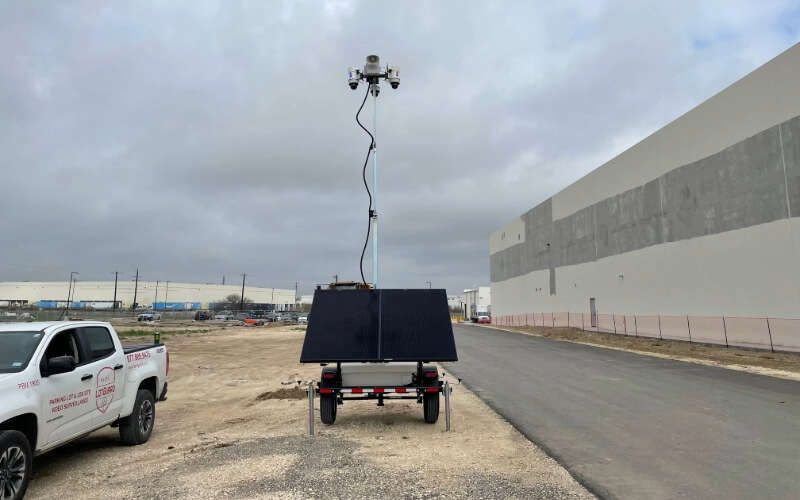
Florida's active projects are consistently busy, with staging areas moving and the highest-risk zones changing every week. Our Solar Surveillance Trailers deploy wherever you need the most coverage, run on both solar and battery power, and deliver constant monitoring through PTZ (Pan-Tilt-Zoom) cameras with near-360° coverage and integrated lighting.
As your site phases progress, our trailers move with them, with no fixed electrical infrastructure needed. Our Mobile Surveillance Trailer Rentals give you a rapid-deployment option that scales with your project from concept to completion.
After-hours intrusion detection
On Florida jobsites, most theft happens overnight and is only discovered the following day, by which point stolen materials and equipment are long gone.
Our Smart Detection Systems use AI-video analytics to analyze footage in real-time rather than just recording it, so the moment an unauthorized access attempt or suspicious movement is detected, the system flags it.
The intrusion detection integration means the overnight exposure stops being a risk factor altogether. Custom detection zones can be configured around your highest-risk areas, so alerts are triggered only by verified human activity and not by false alarms caused by weather, wildlife, or floating debris.
Active 24/7 monitoring
Detection only has value when it triggers a real response, which is why our Live Video Monitoring services connect jobsite cameras to monitoring centers that respond to verified alerts the moment they come in.
When an intrusion is confirmed, trained operators issue a live audio challenge directly to the site using the built-in lights, sirens, and speakers, and notify site management immediately. If needed, they can also escalate the issue to law enforcement for better response times and give investigators everything they need from the start.
Vehicle access control
Vehicles are a central component of large-scale construction site theft, with equipment being towed away, and materials disappearing in the back of vans during the gaps between shifts.
Our License Plate Recognition (LPR) solutions are able to capture and verify license plate data at every site entry and exit point, automatically flagging plates that don't belong and building a complete access record. On high-turnover Florida sites where new subcontractors and delivery vehicles arrive daily, this automated add-on service is more valuable than manual checks by security guards.
Full site visibility
Effective jobsite security on a large Florida project generates a significant amount of data from surveillance feeds, intrusion alerts, access logs, and compliance records across multiple systems.
Our smart cloud-based consolidation platform, brings everything together into a single interface where you can monitor live feeds, review footage, track activity, and pull records for insurance claims or law enforcement, completely remotely from any device.
Read more:
Stopping Florida Jobsite Theft Starts With Smarter Security
The conditions that encourage theft on Florida construction jobsites are becoming more prevalent, with Miami's construction employment projected to grow 8.2% through 2026. As the industry expands, so does the urgency of managing the vulnerabilities that come with it.
WCCTV's mobile surveillance solutions, combined with real-time detection and active monitoring, help reduce your jobsite's exposure to potential theft and require no permanent installation or fixed infrastructure. For Florida contractors who need rapid security deployment, our security experts can advise on the right combination of surveillance solutions for any project.
Contact us today to start building your ideal security plan.

