Florida's construction sector is exploding at a pace that few other states can match. According to the Associated General Contractors of America, construction contributed $97 billion to Florida's GDP in 2023, with private nonresidential spending alone reaching $34 billion.
Additionally, South Florida's commercial and residential development is expanding in both scale and complexity, with Miami-Dade construction employment growing 3.9% year-over-year as of December 2024.
The magnitude of Florida's overall construction industry fundamentally changes the security equation for jobsite project managers and security teams.
A project covering 50 or more acres brings dozens of subcontractor crews on site, plus materials staged across multiple zones. There are also perimeter requirements that change with each phase of development, all of which create a challenge that most jobsites are underprepared for.
This article explores the unique challenges of large-scale construction security in Florida and what a coordinated oversight strategy using mobile surveillance looks like in practice.
Why Large Florida Construction Sites Are Harder to Secure
Construction jobsites in Florida face theft and organized criminal activity, with losses exceeding $300 million each year and individual incidents averaging between $25,000 and $45,000. A larger jobsite doesn't reduce that risk; it distributes it across more ground, with more blind spots and fewer natural checkpoints to catch it.
The majority of security setups are calibrated for a defined, stable footprint, of which large construction jobsites have neither. Perimeters change between phases, and subcontractor traffic creates access pressure at multiple points at the same time. High-value assets are also spread across the site, which creates exposure that simply can't be fully covered by a fixed camera position.
The National Insurance Crime Bureau (NICB) reports that more than 11,000 construction equipment thefts happen every year across the US, with California and Florida consistently ranking among the highest-incident states.
Organized groups often monitor construction sites to identify valuable assets, returning repeatedly when sites lack adequate security measures. On a large jobsite where materials and equipment are staged across multiple zones, that surveillance is harder to detect, and exposure grows with every project phase.
Timing also adds to the risk. The National Equipment Register (NER), as cited by CONEXPO-CON/AGG, has documented a consistent uptick in construction equipment theft around long holiday weekends. In fact, a total of 80% of all construction jobsite theft occurs on weekends or holidays. On large site layouts, that exposure risk is multiplied by the volume of assets left in one place, unattended, for long periods.
Many construction sites in the Sunshine State operate without permanent power or internet during early phases, which limits the use of fixed cameras and alarms, making mobile surveillance systems a practical solution. Without coverage that can adapt to the jobsite and its specific phase, the hours between the end of a shift and the following morning are when most incidents occur.
Read more:
- Why Theft and Burglary Continue to Target Florida Jobsites
- Why Construction Growth in Florida Is Increasing Security Risks
The Challenge of Complex Logistics and Multiple Crews on Bigger Construction Jobsites
On a large jobsite, managing the people and materials moving through the site each day can be just as demanding as securing the perimeter.
Multiple subcontractor crews arrive on different schedules, and delivery vehicles need access to different zones. Additionally, equipment moves between staging areas throughout the day. This creates unmonitored gaps for criminals to strike.
Contractor management and accountability gaps
Bigger construction projects may involve dozens of subcontractors operating across different zones, with each crew bringing its own personnel and equipment onto a shared site.
On a large project, general contractors rarely have direct visibility into every second and third-tier sub on a jobsite at any given time. This makes knowing which crew is authorized in which zone, and when, an operational challenge that exists apart from any other security risks.
When an incident does occur on a multi-contractor jobsite, accountability is difficult to establish without a comprehensive access control record.
A good construction site security plan should include subcontractor agreements that explicitly define security responsibilities and centralized access logging across all entry points. This ensures project managers can create audit trails for insurance and investigation purposes.
Read more:
Moving blind spots
Material deliveries on larger projects don't arrive at a single entry point on a predictable schedule. Concrete pours, steel deliveries, equipment drops, and subcontractor material staging happen across different areas of the site throughout the day. Each delivery brings an unfamiliar vehicle onto the jobsite, moving through multiple zones.
Organized theft rings and seasoned criminals often use delivery activity as an opportunity to scope a jobsite, with the movement acting as cover. Without checking every vehicle entry against an approved list, criminals have a better chance of completing a theft even when a jobsite is active.
Shift transitions and phase handovers
Shift changes and phase handovers are 2 of the highest-risk windows on a large construction jobsite. When workers leave at the end of a shift, the volume of departing traffic makes it easy to miss unauthorized individuals or vehicles moving materials off-site.
At phase handovers, access lists change as one crew demobilizes and another moves in, and that transition period is often poorly monitored and documented.
21% of construction theft occurs in the first hour after workers leave. On a large site, maintaining consistent coverage through those windows is a planning requirement that smaller projects rarely face.
Managing Access Control on Large-Scale Construction Projects in Florida
Access control on a large project is more demanding than on a smaller, single-entry jobsite. Deliveries, equipment movement, subcontractor crew arrivals, and jobsite management all create traffic that can't be funneled through one checkpoint without causing costly delays. This makes unauthorized entry of criminals much easier to miss.
Controlling entry without bottlenecks
Single entry and exit points funnel traffic through one monitored checkpoint to simplify personnel and delivery tracking, but large projects need multiple functional entry points. The practical approach is to designate entry points by their function. For example, there should be separate routes for deliveries or crew access, with each being monitored consistently.
Our License Plate Recognition (LPR) solutions help automate vehicle verification and monitor access points. Plates are checked against an approved list, with unregistered vehicles triggering automated alerts, and every entry is logged with a timestamp.
That kind of record builds across the project's lifecycle, creating a log of access history and detailed reporting that supports incident investigation and compliance documentation.
Read more:
Enforcing zone-level controls for high-risk areas
Not every part of a bigger jobsite carries the same risk. Material storage zones, equipment laydown areas, and high-value tool staging are the most frequently targeted areas on any jobsite and need controls beyond an external perimeter.
Biometric and digital access controls, such as electronic ID badges and keycard readers, help secure high-security zones. Setting inner perimeters around these areas, with access restricted to only authorized personnel with a direct reason to be there, helps limit exposure even when the outer perimeter is under pressure elsewhere on the jobsite.
Asset protection surveillance focused on laydown areas and tool storage gives the highest-value targets dedicated oversight, rather than relying on general perimeter coverage to reach them.
Surveillance Coverage That Keeps Up With Florida's Larger Projects
Fixed security systems are built for stable environments, not for changing construction jobsites. As projects progress, the areas that need the most comprehensive protection change, and fixed security systems become less suited to the jobsite they were originally specified for.
Deploying coverage that moves with the project
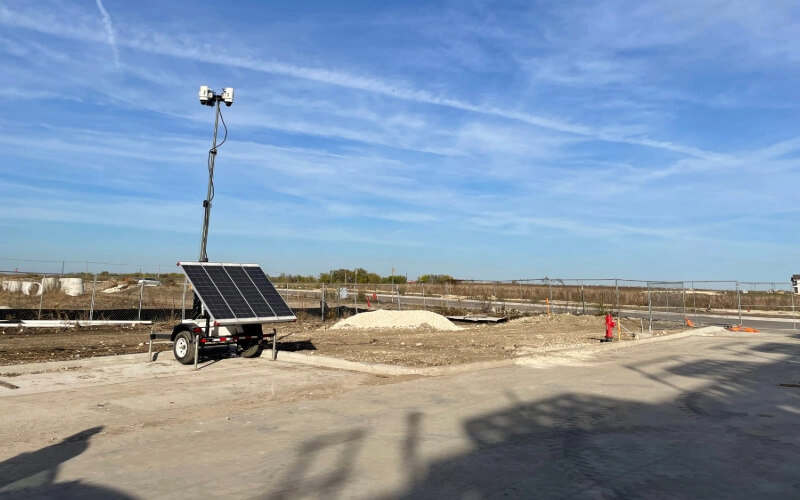
Our Solar Surveillance Trailers operate independently of jobsite power and connectivity, deploying in under 20 minutes for basic setups, wherever coverage is needed. You can also adjust coverage as site conditions change.
On a large site with multiple active zones, spreading coverage across the entire jobsite layout is more effective than concentrating it in one area. Our units are equipped with near-360° PTZ (Pan-Tilt-Zoom) cameras, helping to ensure that perimeter gaps and high-value areas are monitored at the same time, rather than in sequence.
Read more:
Fewer false alarms with verified monitoring
False alarms are a serious operational problem on active construction jobsites. Wildlife, weather, floating debris, and authorized personnel movement all tend to generate alerts that, over time, erode confidence in automated security services.
In fact, research from Arizona State University puts the rate of false alarms for burglar alarms at between 94 and 98%, meaning that the majority of automated alerts aren't tied to a genuine threat.
Professional monitoring, on the other hand, enhances security effectiveness by providing real-time threat detection and coordination with law enforcement for immediate response.
Our fully-managed Live Video Monitoring services are included with all of our cameras, and add the human verification layer that separates real incidents from background noise. Our systems use integrated AI-video analytics to detect real threats, which are further verified by trained operators at monitoring centers.
These operators ensure 24/7 jobsite safety, ensuring a rapid response from operator teams for confirmed events to deter crime or report an incident as it unfolds.
Read more:
Smart Detection on Large Florida Jobsites
Perimeter coverage and access control can reduce the number of security incidents on a jobsite through visible deterrence alone. However, smart detection helps extend that coverage to more specific scenarios that large jobsites face, such as fire risk across multiple zones, and after-hours intrusion in areas that standard cameras may not reach directly.
Fire and smoke detection
Large construction projects, particularly those with open framing and temporary power in multiple zones, have an increased fire risk throughout the build.
Our Smart Detection Systems include AI-powered smoke and fire detection that picks up thermal and visual signatures earlier than traditional smoke detectors. This smart tech gives teams time to respond before a fire spreads to adjacent storage or staging areas.
After-hours perimeter monitoring
A single security guard can't cover the entire perimeter of a large site on foot, and teams of security guards may be stretched thin or eat into a project's budget. After-hours monitoring using AI-driven detection that's triggered by movement in predefined zones helps to remove these risks without requiring guard staffing that's proportional to the jobsite's size.
With intrusion detection systems linked to live monitoring, response teams can assess alerts in real-time and escalate incidents to law enforcement when needed, rather than sending resources out to investigate every automated trigger.
Read more:
Security Across Florida Project Timelines
Large projects tend to run for years, with security requirements at groundbreaking being different from those mid-build and different again at fit-out and handover. A security plan that stays fixed from the project's start will have gaps long before the build wraps up.
Conducting a professional security audit before construction helps identify vulnerabilities and blind spots. On a large project, that audit needs to be revisited during major phase transitions, not just at the start. The risk profile changes as structures are erected and more materials begin to accumulate on-site.
Consistent reporting from security systems helps to support this process. Our cloud-based management platform provides timestamped entry records, incident records, and vehicle data, all pulled from our security systems and loaded onto one comprehensive dashboard.
The platform can be accessed from any device at any time, completely remotely, meaning site managers can monitor multiple large jobsites at once if needed.
Additionally, that documentation has a direct domino effect on compliance. Insurance policies frequently include "reasonable security" clauses requiring specific security measures to maintain coverage, and a clear activity record supports these security and safety regulations if a claim is filed.
Read more:
Building a Layered Security Approach for Large Florida Jobsites
Different phases and jobsite layouts call for different approaches.
The scenarios below show how additional capabilities layer onto mobile surveillance trailers to address the most common challenges on large Florida jobsites.
|
Jobsite Condition |
Additional Security Layer |
|
Multiple vehicle entry points |
LPR solutions for automated plate verification and entry logging at each gate. |
|
High-value material storage and laydown zones |
Zone-level monitoring tools with inner perimeter designation; AI-triggered intrusion detection after hours. |
|
Shift transitions and after-hours perimeter gaps |
Live video monitoring with AI alert verification; law enforcement escalation for confirmed threats. |
|
Elevated fire risk during framing or fit-out |
Video-based smoke and fire detection integrated with monitoring response protocols. |
|
Multi-contractor access accountability |
Centralized LPR entry records and zone-level records supporting incident investigation and insurance compliance. |
Read more:
Building Security Into the Scale of a Florida Construction Project
A good security strategy should account for the jobsite's size and the changing demands of a year-round build. Mobile surveillance systems can provide 24/7 comprehensive protection without the long-term commitments or security gaps of traditional systems.
If you want to discuss the best security plan for your upcoming large-scale projects in Florida, contact us today. Our experienced security professionals can walk you through the best approach for your jobsite.