
Florida (FL) is one of the fastest-growing states in the country, with a construction sector to match. According to the U.S Census Bureau, Florida added 467,347 residents in 2024 alone, second only to Texas. However, more residents mean more housing and infrastructure, and more commercial development, which translates into more active jobsites across the Sunshine State.
With this substantial growth, there's a higher concentration of construction equipment and materials on jobsites with open perimeters. That said, there's a stronger case for operators and jobsite managers to consider using Florida construction security services to mitigate their exposure to theft and other property crimes.
In this article, we'll discuss the scale of Florida's construction industry and what it means for jobsite security planning. We'll also explore how mobile surveillance works as a deterrent for the types of crimes these environments are exposed to.
Florida's Construction Activity: An Overview
The volume of active construction in Florida forces construction managers and property developers to reframe their security challenges. The Associated General Contractors of America reported that Florida added 37,100 construction jobs between September 2023 and September 2024, a 5.9% year-over-year increase that places the state second in the country for job growth.
The National Association of Home Builders also ranked Florida second nationally for single-family building permits in 2024, with the state issuing more permits than any other state except Texas.
On the infrastructure side, the FL 2024-25 transportation budget allocated $5.2 billion to highway maintenance and construction. This added 140 new lane miles to the existing road network. That level of activity means hundreds of individual jobsites are running simultaneously across multiple counties.
Cities like Miami and Orlando have significant volumes of active projects running at any given time. This creates hotspots for criminal activity and security threats that need to be planned for from the start.
Read more:
Why Construction Growth Increases Security Risks on Florida Jobsites
As construction activity continues to grow, more high-value equipment is left on jobsites overnight. Additionally, there are more perimeters to manage and more access points to control. Each one of these represents an opportunity for theft or unauthorized access if smart security measures aren't in place.
Florida construction projects face significant security risks, consistently ranking among the top 3 states for construction theft alongside Texas and California.
Industry data from the National Equipment Register (NER) puts annual losses from construction theft in the U.S at between $300 million and $1 billion, and Florida is contributing a significant amount to that figure. In one documented case, authorities linked a theft ring to 28 separate equipment thefts that totaled more than $1.7 million in losses across the state.
The high demand for tools, metals, copper, fuel, and equipment makes Florida's construction jobsites regular targets for organized crime, especially when security measures are inadequate.
Jobsites are naturally easier to target than most other commercial premises. This is because the perimeters are usually temporary, and access points move as the work progresses. Since assets may also move around daily, this raises the need for better asset protection as part of a jobsite's security requirements.
The average value of stolen equipment per incident in the U.S exceeds $30,000, with recovery rates remaining below 25%. A single incident can completely halt a project phase, push back delivery dates for new equipment, and cause lengthy insurance (and potentially law enforcement) investigations.
Without a proactive security strategy, construction jobsites in Florida can quickly experience compounded risks, turning preventable incidents into costly delays and long-term exposure.
Read more:
The Workforce Security Factor
Florida's already substantial construction workforce is continually growing to meet the demand of new developments.
Miami-Dade alone recorded 64,200 construction jobs as of November 2024, which represented a 10.5% increase in just 12 months. This is a record high for the county, according to the U.S Bureau of Labor Statistics Data. On larger jobsites, that means managing dozens of subcontractors with multiple shift rotations and constant vehicle movement throughout the working day.
Construction jobsites in Florida face constant risks from theft, vandalism, and unauthorized access, particularly after hours. This can lead to significant financial losses and project delays.
The gap between the final shift of the day and the first shift the next morning is when the majority of incidents occur. Often, this is the period when jobsites are left largely unmonitored and exposed.
Security personnel are essential for effective jobsite management as security relies on the people managing it daily. But on large-scale Florida builds, technology needs to support that workforce and extend its reach.
Florida's Legal Protections for Construction Jobsites
Florida offers multiple legal protections for construction jobsites. However, these protections are only available when specific requirements are met. Florida law provides specific incentives, such as felony-level trespassing charges, for jobsites that meet certain posting requirements.
According to Florida statutes, to qualify for felony trespassing charges against intruders, sites under 1 acre must post a prominent sign indicating it is a construction jobsite and that trespassing is a felony. Chapter 33 of the Florida Building Code also mandates barriers for excavations within 5 feet of a street lot line, which is both a compliance obligation and a practical security measure.
All of these protections carry more weight when there is documented surveillance coverage to support any enforcement or legal action. Conversely, without sufficient evidence, certain cases may be dismissed. This is because jobsite operators and managers are unable to prove that the proper measures were in place during the time of the incident. Often, these measures, like barriers, have since been moved.
Securing Jobsites Without Permanent Power or Connectivity
A large portion of Florida's construction projects operate without a permanent power supply or internet connection, especially during earlier building phases, which limits the use of fixed cameras and alarms. Traditional security systems depend on infrastructure that's usually unavailable on active construction jobsites.
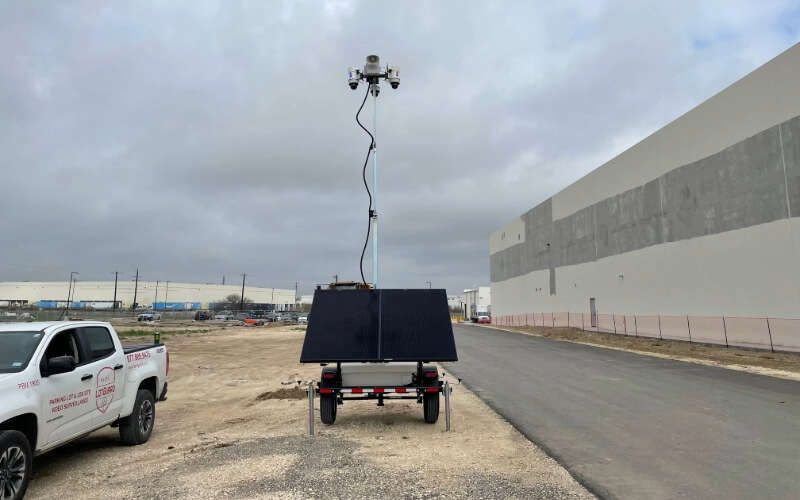
Mobile surveillance systems for construction jobsites can operate independently using solar power and cellular connectivity, ensuring security even when traditional utilities are unavailable. Florida's year-round sunshine makes solar-powered units particularly well-suited for this environment.
Our Solar Surveillance Trailers are fully operational in under 20 minutes for basic setups and can be repositioned across jobsites when necessary, with zero rewiring or additional infrastructure needed.
For contractors managing multiple active projects, our flexible mobile surveillance trailer rental in Florida provides consistent coverage that grows with each project without the upfront cost of purchasing security equipment.
Building a Stronger Security Plan for Florida Jobsites
Best practices for construction jobsite security in Florida involve a multi-layered approach that combines physical barriers and advanced technology, as well as rigorous personnel protocols. But no single security measure addresses every risk. The most secure sites combine deterrence, detection, active monitoring, and response into one coordinated plan.
Perimeter security
A strong physical boundary is the first line of defense against unauthorized entry, and on Florida jobsites, where perimeters are often irregular and subject to change as work develops, maintaining that boundary requires constant and consistent attention.
Generally, enhanced perimeter security includes using robust fencing and surveillance technology, paired with access control systems for better theft prevention.
Our License Plate Recognition (LPR) Camera add-ons can be included with any of our deployed solutions, with LPR cameras at entry points that log every vehicle coming in and going out. This supports daily access management and provides an audit trail for post-incident investigation.
Mobile surveillance for changing jobsites
Florida construction jobsites are prime targets for theft, including tools, machinery, lumber, and copper wiring, leading to project delays and costs. The most valuable on-site assets change location as work progresses, which means fixed camera coverage from the start of a project may not protect the right areas further down the line.
On the other hand, mobile security solutions provide consistent coverage and visible deterrence, which are crucial for protecting jobsites from theft and vandalism.
Our Mobile Surveillance Trailers are equipped with PTZ (Pan-Tilt-Zoom) cameras with near-360° coverage and AI-video analytics to provide wide-area visibility that can move with your project.
All camera activity feeds into a centralized cloud-based platform, giving site managers and project teams remote visibility across multiple active projects from a single dashboard, including incident logs and coverage data that's remotely accessible from any device, at any time.
Additionally, temporary surveillance camera rentals allow contractors and jobsite managers to focus coverage where it's needed most at any stage of the build.
Live video monitoring for real-time response
Live video monitoring in mobile security systems allows trained professionals to intervene during incidents, which helps prevent repeat theft on construction sites.
These services connect any of our on-site cameras to trained operators who assess activity in real-time, and issue live audio challenges, using built-in loudspeakers and other visual and audio deterrents, to any unauthorized people or potential criminals.
A direct verbal response to an intruder's presence is one of the most effective deterrents available, sending a message to offenders that a site is being actively monitored. This is a unique advantage for construction jobsites. Criminal activity often goes unnoticed for hours or several days when they're left unattended at night or on weekends and holidays.
Operators can also get in touch with the right personnel or staff, or even law enforcement, to report incidents when necessary. Every operator alert and response is automatically logged and stored in the cloud, creating a timestamped audit trail that can be accessed remotely and shared with insurers or investigators after an incident.
Smart detection to reduce false alarms
Smart detection systems separate authentic security threats from background movement, ensuring that monitoring teams focus on real events rather than false alarms.
Intrusion detection allows sites to set visual boundaries within the physical perimeter, with alerts triggered when specific zones are accessed outside of designated hours. On Florida jobsites with larger footprints or that run in concurrent phases, this level of control is invaluable.
Additionally, PPE detection flags instances where workers enter areas without protective gear, which can support safety compliance without relying on manual spot checks.
Moreover, integrated smoke and fire detection analyzes live video feeds to identify early-stage incidents faster than traditional sensors. This is particularly valuable on Florida jobsites where open structure and stored materials can accelerate the spread of a fire.
Without smart security measures in place, construction managers and other operators are left exposed to:
-
The cost of a crime
-
Fees or penalties that may be accrued during the insurance process following an incident
-
Safety and liability risks that come with undetected PPE non-compliance
-
The threat of undetected fire or smoke incidents
Regular reviews and a clear incident response plan
Security plans should include incident response procedures and regular risk assessments. A plan written at a project's inception won't reflect the risk picture 6 months in. Generally, progressions throughout the project result in new access points and crew changes. High-value equipment is also typically moved to different areas of the jobsite as it's needed, meaning staging and laydown areas change as well.
Regular reviews keep security coverage properly aligned with where the real risks are at each stage. Our cloud-based management platform makes this process much more efficient, connecting surveillance feeds, monitoring data, security teams, and project stakeholders in real-time.
Our cloud-based management platform gives site managers and security teams centralized access to incident logs and system data, and keeps everything in one place for both day-to-day oversight and any compliance or reporting requirements during a project's lifecycle.
Security That Scales With Florida's Growth
Florida's construction industry isn't slowing down, and the jobsites that will be the best protected are the ones that treat security as a built-in part of project planning rather than an afterthought.
As project footprints expand and more equipment gets moved into the field, the risk of exposure increases. Mobile surveillance and smart detection services give contractors the tools to stay ahead of that risk at every stage of development.
If you want to explore Florida construction security solutions or have questions about our services, be sure to contact our team of security experts today to discuss what coverage your construction project needs.

