Florida recorded a property crime rate of 1,420 offenses per 100,000 residents in 2024, and nearly one in every 1,000 Floridians experienced a burglary in 2023, according to the Florida Sheriffs Association.
Those numbers translate into real losses for homeowners, retailers, contractors, and property managers across the state, often from crimes that could have been prevented with a few structural or procedural changes.
When it comes to property crime in the Sunshine State, criminals look for low visibility, easy access, and unattended hours. The properties that remove those conditions become far less attractive targets.
This piece walks through what property crime looks like in Florida today, the design and operational factors that make a property vulnerable, the prevention strategies with the strongest track record, and how monitoring technology reinforces all of it.
What Property Crime Looks Like in Florida Right Now
Larceny-theft accounted for 80.6% of Florida's property crime in 2024, with motor vehicle theft making up 8.7% and burglary 10.7%. Nationally, a burglary is reported every 26 seconds, and the FBI recorded nearly 850,000 burglaries across the country in 2022.
Vehicle crime moves just as fast, with a car being stolen somewhere in the U.S. every 39 seconds. Over half of those thefts trace back to driver error, like leaving a vehicle unlocked or a key inside.
To round out the picture of crime in Florida, vandalism and trespassing both tend to cluster around the same vulnerable spots:
-
Ground-level windows
-
Unlit parking areas
-
Properties without a visible security presence
Businesses face similar exposure, particularly around asset protection for tools, vehicles, inventory, and materials left in exposed locations after hours.
These figures remain the clearest way to track how Florida's crime statistics change year over year, and they consistently point to the fact that property crime concentrates where visibility, access control, and consistent oversight are weakest.
Read more:
What Makes a Florida Property a Target for Criminals
Crime Prevention Through Environmental Design, known as CPTED, treats the physical layout of a property as a security measure. According to the federal CPTED guidebook, criminals do not want to be observed, and increasing their perceived risk of being seen reduces the likelihood that they'll act.
Properties that unintentionally maximize privacy for an intruder, through dense landscaping or poor lighting, tend to see more repeat incidents.
CPTED breaks the fix for this down into 4 main areas:
-
Natural surveillance: This is a design concept that promotes the ability to see and be seen. Cutting back overgrown shrubs near entry points, adding motion-activated lights to the premises, and keeping sightlines open from the street all reduce the hiding spots an intruder can rely on.
-
Natural access control: This guides movement through a space to reduce opportunities for crime. A single, well-marked entry point is far easier to monitor than a property with multiple unclear ways in, whether that's a side entrance at a vacant industrial building or a commercial lot with several unmanaged access roads.
-
Territorial reinforcement: This strengthens ownership and responsibility through clear boundaries. Fencing and signage help to signal that a space is actively managed, which can deter an opportunistic offender.
-
Maintenance: Regular maintenance and cleanliness of a site and its security systems are just as critical as anything else. A well-kept property signals that it's actively monitored, which is why fixing broken lights and keeping equipment visibly functional all discourage potential incidents.
Operational conditions that increase risk
Layout is only half the picture, as day-to-day habits can undo even a well-designed property.
Here are a few conditions that give criminals a reliable window to exploit:
-
Predictable opening and closing times
-
Inconsistent key control
-
Deliveries left unattended
-
Cash or high-value stock in visible areas
-
Gaps in staffing during early mornings or overnight
These conditions are often invisible during a walk-through inspection, but become obvious to potential offenders who scout a property over time. A business that varies its routines, tracks who holds access to which areas, ensures 24/7 monitoring, and keeps valuable stock out of sightlines closes off the same opportunities that CPTED addresses through design.
Practical Strategies to Reduce Property Crime Risk in Florida
Environmental design works best alongside consistent routines and community partnerships that close the gaps that criminals tend to rely on, particularly after hours.
The programs below put the CPTED principles into daily practice. Neighborhood Watch and Business Trespass Programs extend natural surveillance into the wider community, while ongoing maintenance and access control keep a property's physical defenses working as intended.
The 9 p.m. routine
Many burglaries happen at night, when a property sits unattended and unsecured for hours at a stretch. The well-known 9 p.m. routine takes that risk head-on as a simple closing checklist, and it translates easily to commercial premises as well.
For a business, that means checking all locks, activating exterior and perimeter lighting, arming the alarm system, and securing any street-facing displays, tills, or stockrooms out of view before staff leaves for the day.
The routine takes about 10 minutes to execute at close of business:
-
Set a reminder as part of the closing procedure
-
Walk through your property and confirm all doors, gates, and windows are locked
-
Check any garages, storage areas, loading docks, and any outbuildings
-
Move valuables, stock, tools, or equipment out of sightlines before locking up
Having a consistent checklist for doors and gates, as well as exterior lighting, removes the easy opportunities that criminals depend on.
Business Trespass Programs
A Business Trespass Program authorizes police officers to act as an owner's agent, enforcing trespass law on private property even when the owner isn't present. That removes the old requirement for an owner to physically come out after hours just to issue a trespass warning in front of an officer.
As a result, this speeds up enforcement for retail strips and vacant commercial buildings. It also pairs naturally with surveillance that's built to deter trespassing on properties that may experience repeat intrusion on a site.
Residential Neighborhood Watch programs work on the same underlying principle, training members to spot and report suspicious activity rather than intervene directly, and business districts can adopt the same shared-vigilance approach through tenant or landlord associations to flag unusual activity before it becomes a break-in.
Property maintenance and security
Natural access control and maintenance come down to the day-to-day upkeep of a property's physical defenses. A single, clearly marked entry point only works as a deterrent if it stays locked and well-lit, as well as free of obstruction. Similarly, fencing or signage only signals an actively managed property if it's kept in good condition.
Some practical steps include:
-
Auditing who holds keys or access codes, and revoking access when it's no longer needed
-
Repairing broken locks, gates, fencing, and lighting as soon as they're identified
-
Keeping sightlines to entry points clear of overgrown landscaping or stored materials
-
Scheduling regular checks of security hardware, including cameras and alarm systems, to ensure everything is working
Consistent maintenance also has a domino effect, and this is where the broken windows theory applies directly to property security.
A single unrepaired light, damaged fence panel, or piece of graffiti left in place signals that a site isn't being watched, which can invite further disorder and more serious offenses to follow. A property that's visibly cared for reads as being actively monitored, which compounds the deterrent effect of cameras.
State-backed home hardening grants
The My Safe Florida Home Program offers eligible homeowners a free wind mitigation inspection alongside matching grants of up to $10,000, with the state contributing $2 for every $1 a homeowner spends on approved home improvements such as impact-rated windows or reinforced doors and garages.
Hardened entry points do double duty as well, since they can resist storm damage and make forced entry considerably harder for an intruder.
This program is limited to owner-occupied single-family homes, so it isn't a funding route for commercial properties, but the underlying logic still applies to businesses.
Reinforced doors, impact-rated glazing, and secured loading bays reduce a business's storm exposure in the same way a home's do, and pairing those upgrades with visible surveillance closes off the forced-entry routes that both severe weather and intruders exploit.
Florida law contributes to the visibility aspect of this, as state statute permits video surveillance in public-facing areas. This includes business premises, provided the cameras are either clearly visible or accompanied by a posted notice, which makes overt monitoring both a legal option and a genuine deterrent rather than a legal gray area.
Building Layered Protection with Smart Surveillance
Environmental design and community programs reduce opportunity, but smart surveillance technology adds a layer that watches, detects, deters, and responds when those measures aren't enough. Rather than treating each system as a standalone solution, it helps to think of protection as a stack, with each layer covering a different gap.
Visibility
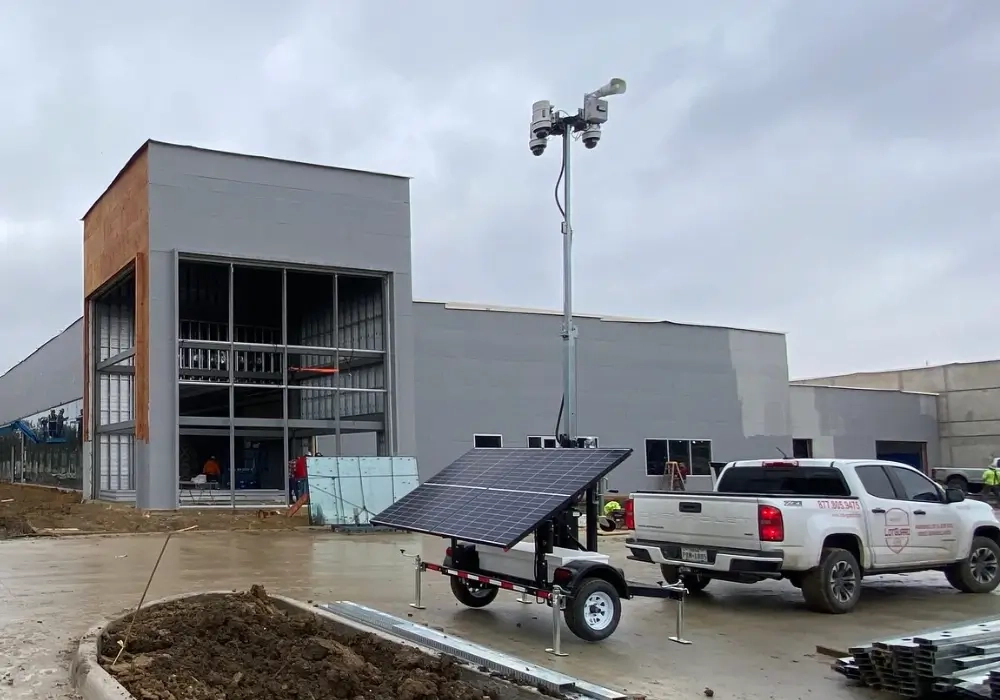
Our Solar Surveillance Trailers give a property visible, independent coverage without needing fixed power or a permanent internet connection. Each rental unit has a telescopic mast extending up to 20 feet to lift cameras above fence lines and parked vehicles. Near-360° camera coverage removes the blind spots that a fixed, wall-mounted camera would leave around a building's corners.
Trailers can also be repositioned as the risk changes from one part of a site to another. Where a trailer may not fit, in narrower spots like alleyways or tight loading bays, our Pole Cameras handle a single vulnerable entry point, like a loading dock or side gate, at a much smaller footprint.
For a construction jobsite or a property that only needs coverage during a specific phase, temporary surveillance offers the same visible deterrent without a long-term commitment.
Detection
Our Smart Detection Systems use Intrusion Detection to flag any unauthorized entry into a restricted area the moment it happens, filtering out irrelevant motion like blowing debris or passing traffic so alerts stay focused on genuinely suspicious activity.
For high-risk locations such as loading access or parking facilities, our License Plate Recognition (LPR) solutions work as an add-on to this detection layer, adding vehicle-level detail. This includes flagging a plate that's returned to a property after hours, which supports both prevention and evidence gathering that follows an incident.
Response
This is where detection turns into action. Live Video Monitoring puts trained operators on footage as it streams, not hours or days later when a review might turn up nothing more than a description for a police report. AI-supported detection handles the initial filtering, screening out irrelevant triggers so that operators can focus their attention on the activity that genuinely warrants a closer look.
When it's the latter, operators issue a live audio warning directly to the person on-site, stating that they're being watched and that police have been notified, without anyone needing to be physically present. Most would-be offenders leave the moment they realize they're actively being watched.
Oversight
This ties your monitoring setup together. Our cloud-based management platform gives an owner one place to view live footage, pull historical clips, manage alerts across multiple properties, and remotely access full incident reporting, without juggling separate logins and systems for every camera or sensor on-site.
This platform builds a usable, time-stamped record for property managers, owners, and auditors alike. That audit trail matters especially on construction sites, where materials, equipment, and personnel turn over constantly, and insurers or project auditors often need to verify exactly when a delivery arrived, a gate was accessed, or an incident occurred.
Historical records tied to a specific time and date make it far easier to pull evidence for a police report, an insurance claim, or an audit review instead of sifting for hours through raw footage.
Putting Prevention Into Practice
Florida's property crime numbers increase the exposure to crime for businesses and residents alike. However, they can easily be mitigated with the right combination of conditions, including visibility, access control, deterrence, and consistent oversight.
A property that's well-lit, with clearly defined perimeters, gives criminals far fewer reasons to take the risk of committing a crime. Layering CPTED design principles with nightly routines, community partnerships, business partnerships, and the right monitoring technology builds a defense that's much harder to get through.
If you want to learn more about which combination would fit your property's specific risk profile, get in touch with us today to speak to one of our security specialists.