
Florida's overarching crime statistics over the last few years have seen positive change. According to the most recent data, the Sunshine State's violent crime rate was 267 incidents per 100,000 residents, which is below the national average by 25.6%, and its property crime rate is also lower than that of several United States cities.
However, these figures tend to mask a pattern that every business owner and site operator in the state needs to understand: crime in Florida isn't evenly distributed. It concentrates in specific cities with higher poverty levels, population density, proximity to drug transit corridors, and tourism.
This article breaks down the top 10 Florida cities with the highest crime rates and takes a closer look at what the data means, in practice, for businesses and operations across the state, from commercial properties to construction jobsite security in areas where theft, vandalism and trespassing present a greater risk/
The 10 Cities with the Highest Crime Rates in Florida
Crime statistics in Florida are collected by the Florida Department of Law Enforcement (FDLE) and reported to the FBI under the Uniform Crime Reporting (UCR) program.
The 2 main categories are violent crime and property crime.
-
Violent crime: Aggravated assault, murder, rape, and robbery
-
Property crime: Burglary, larceny-theft, and motor vehicle theft
The following cities represent the highest concentrations of these categories in Florida, based on the most recent FBI data.
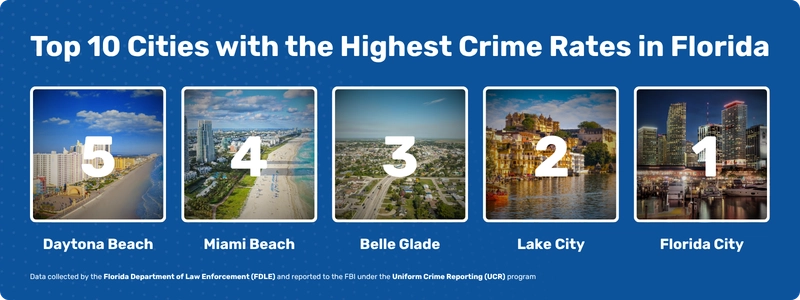
1. Florida City
Florida City has the highest combined crime rate of any community in Florida. An analysis of FBI data puts the overall crime rate at 109 per 1,000 residents, with some of the highest levels of violent crime in the state (more than 1,500 incidents per 100,000 residents).
Violent crime risk sits at 1 in 45 for residents, and the city records one of the highest murder rates in the nation relative to its population size of 13,157 residents.
The city is at the southern end of the Florida Turnpike, and therefore functions as a gateway to the Florida Keys and Everglades National Park. That transit position, combined with a poverty rate of 32.4% and limited local economic opportunity, creates the ideal conditions for consistently higher robbery and assault figures.
Drug trafficking networks that operate along South Florida's road corridors add another risk layer to the city and to the state's crime rate overall.
2. Lake City
Lake City is directly on the I-75 corridor, and the U.S. Sentencing Commission's 2023 Florida data shows that drug-related offenses accounted for 31.3% of all federal cases in Florida that year. This is above the national average of 29.6%.
According to Census Reporter, Lake City's poverty rate was 19.8% in 2024, around 1.5X the state and national averages, while per capita income ($29,767) sits at roughly two-thirds of the state and national per capita income averages. These economic conditions continue to drive higher crime rates.
Northern Florida districts, including Lake City, recorded some of the state's highest trafficking conviction rates, with economic disparity closely linked to spikes in property theft and violent disputes.
Lake City's combined crime rate is 53 per 1,000 residents (higher than than 99% of Florida communities), leaving residents, businesses, and site operators with a 1-in-19 chance of becoming a crime victim overall. The property crime here is recorded as 42 per 1,000 people, which is among the highest in the state.
3. Belle Glade
Belle Glade has a combined crime rate of 39 per 1,000 residents, with more than 97% of Florida communities recording lower figures. Residents and the public face a 1-in-26 chance of becoming a victim of crime, and a 1-in-78 chance of being targeted in a violent incident.
The city has one of the highest murder rates in the nation for communities of its size, and a property crime rate of 26 per 1,000 residents.
Census Reporter data shows poverty rates near 30%, low college graduation rates, and limited formal employment, placing the city on national "most dangerous cities" lists for more than 2 decades.
4. Miami Beach
Miami Beach has a combined crime rate of 85 per 1,000 residents, which is among the highest in Florida. Data puts the overall victim risk at 1 in 12, with violent crime risk at 1 in 93 and property crime risk at 1 in 14. The city also has one of the highest motor vehicle theft rates in the nation.
Miami Beach's crime profile is largely shaped by tourism, driven by its beautiful beaches and nightlife. VISIT FLORIDA reported around 143 million visitors in 2025, generating $133.6 billion in economic impact, with Miami Beach absorbing a significant share of that foot traffic.
The result is a large, frequently distracted visitor population that becomes a predictable target for opportunistic theft and burglary. Hotel districts and entertainment corridors in particular have the highest rates of property crime incidents.
5. Daytona Beach
Daytona Beach combines the opportunistic crime of a high-traffic tourist destination with ongoing socioeconomic pressures in several residential neighborhoods. Major events like Bike Week, spring break, and NASCAR draw large crowds of visitors, creating predictable spikes in theft and property crime.
Regardless of tourist activity, areas with higher poverty concentrations tend to see their fair share of larceny-thefts and burglaries year-round.
Daytona Beach has a crime rate of 30 per 1,000 residents, with more than 92% of Florida communities recording lower figures. The city also has an increased risk of motor vehicle theft, with a 1-in-396 chance of this crime. The general victim risk is 1 in 33, while the violent crime risk is 1 in 116, and the property crime risk is 1 in 46.
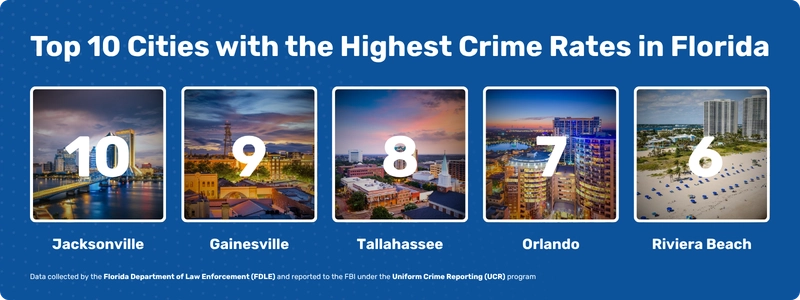
6. Riviera Beach
Riviera Beach is in Palm Beach County, which is one of the wealthiest counties in the United States. This shows how sharply crime risk can vary within a small geographic area. The city's crime challenges are mostly restricted to specific residential corridors, driven by economic disparity and limited access to the labor market that sustains the country's more affluent communities.
Crime statistics place Riviera Beach among the top 100 most dangerous cities in America, with 98% of Florida communities reporting lower crime figures. Residents and businesses or site operators have a 1-in-22 chance of becoming a crime victim overall, with the property crime risk at 1 in 28 and the violent crime risk at 1 in 108.
7. Orlando
Orlando ranks among Florida's major metropolitan areas with the highest per-capita property and violent crime rates. As the state's most visited city, attractions such as Walt Disney World, Universal Studios, and a dense cluster of hotels and convention centers draw tens of millions of visitors each year.
That visitor volume creates the same risk pattern seen in Miami and Daytona Beach: large numbers of people unfamiliar with local risk, condensed in commercial areas, carrying cash and valuables.
Property crimes (particularly theft from vehicles and hotel rooms) remain well above the state average, with a 1-in-29 risk of victimization. While Orlando has made positive progress on violent crime over the past decade, rates still exceed national averages, with a current violent crime risk of 1 in 123.
8. Tallahassee
As the state capital, Tallahassee is home to Florida State University and Florida A&M University, which means there's a large student population living in off-campus housing.
Tallahassee's overall crime rate is around 29 per 1,000 residents, with more than 91% of Florida communities recording fewer incidents each year. The overall victim risk is 1 in 35, with violent crime following closely with a 1-in-42 risk of becoming a victim. Property crime rates in the city, however, are much more promising, with only a 1-in-190 risk.
Overall, Tallahassee's crime rate is more than double the Florida state average. As a result, student neighborhoods regularly see higher levels of burglary and property crime like vehicle theft, particularly during move-in periods and around high-attendance events.
9. Gainesville
Home to the University of Florida, Gainesville's crime patterns closely resemble those of Tallahassee. Off-campus student housing created concentrated property crime exposure, with vehicle theft and burglary being the most persistent problems. Significant spikes typically occur when the university kicks off its semesters and during major events like football weekends.
Established high-risk neighborhoods adjacent to the university campus record crime rates well above the city average of 34 per 1,000 residents. Gainesville is more dangerous than 96% of other Florida cities, with an overall victim risk of 1-in-29. Violent crime is less prevalent than in Tallahassee, with a 1-in-137 risk of becoming a victim, but property crime is a much more serious issue, with the risk around 1 in 37.
10. Jacksonville
Jacksonville is Florida's most populous city, with close to 950,000 residents, and the crime rates to match. The combined crime rate in Jacksonville is 33 per 1,000 residents, while the overall victim risk is 1 in 31. Jacksonville has the highest number of property crime incidents in Florida, with over 30,000 incidents reported, and a violent crime rate of 5,866 incidents.
Duval County's homicide rate has declined significantly, falling from 15 crimes per 100,000 in 2019 to 6.9 in 2024; one of the biggest drops among other large U.S. counties.
That progress is encouraging, though violent crime overall is still well above state and national averages, with a 1-in-167 risk of victimization. However, risk varies greatly by neighborhood, and Jacksonville's urban centers in particular face significant challenges with localized gang violence and retaliatory shootings.
How Mobile Surveillance Addresses Risk in the Most Dangerous Cities in Florida
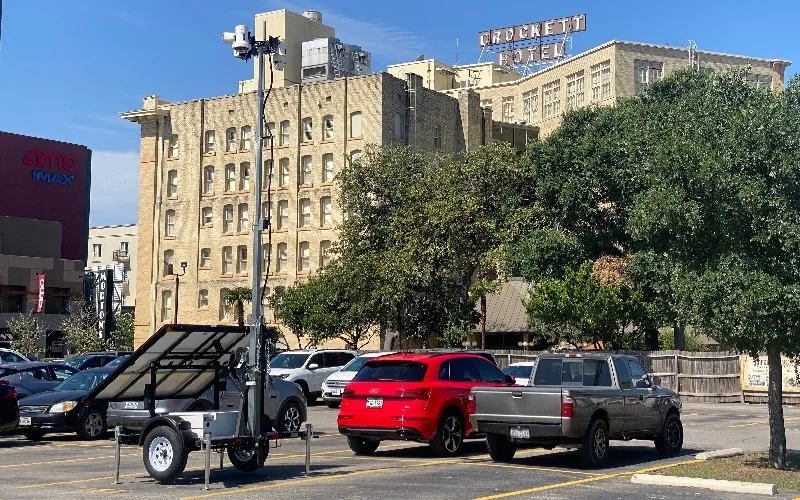
The crime patterns found in all the cities above point to a consistent operational gap for businesses and site operators. Most high-risk sites lack persistent, responsive monitoring. Static cameras can record, but don't deter crime or respond in time.
We support a wide range of industries exposed to these risks, including construction jobsites, critical infrastructure and utilities, government and public works, law enforcement, and vacant properties.
Mobile surveillance and monitoring tools help to address specific risks in high-crime industries and mitigate the chances of becoming a victim.
|
Product |
How It Helps in High-Crime Areas |
|
Solar Surveillance Trailers |
|
|
Smart Detection Systems |
|
|
Live Video Monitoring |
|
|
LPR Solutions |
|
|
Pole Cameras |
|
Across all of these solutions, we offer a cloud-based management platform that can tie these various tools together. Site operators get a single interface for managing footage, alerts, access logs, and compliance reporting across multiple locations simultaneously.
Our platform also supports audit trails and incident documentation, which matters when you're operating in areas with higher crime rates where insurance claims and compliance reporting are a regular part of site management.
For businesses with temporary surveillance requirements or targeted operations, like construction projects, running across several of Florida's high-crime cities at once, that centralized visibility makes it significantly easier to identify patterns and respond to incidents without needing a dedicated security team at every site.
Additionally, our mobile surveillance trailer rental options in Florida make it straightforward to get coverage in place without a long-term capital commitment.
Understanding the Risk in Florida's High-Crime Cities
Florida's statewide crime figures are better than the national average and have been improving for the last 2 decades. But that positive picture changes once you take a closer look at the statistics for specific cities.
Florida's crime-riddled cities each have a distinct risk profile, driven by different combinations of poverty, geography, tourism pressure, and population density. For businesses operating in these areas, the state average isn't the most relevant benchmark. The local rate is, and so is the specific type of crime that is most prevalent in each city.
If you're operating in a high-crime Florida city and you want to understand what smart security coverage looks like in practice, get in touch with us today.

