
Every year, Florida businesses absorb the cost of stolen equipment, damaged property, break-ins, and lost operating time that could have been prevented with the right layers of security.
Under Florida law, property worth less than $750 is usually a misdemeanor, while theft of property worth $750 or more becomes grand theft, which is a felony.
That threshold determines how prosecutors, courts, insurers, and business owners think about risk, but it doesn't change the underlying problem. Every incident of theft, criminal mischief (vandalism), or burglary interrupts operations, damages assets, and costs money to resolve. Businesses, from retail storefronts to construction jobsites, face this exposure daily.
In this article, we'll cover what counts as property crime under Florida law, why the value of stolen property decides the severity of the charge, how layered physical security and environmental design reduce opportunity, and how modern surveillance technology strengthens protection across sites in the Sunshine State.
What Counts as Property Crime under Florida Law
Florida law covers a range of offenses under the umbrella of property crime, including:
- Theft: Occurs when a person knowingly obtains or uses another person's real or personal property with the intent to deprive the owner of it, either temporarily or permanently.
- Criminal mischief: Also known as vandalism. Involves the intentional destruction or defacement of property belonging to someone else.
- Burglary: This is treated more seriously than theft, and includes entering or remaining in a structure or conveyance with the intent to commit an offense inside. This is always charged as a felony in Florida, regardless of the value of what's taken.
- Retail theft: This type of theft is sometimes charged separately, and applies specifically to goods taken from a retail establishment. It can escalate quickly when a defendant has prior theft convictions or acts alongside 5 or more other people.
For a business, the legal distinctions matter less than the practical exposure. Property involved in a crime, whether it's a vehicle, equipment, inventory, or a building itself, represents a direct financial loss, and the possession of stolen property by a third party can complicate recovery even after an arrest.
Understanding how Florida law defines and separates these offenses helps business owners see where their own layered security should focus.
Read more:
- Understanding Property Crime in Florida (and Strategies to Prevent This)
- Why Theft Remains One of Florida’s Most Common Crimes
Why Florida property value determines the charge
The value of the property involved is the most important factor that separates a misdemeanor from a felony in most Florida theft cases. Theft of property valued at $750 or more is grand theft, which is a felony that carries significantly harsher penalties. Theft below that threshold is typically charged as petit theft (a misdemeanor).
A second conviction for petit theft can be reclassified as a more serious misdemeanor, and repeat offenders face escalating penalties with each subsequent conviction.
This threshold also changes how a case is defended. Attorneys can challenge the state's valuation of stolen property, and because the state must prove property beyond a reasonable doubt, a successful challenge can reduce a felony charge down to a misdemeanor or reduce the penalties a defendant ultimately faces.
For businesses, this shows the importance of documentation. Clear records of the value of equipment, inventory, vehicles, and other assets on-site, as well as the circumstances surrounding an incident, directly support a prosecution's ability to secure the appropriate charge if a theft occurs.
What Florida law allows property owners to do
Florida law also addresses what a property owner can lawfully do in the moment. A person may use non-deadly force to protect real estate or personal property that is in their possession or in the possession of an immediate family member, without a legal duty to retreat first.
Florida doesn't extend that justification to deadly force for property alone. Rather, this is only justified when a person reasonably believes it's necessary to prevent the imminent commission of a forcible felony.
This distinction matters for staff safety policies, since employees should never be placed in a position where they're expected to physically confront an intruder. As a result, remote monitoring and rapid alerting matter more than an on-site response.
7 Ways for Businesses to Reduce Property Crime Risk in Florida
Reducing property crime risk means layering different security strategies so that would-be offenders face friction at every stage, from the decision to target a site through to the moment they're identified.
The most effective security solutions involve a combination of the following 7 layers:
1. Secure entry points and harden the site
Target hardening starts with the basics, such as locking gates, closing and securing garage doors, checking that fencing has no unrepaired gaps, and locking down vehicles and equipment overnight. It also means auditing a site for the small gaps that offenders usually look for, like a side gate that doesn't latch properly or a broken fence line.
These fixes cost little to implement but remove the fast, low-risk opportunity that opportunistic criminals rely on, and they can often mean the difference between a site that gets targeted and one that doesn't.
Our flexible Pole Cameras reinforce this layer directly, since they stay focused on a single entry point, loading dock, or stretch of perimeter fencing until they are repositioned. Unlike a lock or a fence, a camera positioned at an entry point also creates a visible deterrent and a usable record if something does happen. This gives businesses both prevention and evidence in one place.
2. Apply CPTED principles to your site design
Crime Prevention Through Environmental Design (CPTED) reduces opportunity through overlapping security strategies:
- Natural surveillance: Designing a site so that people and activity on the premises stay visible, through adequate lighting, trimmed landscaping, clear sightlines, and unobstructed windows facing the street, so offenders feel exposed rather than hidden.
- Natural access control: Limiting how and where people can enter a site, using fencing, gates, and clearly defined routes to funnel movement through points that are easy to observe, rather than leaving multiple informal ways in and out.
- Territorial reinforcement: Using signage, landscaping, and clear boundary markers to signal that a space is owned and actively watched, which discourages someone from treating it as a vacant building or unmonitored ground.
- Ongoing maintenance: Keeping a site well-kept so it doesn't seem neglected or unmonitored, since a maintained property signals active oversight in the same way a break-in that's cleaned up quickly signals a site is being watched.
This is why low, well-lit shrubbery around a building tends to deter crime while tall, dense landscaping near an entrance often invites it. On their own, these are low-cost design choices, but when they're combined with active surveillance, they multiply in effectiveness. This is because a well-lit, clearly bounded site with visible cameras gives an offender every signal that they'll be seen and identified.
3. Deploy surveillance trailers for site-wide visibility
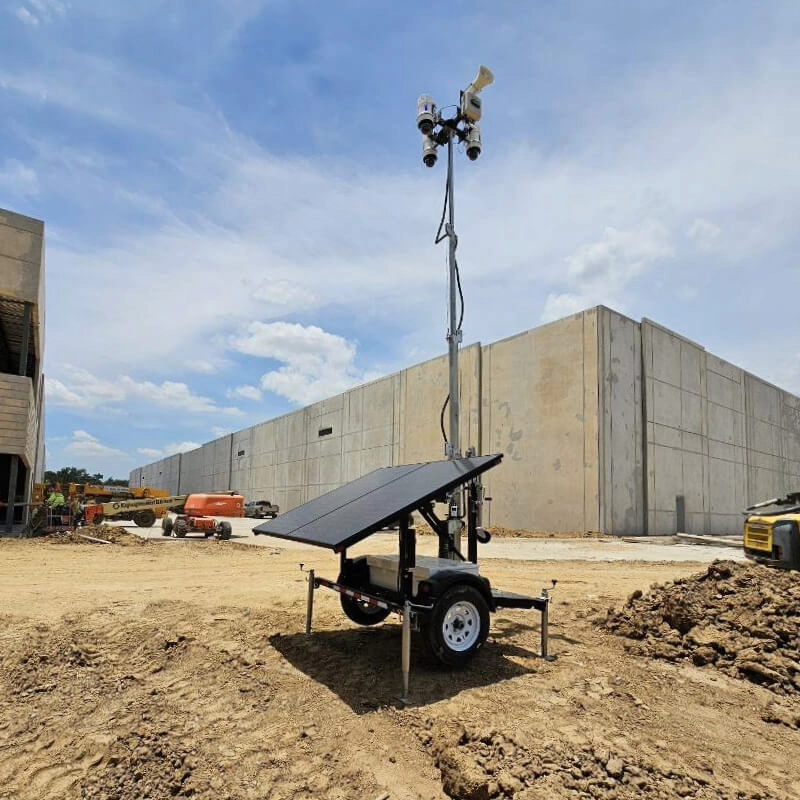
CPTED principles work best when visibility extends across an entire site, not just fixed points. This is where mobility matters. Our Solar Surveillance Trailers are redeployable units that are available for rental and move to wherever risk is highest on a site. They give storage yards, open lots, retail centers, and construction jobsites real-time coverage without waiting on fixed infrastructure or permanent power.
That flexibility comes in handy because risk on a site rarely stays in one place. For example, a jobsite's most vulnerable point in its early phase, like a materials staging area, might change entirely once equipment moves in or a new phase of construction begins.
Rather than leaving a fixed camera covering an area that's no longer the highest priority, on-site teams can reposition the trailer themselves in minutes, without waiting on a provider to send someone out.
4. Add live video monitoring for real-time response
Cameras on their own only document a crime after it has happened. However, live video monitoring puts trained operators behind the feed 24/7, so suspicious activity, whether it's someone testing a gate, lingering near equipment, attempting to scale a fence, or tampering with a vehicle, gets challenged as it happens rather than reviewed after the loss has already occurred.
This is part of WCCTV's fully-managed service, which allows trained operators to issue live audio warnings directly at the scene. If necessary, they can also alert local authorities in real-time, guide a response while an incident is still unfolding, and document the incident for later use, changing surveillance from a passive record into an active deterrent.
For businesses managing multiple Florida locations, this also means consistent, professional oversight without needing on-site security staff at every property.
5. Tracking site access
License Plate Recognition (LPR) works as an add-on to our trailers and cameras rather than working as a standalone system. It automatically logs every vehicle entering and leaving a site, and flags vehicles of interest near-instantly by cross-referencing plates against watchlists so unauthorized or previously flagged vehicles are identified the moment they arrive.
This is particularly valuable for business entry points and lots, where tracking who comes and goes by hand isn't practical. Instead, it creates a reliable, time-stamped record that can support an investigation if equipment or vehicles go missing.
6. Layer in smart detection and AI-video analytics
Our Intrusion Detection adds an automated layer on top of surveillance trailers and pole cameras, built to solve the core weakness of traditional motion-based alerts.
Instead of treating every motion trigger as a potential threat, smart analytics distinguish between blowing debris or passing traffic and someone actually crossing into a pre-defined or restricted zone. This cuts down on the false alerts that make traditional motion-based alert systems difficult to rely on.
This smart system also uses AI-video analytics to separate genuine intrusion attempts from false alarms the moment they occur. For sites that sit empty overnight or on weekends, this smart detection system closes the window that opportunistic offenders count on, since a break-in gets flagged and responded to as it happens instead of being discovered hours later.
7. Building community and policing partnerships
Technology and site design reduce opportunity, but they work best alongside engagement beyond the property line. Neighborhood Watch participation and support for local community organizations create a network of awareness beyond what cameras alone can offer, since neighbors and nearby businesses who know what normal activity looks like are often the first to notice when something is off.
Research shows that each new nonprofit community organization in a city of 100,000 residents correlates with a 0.7% reduction in the property crime rate, which is a measurable effect that compounds as more organizations become active in an area.
Local law enforcement's strategy reinforces this even further. They prioritize police resources in crime hotspots, reducing crime in those areas without pushing it into neighboring streets. As a result, businesses stay engaged with local policing priorities and benefit from enforcement that's actively targeted rather than spread too thin.
Read more:
- Common Property Crimes in Florida and How They Impact Businesses
- How Surveillance Trailers Are Protecting Construction Projects Across Florida
The Cost of Leaving Florida Property Unprotected
Property crime in Florida carries financial and operational stakes for businesses, from the direct cost of stolen equipment and inventory to the disruption a break-in or act of vandalism causes to daily operations. A single incident can also trigger lasting insurance costs.
Reducing that risk is about layering legal awareness, physical design, surveillance technology, and community engagement so that a would-be offender faces difficulty at every stage of their potential crime.
Businesses that combine smart, mobile surveillance with live monitoring and a connected site security strategy put themselves in a much stronger position than those relying on a single line of defense.
If you're ready to strengthen protection across your Florida sites, contact us today to talk through a surveillance plan built around your specific risk.

