
Property crime isn't evenly distributed across the Sunshine State. Florida's statewide property crime rate is around 1,420 offenses per 100,000 residents, which is below the national average, yet Florida City alone reports a rate of 87 property crimes per 1,000 residents, making it more than 6 times the state figure.
For businesses operating across multiple locations in various Florida cities, this distinction matters. A regional average says very little about the theft, burglary, and vandalism risk a specific site faces.
This article looks at reported data to identify which Florida city has the highest property crime rate, and why. We'll cover how Florida's overall property crime rate compares to the national average, a ranked breakdown of the state's highest and lowest property crime rates per city, the factors that drive these differences, and what all of this means for businesses making security decisions across the state.
How Florida's Property Crime Rate Compares to the National Average
According to the latest statistics, Florida's property crime rate places the state 35th in the nation. Additionally, Florida's violent crime rate tells a similar story, with 267 offenses per 100,000 residents in 2024, placing it 31st in the country.
Both figures sit below the national average, which was around 1,760 offenses per 100,000 people in 2024. This means Florida's property crime rate was roughly 19% lower than the national average, while its violent crime rate was about 26% lower.
Larceny-theft accounted for the vast majority of Florida's reported property crimes in 2024, ranging between 72% and 80% of the total, with burglary and motor vehicle theft making up the remainder. That statewide figure, however, hides a significant variation. A handful of cities report property crime rates many times above both the state and national averages, while others report almost none at all.
Read more:
- Understanding Property Crime in Florida (and Strategies to Prevent This)
- Florida Crime Trends: What the Latest Data Shows
- 8 Factors Behind the Surge in Motor Vehicle Theft Across Florida
- Common Property Crimes in Florida and How They Impact Businesses
- How Property Crime Affects Businesses in Florida
Florida's Most Dangerous Cities Ranked By Property Crime Rate
In Florida, property crime covers burglary, larceny-theft, motor vehicle theft, and arson. The cities below represent those with the highest reported property crime rates in the state, according to the most recent available data.
1. Florida City
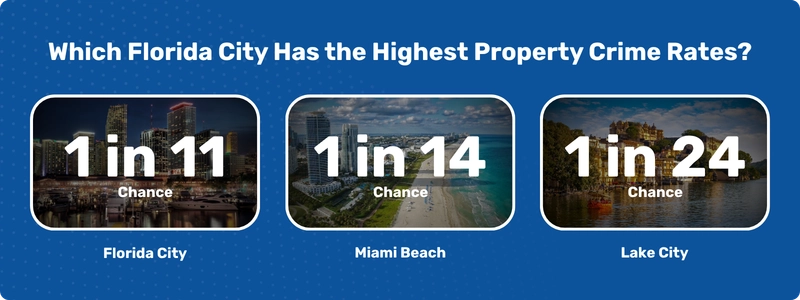
Florida City, a small community near the southern end of the Florida Turnpike, tops the list at 87 property crimes per 1,000 residents. This gives residents and business owners a 1-in-11 chance of property crime victimization in a typical year.
Florida City functions as a gateway to the Florida Keys and Everglades National Park, which brings a steady flow of transient traffic through the area. Combined with a poverty rate of 32.36% and a population of just over 13,000 residents, that transit position creates conditions that consistently push property crime higher than in most other Florida communities.
Because the population base is small, individual incidents also move the per capita rate more sharply than they would in a larger city.
2. Miami Beach
Miami Beach reports a property crime rate of 74 per 1,000 residents, which translates to a 1-in-14 chance of victimization, and one of the highest motor vehicle theft rates in the nation. Its crime profile is built up from heavy tourism, with hotel districts and entertainment corridors recording the highest concentration of incidents.
3. Lake City
Lake City sits directly on the I-75 corridor in North Florida, with a property crime rate of 42 per 1,000 residents. Census data shows a poverty rate of 19.8% in the city, which is roughly 1.5 times the state and national averages, which is a factor closely tied to elevated theft and burglary figures in the area. Although the city is relatively small, residents face a 1-in-24 chance of becoming a victim.
4. Riviera Beach
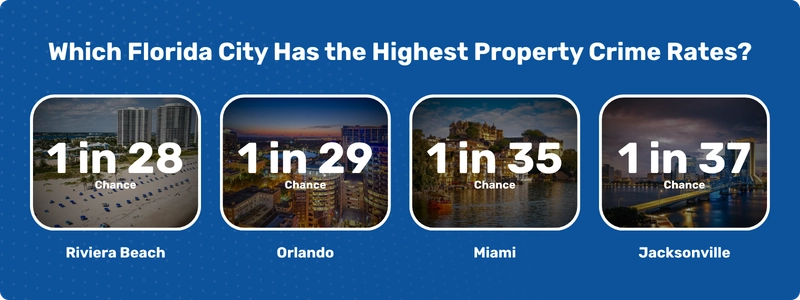
Riviera Beach, inside Palm Beach County, is one of the wealthiest counties in the country, and demonstrates how sharply risk can vary within a small geographic radius, driven mainly by a handful of specific residential corridors rather than the city as a whole. The city has a property crime rate of 36 per 1,000 residents, or a 1-in-28 chance of victimization.
5. Orlando
Orlando reports a property crime rate of 34 per 1,000 residents, giving locals a 1-in-29 chance of victimization. As the state's most visited city, its dense cluster of hotels and attractions creates the same visitor-driven risk pattern seen in Miami Beach, particularly for theft from vehicles and hotel rooms.
6. Miami
Despite reporting a high volume of property crimes in absolute terms due to its population size, Miami's per capita rate is lower than smaller cities such as Florida City and Lake City. The current property crime rate in Miami stands at 28 per 1,000 residents, or a 1-in-35 chance of victimization.
7. Jacksonville
Jacksonville, Florida's most populous city, reports a property crime rate of 27 per 1,000 residents. The city recorded over 26,000 property crime incidents in 2024 (the highest volume of any Florida city), although its rate per resident is far lower than in smaller, higher-risk communities.
Read more:
What Drives Higher Property Crime Rates in Certain Florida Cities
The cities with the most property crime in Florida don't share a single cause. Instead, 4 factors show up consistently across the reported data and the research behind it:
- Population density
- Tourism
- Economic conditions
- The pace of local development
Population density
In small cities, even a handful of crimes can produce a high per capita rate, simply because the rate is calculated against a small population. Larger, denser cities such as Jacksonville need far more incidents to reach the same rate, since their population base is so much bigger.
For instance, the Federal Bureau of Investigation's Crime Data Explorer (CDE) reports the following figures for Jacksonville over the last year alone:
- Arson: 73 incidents
- Burglary: 2,285 incidents
- Larceny-theft: 17,554 incidents
- Motor vehicle theft: 1,722 incidents
- Total property crime incidents: 21,634
As such, even though the city reports a significantly higher property crime rate, the per capita rate is lower than in smaller high-risk cities. And although these figures are improving, having dropped by more than 4,000 incidents since 2024, they are still high enough to solidify Jacksonville as one of the cities most affected by property crime.
Tourism and transient population
Florida's tourism economy draws an enormous number of visitors each year. According to VISIT FLORIDA, there were around 143 million visitors in 2025, generating an estimated $133.6 billion in economic impact.
Tourist destinations often see higher rates of theft because visitors are less familiar with the local risk, tend to carry cash and valuables, and are more easily distracted while in public spaces. This makes them predictable targets in hotel districts and entertainment corridors.
The transient nature of tourist traffic also works against recovery: stolen goods, particularly vehicles, can move out of the area, or out of state entirely, before an investigation gets underway.
Economic activity and poverty levels
Property crime rates correlate closely with poverty levels and access to law enforcement agencies and their resources. Cities such as Florida City and Lake City report poverty rates well above the state average, alongside limited local employment opportunities. Each city also reports property and violent crime figures that are far above the Florida norm.
This pattern isn't unique to Florida, and criminologists have long pointed to a relationship between economic hardship and property crime, often explained through what's known as "strain theory". This is the idea that when legitimate paths to income or opportunity are limited, some individuals turn to theft or burglary as an alternative.
Poverty also tends to correlate with under-resourced local police departments, which can mean longer response times, fewer officers per resident, and less funding for infrastructure like lighting, cameras, or foot patrols that helps deter opportunistic crime in the first place.
The result is often a feedback loop: lower investment leads to higher crime, and higher crime can, in turn, discourage the kind of business investment that would otherwise improve local economic conditions.
Urban development
Rapid growth and dense commercial development can outpace the security infrastructure that a city has in place. Newer corridors and construction zones can lack the lighting, monitoring, and access control of more established districts, which creates short-term opportunities for theft until infrastructure catches up.
By contrast, smaller residential suburbs across Florida typically record some of the lowest crime rates in the state, reflecting lower population density and less commercial foot traffic. In many cases, there is also more consistent local law enforcement coverage relative to the population size.
Read more:
Florida's Safest Cities for Property Crime
On the other end of the scale, several Florida cities report consistently low property crime figures. In terms of property crime, Marco Island is widely recognized as Florida's safest city overall, with a property crime rate of just 4.05 per 1,000 residents.
Tampa, at 15 property crimes per 1,000 residents, and West Palm Beach, at 21 per 1,000 incidents, also post noticeably lower property crime rates than the higher-risk cities, despite serving much larger populations.
Sunny Isles Beach, Doral, and Kissimmee round out a group of smaller cities that consistently rank among the state's lowest for overall crime, alongside Largo.
What High Property Crime Rates Mean for Florida Businesses
The right security setup depends heavily on the type of site and the type of crime most common in that location. A construction jobsite with no fixed power in Florida City needs a very different solution than a retail corridor in Miami Beach.
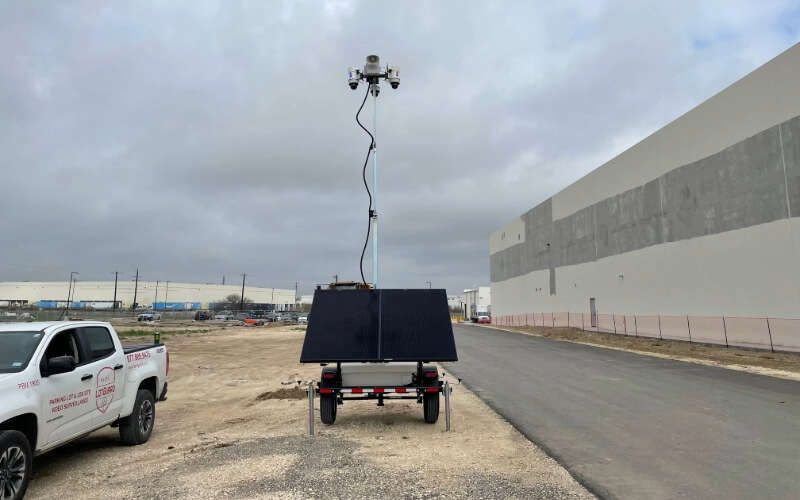
For sites without existing power or internet, renting mobile, solar-powered surveillance trailers offers a way to get coverage up quickly, often within minutes, without waiting on infrastructure. For more targeted problem areas within a larger site, like a single entrance or loading zone, compact pole cameras that mount to existing structures can extend coverage without the footprint of a full deployment.
Recorded footage alone often isn't enough in high-crime corridors, where a fast, verified response matters more than reviewing incidents after the fact. Live video monitoring closes that gap, as trained operators watch footage in real time and can issue on-site audio warnings or escalate straight to law enforcement when necessary.
For cities with elevated motor vehicle theft, like Miami Beach, license plate recognition adds another layer. It logs vehicle activity and flags unfamiliar plates, building a record that can help support an investigation after an incident.
WCCTV offers each of these as part of a connected system. Our cloud-based platform brings footage and alerts from multiple sites into a single view, so businesses managing several locations across Florida's higher-risk cities can spot patterns and respond quickly, without needing a dedicated security presence at every site.
Understanding Florida's Crime Data Before You Plan Security
Florida's statewide property crime figures paint a reassuring picture since they sit well below the national average and continue to decline year after year. But that statewide figure masks an enormous variation between individual cities.
For any business with a presence in Florida, whether that's a single site or operations spread across several cities, the state figures should be treated as background context rather than a planning tool. The local numbers, and the specific type of crime most common in that location, are what should inform how a site is secured.
If you operate in one of Florida's higher-crime cities and want to understand what the right level of coverage looks like for your specific location, get in touch with our team today.

