
Florida sees a steady mix of property crime, violent crime, drug offenses, and traffic offenses each year, influenced by its dense tourism economy and heavy transportation corridors. The state's overall crime rate fell 6.4% between 2023 and 2024, which signaled that statewide trends were moving in a positive direction even as the risk stayed uneven across industries and locations.
That unevenness is why a single statewide number isn't enough for a business trying to gauge its own risk. A retail lot in Orlando, a construction jobsite outside Tampa, and a warehouse near the ports all face different mixes of the most common crimes, determined by hours of operation and what's actually on-site. Knowing which categories drive that risk is the first step toward addressing it.
In this article, we break down the most frequently reported crimes across Florida and what's driving them. We'll also discuss how businesses are responding with better visibility over their sites.
Florida's Overall Crime Picture
Florida's population reached 23.5 million as of July 2025, up from 23.4 million the year before, and the state has grown faster than almost any other in the country since 2020. That growth is concentrated in the areas where security risk tends to follow, such as fast-expanding suburbs and construction activity trying to keep pace with demand.
Florida is also one of the most visited destinations in the country, which means a far larger and more transient population moving through its cities and public spaces than most states of a comparable size.
That mix of rapid growth and heavy visitor traffic is part of why crime in Florida doesn't move uniformly across the state. Some counties see crime patterns shift as new development brings in more people and more unattended equipment, while long-established communities see comparatively little change year over year.
For businesses, this means the more useful question is rooted in what crime rates look like in the specific corridor, county, city, or jobsite where they operate.
Read more:
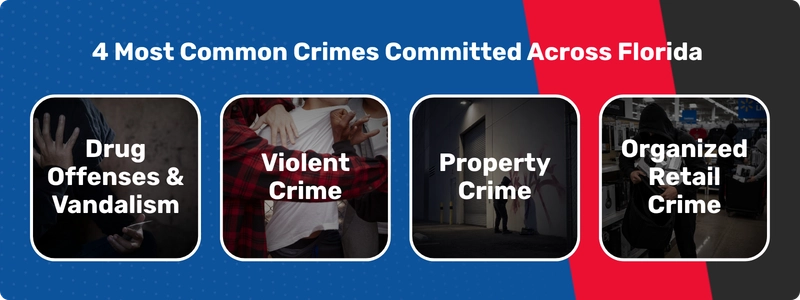
4 Most Common Crimes Committed Across Florida
Florida's crime data breaks down into a handful of recurring categories, each with its own drivers and its own relevance to businesses and locals. The 4 most common crimes committed across The Sunshine State range from violent and property crime to organized retail crime.
1. Property crime
Property crime covers a range of offenses, from shoplifting to equipment theft, and it affects nearly every type of business, retail locations, warehouses, and jobsites alike. Florida's property crime rate stood at 1,420 offenses per 100,000 people in 2024, which was roughly 19.3% below the national average.
Of those offenses, the vast majority were larceny-theft (80.6%), with burglary (10.7%) and motor vehicle theft (8.7%) making up the rest. For businesses, that lines up with the fact that opportunistic theft is far more common than theft as a result of forced entry.
Burglary occurs every 15 minutes in Florida, and is the property crime most directly tied to a site's physical security since it involves unlawful entry into a structure rather than theft from an open area. This typically means that storage containers, site offices, and vacant units sitting empty overnight or between shifts are the easiest targets for criminals, and the highest-priority security areas for business owners and jobsite managers to focus on.
Similarly, motor vehicle theft is just as important to focus on for jobsites holding fleet vehicles or heavy equipment overnight. Depending on the vehicle's value, this can be charged as a third-degree felony. A stolen truck or trailer doesn't just include the cost of the asset; it also stalls whatever project depends on it.
Read more:
2. Violent crime
Violent crime affects a smaller share of Florida's overall offenses, but it carries more serious consequences for the people involved. In 2024, Florida's violent crime rate was 267 offenses per 100,000 people, which was 25.6% below the national average.
Of those violent crimes, aggravated assault made up 73.8%, followed by robbery at 14.3%, rape at 10.5%, and murder or non-negligent manslaughter at 1.4%. Aggravated assault occurs every 11 minutes in Florida, while robbery occurs about once an hour.
Aggravated assault differs from simple assault in a few key ways. It typically involves a deadly weapon, or the intent to cause serious bodily harm, or an unlawful threat that creates reasonable fear of imminent violence in the victim.
On the other hand, simple assault usually stays a misdemeanor, while aggravated assault is charged as a felony under Florida law and can lead to 5 years in prison. This doesn't mean it is less frequent, though.
Domestic violence is a recurring factor behind a portion of aggravated assault cases, since these offenses are often connected to disputes between individuals rather than random encounters. This is one reason aggravated assault dominates the violent crime category even in areas with otherwise low crime rates overall.
Robbery is the violent offense with the most direct relevance to businesses, since it typically involves a confrontation over cash or goods rather than a dispute between acquaintances. This makes retail locations and any other site that handles cash transactions or holds valuable inventory more exposed to this category of crime.
3. Drug offenses, vandalism, and trespassing
Florida's geography puts it on major trafficking routes, and the federal data reflects that. Drug trafficking and possession accounted for 34% of all federal crimes reported in Florida in 2022, which was above the combined national average of 31.6%.
Most drug offenses in Florida carry felony classifications, and penalties can rise significantly depending on several factors, including quantity and intent to distribute. A smaller possession charge might be treated as a third-degree felony, while trafficking charges can escalate to a first-degree felony carrying significant jail time under both state and federal law.
For businesses, drug crimes often overlap with quality of life crimes like loitering, trespassing, and squatting, which tend to concentrate around the same vacant properties and low-visibility areas, sometimes accompanied by unauthorized encampments, that attract opportunistic crime.
Vandalism doesn't show up as its own category in national crime data, but it's one of the most frequent and costly problems businesses deal with day-to-day, including graffiti, broken windows, damaged equipment, and deliberate property damage.
Trespassing is closely related and often precedes more serious incidents. Once a site has been breached once, it rarely stays a one-off event. Repeat trespassing tends to escalate into theft or squatting once word gets around that a site has little to no active deterrence.
As a result, businesses in the construction industry need to factor this risk into their broader jobsite security planning.
4. Organized retail crime
Organized retail crime (ORC) differs from property crimes like opportunistic shoplifting in both scale and intent. Rather than a single individual taking an item, coordinated groups target retail locations specifically, often moving between multiple stores in a single operation to steal high-value merchandise for resale.
Florida's dense retail corridors and high tourist footfall make it a particularly attractive target for these operations, since large crowds and constant turnover make it easier for coordinated theft to blend in.
For retailers, the financial impact goes beyond the stolen merchandise itself. Repeated incidents drive up insurance premiums, strain staff who are often instructed to intervene directly, and can affect a location's broader security standing if left unaddressed.
Visible surveillance paired with AI-video analytics helps retailers both discourage these groups before an incident occurs and build the evidence needed to support law enforcement investigations after the fact.
How Florida's Legal Process Handles These Offenses
Most of the above crimes move through Florida's court system according to the degree of felony or misdemeanor, which determines everything from bond conditions to sentencing exposure.
A second-degree felony carries a materially different court date timeline than a third-degree felony or a simple misdemeanor charge, and the exact degree, depending on the specifics of the incident, can significantly change a case.
Anyone facing a criminal offense in Florida typically works through this process with a criminal defense attorney who can advise on plea options, legal defense strategy, and potential outcomes under state and federal law. Individuals accused of more serious offenses often seek out experienced criminal defense attorneys given the higher stakes involved, including the possibility of enhanced penalties or extended jail time.
For businesses, the practical takeaway isn't legal strategy; it's that better documentation and video evidence at the point of an incident make the legal process more straightforward for everyone involved, including law enforcement.
Proactive Monitoring for Florida Businesses
Given how much of Florida's common crimes center on opportunistic theft and after-hours access, visibility has become one of the most practical tools available to site managers, and the right combination of coverage depends on what a site needs. With smart surveillance technology, businesses can not only deter criminals, but mitigate the potential of becoming targets in the first place.
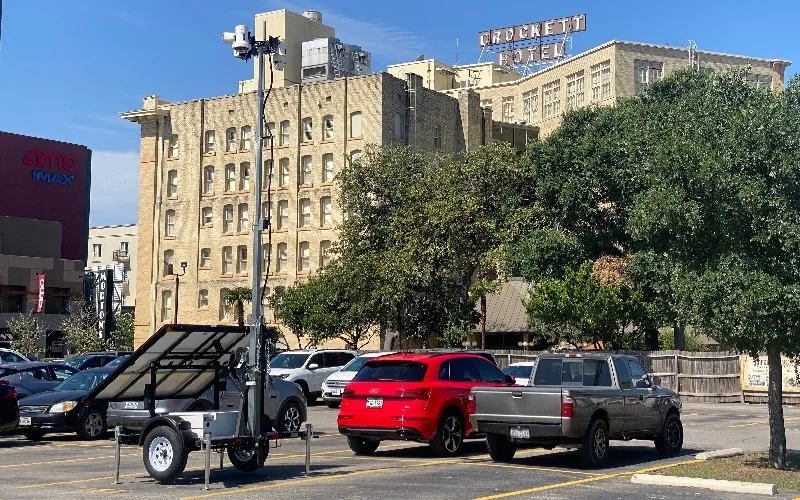
Our Solar Surveillance Trailers are built for jobsites and businesses that don't have fixed power or existing infrastructure to tap into. They run on solar power and deploy without an electrician or a permanent installation.
Our Trailers can also be easily relocated as a project moves through different phases, or as threats develop and change, which matters whether a jobsite's footprint shifts over the course of a build or a business needs to redirect coverage toward a new area of risk.
Where a full Trailer doesn't fit, such as narrow spaces, or when sites need higher vantage points for their monitoring, our Pole Cameras offer a flexible option for Florida locations, and can be easily repositioned as coverage needs change.
Live Video Monitoring adds a human layer on top of our existing hardware. Rather than relying on footage that only gets reviewed after an incident, a live operator watches a site in real-time 24/7 and can intervene directly when intruders or suspicious activity is flagged.
Operators can use speakers that are built into our cameras and trailers to issue a live audio challenge, which can deter criminals before an offense is committed. They can also contact law enforcement directly when necessary, which matters most overnight, when most theft and burglary occurs.
Working alongside this monitoring, our Smart Detection Systems use AI-video analytics to cut down on the noise that makes cameras easy to ignore. Intrusion Detection flags unauthorized entry into a defined zone instead of every passing vehicle or shadow, which keeps alerts meaningful rather than constant.
All of this surveillance activity comes together in one place through our cloud-based management platform. Instead of dealing with separate logins or disconnected feeds across multiple sites, managers and stakeholders can view live and recorded footage and review flagged incidents from a single dashboard.
Turning Florida Crime Data Into a Site Security Plan
Crime statistics can make a difference when they change what a business does on the ground. For most operators, that means treating visibility as infrastructure rather than an afterthought. A trailer or camera that's already in place before an incident happens is worth far more than any response after the fact, since footage and alerts depend on coverage being active the moment something goes wrong.
The right setup depends on the site, since a jobsite that sits empty overnight experiences different crime exposure than a venue managing large crowds on weekends. If you want to know what a smart surveillance setup looks like for your specific location, get in touch with our team to talk through what coverage makes the most sense for your specifications.
