
Commercial properties across Florida face a wide range of security risks, and the exposure often depends on where a business is located and what it does.
Florida's property crime rate reached 20.29 incidents per 1,000 residents in 2026 and included incidents such as burglary, theft, and vandalism. Vehicle-related crime is just as prevalent. Florida ranked third nationally for vehicle thefts in 2023, with the National Insurance Crime Bureau reporting 46,213 vehicle thefts that year.
To fully protect commercial properties in the Sunshine State, it's necessary to take a layered approach to security. It should combine physical deterrents, access controls, surveillance, and mobile security that have been tailored to fit each property's risk profile.
In this article, we'll cover the security risks that Florida's commercial sites face, how these risks change across various property types, and the layered measures that help businesses mitigate the risk of crime.
The Security Risks Facing Florida's Commercial Properties
Florida's commercial property managers and business owners contend with a wide range of threats, and each one carries its own pattern, its own warning signs, and its own point of entry. Understanding them individually, rather than grouping them under the umbrella of "crime", is what makes a security plan effective rather than generic.
Theft
Theft is the most persistent risk across nearly every type of commercial property, from shoplifting on a retail floor to equipment being stolen off a construction jobsite overnight.
Organized retail crime (ORC) has become a particular concern in Florida's high-traffic metro areas, with retailers nationally reporting an 18% increase in shoplifting and merchandise theft incidents between 2023 and 2024. Half of the retailers surveyed by the National Retail Federation (NRF) in 2025 also reported a 53% rise in cargo and supply chain theft tied to organized retail crime.
Beyond retail, theft on commercial properties often targets what's easiest to move quickly, like electronics, small equipment, tools, and cash left on-site overnight. Employee theft also adds complexity to this issue, since it typically involves someone with legitimate access exploiting gaps in oversight rather than forcing entry.
Read more:
Burglary
Burglary differs from theft in that it involves unlawful entry, usually after hours, when a property is unoccupied and least likely to have an immediate witness to a crime.
Construction jobsite theft and burglary alone cost the industry between $300 million and $1 billion annually, which shows just how much value sits exposed on developing commercial sites before permanent security is in place.
Offenders typically target the weakest point of entry rather than the front door, which is why side entrances and windows out of street view tend to see disproportionate activity. Repeat burglary is also common at commercial properties, since an offender who succeeds once and avoids detection often returns, testing whether the same gap remains open.
Read more:
Vandalism
Vandalism ranges from graffiti and broken windows to deliberate equipment or vehicle damage, and it often follows the same pattern as burglary in that it usually happens when a property looks unmonitored.
Beyond repair costs, vandalism tends to have a visibility problem of its own, since a defaced storefront or damaged perimeter signals to other opportunistic offenders that a property isn't being watched. Left unaddressed, vandalism can compound quickly, with one incident inviting another as a property develops a reputation for being an easy, unwatched target.
Vacant or transitional commercial properties are particularly exposed, since there's often no one on-site to notice or report the damage until it has already escalated.
Read more:
Vehicle-related crime
Vehicle-related crime deserves particular attention on commercial properties with vehicle traffic. Florida ranked third nationally for vehicle thefts by volume, and catalytic converter theft, break-ins, and fleet vehicle theft have become persistent costs for businesses that rely on company vehicles.
The risk is amplified in high-traffic tourist corridors, where visitor vehicles and commercial fleets often share the same exposed space. Fleet vehicles carry an added complication, though, since a stolen or vandalized company vehicle doesn't just represent a financial loss. It can also disrupt deliveries, service calls, or scheduled work until it's replaced or repaired.
Read more:
- 8 Factors Behind the Surge in Motor Vehicle Theft Across Florida
- Understanding Vehicle Theft Trends Throughout Florida
Trespassing and unauthorized access
Trespassing and unauthorized access are often the precursor to every other risk on this list. A person who shouldn't be on a property, whether wandering onto a vacant lot, slipping through an unlocked service entrance, or lingering on-site after hours, is frequently the first sign of a bigger problem.
Developing commercial sites and vacant or transitional properties are especially exposed here, since incomplete fencing and the absence of a regular on-site presence make unauthorized entry harder to detect until it has already escalated into theft or vandalism.
Unauthorized access isn't always obvious and dramatic, either. It can be as simple as a door that wasn't latched properly or a former employee's access credentials that were never deactivated, which can extend the window an offender has to act.
Read more:
How Risk Differs Across Different Commercial Property Types in Florida
The type of commercial property changes not just how much risk a business faces, but what kind of risk it is. A security plan built for one property type rarely transfers cleanly to another, which is why understanding these differences matters before deciding what security systems to invest in.
Retail areas
Retail stores usually have the highest foot traffic and, with it, the highest exposure to shoplifting, employee theft, and after-hours burglary targeting cash registers or high-value inventory.
Security cameras positioned at entrances, exits, stock rooms, and point-of-sale areas capture the moments most likely to lead to a loss, since most retail crime is opportunistic and responds well to visible deterrence rather than after-the-fact investigation.
Offices
Office environments carry a different profile. They have lower physical inventory risk but greater concern around server rooms, sensitive documents, and controlling who has access to interior spaces during and after business hours.
Roughly 42,508 commercial properties and office buildings were burglarized nationally in 2023, meaning that the priority in an office setting tends to change from deterring outside intrusion toward managing internal access. The biggest risks are often tied to who can get past the front door rather than what's visible from the street.
Industrial properties
Industrial properties and warehouses, often set back from public view, are attractive targets because of that isolation. Cargo and warehouse losses increased 27% nationally in 2024, with large distribution and storage facilities among the most frequently targeted locations.
Large volumes of equipment, materials, and vehicles sitting in low-traffic areas create opportunities that retail locations rarely offer, and the distance from regular foot traffic means an intrusion can go unnoticed far longer than it would be at a busier property.
Developing commercial sites
Developing commercial sites, which are those still under construction, are frequently the most exposed of all. Fencing may be incomplete, permanent lighting and access control systems are not yet installed, and valuable materials or equipment sit on-site with minimal oversight.
These properties often need temporary mobile solutions rather than the fixed infrastructure that a completed building can support, since the site itself continues to change through construction phases.
Building a Layered Security Approach in Florida
A layered approach combines several measures so that a gap in one area doesn't leave the entire property exposed. Layering works because it closes the specific gaps that a generic approach misses, addressing lighting, access, and visibility together rather than relying on a single fix.
Start with a site assessment
A formal risk assessment identifies where a specific property is vulnerable before money is spent on equipment. Crime Risk Prevention Through Environmental Design, or CPTED, is a widely used framework for this kind of assessment.
The Fort Myers Police Department describes CPTED as using "natural surveillance, natural access control, and territorial reinforcement" to influence how a space discourages criminal activity before any technology is installed.
An assessment for a retail storefront looks at sightlines and entry points, while one for an industrial site or developing commercial property focuses more on perimeter coverage across a much larger, less occupied footprint.
Physical deterrents and lighting
Adequate lighting is one of the most consistently effective and least expensive deterrents available to commercial property owners. The Florida Building Code sets minimum illumination standards for building entrances and surrounding areas, generally requiring at least 1 footcandle across walkways and 2 footcandles at entrances and exits.
Retail and office properties typically already have fixed lighting infrastructure to build on, while industrial sites and developing commercial properties often need standalone or portable lighting solutions until permanent power is connected.
Backup power for lighting and alarm systems matters just as much in Florida, where hurricane season regularly knocks out grid power and leaves properties without their primary deterrents at the time when they're most vulnerable.
Wind and storm hardening measures required under the Florida Building Code Section 1620, including reinforced roofing and impact-rated openings, also protect the physical infrastructure that security systems depend on. A damaged building envelope can take cameras, alarm systems, and access control offline along with it.
Access control systems
Modern access control systems restrict entry to authorized individuals and eliminate many of the vulnerabilities that come with traditional keys, which can be copied, lost, or shared without a property owner's knowledge. These systems use keycards, PIN codes, or biometric credentials, and they generate detailed logs of who accessed which access point and when.
Upgrading exterior doors with robust deadbolts closes one of the most common physical gaps burglars exploit, and pairing that hardware with electronic access control adds tracking capabilities for movement monitoring that a lock alone can't provide.
This matters most for office environments, where controlling interior access to server rooms and sensitive areas is often the top priority. However, it also applies to industrial sites and developing properties where restricting who can pass through a perimeter gate is the first line of defense.
Vehicle access is the other half of the picture for properties with parking areas, delivery bays, service roads, or gated yards. License Plate Recognition (LPR) works as an add-on to existing surveillance. It automatically captures and logs every plate entering or leaving, and flags watchlisted vehicles in real-time, so staff don't have to rely on memory or paper logs to spot a repeat visitor.
For commercial properties with dedicated parking, LPR also supports parking lot security. It creates a searchable record of vehicle movements that can be matched against incidents like break-ins, catalytic converter theft, fleet vehicle theft, or unauthorized after-hours use.
Mobile surveillance systems that bring it all together
The right mix of coverage depends on several factors, including the property's size and layout, whether there's existing power and infrastructure to build on, how long protection is needed, the specific risks the site faces, and the budget available.
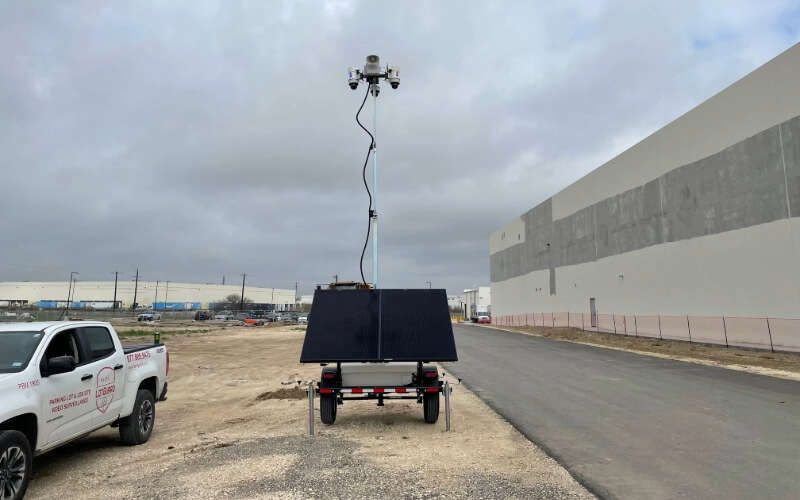
A completed retail store or office can often support pole cameras mounted on existing structures. A warehouse yard, vacant building, storage compound, or developing site without permanent power is better suited to self-powered mobile units that can be repositioned as needs change.
Visible cameras and active surveillance signage reinforce that deterrent on their own, giving businesses layered coverage that adapts as a property evolves.
|
Product |
Key Benefits |
|
Rapidly deployable, solar-powered surveillance available for rental across Florida |
|
|
Surveillance cameras mounted to existing poles or structures |
|
|
Perimeter and access point monitoring |
|
These commercial security systems work best when they're layered together and managed from one place.
Our cloud-based management platform brings connected devices into a single, centralized view. It gives property managers remote access to live and recorded footage and consolidates oversight across multiple Florida locations, which matters for businesses managing security at more than one site without a dedicated team at each one.
For commercial property owners, that centralization also means audit-ready reports can be pulled in a few clicks when insurers or legal counsel need documentation after an incident, and custom user permissions keep footage and alerts visible only to the team members who need them.
Getting Commercial Building Security Right in Florida
Florida's commercial properties don't all face the same risks, and they shouldn't all apply the same commercial security strategy. A retail store needs different coverage than a developing site with no fencing yet, and a warehouse tucked away from public view needs different security protocols than an office managing who gets past reception.
That variety is why we don't take a one-size-fits-all approach. Our mobile surveillance solutions can be configured around each property's layout, budget, threat level, and stage of development, whether that means a pole camera covering a loading dock, multiple surveillance trailers across a developing site, LPR at a vehicle entrance, or cloud-based oversight connecting several Florida locations.
A site assessment helps to identify security gaps, and a layered combination of lighting, access control, surveillance, and mobile security systems closes them in a way that fits the property's risk profile. Get in touch with WCCTV to talk through what that looks like for your Florida property.
