Florida's statewide property crime rate is around 1,420 incidents per 100,000 residents, which is 19.3% lower than the national average. However, although that figure can be reassuring on its own, it says very little about what happens to an individual business once it has been targeted for crime.
For example, a retailer dealing with repeat shoplifting or a construction jobsite manager who has lost a trailer full of tools faces costs that go well beyond whatever was physically taken or damaged during a crime. That wider impact, the part that shows up weeks or months after the initial incident, is what separates businesses that recover quickly from these offenses from those that don't.
In this article, we'll break down the types of property crime that Florida businesses are most likely to face, the financial and operational costs that follow, the toll it takes on customers and employees, and the monitoring strategies that prevent it from happening in the first place.
Common Property Crimes Against Florida Businesses
Property crime covers more offenses than most business owners expect, and the specifics matter because they determine how a case gets classified and prosecuted, as well as how much risk any given business is exposed to.
Theft and burglary
Florida law groups a handful of distinct offenses under the property crime umbrella, and each carries a different risk profile depending on the industry. Theft crimes range from grand theft down to shoplifting, while burglary can involve occupied or vacant properties under Florida Statute 810.02.
These offenses are classified as either misdemeanors or felonies depending on value and circumstance. Under Florida Statute 812.015, a retail theft spread across multiple locations escalated to a third-degree felony once the value taken across those incidents adds up to $750 or more within a 120-day period.
Business owners need to remember that once sites are hit, they tend to get hit again, and repeat victimization drives future risk.
Read more:
- Why Theft Remains One of Florida’s Most Common Crimes
- Florida Crime Trends: What the Latest Data Shows
Organized retail crime
Retail establishments are consistently among the businesses most frequently targeted for crime, which is part of why organized retail crime (ORC) has become such a visible cost for the sector.
Retailers reported an 18% increase in average shoplifting incidents in 2024 compared to 2023, and 67% said a transnational organized retail crime group was involved in thefts against their company in the past year, according to the National Retail Federation's 2025 Impact of Retail Theft & Violence report.
The National Association for Shoplifting Prevention puts the average shoplifter's odds of getting caught at about 1 in 49. This helps to explain why the problem keeps compounding rather than leveling off.
Motor vehicle theft
Employee theft, vehicle-related theft, and organized crews reselling stolen goods through online marketplaces all fall under the same broad umbrella, and small business owners without dedicated security guards or loss-prevention staff often carry a disproportionate share of the exposure.
Catalytic converter theft has also become a significant contributor to commercial property crime losses, particularly for businesses running vehicle fleets, since the precious metals inside (such as platinum and rhodium) can be stripped in minutes and sold to scrap buyers with little way to trace them back to a specific vehicle.
Read more:
- Understanding Property Crime in Florida (and Strategies to Prevent This)
- Understanding Vehicle Theft Trends Throughout Florida
The Cost of Property Crime for Florida Businesses After An Incident
The financial hit from property crime doesn't stop at the value of what was stolen or broken. Instead, it shows up later, in places that most businesses don't budget for.
Insurance and operational disruption
The stolen goods are usually the smallest lines on the bill. Businesses that are hit by repeated property crime often see their insurance premiums spike. In areas with persistent crime, commercial development slows down as investors grow more cautious about committing capital.
Operational disruption is one of the least visible costs, as a break-in or theft can often cause businesses to temporarily close while a site is repaired and investigated. For certain industries, such as construction jobsites, that can mean losing days on an already tight schedule.
Why the risk compounds over time
Economic conditions and business density both change how exposed any given location is, and neighborhood characteristics influence crime rates and business performance in tandem rather than separately. Property crime and violent crime often get treated as separate issues, but on the ground they tend to cluster.
For instance, a jobsite with blind spots in its coverage is exposed to robbery and burglary alike, and communities with elevated crime rates tend to see both categories rise together instead of in isolation. Elevated property crime then pushes operating costs up through a mix of security spending and insurance expense, and it can significantly cut into profitability over time.
Businesses that experience one incident are statistically more likely to experience another, meaning that the cost of an unaddressed vulnerability rarely stays a one-time expense. In some cases, perceived safety alone determines where a business chooses to locate, and persistent crime is sometimes enough to push a business to relocate entirely rather than continue absorbing the losses.
The Toll That Florida's Property Crime Takes on Customers and Employees
The damage resulting from property crime isn't only financial; property crime changes how people, both customers and staff, feel about a location, and that shift has its own cost.
The impact on customers
Businesses in high-crime areas tend to see fewer visitors and less consumer spending than other areas, which compounds the direct losses from theft or vandalism.
A shopping center known for repeated break-ins or a jobsite in a neighborhood with a reputation for crime both carry that association whether or not a given visitor has any first-hand experience of it, and that perception alone can change spending and foot traffic.
The impact on employees
Ongoing employee safety concerns can affect hiring and retention, as well as day-to-day productivity. When staff members don't feel safe on-site, it's harder to attract and retain a reliable workforce. This can be seen in employees working night shifts at a property with a history of break-ins or crews arriving at a construction jobsite that has been targeted for equipment theft before. Over time, these concerns often contribute to higher staff turnover.
Florida businesses also have a legal responsibility under Florida Statute 768.0701, which is the state's premises liability law covering criminal acts of third parties. Under this, courts weigh whether measures like adequate lighting, functioning locks, reinforced doors, and active monitoring were in place. Skipping these measures can expose a business to negligence claims when a third party commits a crime on the premises, particularly if a pattern of prior incidents suggests that the risk was already known.
Read more:
How Monitoring Can Help Mitigate Crime Exposure for Florida Businesses
Some industries carry more risk than others, and knowing where that exposure concentrates is the first step toward closing it. Construction, logistics, commercial real estate, utilities, and industrial sites share a common vulnerability, being that they're home to valuable, portable equipment left in places that aren't staffed 24/7.
A site security plan that addresses after-hours exposure is one of the most effective ways to mitigate that risk. Protecting high-value assets should also be an ongoing part of daily operations rather than a one-time setup after a bad incident.
For businesses, property managers, site supervisors, and other operators, there is a real need for visibility over a site and a fast response when an incident (or potential incident) is unfolding.
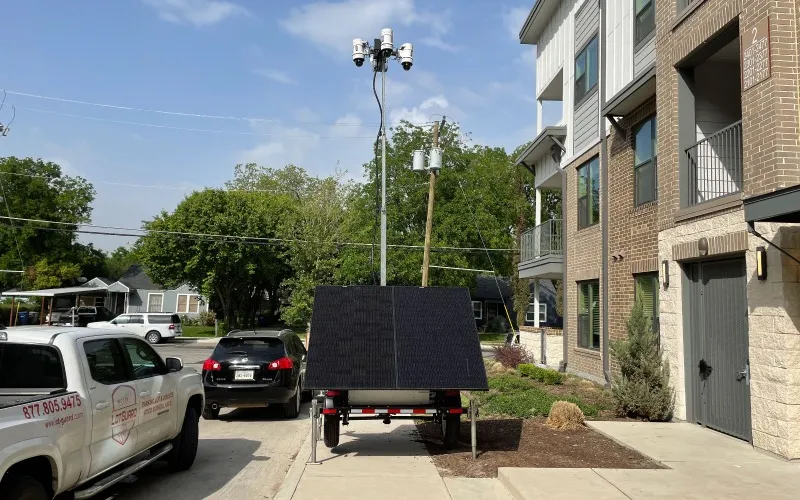
These tools are most effective layered together rather than used in isolation, and the table below breaks down how each of WCCTV's solutions can be layered together to mitigate crime exposure:
|
Solution |
Key Benefits |
Use Case |
|
Redeployable, solar-powered units available on a rental basis for ongoing or project-based coverage. |
|
Overnight coverage on construction jobsites, logistics yards, retail properties, and vacant commercial properties. |
|
AI-video analytics deployed on our trailers and cameras that flags unauthorized entry the moment it happens. |
|
Sites needing continuous coverage overnight, over weekends, and during holidays when sites are left unattended or are more at-risk of opportunistic theft, or without a dedicated on-site security team. |
|
License Plate Recognition (LPR) solutions Add-on surveillance system that logs vehicle activity around a site alongside a wider monitoring setup. |
|
Sites with frequent repeat visits from the same vehicle, or fleet-heavy operations. |
|
Flexible coverage of a defined area to accompany our trailers, where they're unable to fit. |
|
Smaller commercial properties, a single high-risk zone within a larger site, or urban spaces and events where fixed infrastructure is limited, and risk is elevated. |
Tying these tools together is our cloud-based management platform, which brings footage, alerts, live feeds, and reporting into a single view rather than leaving a business to piece together separate systems after something has already gone wrong.
For businesses managing more than one site across the Sunshine State, that shared visibility matters more than any single camera or detection tool on its own. Our comprehensive platform:
- Gives one team a live view across every property, not just where they're on-site
- Keeps alerts and footage in one single place, so nothing gets missed between systems
- Speeds up how quickly footage and incident data can be pulled together during an investigation
- Builds a documented history across sites, which is useful for insurance claims and repeat-offender patterns
- Scales easily as a business adds new locations without increasing the number of different vendors
- Cuts down the admin time spent logging into separate platforms
- Is remotely accessible from anywhere and any device
Protecting Your Florida Business Starts Before An Incident Occurs
Property crime's real cost to a Florida business is never just the cost of the item that was taken or damaged. Instead, it's the closure while the site is investigated, the premium that rises after a second claim, the project that slips a week behind schedule, and the employee who starts looking for work elsewhere because they no longer feel safe there.
None of these elements show up on the police report, but they do show up on the balance sheet. They also tend to compound if nothing changes after (or before) the first incident.
The businesses that are ahead of Florida's crime treat security as infrastructure from the get-go, which means taking an honest look at where a site or property is most exposed. Contact our team today to talk through how to do that (and what security setup is best) for your business.