
California's ports move nearly 40% of all containerized imports entering the United States, and much of that freight passes through the state's warehouses and distribution centers before reaching store shelves or moving further inland.
That concentration of goods movement makes California's logistics network among the most exposed in the country, and the exposure carries a high cost for supply chain operations.
Supply chain disruptions cost businesses an estimated $184 billion annually, according to the 2025 J.S. Held Global Risk Report, and that figure captures losses many logistics operators encounter on their own sites.
This exposure isn't limited to one type of incident, either. From cargo and vehicle theft to unauthorized access, the Golden State's logistics and distribution sites face threats that can disrupt operations, damage assets, and interrupt the flow of goods through the supply chain.
In this article, we'll cover 8 of the most common risks affecting these sites and outline how layered security and surveillance can help address them.
8 Security Risks Across California's Supply Chain Networks
California's ports, warehouses, and distribution centers move goods at a rate most other states can't match, making them a prime target for crime. The 8 risks below cover the most common ways that scaling turns into vulnerability, from freight sitting in a staging yard to a perimeter line running the length of several city blocks.
1. Cargo theft at ports, yards, and staging areas
Cargo theft is the risk most directly tied to California's status as the nation's busiest import gateway. CargoNet's 2025 annual analysis recorded California as the most affected state, with 1,218 confirmed cargo theft incidents that year.
The average value stolen per cargo theft incident also rose to $273,990, up 36% from the year before, as organized criminal groups increasingly target high-value freight rather than opportunistic loads.
Most of this activity happens while freight is stationary rather than moving, such as in staging yards, at loading docks, or in trailers parked overnight before the next leg of a shipment. Beyond the immediate loss, a stolen load means delayed deliveries and the added cost of replacing inventory that was already committed to a customer or downstream partner.
2. Vehicle theft across yards and loading areas
Vehicle theft compounds the cargo theft problem, since the same yards, parking areas, and loading zones that hold freight also hold the trucks, vans, and equipment that move it.
According to the National Insurance Crime Bureau (NICB), California recorded more vehicle thefts than any other state in 2025, with 136,988 vehicles stolen statewide, which is more than a fifth of the nation's total. The Riverside-San Bernardino-Ontario metro area, home to much of the Inland Empire's warehousing and distribution capacity, alone accounted for over 14,000 of those thefts.
A stolen forklift or delivery vehicle doesn't just cost the price of the replacement, which may already be a hefty expense. Instead, it takes a piece of daily warehouse operations offline until a replacement is sourced, insured, and back on-site.
3. Unauthorized access to fenced yards and storage areas
Unauthorized access is less about high-value freight and more about anyone entering a site who has no legitimate reason to be there. This may include trespassers cutting through a perimeter to former employees or contractors who still know a facility's layout.
The NICB identifies distribution centers and warehouses, alongside truck stops, ports, and rail yards, as among the locations most frequently targeted for this kind of activity. This is largely because these sites combine long stretches of fencing with limited staff coverage after-hours.
An unauthorized person on-site isn't only a theft risk. It's also a liability exposure, since an injury involving someone who shouldn't have been on-site can have its own legal, operational, and financial implications.
4. Perimeter breaches across large, open sites
Perimeter breaches are a persistent risk simply because of scale. Distribution centers and logistics sites can span dozens of acres, with fencing running for thousands of feet around open yards. As a result, a single blind spot is often all it takes for an intruder to get through undetected.
Gaps between buildings, unlit boundaries, and areas where visibility is blocked by freight or parked trailers all create opportunities a security guard on a set patrol schedule can miss.
Additionally, a breach that goes unnoticed for even a few hours can mean damaged equipment, compromised inventory, or materials that have to be written off completely. These are costs that land well beyond the price of the breach itself.
5. Internal theft and inventory management
Internal theft is harder to detect than a break-in because it doesn't leave the same obvious signs of forced entry. Missing inventory, shorted pallets, or small, repeated losses over time often point to activity happening from inside a facility rather than outside it. Without consistent oversight, these losses can go unnoticed for months.
Shrink reached $112.1 billion in losses across the industry in 2022, and internal and external theft together accounted for nearly two-thirds of that total, according to the National Retail Federation (NRF). Much of that inventory passes through a distribution center or warehouse space before it ever reaches a shelf, which puts logistics inside that exposure.
Left unaddressed, this kind of shrinkage distorts inventory counts, complicates audits, and erodes margins in ways that are difficult to trace back to a single cause.
6. Vandalism in transitional and underdeveloped zones
Vandalism tends to cluster in the parts of a site that are the least finished, sections under construction, newly leased parcels not yet built out, or areas earmarked for future expansion. These zones often sit without fencing, lighting, or fixed cameras for months at a time, since permanent security infrastructure is usually one of the last things installed rather than one of the first.
Beyond the repair bill, vandalism in a transitional zone can delay a build-out or expansion timeline, pushing back the date a site becomes fully operational.
7. Trailer and container theft in staging yards
Trailer and container theft is a variation on cargo theft, but the target is the entire unit rather than what's inside it, and the loss extends to the equipment itself.
CargoNet's latest data shows confirmed cargo theft incidents, which include trailer and container theft, rose 18% nationally in 2025. This reflects how organized groups increasingly target the equipment sitting in staging and laydown yards rather than freight already loaded for delivery.
Losing the trailer or container itself compounds the loss, since a delivery delayed by a missing unit can cascade into missed commitments further down the supply chain.
8. Exposure from large outdoor storage and parking areas
Large outdoor storage yards and parking areas carry a different kind of risk because the exposure isn't only criminal. These open areas sit outside the controlled environment of a building, meaning they're also exposed to wildfires and the regulatory requirements that come with operating a large facility in California.
Wildfires in August 2020 forced a shutdown of parts of Interstate 80, and Supply Chain Dive reports that logistics operators can reduce the impact of events like this by holding buffer stock outside the affected region during higher-risk periods.
The regulatory side carries its own weight. Warehouses of 100,000 square feet or more within the South Coast Air Quality Management District fall under the Warehouse Actions and Investments to Reduce Emissions Program.
As a result, operators who rack up continuing violations face penalties that can exceed $11,710 per day. Between crime exposure and compliance requirements, large outdoor footprints demand more active oversight than a smaller, enclosed site typically needs.
Read more:
- Cargo Theft, California: Why Logistics Sites Are High-Risk
- Which Industries Face the Highest Crime Risk in California?
- How Can Businesses Reduce Property Crime Risk in California?
- How Vehicle-Related Crime Impacts Businesses and Industrial Sites in California
- How Monitoring Technology Helps Prevent Environmental Violations in California
Layered Security Solutions for California Logistics and Distribution Sites
Addressing these risks calls for more than one type of camera or surveillance system. The table below breaks down how each of WCCTV's products fits into a broader security layer, from perimeter coverage to vehicle-level tracking.
|
Product |
Key Benefits |
Use Case |
|
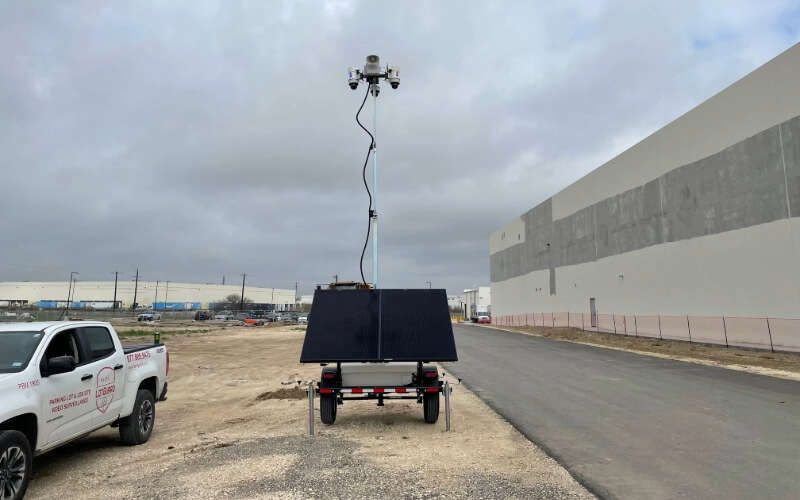
Redeployable units for yards and perimeters, paired with trained remote operators watching feeds 24/7 in real-time. |
|
Ideal for covering wide, open perimeters around distribution yards where fencing alone can't stop after-hours entry. |
|
Flexible, mounted coverage with trained operators watching the feed in real-time. |
|
Suited to dock doors, loading bays, and entry lanes where a permanent, adaptable vantage point matters more than mobility. |
|
License Plate Recognition (LPR) solutions An add-on security layer that logs vehicle plates automatically at every entry and exit point. |
|
Deployed at gate and exit points to log plate data on every truck or trailer moving through the site. This is useful for flagging unfamiliar vehicles or confirming a load matched the vehicle that left with it. |
|
AI-powered alerts that flag genuine activity in fenced yards and storage areas after-hours. |
|
Best suited to cover fenced yards and storage areas outside operating hours, triggering alerts on unauthorized movement rather than relying on staff to notice a breach the next morning. |
|
AI-video analytics can help catch visible smoke or flame before it spreads. |
|
May be worth considering for outdoor storage yards and parking areas where early visibility of smoke or flames could help teams assess potential fire risks and respond more quickly. |
Every security solution is important on its own, but California logistics operators rarely manage just one site or one type of coverage.
Our cloud-based management platform consolidates up to 81 camera feeds, bringing live and historical video feeds, detection alerts, and vehicle-related data into a single view. This allows operations and security teams to monitor an entire portfolio of California distribution centers from one place rather than switching between separate systems for each location.
Read more:
- How to Monitor Remote and Off-Grid Locations Across California
- Best Security Systems for California Logistics, Warehousing, and Distribution Sites
Protecting California's Logistics Network Starts with Visibility
California's logistics and distribution sites face a range of security and operational risks, often at the same time. When something goes wrong, the impact can extend well beyond the site itself, affecting assets, deliveries, and the wider supply chain.
The longer these issues go unnoticed, the harder they can be to contain. A single incident can lead to damaged equipment, delayed shipments, and unexpected costs that disrupt day-to-day operations.
We work with logistics and distribution operators across California to build coverage that fits each site's layout and risk profile, whether that's a single facility or a multi-site portfolio. Contact us about your site's security needs, and we'll advise where additional coverage could help.
