
Cargo theft losses across the United States surged 60% in 2025, reaching nearly $725 million. California was hit the hardest, accounting for 38% of all recorded incidents nationwide. The average loss per theft climbed to $273,990, driven by organized crime groups targeting high-value shipments as opposed to opportunistic smash-and-grab hits.
For warehouse operators, distribution centers, and logistics sites across the state, this shift means traditional security systems no longer match the scale of the threat. Large sites also bring their own complications, with sprawling perimeters, multiple loading docks, high employee turnover, and constant vehicle movement creating blind spots that a handful of fixed cameras can't cover.
In this article, we cover the risks facing California's logistics and distribution sites, the features that distinguish a modern security system from an outdated one, and the core solutions available for large-scale facilities. We also explain how integrated technology improves asset protection and business continuity across large, high-value facilities.
The Security Risks Facing California Logistics and Distribution Sites
California's warehouses, distribution centers, fulfillment centers, and logistics hubs each carry a slightly different risk profile, but the underlying pressure is the same across all of them. Every site holds high-value inventory in one place and relies on a large, rotating crew of employees and contractors moving through its gates.
That combination is what organized theft groups look for, and understanding how each risk plays out on the ground is the first step toward choosing the right protection.
Cargo theft and organized crime
Organized theft operations are increasingly targeting facilities with weak security, and warehouses and distribution centers were the most targeted location types in California in 2025. The facilities alone accounted for 36% of all incidents.
Organized groups often study a site's patterns before acting, watching for gaps in coverage around loading docks and trailer yards, testing how quickly staff responds to unusual activity, and timing their approach around shift changes or slow, unmonitored overnight periods.
Distribution centers are particularly exposed because they hold consolidated, high-value freight in one place, which is what makes a single successful theft more expensive than a typical retail backroom loss.
Logistics sites that operate as transfer points face a related risk, as trailers sit in a yard for hours awaiting a connecting load. This gives thieves a window to strike before the freight moves on.
Warehouses storing finished goods long-term see less in-transit crime exposure, but a breach there targets the facility itself rather than a single passing trailer.
Unauthorized access at loading docks and gates
Most warehouse incidents occur at loading docks and gates, where high volumes of vehicles, drivers, and third-party contractors move through entry points every day. A single unmonitored gate or dock door can undo the value of an otherwise well-secured perimeter.
This exposure grows with the number of dock doors a site operates, since each one needs its own line of sight. Distribution centers running dozens of simultaneous loads have far more of these moving parts than a warehouse with two or three bays, and it only takes one unescorted visitor slipping through an unmonitored door to create a loss.
Logistics hubs handling frequent third-party pickups face an added risk, since staff can't always verify on sight whether a driver is authorized to be there.
Internal theft and inventory shrinkage
Employee theft is a persistent driver of inventory loss in a warehouse environment, and internal theft typically accounts for roughly 29% of total shrinkage, according to the National Retail Federation. It often goes undetected for long stretches because employees understand where the blind spots sit and have ongoing access to inventory records.
Warehouses storing goods for extended periods are especially vulnerable to this slow but cumulative loss, since small, repeated thefts can go unnoticed between physical counts. Distribution centers with high seasonal turnover face a different version of the same risk, as new hires rotate through faster than protocols can be reinforced.
Sites relying heavily on manual pick-and-pack processes face even greater exposure, since every additional hand on a shipment is another opportunity for products to go missing before they reach the dock.
Vehicle and trailer theft
Trailers, forklifts, fleet, and other company vehicles left in yards overnight are common targets for thieves, particularly at sites without perimeter protection or after-hours monitoring. Southern California's dense concentration of logistics hubs makes these sites especially attractive to thieves who can move stolen equipment quickly through major freight corridors.
Logistics sites near major highways and ports also carry significant exposure, since a stolen trailer can disappear onto a freeway within minutes. Distribution centers running mixed fleets of owned and third-party trailers face added complexity, as it's not always obvious which vehicles belong on-site without a system that logs every plate at the gate.
Warehouses with fenced perimeters but no active monitoring often assume the fence alone is protection enough, but it only slows a determined thief rather than alerting someone that a breach is happening in real-time.
Read more:
Discuss Your Security Needs Today
Key Features to Look For in a Security System
Not every camera system is built for the scale of a warehouse or distribution site. These are the features that make the biggest difference for large, high-value facilities:
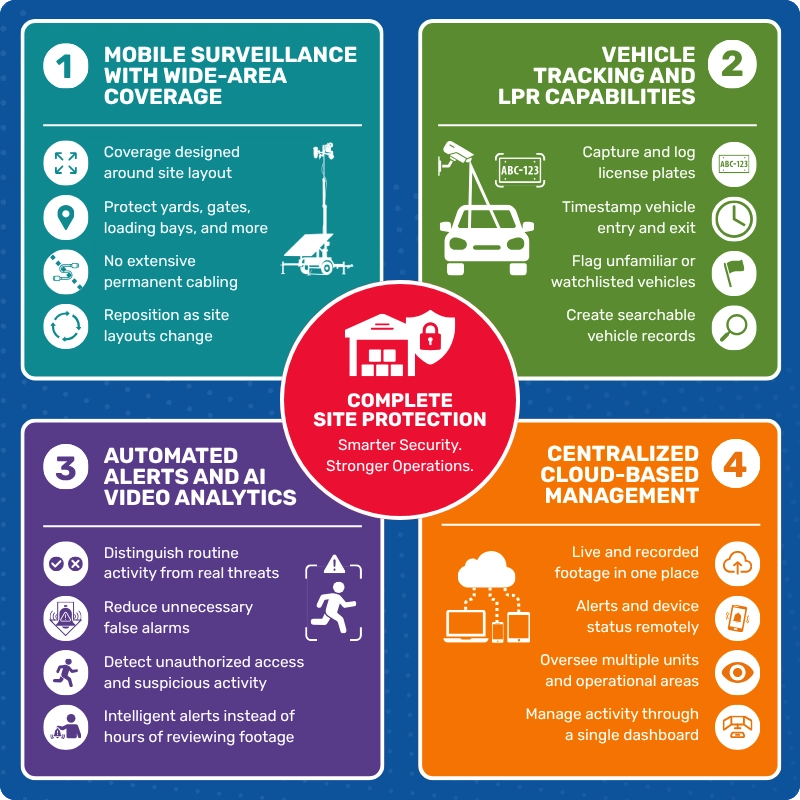
Mobile surveillance with wide-area coverage
The right camera count for a warehouse or distribution site depends far more on layout than on square footage alone. Perimeter length, the number of vehicle entrances and exit gates, loading bays, parking areas, and outdoor storage zones all influence the amount of surveillance needed. That's why 2 facilities of the same size may need very different coverage plans.
Mobile surveillance trailers extend coverage to yards and gates without the cost of running permanent cabling, and they can be repositioned as a site's layout changes.
Vehicle tracking
License plate recognition gives security teams a level of vehicle-related accountability that standard cameras can't provide on their own. It logs every vehicle entering and exiting a site, timestamps each event, and flags unfamiliar or watchlisted plates automatically.
For sites with constant truck and trailer movement, that record turns a vague description of a "white van around 3 p.m." into a searchable, verified entry.
Automated alerts and AI-video analytics
AI-powered analytics enhance video surveillance by distinguishing between normal activity at your warehouse and genuine threats, which cuts down the number of false alarms while still flagging real ones.
This layer of intelligence can cover several risks at once, from unauthorized activity at a fence line to suspicious movement on a site after-hours. Additionally, this gives a site a single source of alerts instead of a wall of unreviewed footage.
Centralized, cloud-based management
Remote monitoring only works well when footage from every device is easy to access. A cloud-based management platform brings live and recorded footage, alerts, and device status into one place, making it easier to oversee large warehouse sites with multiple units, loading areas, and/or operational zones.
Instead of switching between separate systems for each site, security teams can view activity across the entire site through a single dashboard, giving them a clearer picture of what's happening and helping them respond more quickly to incidents.
Read more:
Security Solutions for California Logistics and Distribution Centers
The right combination of technology depends on a site's layout, but these are the core solutions that WCCTV provides for logistics, warehousing, fulfillment, and distribution environments:
|
Solution |
Key Features |
Use Case |
|
Redeployable, solar-powered units available for rental for yards and perimeters, paired with trained remote operators watching feeds 24/7 in real-time. |
|
Monitoring trailer yards, gates, parking areas, and open storage areas overnight |
|
AI-video analytics that continuously monitor fence lines, loading areas, gates, and restricted zones for unauthorized entry. |
|
Flagging and responding to unauthorized entry at fence lines and gates before it escalates |
|
License Plate Recognition (LPR) solutions License plate capture as an add-on to site coverage. |
|
Tracking trailer and vehicle movement at gates, on-site, and at site perimeters |
How Integrated Security Improves California Business Continuity
A layered system does more than deter theft as it changes how a logistics operation runs day-to-day.
- Reducing loss and insurance exposure: Layered security combines multiple technologies for better protection, which matters when a single incident can result in a loss of over $200,000. Regular audits of a security system help teams address any vulnerabilities before they turn into claims, keeping both losses and premiums lower over time.
- Supporting compliance and workplace safety: California regulations require warehouses to meet workplace safety requirements, and video documentation makes compliance easier to demonstrate during an inspection. Training employees on security protocols alongside these systems supports both loss reduction and a safer work environment.
- Enabling faster incident response: Real-time alerts let security teams respond to breaches while they happen rather than reviewing them after the fact. Because activity is captured externally, at the perimeter or in the yard, before an intruder ever reaches the building, teams have a better chance of preventing a theft rather than just responding to one.
- Protecting multi-site operations: Distribution networks with several sites across the state benefit most from centralized management, since a single team can maintain consistent coverage standards without traveling between locations to check on individual systems.
Protecting California's Logistics Sites for the Long-Term
The size of California's logistics industry is exactly what makes it a target. Warehouses and distribution centers store high-value inventory, operate 24/7, rely on a large and rotating workforce, and move vehicles through dozens of access points daily, and each of these factors gives organized criminals more chances to find a gap.
The businesses that stay ahead of these crimes are those that combine mobile surveillance with active and consistent monitoring, with centralized management covering the whole site rather than isolated corners.
With average losses now approaching $274,000 per incident, closing the gap costs far less than leaving them open. Talk to our team today about a security solution built around your site's layout and risk profile.

