
The Department of Justice estimates that between 94 - 99% of police alarm calls are false, and in Los Angeles alone, the city responded to over 50,000 false alarm incidents in 2023, generating $8.03 million in cost-recovery fees just to offset the burden on police resources.
This may help to explain why so many organizations running multiple sites across California struggle to trust their own security systems, because when the overwhelming majority of alerts turn out to be nothing, teams stop treating alerts with urgency before a real incident happens.
The loss of urgency becomes almost unavoidable for organizations juggling several kinds of sites at once, whether that's a construction project, a logistics facility, an industrial yard, or a commercial property, each running its own cameras, its own alarm panel, and its own reporting process, with nobody pulling it all into one overarching security picture.
In this article, we'll cover why fragmented systems create blind spots, what a centralized approach changes about incident response, the technology that makes it possible, and the California-specific compliance factors worth building into any multi-site security plan. We'll also discuss how WCCTV's cloud-based platform brings all of this together for organizations operating across the state.
The Blind Spots That Come With Managing Multiple Sites
A single jobsite is easy to oversee, since there's only one location to track and one clear escalation path for whoever needs to be notified when an incident occurs.
But that approach breaks down once an organization is running 6, 10, or even 20 locations spread across Southern California and the Central Valley, because every additional site adds another login, another export format, and another point where a problem has to be flagged before anyone can act on it.
This is typically where multi-site security programs begin to lose consistency, often before anyone identifies the gap. Security metrics like incident frequency and response time are only useful if someone is actually tracking them consistently, and that rarely happens when the job of pulling data from 6 separate systems into one view has never been formally assigned to anyone.
Response times increase because word of an incident takes longer to reach the person in a position to authorize a response, and every extra minute in that chain is a minute a criminal has to finish the job and leave.
Currently, cargo and construction jobsites carry this risk more heavily, since California is the state most impacted by cargo theft across the United States. Construction jobsites face a parallel problem, with California ranking among the states that are also worst affected by jobsite theft in the country.
When a company operates several logistics or construction yards across the state, and each one is monitored differently across multiple locations, that risk multiplies with every site added to the portfolio.
What Fragmented Security Costs California Businesses
Disconnected systems cost more than most budgets account for, since staffing a security officer at every gate is expensive to sustain and difficult to scale, particularly across a growing footprint of sites.
Because of this, centrally monitored video surveillance tends to reduce costs compared to maintaining static guarding at every single location. Automating the routine of watching a security feed, rather than paying someone to do it separately at each site, frees up budget that can be redirected toward protecting the assets that matter most to businesses and improving security coverage where it actually matters.
The harder cost to see is the one buried in the data. When systems don't integrate, spotting patterns such as the same vehicle showing up at several of a company's sites within the same week requires someone to manually cross-reference incident logs across platforms that were never designed to share information.
As a result, that kind of pattern usually goes unnoticed until it has already cost the business multiple times. Data collected through separate, disconnected systems is also harder to keep compliant, which becomes its own liability once the California Consumer Privacy Act (CCPA) is considered.
Lastly, false alarms tend to compound the problem. Commercial properties can see false alarm rates run as much as 3 times higher than residential properties, largely because more people share responsibility for arming and disarming the system and the system itself tends to be more complex.
Every one of those false alarms still requires someone to notice it, confirm what triggered it, respond appropriately, and log the outcome for later review. Across a dozen sites running independent systems, that overhead adds up quickly.
Read more:
- How Smart Security Systems Benefit Construction Jobsites
- Vendor Sprawl in Construction IT: Why Consolidated Monitoring Matters
Bringing Multiple Sites Into One View
Our centralized, cloud-based management system platform pulls surveillance feeds, alerts, incident reports, and site data from every location into a single dashboard, so security management teams see the entire portfolio at once instead of logging into different systems for each site. Everything arrives in the same format with the same context, regardless of location.
System consolidation matters most in the moment an incident is actively happening. Centrally monitored video surveillance allows suspicious activity to be flagged and verified quickly, often before it has a chance to escalate into an actual loss.
Additionally, a manager can pull up every connected site through one interface and see exactly what's happening at each one, without needing to be on-site or logged into separate systems. This is because the process, escalation path, reporting format, and the underlying platform never change from site to site.
That consistency is beneficial because response delays are usually caused by inconsistency between locations rather than the technology itself.
Scalability follows the same logic. Adding a new site to a cloud-based system means provisioning another feed into the same dashboard rather than setting up an entirely different monitoring setup from the ground up, and cloud infrastructure gives security teams the flexibility to grow a portfolio of sites without growing complexity.
Read more:
- What Does System Integration Really Mean and Why Does It Matter?
- The Benefits of Integrating Your Security and Communications Systems
How Mobile Surveillance Technology Enables Multi-Site Security Management in California
Getting one new site up and running in a growing California portfolio usually means asking the same set of questions: how fast can coverage go up, who's watching it once it's live, how the layers of detection work together, and how it all connects back to everything else in the portfolio. But when this is applied to multiple sites at once, those questions compound.
Consolidating security across multiple sites depends on the right combination of hardware and software working together in one platform, rather than treating each product as its own separate system.
Here's how WCCTV creates a centralized setup for your sites:
Getting coverage up fast
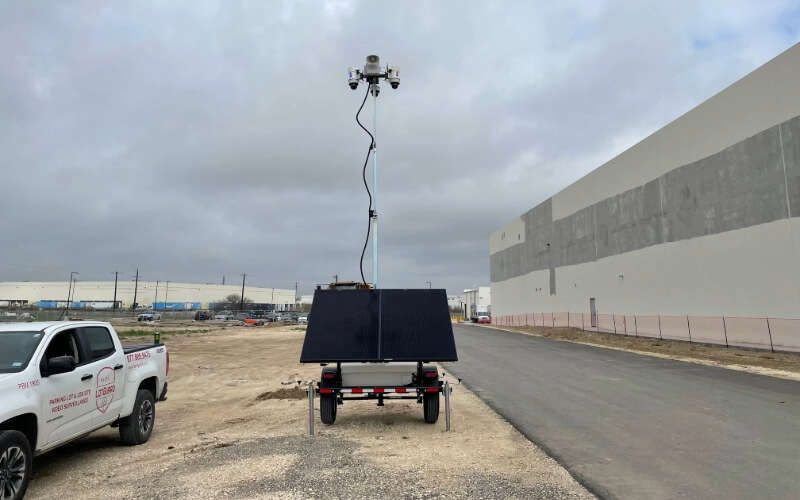
Within hours, coverage can go up using a Solar Surveillance Trailer, which is a self-contained, solar-powered unit that can be positioned anywhere on a site without relying on fixed power or wiring. This makes them a natural fit for active job sites, logistics yards, or vacant lots that don't yet have permanent infrastructure in place.
A single unit delivers near-360° coverage, so one trailer often does the job that would otherwise take several fixed cameras. It's also available for rental across California, so scaling a portfolio doesn't mean building out an entirely new setup at every site.
Because they connect to the same cloud-based platform as other solutions, a trailer deployed at a jobsite in Sacramento reports through the same dashboard as one covering a distribution yard near Fresno.
Where space is tighter, such as a loading dock or a building perimeter, a Pole Camera mounts directly onto an existing structure instead, adding a discreet layer of coverage without extending the site's footprint, and feeding the same live remote view back to one central dashboard.
Actively monitoring a multi-site portfolio
With cameras in place, the next question is who's watching them and whether monitoring is ongoing. Each of our mobile surveillance solutions is covered by 24/7 live video monitoring, with trained operators reviewing activity across every connected site in real time.
The moment an alert is triggered, an operator confirms whether it's a genuine threat and follows the same escalation process no matter which site it comes from.
Smart Detection Systems are built directly into our trailers and cameras, running AI-driven analytics that automatically recognize conditions like intrusion, missing personal protective equipment, early signs of smoke and fire, or unauthorized access after hours, with detection rules configured to match each site's layout. Together, the two cut down the false alarms that erode trust in a system over time.
Knowing who's on site
Cameras and detection systems cover what's happening on site, but vehicle activity often tells its own story, especially across a portfolio where the same vehicle could be showing up somewhere it shouldn't.
For sites that need it, License Plate Recognition (LPR) can be added to a trailer or pole camera, logging every vehicle entering and exiting and building a searchable record over time. That record cuts down on manual gate checks and makes it possible to spot a flagged or repeat vehicle turning up at more than one location, something that's nearly impossible to catch manually across separate systems.
However, none of these pieces work in isolation. Coverage, monitoring, detection, and vehicle tracking report through the same cloud-based platform, so a trailer in Sacramento and a pole camera on a Fresno loading dock show up in the exact same view. That's what makes it possible to manage a growing portfolio without managing a growing set of problems.
Read more:
- Cost Benefits of Deploying Solar Surveillance Trailers
- Ten Key Benefits of Mobile Surveillance Units
- Top 8 Features of Solar Surveillance Trailers
- The Benefits of License Plate Recognition (LPR) Cameras
Building a Framework That Holds Up Across California Sites with WCCTV
Technology only works as well as the framework that's built around it, and a handful of practices tend to separate multi-site security programs that run smoothly from the ones that fall apart.
- Standardize security protocols across every site. Consistent access control systems, incident response steps, and reporting formats mean staff at one location can step into another without relearning the whole system from scratch.
- Run site-specific risk assessments on a regular schedule, since a warehouse near a major freight corridor faces a different risk profile than a remote construction site, and a security framework needs to reflect that difference rather than applying the same template everywhere.
- Define clear roles and escalation paths for each location. That way, when an alert is detected, someone knows it's their responsibility to respond, with a designated contact assigned for every alert so there's never ambiguity about who acts first.
- Run joint emergency exercises across sites. This is because coordinated drills tend to reveal gaps in communication between locations that day-to-day operations rarely expose on their own.
- Review and update security policies on a set schedule, since threats and site conditions change over time and a policy written 2 years ago may no longer reflect what a jobsite security plan needs in the moment.
Taking California Security Compliance Into Account for Multi-Site Operations
Operating across multiple California locations adds a layer of regulatory complexity that security leaders need to plan around directly rather than treat it as an afterthought.
Data collected through surveillance and access control systems falls under the California Consumer Privacy Act, and the penalties for falling short are far from trivial. As of 2025, administrative fines under the CCPA run up to $2,663 per violation, rising to $7,988 for intentional violations or those involving the data of consumers under 16.
For an organization managing footage and access logs across a dozen sites, inconsistent data handling at even one location can create exposure that touches the whole portfolio instead of only where the gap occurred.
Read more:
- 7 Costly Compliance Mistakes US Construction Firms Can't Afford
- The Overlap of CPRA, OSHA, and Federal Rules
- How Digital Tools Ease Audit Prep and Cut Reporting Time in Half for Your Jobsite
The Bottom Line for Multi-Site Security Management in California
Managing security across multiple locations in California without a centralized system means accepting blind spots as the cost of doing business, and that cost shows up in several areas.
It shows up in response times that stretch out because word of an incident has to travel further, in staffing budgets stretched thin covering sites that could be monitored more efficiently through one system, in compliance risk that multiplies with every site, and in patterns that go unnoticed because no one has the visibility to catch them in time.
None of that is inevitable. In fact, a cloud-based platform that can bring surveillance, alerts, reporting, and site data into one dashboard turns a portfolio of scattered locations into something a security team can easily oversee.
If you're ready to bring your sites into a single view, get in touch with our team to talk through what centralized security could look like for your organization.
