Between 2021 and 2025, the Division of Occupational Safety and Health, California's workplace safety regulator (Cal/OSHA), issued roughly 90 trench safety violations tied to worker injuries and fatalities. This serves as a reminder that construction compliance in California is far more than paperwork. It can be the difference between a routine jobsite and a preventable tragedy.
Beyond safety, compliance governs nearly every part of a project, from how workers are protected on-site to how subcontractors get paid. For general contractors and subcontractors working across the state, from San Francisco to San Diego, keeping up with new legislation and existing regulations simultaneously has become a full-time responsibility in itself.
In this article, we break down the construction laws currently shaping California compliance, the safety and environmental requirements tied to them, and how better jobsite monitoring supports accountability and audit readiness across construction environments.
California Legislature Governing Construction Compliance
Several new statutes took effect on January 1, 2026, and together they changed how private construction projects are paid and documented. These rules sit on top of the safety and environmental obligations already in place, so compliance now reaches almost every stage of a project.
Here's what has changed for construction projects across California and what it means on the ground.
Senate Bill 61: A 5% retention cap on private projects
Retention is the share of each payment an owner holds back until work is finished, and the rules around it have tightened. Under SB 61, retention on most private construction contracts is now capped at 5% of the contract price, down from the 10% that had been the norm until the start of 2026.
The cap also applies down the payment chain, which means general contractors can't withhold more than 5% from their subcontractors. This new limit applies only to contracts signed on or after January 1, which means older agreements keep their original terms until the project comes to a close.
Senate Bill 440: A fixed process for change orders
Change orders and delay claims used to vary contract by contract, and that inconsistency bred plenty of disputes. The Private Works Change Order Fair Payment Act, introduced by SB 440, establishes a mandatory claim resolution process for submitting and resolving change-order and time-extension claims on most large private projects.
Strict documentation and timely notice now have real consequences, because a missed deadline can affect what gets paid. Therefore, contractors who keep clean, dated records are in a far stronger position when a claim lands.
Senate Bill 517: Subcontractor disclosure on home improvement work
In the past, homeowners often had no idea who was doing the work on their property. SB 517 changed that by requiring disclosure of whether subcontractors will be used. If a subcontractor performs work valued at more than 50% of the estimated project cost, that subcontractor's name must appear in the contract.
Even so, the prime contractor stays responsible for completing the project to specification. That makes accurate documentation very important, especially on residential jobs where owner expectations and contract terms can quickly become points of conflict.
The 2025 California Building Standards Code
Every permit application filed on or after January 1, 2026 now falls under the 2025 California Building Standards Code, which pulls wildfire-resistant construction into a new standalone Wildland-Urban Interface Code.
However, the change extends beyond new builds. Alterations and additions, as well as repairs, fall under the California Existing Building Code, which is Part 10 of Title 24, so renovation work is measured against the updated standard the moment a permit is pulled.
That makes field verification and documentation more important than before, because inspectors are checking every stage against a much stricter California Building Code.
SB 779: Higher penalties for unlicensed work
Licensing enforcement is about to become much more expensive for anyone cutting corners. Beginning July 1, 2026, SB 779 raises the minimum civil penalty for unlicensed activity from $200 to $1,500, with other violations carrying minimums from $500 to $1,500, depending on the offense.
The board can also adjust these figures for inflation every 5 years. For legitimate operators, it's now essential to keep license numbers up-to-date and classifications correct.
Read more:
- Construction Jobsite Compliance Failures and Lessons Learned
- 7 Costly Compliance Mistakes US Construction Firms Can't Afford
Safety Requirements That Define Day-to-Day Compliance in California
Safety compliance in California is judged as much by records as by site conditions. A jobsite can be physically safe yet still draw a citation when the paperwork behind it doesn't exist, so here's how to stay compliant in 2026 and beyond.
The Injury and Illness Prevention Program
Day-to-day safety compliance in California starts with a written Injury and Illness Prevention Program (IIPP). Employers have been required to keep one for more than 30 years, and this is how the state expects jobsite managers to find and correct hazards before anyone gets hurt.
The difficulty comes with having a running plan rather than only having the documentation on paper. Failure to maintain an effective IIPP is the most frequently cited Cal/OSHA violation year after year, which means a jobsite can look safe and still end up with a citation when the program isn't being followed.
Trenching and excavation
Any trench 5 feet deep or more requires cave-in protection and a competent person to inspect it before entry. The fines for skipping these steps can be severe. In 2024, two plumbing firms were cited nearly $530,000 after a San Mateo trench collapse that seriously injured a worker.
Fall protection
Fall protection follows the same logic as trenching, and in California, falls and related incidents caused 43 of the 81 construction deaths recorded in 2024.
The safeguard has to be physically in place and documented, because its absence on paper is what an inspector records after an incident. Current IIPP records and dated competent-person inspections are what hold up when an inspector walks the site, and they're almost impossible to reconstruct convincingly after the fact.
How prior warnings escalate penalties
Penalties also climb quickly once a hazard has already been flagged. In one case, Cal/OSHA had warned a contractor just weeks earlier at a different jobsite for failing to provide shoring and a safe way out of an excavation. Later, a collapse at another one of his jobsites resulted in a worker's death.
The agency then issued $371,000 in citations for willful-serious violations in San Francisco. A documented prior warning is what turns a serious citation into a willful one, and the penalty scales accordingly.
Environmental Obligations on California Jobsites
Environmental compliance in California starts the moment the ground is disturbed, which is sometimes long before any structure goes up. It runs across waste, water, air, and noise, and each area comes with its own paperwork that an agency can ask to see.
The pattern is the same throughout. Rules set the standards, and documentation is what shows whether the jobsite actually met them.
Construction waste diversion
CALGreen sets the baseline for what leaves a jobsite, stating that covered projects must recycle or salvage at least 65% of nonhazardous construction and demolition waste, and enforcing agencies can require a waste management plan plus verifiable proof of where the material went.
Recyclable materials, concrete, wood, and cardboard all count toward the target, but only if the diversion is documented with weigh tickets or hauler records. Without that trail, agencies can hold up closeout even when the physical work is finished.
Stormwater and the Construction General Permit
Water obligations change depending on the size of a jobsite. Any project that disturbs 1 or more acres of soil must obtain coverage under the Construction General Permit and prepare a Storm Water Pollution Prevention Plan, which has to be written by a Qualified SWPPP Developer.
The permit doesn't stop at paperwork. It carries a risk-based set of best management practices and sampling obligations that need to be logged. A plan on file means very little if the inspection records behind it are too thin, which is where most stormwater findings originate.
Air quality and dust control
Air quality is the third area contractors have to manage, and it's enforced at the local level. Regional air districts govern construction dust, and rules like South Coast's Rule 403 prohibit visible dust from crossing the property line and require active control measures such as watering and reduced haul-road speeds.
Worker exposure to dust is covered separately under Cal/OSHA's Title 8 Respirable Crystalline Silica Standard for Construction, which sets a permissible exposure limit for fine dust generated by cutting, grinding, or drilling silica-containing materials like concrete and requires monitoring and respiratory protection once that limit is reached.
For larger sites, that often means a dust control plan being approved before work begins, not after a complaint comes in. Because PM10 and related fine particles carry real health risks, enforcement can move quickly, and continuous readings are easier to defend than a single spot check taken after someone raises a concern.
Noise limits
Noise is regulated locally rather than through a single statewide rule. Most California cities and counties set permitted construction hours and decibel limits through their own municipal codes, and these thresholds vary from one jurisdiction to the next.
However, worker-facing noise exposure sits under a separate standard. Cal/OSHA's Title 8 regulations set a permissible noise exposure limit of 90 decibels over an 8-hour shift, and jobsites that exceed it need administrative or engineering controls in place.
As with dust, a logged decibel reading tied to a timestamp is what supports a jobsite's position if a noise complaint or inspection follows.
Read more:
- Air Quality Data Management: Turning Sensor Data Into Actionable Insights for Jobsites
- How Monitoring Technology Helps Prevent Environmental Violations in California
How On-Site Monitoring Strengthens Accountability and Audit Readiness
In California, compliance is judged on evidence rather than intent. A safe trench, a diverted load of debris, a timely change-order notice, and a completed safety briefing only count if you can produce the record that proves them. Inspectors, owners, auditors, and insurers work from those records rather than what happened on the day.
This is why continuous oversight is replacing periodic checks. A weekly walk-through or a hand-kept log leaves gaps that are hard to explain later, and records reconstructed after an incident rarely hold up as well as ones captured in real-time as events happen.
A jobsite security plan built around continuous visibility gives you a defensible record long before anyone asks for one.
The monitoring tools below line up with the duties that jobsite and project managers need to meet. Each runs as part of a single, integrated system rather than separate standalone systems, and each turns a requirement that would otherwise be tracked manually into a continuous, time-stamped record.
|
Monitoring Capability |
Compliance Area It Supports |
What It Documents |
|
Worker safety (Cal/OSHA, IIPP) |
Real-time warnings and time-stamped reports when workers are missing required safety equipment |
|
|
Air quality and dust (CARB, South Coast Rule 403) |
Continuous particulate readings measured against permit limits, with automatic flags as levels approach the threshold |
|
|
Noise limits (Cal/OSHA Title 8, local noise ordinances) |
Logged sound levels measured against local decibel limits, with automatic flags as levels approach the threshold, ready for community and regulatory reporting |
|
|
Stormwater and overall jobsite conditions (Construction General Permit, SWPPP) |
Recorded conditions that affect runoff and safety-related work stoppages |
|
|
Fire safety (California Fire Code) |
Early warning through AI-video analytics, logged for incident records |
|
|
Audit readiness |
Continuous verified footage showing what happened and when |
Pulling these together is our cloud-based management platform, which brings security, safety, environmental monitoring, and project overview into a single view. Instead of gathering footage, sensor logs, permit records, and inspection notes from separate systems when an audit is due, you can pull them from one integrated dashboard, with incident reports generated at the click of a button.
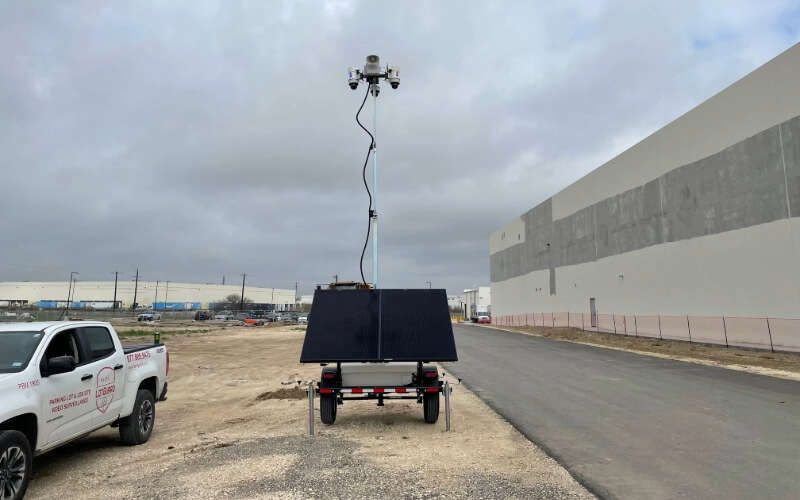
On sites without power or permanent infrastructure, the same tools run from our Solar Surveillance Trailers, which are available for rental across California, so coverage is in place from the first day of ground disturbance.
Building Compliance Into How Your California Jobsite Runs
California's compliance regulations aren't going to loosen any time soon, meaning it's important to treat compliance as something built into daily operations rather than reconstructed at audit time. The contractors who document as they go and let their monitoring do the recording for them are the ones who spend audit week answering questions instead of hunting for answers.
If you want your jobsite generating its own audit trail as work progresses, talk to us about your construction jobsite security needs.