
California construction teams and businesses know that environmental compliance is non-negotiable, but are often unaware of how much their compliance risk comes down to visibility.
California's water regulations alone resulted in roughly $29.1 million in penalties across more than 1,600 compliance and enforcement actions between 2024 and 2025, according to the State Water Resources Control Board, which is just one of several agencies with enforcement authority over the average site.
Environmental monitoring technology helps operators to close that visibility gap, as it collects continuous environmental data and sends alerts the moment conditions change. It also helps to maintain a documented, time-stamped record of site conditions that stands up to regulator scrutiny and helps protect the state's natural resources.
In this article, we'll look at how that works in practice, and where monitoring fits within California's most heavily enforced regulations.
California Environmental Compliance: What Operators Need to Know
California's environmental enforcement spans air, water, waste, and noise, often with overlapping jurisdiction.
These frameworks apply across California industries, but construction and critical-infrastructure sites tend to trigger them most often, since ground disturbance, temporary permitting, and proximity to the public raise the stakes of compliance.
|
Framework |
What It Requires |
|
Public agencies must assess a project's likely environmental impact, covering air quality, noise, water, and more, before approving permits. Construction and demolition projects are reviewed especially closely because ground disturbance is a direct trigger for CEQA review, and temporary or critical-infrastructure sites often face additional scrutiny during this review process. |
|
|
The California Air Resources Board (CARB) |
Facilities and larger construction operations must report emissions annually, and California's 35 local air districts each enforce their own separate thresholds and permits on top of state rules, meaning a single jobsite can fall under more than one set of limits at once depending on its location and scale. |
|
The Department of Toxic Substances Control (DTSC) |
Jobsites handling hazardous materials, including many construction and demolition sites, face strict permitting requirements, and certain facilities must maintain monitoring records for up to 30 years after closure. |
|
National Pollutant Discharge Elimination System (NPDES) and State Water Resources Control Board (SWRCB) |
Construction jobsites over 1 acre need a site-specific stormwater pollution prevention plan and must carry out multiple physical sampling events across the year, with rainfall and site conditions directly affecting when those events are triggered. |
Dust from construction and earthmoving is one of the categories regulators return to most often. South Coast Air Quality Management District's (AQMD) Rule 403 (Fugitive Dust) appears as a repeat line item across its penalty reports month after month.
This is a clear sign of how much value continuous, real-time monitoring can add on active jobsites where conditions can change well before a scheduled inspection would ever catch them.
Read more:
How Monitoring Technology Supports Proactive Compliance in California
Monitoring technology prevents violations by working across 3 points of failure at once:
- It detects a condition before it becomes a breach
- It alerts the right person while there's still time to act
- It logs the evidence that proves the response happened
Real-time monitoring changes compliance from a reactive scramble into a focused, daily habit. Instead of waiting for a scheduled inspection to reveal an issue, teams get continuous data they can act on the same day it appears, closing the gap between a risk forming and a regulator finding it.
Air quality monitoring
Our Air Quality Sensors measure particulate matter (PM1, PM2.5, PM10), CO₂, carbon monoxide (CO), and total volatile organic compounds (TVOC) in real-time, flagging readings the moment they approach a permit threshold. When levels spike during excavation or heavy equipment use, the alert reaches your team, helping prevent airborne pollutants from reaching a sensitive receptor like a school or residential boundary.
This data supports the particulate standards the EPA sets nationally, giving operators a benchmark that regulators already recognize.
Built for rugged jobsite conditions, they feed real-time readings into our cloud-based management platform. That way, teams aren't juggling a separate app or login just to check air quality, but rather accessing all information from one, easy-to-use dashboard.
The data helps operators prove compliance with local air district rules and respond quickly if levels climb near a sensitive boundary, like a school or residential area. As a result, they help operators meet public safety expectations for workers and nearby residents alike.
Noise monitoring
Our Noise Monitoring Sensors measure ambient noise from 30dB to 130dB across a 20Hz to 12.5kHz frequency range, logging decibel levels 24/7 and pushing automated alerts when readings approach the preset threshold.
That means a crew running heavy machinery and equipment triggers a notification, not a neighbor complaint. Sensors run continuously regardless of weather or access to fixed power, feeding readings into our online dashboard.
Continuous logs give operators evidence of compliance and an early warning if equipment or activity is pushing past permitted thresholds. That same log can settle a neighbor complaint quickly, since operators can show exactly what the decibel reading was at the time in question rather than relying on guesswork or memory.
Weather tracking
Our Weather Monitoring Stations track wind speed (0 -110 mph), temperature (-4°F to 122°F), humidity (10 -99%), rainfall, dew point, and lightning activity, feeding all of it directly into your dashboard. That gives crews the data to adjust dust suppression, pause earthwork before conditions create a runoff event, or trigger an evacuation protocol when lightning is detected.
This data supports the engineering controls that many sites already have in place, since heavy rain and high winds can quickly influence soil erosion and stormwater runoff patterns.
Because our weather sensors run on solar power and are built to withstand extreme conditions, they can be deployed at remote or temporary sites without needing a fixed power source. Wind data alone can be the difference between a controlled demolition and a dust complaint from a neighboring property.
Automated alerts and real-time visibility
If you rely on manual checks, automated alerts and real-time visibility can help reduce the risk of missing a threshold breach. Our automated alert system pushes notifications the moment a reading crosses a permitted limit, routing them to the site manager, the compliance lead, or both depending on how the dashboard is configured.
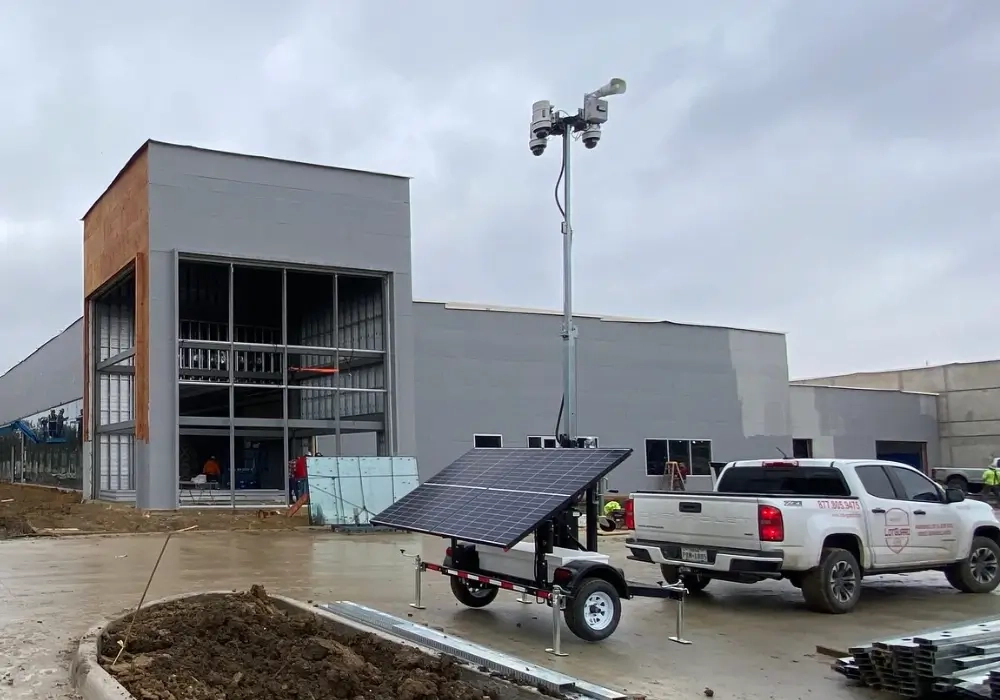
Air quality, noise, and weather sensors mount directly onto our Solar Surveillance Trailers, so environmental data feeds into the same platform as your site's video and security footage rather than a separate system.
That data comes together in a single cloud-based management platform, which is the same live view our Project Insights tools give teams that are tracking progress and activity, so site managers and compliance teams can respond immediately rather than reviewing a report days later.
Our dashboard also doubles as a record for audits, giving operators a documented history to hand over if a regulator asks for evidence of ongoing monitoring or supporting research into site-level trends.
Read more:
How to Build a Complete Compliance and Security Ecosystem That Works Across Your Site
Environmental monitoring and physical security carry equal weight in a compliance program. The strongest setups look for ways to integrate the two, so environmental data and physical security fill the gaps that the other can't cover alone.
For instance, solar-powered surveillance trailers run on renewable energy and can carry environmental sensors alongside their cameras. This gives operators a single deployable unit that covers both site security and environmental data collection.
To extend this coverage, smart detection systems add further layers to cover safety and security concerns beyond environmental data that often accompany environmental non-compliance, such as illegal dumping. These systems include:
- Smoke and fire detection to flag hazards before they escalate
- PPE detection and monitoring to support jobsite safety compliance
- Intrusion detection to flag unauthorized entry near a sensitive zone
Benefits of Real-Time Environmental Compliance for California Operators
Real-time visibility allows operators to respond faster to environmental risks before they escalate into violations or project disruption. Operators who can solve environmental problems in real-time, rather than after a regulator flags them, protect both their project timeline and their community relationships.
Continuous monitoring gives teams documented, time-stamped evidence that air, noise, and weather conditions were being tracked at the moment a reading changed, not reconstructed after the fact. This matters if a regulator ever questions what happened or certain readings on a given day.
For general construction site security programs, environmental monitoring has become as central to risk management as physical security itself.
Bringing environmental data into the same system as physical security also simplifies how teams respond when something goes wrong, since a single alert reaches the same team through the same platform instead of getting lost across separate logins and spreadsheets.
All of this underscores the importance of building monitoring into a project's plan from day one rather than adding it after an issue surfaces. A site that has been logging environmental data since groundbreaking can answer a regulator's questions in minutes, but a site that starts monitoring only after a complaint is filed is left trying to explain a gap in its own records.
Staying Ahead of California's Compliance Curve
California's compliance rules will keep growing, and the operators who stay ahead of them are the ones who treat monitoring as a daily, sustainable practice rather than an annual rush. Waiting for a violation notice before investing in monitoring almost always costs more in the end, whether that shows up as a fine, a stalled project, a strained community relationship, or all 3 at once.
Our team can help you design and install an environmental monitoring setup for your site, setting up sensors alongside your WCCTV Solar Surveillance Trailer. Contact us today to talk through your environmental regulation needs and see how we can help you stay on top of them.

