
Florida ranked among the top 3 states for internet crime complaints and financial losses in the FBI's 2025 Internet Crime Report, putting Florida businesses in the same exposure bracket as California and Texas.
That sits on top of a retail crime environment that has grown progressively worse. Shoplifting incidents rose by 93% nationally between 2019 and 2023, and the total retail shrink reached $112.1 billion in 2022.
Construction adds more complexity to the issue, with jobsite theft costing the industry between $300 million and $1 billion every year. However, none of these numbers are spread evenly across Florida, with the risk profiles changing from one city to the next.
In this article, we'll cover why location changes a business's risk profile, what makes Florida cities distinct from one another, the digital and physical threats businesses face statewide, and how a security strategy can be matched to a business's specific city and industry.
Why Location Changes Security Risk for Florida Businesses
A business's security risk profile changes with the environment it operates in. For example, cities with high tourism volume see more foot traffic, more visitors who are unfamiliar with the area, more valuables left visible in parked vehicles, and, as a result, more opportunistic crime around retail corridors.
Similarly, cities in the middle of a construction boom see more active jobsites, more exposed equipment, more material left on-site overnight, and more entry points that haven't been secured yet. Logistics-heavy cities near ports see more cargo and vehicle-related theft, while dense urban centers see more organized retail crime (ORC).
Understanding which factor dominates in a given city helps a business decide where to prioritize resources, whether that means physical surveillance, access control systems, cybersecurity protocols, employee training, or all of the above.
Read more:
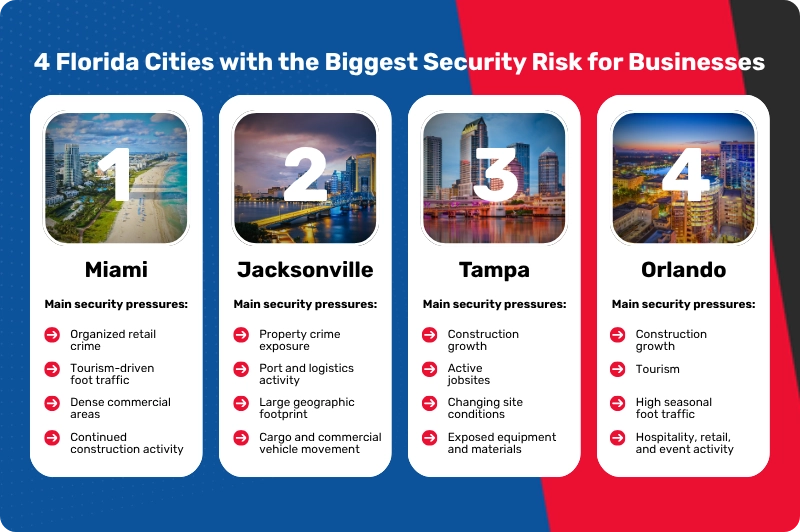
4 Florida Cities with the Biggest Security Risk for Businesses
Statewide averages hide how differently risk shows up across different cities in the state. Miami, Jacksonville, Tampa, and Orlando each have a distinct risk profile that is determined by what drives their local economy.
1. Miami
Miami appears among the 10 United States metro areas retailers report as most impacted by organized retail crime in the National Retail Federation's (NRF) 2023 annual security survey.
That pressure is further compounded by the city's tourism levels, its dense commercial corridors, and a construction market expanding across residential and hospitality development.
High foot traffic combined with ongoing development creates more entry points and more opportunities for crime to go unnoticed.
2. Jacksonville
Jacksonville consistently reports one of the highest property crime rates of any city of its size in the country. As Florida's largest city by population and a major logistics hub anchored around its port, Jacksonville sees a steady flow of commercial vehicles, cargo, and construction activity spread across a large geographic footprint.
This makes consistent, visible security coverage especially important for businesses with multiple sites.
Read more:
3. Tampa
Tampa sits further down most statewide crime rankings, but the city is managing risk driven by growth rather than crime rate alone. Central Florida's construction pipeline, spanning commercial development, multifamily housing, and infrastructure upgrades, means more active jobsites and more exposed materials at any given time.
Businesses expanding in the area benefit from evaluating their construction jobsite security in Tampa early in a project timeline rather than after a first incident forces the issue.
4. Orlando
Orlando shares Tampa's construction growth pressure, plus a tourism layer of its own. As one of the country's top tourism destinations, Orlando sees high seasonal foot traffic around hospitality, retail, and event venues, creating theft opportunities that a slower-growth market wouldn't see.
Every Florida City Shares a Digital Risk
Physical crime rates vary by city, but cyber risk doesn't stay confined to city limits. Florida's top-3 ranking for internet crime complaints and losses applies statewide, and small businesses carry a disproportionate share of it.
Nationally, 43% of all cyber attacks target small businesses, often because owners assume their size makes them an unlikely target. However, extortion malware now appears in 88% of small and midsize business data breaches, compared with 39% at larger organizations. And yet, two-thirds of SMBs have no incident response plan in place.
Human error remains the biggest single factor behind these incidents, involved in roughly 60% of all data breaches tracked in Verizon's Data Breach Investigations Report. These are mainly driven by personal devices, unsecured home Wi-Fi for remote staff, weak or reused passwords, and unpatched software creating easy entry points for social engineering.
Multi-factor authentication, documented training programs, regular software updates, and a written incident response plan remain the most cost-effective first line of defense against cyber threats, and each is far cheaper to put in place than the cost of recovering from a breach after the fact.
The same principle applies to the security technology that Florida businesses install on their sites. Surveillance systems collect and transmit sensitive data, so choosing NDAA-compliant equipment and platforms secured with AES256 encryption closes a gap that's easy to overlook when the focus is on physical deterrence alone.
Read more:
The Physical Security Threats Florida Businesses Face
Underneath the city-level statistics, Florida businesses face a consistent set of physical threats, regardless of their location.
- Organized retail crime, which is still climbing. Retailers reported a combined 18% increase in shoplifting and merchandise theft incidents from 2023 to 2024, per the NRF, and increasingly involves coordinated groups rather than opportunistic shoplifters.
- Construction jobsite theft, which hits Florida particularly hard given its year-round building activity and leaves contractors absorbing the cost of stolen materials and equipment mid-project.
- Vehicle theft and break-ins around commercial properties and parking areas, where unattended fleet vehicles and delivery trucks are often common targets.
- Cargo and delivery-area theft, which is a growing concern as businesses rely more heavily on frequent shipments.
Internal theft also accounts for a meaningful share of business losses across each of these categories, which is why access control and monitoring matter as much inside a facility as at its perimeter, and why a documented security protocol should cover employees as well as outside threats.
Which risks matter most depends on a business's location, industry, and site type. That's what determines the right mix of physical deterrence, monitoring, and reporting for each individual business.
Matching Your Security Strategy to Florida's City Risk Profiles
A single security setup rarely covers every kind of risk that a Florida business faces. The strongest strategies combine physical deterrence, active monitoring, data-driven detection, and clear reporting, so coverage adapts to the risk profile of a specific site. In most instances, that first line of defense begins with the perimeter.
|
Product |
Key Benefits |
The Challenge It Addresses |
|
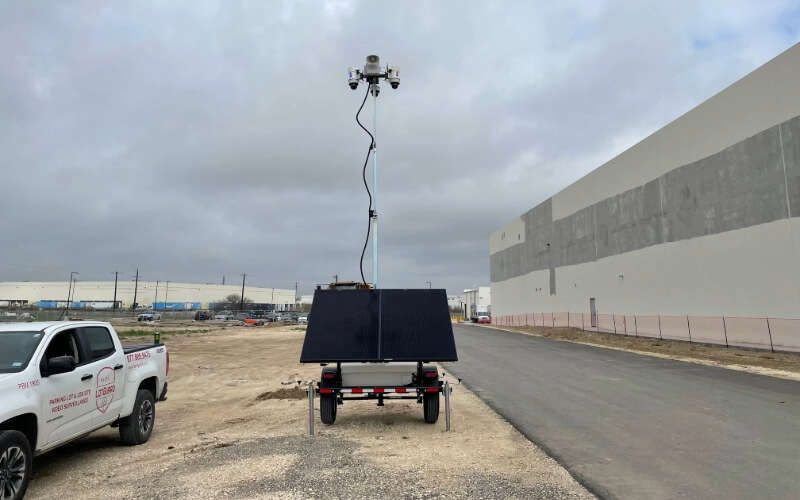
Self-contained mobile units built to bring coverage to locations without existing power or network infrastructure. |
|
Sites with no existing power or network infrastructure that still need flexible, self-contained coverage. |
|
Cameras mounted to existing poles or structures that can be easily repositioned as site needs change. |
|
Specific points, like entrances or loading docks, that need a lower-profile, long-term camera presence. |
|
A remote monitoring service where trained operators actively watch camera feeds as events happen. |
|
Locations where waiting for after-the-fact footage isn't efficient enough, and active intervention is needed. |
|
An analytics layer that sits on top of camera feeds to automatically flag suspicious activity. |
|
Sites needing verified after-hours coverage, with clear follow-up and reporting once activity is flagged. |
|
License Plate Recognition (LPR) solutions Add-on solutions that read and record vehicle license plates entering or leaving a site. |
|
Open sites that need vehicle-level access control alongside general surveillance. |
Businesses running more than one of these tools benefit from bringing the data together in one place rather than checking separate systems for footage, alerts, and reports.
Our cloud-based management platform gives site managers a single view across every connected device and location, which matters most for businesses managing multiple properties across Florida cities with different risk profiles. Centralizing that data also makes it easier to demonstrate compliance and support insurance claims after an incident.
Read more:
Build a Security Plan Around Your Florida Business Location
The cost of getting your security measures wrong is more than the price of replacing what was stolen. It shows up in delayed projects, higher insurance premiums, lost customer trust, and the staff hours spent recovering from an incident instead of running the business.
Florida's mix of dense retail corridors, active ports, high seasonal tourism, and fast-growing construction markets means businesses can't rely on one generic security setup everywhere they operate. The businesses that manage risk well treat security as an ongoing process tied to where and how they operate.
To discuss which combination of coverage fits your city, industry, and risk profile, contact our team today.
