
California's construction industry contributed $152.9 billion to the state’s $4.3 trillion GDP in 2025. While this was a significant contribution to the state, the industry's value means each jobsite houses valuable equipment and materials. As a result, contractors face a growing theft problem on their jobsites.
Permanent security systems offer little protection during the early phases of a build, when sites often have no power or internet and change from week to week. Jobsites across California also face higher risk because they lack both deterrence and on-site oversight.
However, mobile surveillance is built for this stage of a project, bringing visible deterrence and remote oversight to jobsites that don’t yet have power or internet and keep changing from week to week. In this article, we'll cover 7 benefits of mobile surveillance, how these solutions contribute to better security, and where deployable systems fit within a wider jobsite security strategy.
7 Ways Mobile Surveillance Strengthens Jobsite Security in California
Mobile surveillance protects California jobsites by putting cameras, AI detection, live audio, and professional monitoring on-site without waiting for permanent infrastructure installations.
These 7 benefits show how that protection works in practice, from getting coverage in place to scaling it across multiple projects.
1. Rapid deployment without permanent infrastructure
Mobile surveillance units go live without trenching, cabling, external power, or a local internet connection, so coverage can start before the first excavator is left on-site overnight rather than weeks into the project.
For example, with mobile surveillance trailer rental, technicians deliver and set up each unit on-site, avoiding the weeks that permits or limited access can add to a fixed camera installation.
Once deployed, solar panels and battery backup keep each system running, which is why mobile units are often used in remote locations, disaster zones, transit corridors, and early-phase builds where permanent infrastructure hasn’t been installed yet.
There are several products that make this rapid deployment possible, with each one bringing comprehensive coverage to local jobsites. Two examples of these include:
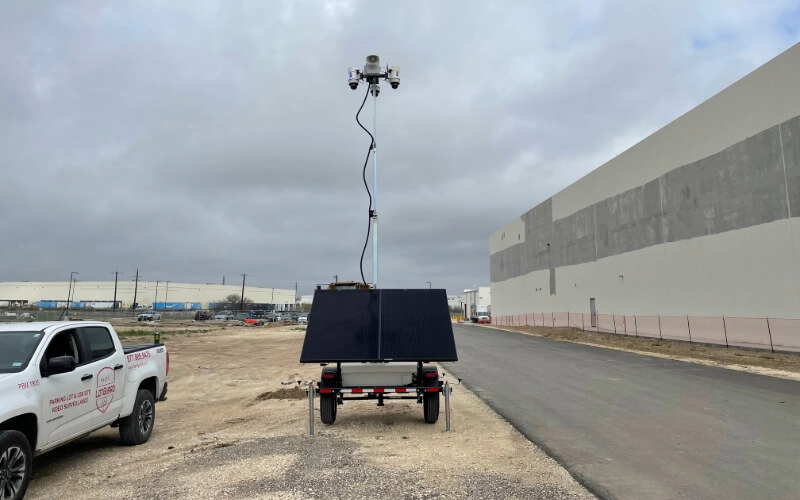
- Solar Surveillance Trailers: Arrive fully assembled with solar panels, battery storage, Pan-Tilt-Zoom (PTZ) cameras, and built-in 4G/5G wireless connectivity, so basic setups can be fully operational in under 20-minutes without tying into site power systems.
- Temporary Surveillance Cameras: Security cameras with a compact form factor that add temporary security to specific areas, such as a jobsite entrance or a material store, without permanent installation.
2. Flexibility as site layouts change
Mobile surveillance can be adjusted to suit the project at every stage, so coverage can keep up as laydown areas, access points, material stockpiles, and work zones change between phases.
Fixed cameras are positioned for the site's layout on day one, but once foundations give way to framing and framing transitions to fit-out, those cameras end up watching areas where nothing valuable is stored anymore.
Because each unit is self-contained, either our team or your on-site crews can tow a trailer to a new position, with no cable to pull or cameras to remount. As a result, it's simple and practical to adjust coverage every time the build moves into a new phase.
The best position for each product depends on what the jobsite looks like at the time. During site prep and grading, solar surveillance trailers suit entrances and boundaries, where they can cover a wide perimeter without relying on site power.
Once foundations and framing begin and materials start to arrive, the risk moves toward laydown yards and equipment compounds. Towing a trailer beside these areas gives its cameras a closer view of high-value stock, and extra units can be added as new risk areas open up between phases.
Intrusion detection zones can also be redrawn around the areas that now hold materials, so alerts stay focused on where the risk sits at each stage.
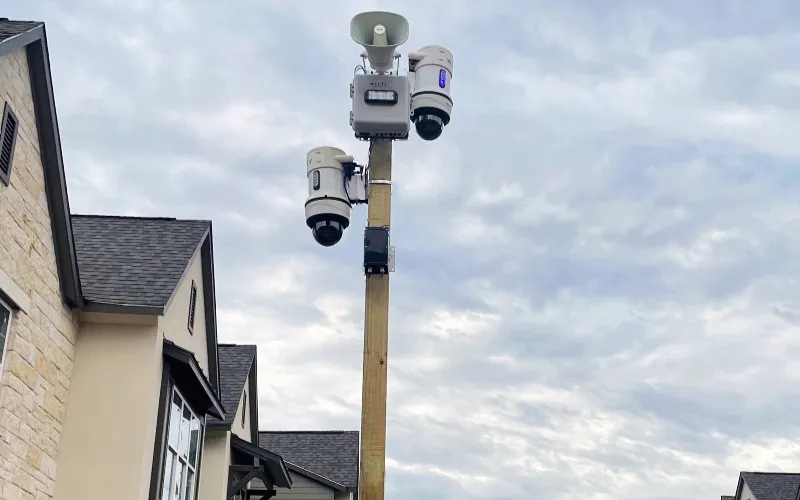
Pole cameras become a stronger option during fit-out, when site power is available. They mount onto light poles or building structures, which keeps coverage focused on entrances and access points as trades move in and out. By closeout, the smaller footprint needs fewer units, so the rest can be relocated to your next project.
3. Visible crime deterrence
A surveillance trailer standing up to 20-feet tall can be seen from well beyond the perimeter. With PTZ cameras, flashing lights, audio speakers, and AI detection on board, it also alerts potential offenders that the jobsite is being monitored.
Live video monitoring turns that visible deterrent into an active response as well, with trained operators watching the jobsite 24/7. They can also step in and issue a live audio warning to criminals before they've accessed the site or had the chance to carry out a crime. A live operator's warning, delivered near-instantly, is much harder to ignore than a camera on its own.
Alongside this, operators can also activate sirens and strobe lights on the unit, then escalate incidents to local law enforcement.
Here is an example of how a monitored response works on a California jobsite after hours. It runs from the moment the cameras pick up movement inside a restricted zone to the point where an operator steps in:
- Our add-on Intrusion Detection systems flag unauthorized movement inside defined zones on construction jobsites after hours.
- AI-video analytics carry out the initial screening, filtering out routine movement so operators only receive alerts regarding genuine threats.
- Operators at professional monitoring centers verify the alert.
- Operators issue live audio warnings, activate sirens and lights, and alert the site security team, or escalate to law enforcement for an emergency response.
- Video evidence and an incident report are saved, giving teams a record for investigations and showing patterns that can guide future security planning.
Read more:
4. Protection for equipment and materials
Mobile surveillance protects the valuable assets that keep a construction project on schedule. Jobsite theft in California regularly targets generators, heavy equipment, power tools, and fuel, with high-value items commonly taken after hours when jobsites are empty.
Copper is a prime target for organized and opportunistic thieves. Copper prices spiked by more than 30% in the U.S. in 2025, and Los Angeles has become one of the nation’s hotspots for copper wire theft. In fact, a Los Angeles Sheriff’s Department detective named construction sites among thieves’ frequent targets. Statewide, AT&T alone reported 4,300 copper theft incidents in California in 2025.
The cost of each theft starts with the stolen item, but it rarely stops there. For instance, a stolen generator can leave crews idle until a replacement arrives, while metal theft from electrical rooms means ripping out and redoing the work that had already been installed.
If you want to strengthen asset protection on your jobsite, mobile surveillance solutions can help, with each one addressing a different way equipment and materials are lost or damaged.
Our Pole Cameras mount directly onto columns or building structures, which makes them a good fit for dense urban jobsites or for later-phase projects where power systems are already available. Instead of covering open ground, they focus directly on the points where losses tend to be most common, such as site entrances, material laydown areas, fuel stores, and high-value equipment storage areas.
Our Solar Surveillance Trailers cover the open ground around these points and can be towed to a new position whenever high-value stock moves between phases, so coverage follows the assets from site prep through to closeout without relying on site power.
Both can use infrared PTZ cameras that give near-360° coverage, even in low light. Each unit also combines AI-driven threat detection, live monitoring, remote access, and time-stamped recording, so the same verified response applies from the perimeter through to individual storage areas.
Additionally, Intrusion Detection zones drawn around equipment compounds and copper storage containers send real-time alerts the moment someone enters a predefined area, allowing for faster response times.
As an add-on, License Plate Recognition (LPR) solutions also capture any vehicle that enters or leaves the jobsite, including its plates, make, model, color, and speed. This gives investigators a vehicle record when cars or vans are used to steal equipment from a site.
Read more:
5. Remote access to footage and site information and improved compliance
Mobile surveillance allows project managers to check on a jobsite from their phone or laptop, which is even more beneficial for teams running several jobsites at once. Through our cloud-based platform, they can view up to 81 camera feeds, watch live footage, replay recordings, and take remote control of PTZ cameras to look more closely at a specific area of the jobsite.
The same dashboard creates and stores incident reports and alerts from every deployed unit, so a manager can review overnight activity across all of their active projects before the first crew arrives instead of driving between locations to find out what happened.
The platform also puts site management in the same place as site visibility. Managers can adjust their alert settings and detection rules remotely as activity on the jobsite changes, or track intrusions, weather conditions, safety compliance, and operational performance alongside the video feeds in real-time.
Besides camera feeds, environmental data and smart detection tools also feed the dashboard with live data. Some of the additional tools that we offer to improve security, safety, and compliance on California jobsites include:
- Weather Monitoring: Tracks temperature, humidity, rainfall, and wind speed. This helps crews act on Cal/OSHA's heat illness standard, which requires shade for workers at temperatures above 80°F and extra high-heat procedures at 95°F.
- Air Quality Sensors: Monitor dust, fine particulate matter, carbon monoxide, and volatile organic compounds (VOCs), with real-time alerts so crews can step up dust control before exposure builds.
- Noise Monitoring Sensors: Track decibel levels against defined thresholds, so supervisors can act before workers’ exposure exceeds Cal/OSHA's permissible limit of 90 dBA averaged over an 8-hour shift.
- PPE Detection: Flags workers without the required personal protective equipment (PPE) and can issue a live audio warning so they can correct it on the spot, which keeps safety checks ongoing and not only during supervisor walkthroughs.
Read more:
6. Evidence capture for incidents and insurance claims
Mobile surveillance records time-stamped footage showing what happened during an incident, be it safety- or security-related. It also shows when and where the incident took place, who was involved, and what actions were taken. That record backs up police reports and insurance claims after a theft, and it helps to establish the facts when workplace accidents need investigating.
Speed is crucial after a serious on-site accident, and California employers have no more than 8 hours to report a serious injury or death to Cal/OSHA once they know about it. Recorded footage gives jobsite managers a factual starting point for that report and for the investigation that follows, so they aren't piecing events together from memory.
California law also treats still images from recorded footage as reliable evidence. Under Evidence Code §1553, printed images taken from stored video are presumed to be accurate. If anyone disputes the image in a claim or court case, it's up to them to prove it's wrong rather than the contractor to prove it's right.
Below is a breakdown of 4 common jobsite incidents and the type of record mobile surveillance provides for each one:
|
Incident |
The record mobile surveillance provides |
|
Equipment theft |
Time-stamped video evidence of the perpetrators and of entry and exit points, with LPR capturing any potential vehicles involved |
|
Workplace accident |
Footage of jobsite conditions at the time of the incident, alongside any PPE detection alerts raised before the incident |
|
Project dispute |
Time-stamped video footage showing site activity and the work completed on the dates in question |
|
Insurance claim |
Clips and incident reports exported from our cloud-based management platform to share with insurers |
AI-video analytics tag detected events as they happen, so footage of an incident can be pulled up in moments rather than found by scrubbing through hours of recordings. Teams can then turn that footage into audit-ready reports in just a few clicks.
7. Scalability across multiple projects
Mobile systems are easy to scale because of how they’re designed. Each unit arrives as a complete system with its own cellular connection, so adding coverage doesn’t mean trenching or running new cabling.
Units can be added as new projects break ground and relocated as others wrap up, which keeps security spending tied to the number of active sites within a portfolio rather than locked into fixed installations.
Renting mobile surveillance is what makes that flexibility even more practical, and it can reduce security costs by up to 88% compared with security guards. Our fully-managed service covers delivery, installation, ongoing support, and relocation with one predictable monthly price for the length of each deployment.
As a contractor's portfolio grows or shrinks, the following parts of a rental setup can scale up or down to match:
- Units added or removed
- Up to 81 camera feeds accessible through one online platform
- Monitoring coverage adjusted as risk levels change
- Technical support across every deployment
Building Security Into Every Phase of Your California Construction Project
The longer a California jobsite sits unprotected, the more it carries a cost that rarely appears in the original budget.
Contractors within the state are building in a market where equipment and copper theft keep rising, and a single break-in costs more than the value of the stolen items. Replacement materials have to be reordered at current prices, and the trades waiting on them lose days that are hard to win back later in the schedule.
Mobile surveillance protects a jobsite from the day the first delivery arrives, without waiting on utilities or committing to a fixed system that the project will outgrow. On jobsites that change every few weeks and sit empty every night, it's the difference between discovering a theft the next day and stopping it before it can be completed.
If you're interested in mobile security systems for your jobsite, speak to our team about the best setup for your portfolio.
