
California's economy generated $4.3 trillion in 2025, making it the largest state economy in the United States. However, its population growth has slowed to the weakest rates in the state's history. For businesses, that combination changes what's worth protecting and how closely it needs to be watched.
Job growth is concentrating in specific corridors, venture capital is flowing into California at a record rate, the labor market is tightening, and commercial crime patterns are changing in ways that don't always reflect general U.S. figures.
Property crime in the state has fallen overall, but sub-categories such as shoplifting, organized retail crime, vehicle theft, and cargo theft are still affecting brick-and-mortar businesses with physical assets.
In this article, we'll cover 12 statistics behind California's growth, what they mean for commercial risk, and the surveillance strategies that help business owners stay ahead of it.
California's Economic Scale and Growth
California's economy size largely determines where commercial activity, and the assets that come with it, are concentrated.
1. California's economy generates $4.3 trillion a year
California's economy produced $4.3 trillion in 2025, which was about 14% of the nation's total economic output, with GDP per capita reaching $86,100. That amount of activity means a similarly large concentration of commercial buildings, warehouses, vehicles, and equipment that require protection.
Businesses operating in one of the most economically dense states in the country carry more crime exposure by default, which is why asset protection strategies matter more than in smaller markets.
2. California's growth is concentrating around existing hubs
California's economy has grown just 3% annually since 2020, trailing behind Texas (5%) and Florida (5.4%) over the same period. However, that growth isn't spreading into new areas of the state. Instead, it's landing in the same established commercial hubs rather than opening up new ground elsewhere. It typically expands into the Bay Area, Los Angeles, and the logistics corridors feeding California's ports.
For businesses already operating in those areas, that means more investment and more valuable assets concentrating on the same sites year after year, without new locations opening up to absorb any of that growth or spread the risk that comes with it.
3. The wage gap between California's hubs keeps widening
The wage gap between those hubs and the rest of the state proves the point. The San Francisco Bay Area per capita income hit $133,000 in 2024, which was more than $70,000 higher than the Northern, Central Valley, and Inland Empire regions. Additionally, hourly wages in 2024 ran $37 in the Bay Area and $30 in San Diego County, compared to $22 to $23 in the Central Valley and Northern regions.
This gap isn't new. High-wage jobs have grown 60% statewide since 2000, while incomes at the bottom 10th percentile have risen just 19% since 1980. This means the same hubs pulling in higher wages are pulling in more commercial investment, and subsequently more targets, too.
Read more:
Population and Development Pressure in California
Population trends change how long businesses stay in the same footprint and who moves through it. These 3 statistics point to a state where growth is slowing, but where activity is still concentrating around the state's major commercial corridors.
4. Population growth has slowed
The Golden State's population reached 39.5 million residents as of mid-2025, with growth since 2000 running at the slowest rates the state has ever recorded. The state lost 322,000 residents between July 2020 and July 2022, driven largely by out-migration during the pandemic, before growth grew 0.8% (309,000 people) between July 2022 and July 2025.
The Department of Finance projects the state will reach just 39.7 million by 2030, which is a fraction of the growth California saw through most of the 20th century.
For businesses, the state isn't expanding the way it used to, which means the sites already in operation today are the ones that will keep absorbing growth, and the risk that comes with it, for years to come.
5. Migration patterns are changing who's on site
California has lost almost 1.3 million people to other states since April 2020, even though net international migration rose to 718,000 between 2022 and 2025. Foreign-born residents make up 28% of California's population, which is more than twice the national average.
At the same time, birth rates hit a record low in 2025, with the number of births down 30% since 2008, while deaths fell 16% since 2021 as pandemic-era mortality eased.
That churn changes who's familiar with a given site and its surroundings, which affects how quickly unusual activity gets noticed locally and increases how much businesses need to rely on continuous monitoring rather than on long-term staff recognizing when something is out of place.
6. Job growth is concentrated in active commercial corridors
California's job growth has cooled sharply from where it used to be. From mid-2016 to February 2020, the state's job growth averaged 6.9%; since 2022, growth has largely stalled statewide, with the exception of the Central Valley, which has grown 4.7% since mid-2022 even as the Bay Area shed jobs over the same period.
That divergence means hiring, and the activity that comes with it, is concentrating in specific inland corridors rather than spreading statewide. More recently, the state has contributed 14.9% of the nation's total job growth since the start of 2026, with the number of unemployed Californians falling by 66,500 over the year to June 2025.
Even so, the labor market remains tight for job seekers: there are 1.9 unemployed workers per job opening in California, compared to 1.1 nationally, which pushes businesses toward filling roles with subcontractors and temporary labor rather than waiting on a thin applicant pool.
Concentrated hiring means more activity on construction jobsites, in warehouses, along logistics corridors, and across staging yards, with more vehicles, equipment, materials, and unfamiliar contractors moving through the same limited set of active sites.
Read more:
California's Labor Market and Investment Climate
California's unemployment rate is falling, and venture capital is pouring into the state at a record pace, and both of these trends change what businesses need to watch for. A tighter labor market means more subcontracted and temporary workers cycling through sites, while record venture capital funding means more high-value tech equipment sitting in California facilities than almost anywhere else in the country.
7. A tightening labor market means more vendor and contractor traffic
California's unemployment rate reached 5.4% by February 2026, and fell to 5.2% in June 2026, which was its lowest point since May 2024, with 1,024,100 Californians officially unemployed that month. A tighter labor force pushes businesses toward subcontracted and temporary labor to fill the gaps, which means more unfamiliar vehicles and personnel cycling through commercial sites and jobsites.
As a result, there's less certainty about who's supposed to be there on any given day. For opportunistic criminals and organized criminal groups (OCG), this gives them the perfect chance to take advantage of busy business sites.
8. Investment capital is concentrating in California
In 2025, California captured 62% of all U.S. venture capital dollars, which was its highest share on record and a 54.2% increase from the year before.
That momentum has only accelerated, since California companies have raised roughly $366 billion in venture capital since the start of 2026 alone, more than 3X the combined total of the national average. Much of that capital is anchored in Santa Clara and San Mateo counties, which are the core of the state's tech industry.
That concentration of capital brings a concentration of high-value equipment and inventory, which are the kind of electronics and enterprise hardware that already rank among the most frequently targeted commodities in cargo and warehouse theft statewide.
Read more:
Commercial Crime and Theft Risk in California
Overall crime trends may look encouraging, but the categories that matter most to commercial operators are moving in the opposite direction and becoming areas of concern.
9. Property crime fell to its lowest rate
The state's property crime rate hit its lowest level since 1985 in 2024, with commercial burglaries falling by 12.5% and landing 6.2% below pre-pandemic levels. Within that trend, larceny fell 7.1%, and burglary fell 11.8% in 2024 alone, reaching 14.1% and 20.3% below their respective 2019 levels.
However, businesses that rely on the headline number risk assuming that the threat has eased across the board when it hasn't. The statewide average blends categories moving in opposite directions, but the ones still increasing (shoplifting, cargo theft, etc.) are those that hit commercial operators the hardest.
10. Shoplifting has risen above pre-pandemic levels
Even as broader property crime fell, shoplifting rose 14.2% in 2024 and now sits 48% above 2019 levels. Unlike a one-time break-in, shoplifting and organized retail theft usually involve the same individuals or crews returning to the same locations repeatedly once they've identified a site with weak coverage or slow response.
That repeat pattern is what static cameras and untrained staff struggle to identify, since a single incident rarely triggers a response. However, a documented pattern across visits, tied to specific vehicles or faces, gives loss prevention teams and law enforcement something they can act on.
11. The scale of organized retail crime
California runs a standing statewide task force built specifically around organized theft crews to address the growing threat throughout the state. The California Highway Patrol's Organized Retail Crime Task Force recovered more than 272,000 stolen items and made 1,208 arrests across 734 investigations in 2025 alone. But these aren't isolated incidents.
Organized groups scout locations, return repeatedly, and move stolen goods through established resale networks, which means a single unprotected site can be hit more than once by the same group.
Businesses without timestamped footage, vehicle plate records, or clear incident documentation are far less likely to see stolen inventory recovered or a case prosecuted. This leaves them to absorb the financial loss.
12. California leads the nation in vehicle and cargo theft
California led the country with 136,988 vehicles stolen in 2025, which is more than 20% of the national total, with the Los Angeles-Long Beach-Anaheim metro alone accounting for 53,911 thefts, even as vehicle theft fell 23% nationwide in the same year.
Fleet vehicles and equipment left overnight on commercial lots and jobsites are frequent targets because they sit unattended for long periods.
California recorded 1,218 cargo theft incidents in 2025, which was more than any other state, as national cargo theft losses surged by 60% to nearly $725 million and the average theft value climbed to $273,990 (up 36% year over year).
Most of that loss happens while freight sits staged in a yard waiting to move, which is a window that fixed cameras rarely cover well since staging areas change with each shipment.
Read more:
- How Can Businesses Reduce Property Crime Risk in California?
- How Vehicle-Related Crime Impacts Businesses and Industrial Sites in California
- Property Crime in California: Trends, Statistics, and Risk Areas
- The Rise of Organized Retail Crime: California
Reducing Commercial Risk Across California Operations
California businesses are facing 3 distinct exposure profiles, and each one of these profiles calls for a different surveillance setup to mitigate the risk of victimization.
For high-value logistics and cargo sitesFor high-value logistics and cargo sites
The Ports of Los Angeles and Long Beach together handle approximately 31% of all containerized imports entering the U.S., making the corridor feeding into them a natural hotspot for theft.
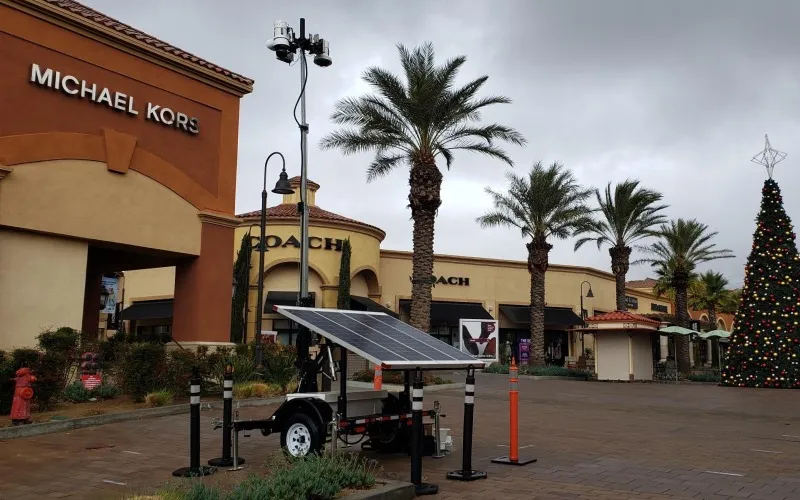
Mobile solar surveillance trailers deploy directly onto a yard without fixed infrastructure, providing near-360° coverage with PTZ cameras and built-in AI-video analytics that pick up suspicious activity around staged freight. This matters for temporary or overflow storage areas where a fixed camera system isn't practical.
Add-on license plate recognition (LPR) solutions timestamp every vehicle entering and exiting a site, day or night, and check plates against a blacklist.
Watchlisted vehicles are flagged automatically while routine traffic passes without an alert, so operators aren't flooded with notifications from every truck in the yard. This directly intercepts the deceptive pickup schemes behind much of the recent rise in cargo theft.
For active and multi-phase construction sites
Jobsite layouts change as work progresses, which makes solar surveillance trailers the strongest fit for active construction. Their high, visible mast and wide coverage deter crime across large open areas, and they can be repositioned as the site changes, with most units operational in under 20-minutes for basic setups.
Adding intrusion detection to these trailers gives open jobsites an early warning when someone enters a restricted area. It uses AI-video analytics to flag perimeter breaches and after-hours loitering, when most jobsite theft occurs. Paired with live video monitoring, trained operators can respond to each alert with sirens and flashing lights, interrupting an incident before it escalates.
For retail and high-turnover commercial properties
Retail crime often means repeat visits from the same individuals or crews rather than one-off break-ins, so coverage needs to capture who keeps coming back.
In dense urban and retail spaces, pole cameras mount onto existing streetlights or poles to cover storefronts, entrances, and loading areas without taking up ground space. Their PTZ cameras can zoom in on faces and vehicles, giving loss prevention teams the clear footage needed to link repeat visits and support prosecution.
For the open lots surrounding retail centers, surveillance trailers give visible coverage where there's nothing to mount a camera on. Built-in speakers let trained operators issue live audio warnings the moment suspicious activity is flagged, which is often enough to stop an incident before it's completed.
Staying Protected as California Continues to Grow
California's economy isn't slowing down, even as population growth does, and businesses are defending increasingly valuable assets in a built environment that isn't expanding to match.
However, the national property crime numbers aren't enough to build a security setup from. Sub-categories of property crime like shoplifting and cargo theft are still increasing, and the cost of one incident can outweigh years of savings from inadequate security coverage.
If you want a mobile surveillance plan built around your California business and risk profile, get in touch with our security professionals today.

