Florida's overall crime rate fell by 6.4% between 2023 and 2024, driven largely by an 8.7% drop in violent crime. However, property crime declined at a slower pace, down just 6% over the same period, and remains disproportionately concentrated around the state's busiest nightlife corridors.
Entertainment districts tend to draw dense, late-night crowds night after night. That combination of alcohol, high foot traffic, and reduced oversight after dark creates a crime pattern that looks nothing like Florida's statewide averages.
For businesses, commercial properties, public spaces, government facilities, and construction jobsites operating in or near these areas, understanding this pattern matters as much as understanding the citywide numbers.
In this article, we'll cover Florida nightlife crime trends, where these effects show up most across the cities, what surrounding businesses and jobsites can do to stay protected during the highest-risk hours, and which security measures address each type of risk.
Florida's Overall Crime Statistics
Florida's crime data tells 2 different stories depending on the category. The state's violent crime rate dropped by 8.7% in 2024 to 267 offenses per 100,000 people, placing Florida 31st nationally for violent crime.
On the other hand, property crime followed a slower downward trend, falling 6% to 1,420 offenses per 100,000 people in 2024. Still, this was enough to rank Florida 35th among states for property crime.
Aggravated assault makes up 73.8% of Florida's violent crime, while robberies account for 14.3% and murder represents just 1.4% of violent offenses statewide. On the property side, larceny-thefts drive 80.6% of all property crime, with motor vehicle theft and burglary splitting most of the rest.
Although these figures represent the state as a whole, Florida's nightlife corridors see a far more concentrated version of these trends.
A 2025 systematic review published through the National Institutes of Health reinforces this pattern, finding that across nightlife studies, incidents cluster heavily around late-night hours and are consistently concentrated among younger adults. This is a group that also makes up the bulk of nightlife foot traffic in Florida's entertainment corridors.
Read more:
- Top 10 Cities with the Highest Crime Rates in Florida
- Why Theft Remains One of Florida’s Most Common Crimes
- How Safe Is Florida Compared to Other States?
- What Are the Most Common Crimes in Florida?
4 Ways Florida's Nightlife Districts Shape Crime Around Them
Entertainment districts don't only add foot traffic to a neighborhood. Instead, they determine local crime around them in ways that show up consistently from one city to the next. The mix of alcohol, late hours, major crowds, and reduced oversight in the Sunshine State creates conditions that don't typically exist in a standard retail corridor, residential block, or municipal property.
1. Alcohol outlet density raises violent crime risk
Areas with a high concentration of bars, clubs, and lounges consistently report more violent crime than areas without them. Research published through the National Institutes of Health found that every 10% increase in access to alcohol outlets corresponds with a 4.2% increase in exposure to violent crime, with off-premise outlets carrying an even stronger association than bars themselves.
Aggressive behaviors track closely with alcohol consumption as well, and that link is a leading factor behind physical fights near entertainment venues and confrontations once visitors are asked to leave.
2. Late-night hours and aggravated assaults
Most nightlife-related incidents cluster in a narrow window after midnight, when crowds peak and judgment is most impaired.
According to research from the National Library of Medicine, men and younger adults consistently show the highest rates of substance use and related risk. This is a pattern that shows up in both physical altercations and predatory behavior once venues are near closing time.
3. Seasonal crowds strain property security
Nightlife-driven crime doesn't stay flat throughout the year, and seasonal events like spring break bring in crowds large enough to regularly overwhelm local police resources. Additionally, crowded tourist zones see a corresponding rise in theft and property crime.
Large, chaotic crowds create conditions where theft and vandalism can go unnoticed until well after the fact. This is particularly true for vehicles parked near venues or construction jobsites operating nearby.
4. Weak security standards create liability exposure
Florida's Dram Shop Act emphasizes how important effective alcohol service and security practices are in nightlife settings, and negligent security staffing is a recurring factor in incidents ranging from theft and robbery to public intoxication.
Venues and neighboring properties that rely on minimal staffing or outdated surveillance coverage face a higher chance of incidents escalating, and a higher chance of reputational damage once they do.
Government-owned properties and municipal facilities near these corridors carry an added layer of public accountability, making consistent coverage as important as the response itself once an incident happens.
Read more:
- Security Considerations for Florida’s High-Traffic Destinations
- Common Property Crimes in Florida and How They Impact Businesses
Where Nightlife Crime Shows Up Across Florida's Cities
The common crime patterns play out differently depending on the city, although tourism and entertainment activity remain consistent drivers. The wider Miami-Dade area, home to some of the state's busiest nightlife activity, includes Miami Gardens, which recorded the highest homicide rate among Florida's 10 most populous cities in 2024 at 11.77 per 100,000 residents.
Palm Springs, near West Palm Beach, also ranks among Florida's most dangerous cities based on overall crime rate. This shows how concentrated entertainment and nightlife activity outside major resort areas can push local numbers well above the state level.
Orlando's entertainment districts and year-round tourism bring similarly elevated foot traffic to areas around hotels, venues, and construction projects tied to the city's continued growth.
Marco Island offers a useful contrast. The city holds one of the state's lowest overall crime rates, helped in part by a quiet nightlife scene and a low-density, gated layout. The gap between Marco Island and cities with dense entertainment corridors shows how closely local crime levels track with nightlife activity rather than population size alone.
The ripple effect for nearby businesses and jobsites
Crime linked to nightlife activity rarely stays confined to the venues themselves. Property crime, vandalism, assault, and motor vehicle theft frequently spill into the surrounding retail storefronts, government buildings, and construction jobsites, especially where those properties sit exposed after-hours during the same window that nightlife crime peaks.
Construction jobsites near entertainment districts face a particular challenge of crews leaving for the night right as foot traffic and risk increase nearby. A jobsite security plan that accounts for these overlapping hours, rather than treating jobsite risk and nightlife risk as separate problems, gives contractors and property managers a more accurate picture of when coverage actually matters most.
Commercial properties and public spaces face the same exposure. A plaza, municipal lot, or government-managed spaces bordering an entertainment district sees the same after-hours risk window as any storefront, even when it's not part of the nightlife scene itself. Coverage that only accounts for the venues themselves misses the businesses and shared spaces absorbing the spillover.
Monitoring Solutions for Florida's Nightlife-Driven Crime Risk
Static security measures struggle to keep up with crime that spikes for a few hours several nights a week, and fixed cameras can't be repositioned once a hotspot shifts to a different block or entrance. This is why flexible, mobile-first monitoring works better around nightlife corridors than fixed cameras alone.
Construction jobsites near entertainment corridors
Jobsites need coverage that goes up fast and holds a visible deterrent through the exact hours crews aren't there. Crews leaving for the night right as nightlife foot traffic peaks leave equipment and materials exposed during the same window when risk is highest.
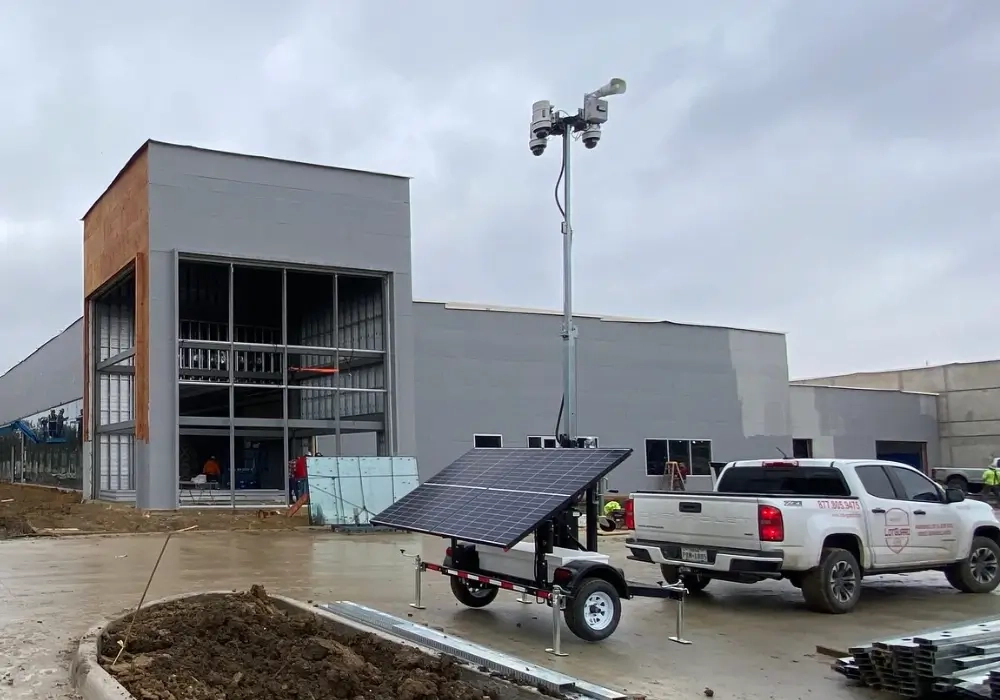
Solar Surveillance Trailers answer this by deploying directly to the jobsite's perimeter with no fixed infrastructure required, going up within 20 minutes for basic setups and running on solar power and cellular connectivity alone.
PTZ cameras handle close-up coverage of entrances and access points, the elevated, 20-foot mast gives a wide field of view across the site, and AI-video analytics flag activity as it happens so a trained operator can issue a live audio warning the moment someone lingers near a fence line or parked equipment.
Public spaces and government facilities bordering nightlife activity
Shared and municipal spaces need coverage that can move with the risk rather than stay fixed on one corner while activity shifts a block over.
A plaza, park, or municipal lot managed by local government near an entertainment district carries the same after-hours exposure as any storefront, and public safety in these shared spaces depends on coverage that can move with the crowd rather than sit fixed on one corner while risk shifts to the next block over.
Solar surveillance trailers meet this need directly, since the units are fully mobile and can be repositioned as risk shifts from one corridor to another over a weekend.
However, Intrusion Detection adds an additional security layer, using AI-video analysis to flag unauthorized entry and unusual movement once a space empties out for the night. It also filters out non-threat movement such as passing traffic or weather so trained operators focus only on genuine risk.
Commercial properties and storefronts
Storefronts near a busy corridor need verification behind every alert, not just detection, since the narrow late-night window when most nightlife-related incidents occur is exactly when a false alarm or a missed one costs the most.
Live video monitoring services put a trained operator behind every alert instead of leaving footage to be reviewed after the fact, distinguishing a passerby cutting through a lot from someone testing a door and following an agreed escalation path that logs every response for insurance or liability purposes.
For properties near bars and clubs where the same vehicles often return night after night ahead of a break-in and alcohol-related impairment raises the odds of reckless driving on-site, License Plate Recognition (LPR) strengthens this coverage.
It does this by logging vehicles as they enter and exit, flagging repeat visitors or anyone already on a watchlist, and giving property owners a timestamped record to cross-reference if a driving incident is reported.
Coordinating coverage across multiple sites
A property manager or contractor covering several sites near different entertainment corridors needs one view instead of switching between systems for each.
Our cloud-based management platform meets this by centralizing footage, alerts, compliance data, and reporting from every camera and trailer into a single dashboard, so flagged activity at one property can be checked against another if the same vehicle or individual turns up more than once, and each site keeps a running incident history to simplify reports to insurers or local authorities.
Staying Ahead of Florida's Nightlife-Driven Risk
There's a hefty price associated with getting nightlife-district security wrong, since a vandalized storefront or an assault outside a business can mean insurance claims and reputational damage that outlasts the night it happened.
Businesses, government facilities, and contractors operating near these zones don't need to accept that risk as a fixed cost of being nearby. Mobile surveillance can be deployed for the specific locations and seasons that carry the highest exposure, then repositioned once conditions change.
If you want to protect your Florida business after-hours, contact our security team today to discuss the best mobile security setup for your needs.