
Data from the Federal Bureau of Investigation (FBI) showed that law enforcement agencies recorded 141,695 burglaries between midnight and 6 a.m. in 2025, which was more than in the morning hours that follow. Motor vehicle thefts were also more frequent between 6 p.m. and midnight, often the window when businesses close and staff head home.
For Florida businesses with yards, loading areas, storage containers, and long fence lines, those late-night hours bring a drop in the informal oversight that comes from people working nearby. An incident that would be spotted within minutes during the day can go unnoticed until morning, giving intruders more time and leaving the business with less evidence to work with.
This article covers 6 late-night security risks Florida businesses should plan for and the practical steps that reduce each risk. We'll also look at where mobile surveillance can extend coverage to outdoor and temporary areas without permanent infrastructure or extra on-site staff like night shift security guards.
6 Overnight Security Risks Florida Businesses Need to Plan For
Florida businesses can't rely on the same protection at night as during business hours, when staff and customers are around to notice problems. Below, we'll explore how standard measures tend to fall short once a site is empty and what can mitigate these risks.
1. Commercial burglary
Commercial burglary is a concern for warehouses and storefronts after closing, when the building is locked, and nobody is on-site to notice a forced door or broken window. An empty building gives an intruder time to search for cash, stock, tools, and equipment without being disturbed.
Strong locks, monitored door contacts, a perimeter alarm and monitoring system, and clear security policies for locking up are the first layer of protection against this. Lighting adds another layer, although it has its limits.
Florida already treats lighting as a baseline for businesses that trade late. Under Florida Statute 812.173, convenience businesses need a parking lot lit to at least 2 foot-candles per square foot, measured 18 inches above the surface, alongside a security camera system and a silent alarm.
Even so, the same law requires stronger measures between 11 p.m. and 5 a.m., such as 2 employees on-site or a security guard, once a court finds that a serious crime such as robbery happened at the business.
Locks, alarms, and lighting all still rely on someone noticing an alarm or reaching the site in time.
Adding a visible presence after dark
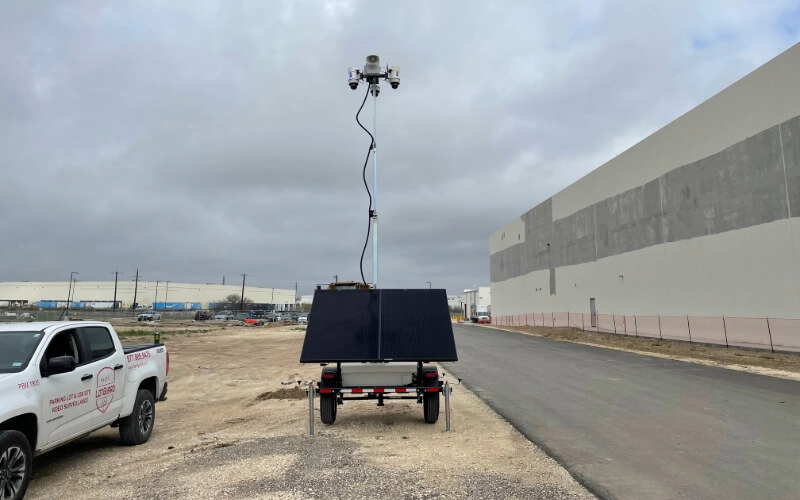
Our Solar Surveillance Trailers carry that protection beyond the storefront, adding a visible, monitored presence across yards, loading areas, side entrances, and back walls.
These units stand up to 20-feet tall with infrared Pan-Tilt-Zoom (PTZ) cameras that give near-360° coverage in low light. Additionally, integrated lighting and audio-visual alarms make them hard to miss after dark and warn intruders off before they reach the building.
Each rental trailer runs on solar panels and battery storage, and 4G/5G connectivity streams live footage, so they work on properties with no spare outlet or reliable internet. Basic setups are operational within 20-minutes, and our units can be repositioned by on-site staff when risk moves around the property.
Read more:
2. Equipment and material theft
Equipment and material theft hits construction sites and other businesses in the Sunshine State that leave tools, machinery, generators, or building supplies outdoors overnight. The National Equipment Register's (NER) 2026 theft trends for July 4th counted 245 equipment thefts reported during the July 1 to 7 holiday window. Florida accounted for 16% of them, second only to Texas at 24%.
Equipment yards and construction jobsites in Florida are particularly exposed because valuable assets are behind temporary fencing with nobody nearby.
Practical steps that cut overnight losses include:
- Grouping machinery away from the fence line with keys removed and attachments locked
- Moving hand tools and small equipment into locked containers at the end of each shift
- Keeping an inventory with serial numbers so stolen items can be identified
- Locking or immobilizing trailers so they can't be used to haul equipment away
To close the gap that fencing leaves, our Smart Detection Systems like Intrusion Detection use artificial intelligence (AI) video analytics to monitor custom zones drawn around perimeter lines and areas where equipment, materials, and fuel are kept. You can also set schedules that switch alerts on when the site closes.
The analytics are trained to ignore wildlife, shadows, swaying foliage, and weather, so site teams get alerts for genuine activity in each zone rather than every movement the cameras pick up overnight. Each event is logged with a timestamp, snapshot, video clip, and its location, which supports investigations and asset protection across every zone.
Read more:
3. Vandalism and property damage
Vandalism and property damage tend to target buildings that look unmonitored after dark, from graffiti on a back wall to smashed windows on a unit between tenants. The repair bill is only part of the cost, since cleanup and lost business hours usually follow. Repeated damage can also make a vacant property harder to lease, but that's not the only thing that adds to the cost.
Leaving damage such as broken windows, damaged fencing, graffiti, or an unsecured opening on a vacant building unrepaired can also lead to code enforcement action. Under Florida Statute 162.09, fines can reach $250 a day for a first violation and $500 a day for a repeat violation.
Counties and cities with populations of 50,000 or more can raise those limits to $1,000 and $5,000 a day, and the local government can record unpaid fines and repair costs as a legal claim (lien) against the property. This lien would also need to be paid off before the property can be sold or refinanced.
As a result, prompt repairs matter as much as prevention. Fixing broken windows and removing graffiti quickly signals that someone is paying attention, while anti-graffiti coatings make cleanup faster.
Targeted coverage for every part of the property
Our mobile surveillance systems are built to cover the parts of a property most exposed to damage, from back walls and windows to gates and empty units. Each site can choose the setup that suits its layout, whether that’s a single unit on a vulnerable back wall or several covering a large yard, so there’s no gap left without coverage.
Units combine high-definition cameras and infrared night vision with built-in AI analytics that detect loitering and intrusion, and they can be fitted with a high-output speaker for live and pre-recorded audio warnings. They also relocate easily when priorities change, so coverage can follow damage hotspots as they shift around the property.
Vacant units and empty yards also attract illegal dumping after dark, and mobile surveillance backed by live monitoring and LPR technology aimed at known dumping spots records timestamped footage of the vehicle and the person unloading it for local code enforcement.
Arson is the other risk for buildings that sit empty overnight. US fire departments responded to 14,300 intentionally set fires in nonresidential buildings in 2023, causing $349.1 million in losses. Our Smoke and Fire Detection analytics watch for visible smoke and flames through the same cameras and send an alert to a designated site contact, so the fire department can be called sooner.
Read more:
4. Vehicle crime
Vehicle crime puts fleet vans and work trucks at risk whenever they're left on-site overnight, along with the tools stored inside them. Florida recorded 10,211 vehicle thefts in the first half of 2026, down 31% from the same period in 2025, according to the National Insurance Crime Bureau (NICB). That still works out to more than 55 thefts a day across the state.
Fleet yards need the same end-of-day attention as buildings, from locked doors and secured keys to trackers that help recover a vehicle once it's gone. A short checklist helps:
- Lock every vehicle and keep keys in a secured cabinet
- Park high-value vehicles in lit areas within camera view
- Close and lock gates, and log the last vehicle out
- Fit GPS trackers to vehicles and towable equipment
Record every vehicle in and out of a property
Our License Plate Recognition (LPR) solutions record every vehicle that enters a yard overnight and work as an add-on to our Trailers and Pole Cameras. AI-assisted imaging reads plates at speed and from a distance, and built-in infrared keeps readings accurate after dark and in poor weather. Each read logs the plate number, make, color, and model, so investigators have more to work with than a partial plate.
Plate readings and footage are stored together and can be searched through our cloud-based platform. Teams can build watchlists of vehicles that shouldn't be on-site after hours and approved lists for their own fleet, so a flagged plate triggers an alert straight away. That makes it easier to spot a vehicle that has been casing the yard on earlier nights before it returns.
LPR can be deployed in 2 ways, depending on how vehicles reach the site:
- Trailer-mounted LPR covers yard entrances and access roads without fixed power or internet, alongside the Trailer's voice-down speaker and audio-visual alarms.
- Pole-mounted LPR suits fixed gates and exit points, mounting to existing infrastructure and connecting over cellular networks.
The result is a timestamped trail law enforcement can follow after a theft and a clear log of which vehicles came and went overnight.
Read more:
5. Unauthorized access
Unauthorized access covers anyone who enters a building, yard, roof, or restricted area without permission after hours, from people looking for shelter to former employees who still know the layout. Limiting access starts with company policy.
When someone leaves the company, take back their keys and change their codes. Check that doors lock properly when they close, look through room access records regularly, and keep a short list of who is allowed in after hours.
Each of these makes it harder for someone to walk in. Healthcare facilities and other businesses with night shifts should also give staff a duress alarm, so they can call for help without reaching for a phone.
Real-time verification and response
Our Solar Surveillance Trailers and Pole Cameras can both connect to live video monitoring, so trained operators can verify activity and respond in real-time, supporting trespass prevention on sites with nobody present.
When a unit detects activity in a protected area, the response follows an agreed sequence:
- An alert reaches trained operators at a monitoring center, who connect to the live feed within seconds.
- The operator verifies whether the activity is a genuine threat, which filters out false alarms before anyone is called out.
- A live audio warning goes out through the unit's speaker, telling the intruder they've been seen.
- Lights and sirens are activated if the person stays, and operators contact law enforcement or a designated site contact under the agreed plan.
Corporate security teams then receive a clear account of each verified incident for internal reviews and police follow-up.
Intrusion Detection adds another layer before an operator is involved. Sites draw custom detection zones around the areas that matter most, such as gates, doorways, stock, and equipment.
Built-in filtering separates people and vehicles from background movement, so false alarms are screened out before they reach anyone. When a zone is breached, the unit can trigger lights and audio warnings automatically, giving intruders a reason to leave in the first few seconds while operators verify the alert and decide on the next step.
6. Perimeter breaches
Perimeter breaches happen along fences and gates that are long, temporary, unlit, or hard to see from the main facility. Storage yards and loading areas that back onto vacant land, rail lines, canals, or wooded lots give intruders cover until they're already inside.
A perimeter alarm system helps, but fence sensors that trigger on wind or animals can produce many false alarms. Physical checks still matter, so walk the fence line before closing and look for cut sections or materials stacked against walls.
Watching the full fence line
Mobile surveillance adds detection along the full length of the boundary. Intrusion Detection zones can be drawn along a fence line to flag anyone who crosses it or loiters nearby, and the system can trigger lights and audio warnings as soon as that happens. As a result, intruders are challenged before they reach stock or equipment, which stops a potential theft before anything has left the site.
As fences move or new storage areas open, perimeter security can follow the boundary rather than staying fixed in one place. Over time, alert history shows which stretches of fence draw the most attention, so coverage can shift toward them.
Manage Overnight Coverage From One Place
Our cloud-based platform brings footage, alerts, incident logs, and LPR records from up to 81 cameras into one dashboard that teams can open from their phone or laptop, so managers responsible for several properties can review overnight activity across every site each morning.
Units are available to rent through our fully-managed service, which includes delivery, professional installation, connectivity, maintenance, and ongoing support.
Each site can choose the mix of units and add-ons it needs, from LPR at a yard gate to smoke and fire detection on a vacant building, while every location runs on the same equipment and the same cloud-based platform. That keeps coverage tailored at the site level and consistent across the portfolio, without the vendor sprawl that comes from sourcing separate systems for each property.
Coverage can also expand during busy seasons or move to a new location without capital spending, and teams don’t have to manage the system themselves.
Finding the After-Hours Gaps on Your Florida Site
A regular security assessment shows where overnight coverage is thin before an incident exposes it. Every site's gaps are different, though, so a distribution yard in West Palm Beach will turn up different weak points from a vacant storefront in the Panhandle.
Assessments are worth repeating after dark, when lighting and sightlines look nothing like they do on a daytime walk-through:
- Walk the site at night and note unlit corners and blind spots
- Test cameras after dark to confirm footage shows faces and plates clearly
- Review incident logs for patterns in timing and location
- Check who still has keys and access codes
- Confirm how quickly someone can reach the site at 3 a.m.
Put the findings into a written site security plan with clear procedures for locking up, responding to alerts, escalating incidents, and reporting damage.
Night shift security guards and roving patrols still play a role on-site, particularly at healthcare campuses and corporate sites where a security officer needs to deal with people who are on the property. A stationary guard can only watch one area at a time, though, and a patrol leaves every stop uncovered between visits.
Guards working alone overnight benefit from live footage and alerts from the areas they can't see, which helps them identify problems sooner and check an area remotely before walking into it.
The footage also reassures guards that their shift is on record, and it gives managers an independent account to review if a complaint is raised about a guard’s conduct, whether that backs up the guard or shows where procedures need tightening.
Keeping Florida Businesses Protected After Dark
A cut fence, damaged equipment, or a missing work truck costs a business much more than the item itself once repairs, downtime, insurance paperwork, and disrupted work for employees are added up. Businesses that plan for the hours after closing give their teams and the wider community a safer place to work.
Visible deterrence and verified alerts helps cover the hours when nobody is on-site. To find out which setup fits your property, contact our team today, and we'll walk you through the options for your site.

