
Florida issued 178,297 building permits in 2025, and as of July 2025, its population has grown 8.9% since 2020 to more than 23.4 million residents. That activity isn't spread evenly across the state, though, so the work facing contractors looks very different from one city to the next.
Housing demand and major public projects are driving Florida construction growth. Cities such as Orlando and Miami are taking on multibillion-dollar airport programs, while Port St. Lucie and Ocala rank among the nation's fastest-growing places.
In this article, we'll cover what's driving demand in 10 Florida cities and what sustained construction means for managing equipment, materials, vehicles, and temporary jobsite infrastructure across multiple jobs.
10 Florida Cities Leading Construction Growth
Florida's biggest metros continue to lead in airport and downtown projects, but new housing demand is also going up in smaller markets nearby. In September 2026, St. Lucie County recorded 237 new home permits, more than double Palm Beach County's 104.
For contractors, growth in these smaller markets spreads active jobsites in Florida further apart. Moving crews and equipment between them takes longer, and project managers spend more time on the road than on any one site.
1. Orlando
The Orlando metro added 37,690 residents between July 2024 and July 2025, and the housing units authorized in 2025 were the highest total of any Florida metro (27,845).
Orlando International Airport's $6.9 billion capital program now includes plans for at least 7 new gates and new baggage facilities. Housing and airport projects can draw on the same crews and equipment, which makes each jobsite harder for contractors in Orlando to oversee.
2. Miami
Miami International Airport's capital plan totals $14 billion, including a $750 million Concourse K due by 2029 and a $1.1 billion Concourse D60 that breaks ground in 2027.
Downtown, the 100-story Waldorf Astoria Hotel and Residences reached its 75th floor in May 2026, while population growth and real estate investors from abroad are supporting more high-rise projects across the city.
Jobsites in Miami have very little room for laydown areas, so contractors need tighter control over where materials are stored and how deliveries reach them.
3. Tampa
The Tampa region led Florida with 1,898 residential permits in September 2026, out of 6,184 permits across the 5 regions tracked by the building permit data company HBW.
- Tampa recorded 1,898 permits worth $639.8 million, led by Polk and Pasco Counties
- Southwest Florida recorded 1,660 permits worth $565.9 million, led by Lee and Collier Counties
- Jacksonville recorded 1,031 permits worth $284.8 million, led by Duval and St. Johns Counties
- Orlando recorded 1,009 permits worth $385.3 million, led by Brevard and Lake Counties
- Southeast Florida recorded 586 permits worth $287.6 million, led by St. Lucie and Palm Beach Counties
Downtown, construction has begun on Water Street's second phase, while the current phase of Gasworx adds about 1.5 million square feet across 4 buildings. Contractors in Tampa working on phased districts like these have to move access points and storage areas as each stage progresses.
4. North Port
North Port’s population grew 28.7% to 96,551 between April 2020 and July 2025, and city leaders put it past 100,000 in September 2026. That growth is adding to the housing demand in southern Sarasota County.
In October 2026, city commissioners approved up to 1,875 more homes at Wellen Park, along with 400,000 square feet of retail and services and 100,000 square feet of office space. Master-planned communities on this scale have long boundaries and homes at different stages of completion, which gives contractors more entry points to manage.
5. Jacksonville
Downtown Jacksonville has a $7 billion development pipeline, with $3 billion already under construction. That work includes a $1.4 billion stadium renovation, a new University of Florida graduate campus, a Baptist Health expansion, and more than 1,500 housing units.
These commercial, education, healthcare, and residential projects sit close together in a compact downtown. Contractors in Jacksonville share roads and delivery space with neighboring projects, so vehicle movement around each jobsite takes more planning.
6. West Palm Beach
The West Palm Beach-Boca Raton market ranked 5th nationally for office space under construction in January 2026, with nearly 1.6 million square feet in development.
That pipeline reflects the number of wealthy residents and businesses moving into South Florida, even though Palm Beach County's population was nearly flat between July 2024 and July 2025. Jobsites in West Palm Beach typically sit on dense downtown blocks, where contractors have very little secure space to store high-value materials.
7. Port St. Lucie
Port St. Lucie grew 3.5% through July 2025, which was the fastest rate among the nation's largest cities for the 5th year running. Florida's lack of state income tax and the city's lower housing costs draw relocating households, with a median single-family price of $400,000 against $650,000 in neighboring Palm Beach and Martin Counties.
Tradition Commerce Park, which is an industrial and flex development approved for more than 530,000 square feet, broke ground in August 2026. Contractors working on both housing and industrial projects have to split crews and equipment between scattered residential jobsites and large industrial parcels.
8. Cape Coral
Utility work is opening more of Cape Coral to development. The city is still only 60% built out, and a $227.5 million utility expansion is bringing services to 7,300 parcels in the north.
Larger projects are also moving forward in the northwest. Forestar bought the 1,745-acre Hudson Creek site for $100 million, with entitlements for more than 3,500 homes and up to 500,000 square feet of commercial space. As development moves north, contractors will be working on jobsites with fewer utilities in place.
9. Lakeland
Lakeland's central location between Tampa and Orlando makes logistics its main construction driver. The $750 million Lakeland Central Park spans 740 acres, and its second phase includes a 261,000-square-foot industrial building and pad-ready sites for facilities of up to 1.7 million square feet.
The Lakeland-Winter Haven metro also grew 2.7% to 874,790 residents through July 2025, adding to housing demand in the area. Industrial parcels this large leave equipment and materials spread across open land long before permanent buildings and infrastructure are finished, leaving them exposed.
10. Ocala
Ocala was the nation's fastest-growing metro at 3.4% up to July 2025, and new road projects are underway across Marion County. A $242 million contract is adding I-75 auxiliary lanes between State Road 200 and State Road 326, with completion expected by 2029.
Logistics is also drawing investment, with Amazon paying $97.7 million for warehouse and distribution facilities covering more than 1 million square feet in 2025. Road projects move along a corridor, so plant, vehicles, materials, and temporary site infrastructure keep changing location as the work advances.
Read more:
- Why Construction Growth in Florida Is Increasing Security Risks
- Florida’s Construction Growth Boom: What It Means for Site Security
- Florida’s Construction Expansion: Security Challenges for Large-Scale Projects
- The Projects Transforming Florida’s Cities and Infrastructure
What Sustained Growth Means for Contractors Across Florida
Contractors working across these Florida cities are keeping track of more jobsites, and each one changes as the project progresses. The construction industry contributes around $101 billion, or 5.7% of Florida's economy, according to the Associated General Contractors of America (AGC), and the state expects to have its population passing 24 million by 2027.
The Florida Department of Transportation's $20 billion-plus Turnpike widening covers 320 miles from Florida City to Wildwood and was 55% complete as of September 2026, adding long-running work that passes through several of these markets.
Outside of these 10 cities, the Space Coast has its own aerospace construction. Blue Origin's $600 million expansion in Brevard County will support 500 aerospace jobs, and Relativity Space has committed to thousands of jobs by 2034 as it grows its Space Coast operations.
Nearby Palm Bay has grown 23.7% since 2020 to 148,092 residents. For contractors already working across Central Florida, these projects compete for the same crews and equipment, and their large, open sites add to the number of jobsites that need watching.
Florida's multifamily permitting slowed down in 2026. The state was second nationally for multifamily permits in 2025, but it had dropped to third by August 2026, with permits down 28.1% from the same period in 2025. Projects that slow down can still leave partly built structures and stored materials on-site for longer, with fewer crews around them.
Construction employment also grew by only 3,300 jobs in the year to September 2026. Contractors are stretching a slowly growing workforce across projects in several markets, which leaves fewer people on each jobsite to spot problems.
Teams running several construction projects at once have 4 practical pressures to manage:
- Valuable equipment stays on-site overnight and between phases, so protecting assets becomes part of daily planning.
- Materials such as stored cabling and piping are exposed to metal theft, particularly in open laydown yards with limited supervision.
- Vehicles from deliveries and subcontractors make it harder for your team to tell who belongs on-site.
- Temporary site infrastructure such as fencing, power, lighting, and storage moves as phases change, so your jobsite perimeters keep changing.
Read more:
- Why Theft and Burglary Continue to Target Florida Jobsites
- Key Statistics Shaping Construction and Security in Florida
How Connected Monitoring Supports Changing Florida Jobsites
Connected monitoring supports changing Florida jobsites by covering security, safety, environmental conditions, and project progress from the same deployment, and that deployment can move as each site changes.
Guards may be appropriate for some of your security requirements, but mobile surveillance is stronger where priorities, layouts, access points, or timelines shift. The considerations differ by jobsite type, so each section below sets out what to think about and where our products can fit.
Early-Phase Sites Without Power or Internet
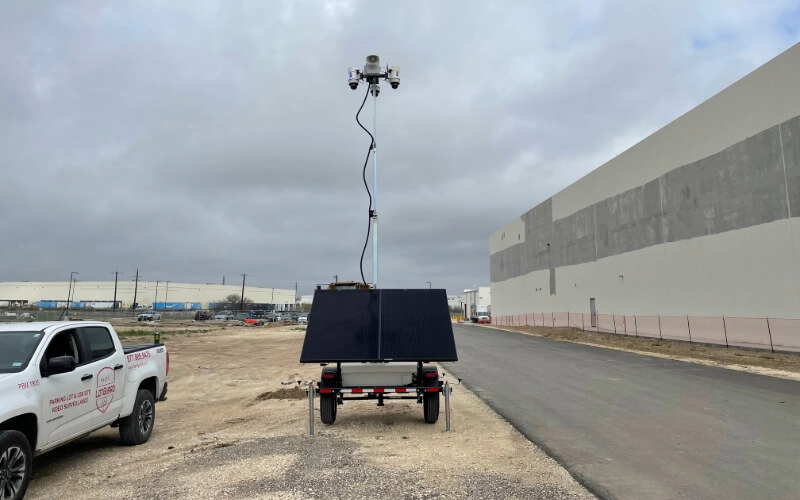
Early-phase jobsites can open before permanent utilities are connected, as with the northern parcels in Cape Coral where services are still being extended, which rules out systems that depend on fixed power or internet.
What to consider
Security: Our Solar Surveillance Trailers run on solar power and battery storage, giving you a visible deterrent from the day equipment arrives. Basic setups can be fully operational within 20-minutes without trenching or cabling, and masts up to 20-feet carry Pan-Tilt-Zoom (PTZ) infrared cameras with near-360° coverage.
Units can be moved by our team or your on-site crews as work zones change, and surveillance trailer rental in Florida is fully-managed, with installation, connectivity, maintenance, and support included. Live video monitoring adds trained operators who can issue live audio warnings to potential offenders on-site.
Safety: Open ground leaves crews exposed to lightning and extreme heat. Our Weather Monitoring Stations mount to the Trailers and track lightning strikes, temperature, humidity, rainfall, and wind speed. They send alerts when readings pass the thresholds you set, so supervisors can pause work before conditions become unsafe.
Environmental: Grading and earthworks raise dust that can drift toward neighboring roads and homes. Our Air Quality Sensors measure fine particulate matter at several sizes, plus carbon monoxide, carbon dioxide, temperature, and humidity. Each reading is time-stamped and stored for compliance reporting.
Project visibility: Before a site office is set up, project managers still need to see what’s happening on the ground.
Our cloud-based platform gives remote access to live and recorded footage from the day the Surveillance Trailers arrive, so teams can confirm equipment deliveries and track grading progress without a site visit. Footage, monitoring alerts, weather data, and air quality readings are stored together from the start, giving you a clear record of the first phase for stakeholder updates.
Tight Urban Jobsites Near Neighbors
Downtown jobsites in Miami, West Palm Beach, Tampa, and Jacksonville have very little ground space to spare and sit close to occupied homes and offices.
What to consider
Security: Our Pole Cameras mount to existing poles, fencing, or structures, so they cover gates and material storage areas without taking up space that crews and deliveries need. They transmit over cellular networks with remote access from any device. As work progresses, they can be moved to new mounting points.
Safety: Busy downtown sites bring many trades and subcontractors onto the same footprint. PPE detection uses AI-video analytics on our cameras to flag missing or incorrect safety gear as it happens. Supervisors get the chance to step in early, along with an audit trail for safety reviews.
Environmental: Neighbors are quick to notice noise and vibration from piling and demolition. Our Noise Monitoring Sensors measure sound levels in decibels against thresholds you set, and our Vibration Sensors track ground movement near sensitive structures and nearby neighborhoods. Each reading is time-stamped and linked to video footage, which helps you investigate complaints with evidence.
Project visibility: With limited laydown space, deliveries have to arrive on schedule. Remote access lets project managers check deliveries and progress across several downtown jobsites from a phone or laptop instead of driving between them.
Master-Planned Communities and Industrial Parks
Large developments such as Wellen Park in North Port and Tradition in Port St. Lucie have long boundaries and buildings at different stages of completion, where residents may already live in finished phases.
What to consider
Security: Intrusion Detection uses AI-video analytics to flag unauthorized access in predefined zones at the perimeter or in storage areas after crews go home. You set the detection zones and schedules to match your layout and working hours, and the analytics filter out false triggers from wildlife, shadows, moving foliage, and weather.
When an alert triggers, live monitoring operators check the footage in real time and escalate to law enforcement when needed. If an incident does happen, time-stamped footage of each event gives you video evidence to support police reports and insurance claims.
Safety: Finished phases bring residents and visitors close to active work. Detection zones can also cover excavations and other restricted areas, flagging anyone who enters them.
Our Smoke and Fire Detection runs on the same cameras to spot visible smoke and flame around timber frames and stored materials, sending alerts to a designated site contact so your team can respond before a fire reaches occupied homes.
Environmental: Dust and noise carry from active phases into occupied streets. Our Air Quality and Noise Monitoring Sensors alert your team when readings pass the thresholds you set, so crews can adjust work before residents raise complaints.
Readings are logged automatically and can be exported to share with developers and homeowners’ associations when questions come up about site conditions.
Project visibility: Phases on large developments move at different speeds, and developers and owners expect updates on each one. Trailers and pole cameras placed across separate phases let project managers check progress on each one remotely instead of covering the full site on foot or by truck.
Weather monitoring station readings are logged alongside video footage, so you can show with evidence why a phase was delayed by lightning, heavy rain, high winds, or extreme heat.
Corridor Projects With Heavy Vehicle Movement
Corridor projects such as the I-75 auxiliary lanes in Ocala and the Turnpike widening move along a route, with a steady flow of deliveries, plant, crews, and subcontractors at each new entrance.
What to consider
Security: License Plate Recognition (LPR) solutions are an add-on for our Trailers and Pole Cameras that log vehicles entering and leaving. They capture plate data with vehicle make, model, color, and speed, and work 24/7 using infrared and low-light technology. Searchable records are stored in our cloud-based platform, with lists of approved and flagged vehicles for faster alerts.
Safety: Crews on corridor projects often work beside live traffic and moving plant. PPE detection along active work zones flags workers missing hard hats or high-visibility vests, and detection rules can be adjusted for each zone as the work moves.
Supervisors receive alerts in real time, so they can correct the issue before anyone steps into a live lane or the path of moving equipment. Live monitoring operators can also receive these alerts and issue live audio warnings to workers on-site, telling them to put on the missing safety gear.
Environmental: Corridor work passes close to homes along the route, and milling, paving, compaction, and pile driving can carry noise and vibration beyond the work zone.
Noise monitoring and vibration sensors mounted to our systems move with them, so readings follow the work as each section advances. Alerts trigger when levels pass your thresholds, giving crews the chance to adjust equipment or working hours near sensitive properties before complaints build up.
Project visibility: Relocatable trailers and pole cameras follow the work along the corridor, keeping every active section in view as crews move on to the next stretch.
Our cloud-based platform lets project managers review each section remotely, which matters when a single project covers several miles of road. Recorded footage from each completed section also gives you a visual record for progress reports and dispute resolution.
With this system, teams can access up to 81 cameras from their phone or laptop, with live footage, alerts, environmental readings, and detection events in one dashboard, and generate reports for stakeholders in a few clicks.
Read more:
- Integrating Environmental Monitoring Sensors on Construction Jobsites
- AI for PPE, Fire, and Intrusion: Proving Jobsite Safety and Compliance in Real Time
- Why You Should Install Time Lapse Cameras at Construction Sites
Planning Security for Florida's Next Phase of Growth
Housing permits are slowing down in certain parts of Florida, but airport, highway, commercial, and industrial work continues in its busiest construction markets.
A theft, a damaged delivery, a safety incident, or a noise complaint from neighbors on one jobsite can delay work on one jobsite and push back the crews who are scheduled to move on to your next project, and that delay becomes more expensive when your teams are spread across several cities.
Building monitoring into your plan from the first phase means security, safety, environmental, and progress data are in place before any of your materials arrive, which supports your schedule and the long-term value of each project. To discuss monitoring options for your Florida jobsites, speak with our team today.
