
Florida's construction and infrastructure sectors are expanding at a pace few other states can match. With a population that has already surpassed 23 million residents and is projected to reach 26 million by 2030, the Sunshine State is responding with a wave of investments. These span highways, bridges, transit systems, seaports, and environmental infrastructure.
The scale of what's being built, coupled with the pace, is creating significant operational pressure for contractors, developers, infrastructure managers, and site operators across every major region.
This article looks at the major projects taking place in Florida's cities, the funding commitments driving them, and the security and oversight challenges that come with managing large-scale construction at this volume. We'll also explore the surveillance solutions that help jobsite teams mitigate crime risk.
Florida's Infrastructure Investment
The cost behind Florida's current infrastructure push is substantial. Launched in 2023, the Moving Florida Forward Infrastructure Initiative committed more than $68 billion to transportation improvements over a 5-year period. More than 20 major congestion relief projects are being rolled out statewide, with many delivering years ahead of their original schedules. The State Transportation Work Program for FY 2025-2026 alone had a budget of $13.7 billion.
The main driver behind this construction and infrastructure boom is population pressure, as Florida is predicted to be the third most populous state in the U.S. by 2030. The Florida Chamber of Commerce projects that over 1 million new jobs will be needed by that same year to support the growth, with the construction sector carrying a significant share of that demand.
Commuters are already feeling the strain. Drivers in Miami lost an average of over 90 hours to slow traffic flow in 2024, while Orlando hit a new record high of 68 hours. This shows the urgent need for infrastructure improvements to accommodate the state's growing population.
The Florida Department of Transportation (FDOT) oversees a highway network that has struggled to keep up with the state's growth, with aging bridges and congested corridors representing a consistent priority for bridge repair and expansion alongside new construction.
Key Projects Reshaping Florida's Cities
The projects currently underway or that have been recently completed represent some of the most significant infrastructure work in the state's history. However, each project has its own construction timeline, footprint, set of jobsite management challenges, and security exposure.
Tampa Bay: a $1.3 billion transformation
Tampa Bay is one of the most active infrastructure zones in the state. The new Howard Frankland Bridge, which was part of a $1.3 billion investment in Tampa Bay infrastructure, has increased crossing capacity by 50% and is designed to withstand natural disasters such as hurricanes.
This represents the largest transportation project ever delivered in FDOT's District 7, with the bridge replacement taking years to execute. It requires continuous jobsite security across a heavily exposed waterfront environment.
Building on that, Governor Ron DeSantis announced the groundbreaking of the I-275 Express Expansion Project in Pinellas County, which will widen the interstate and add new express lanes.
When complete, the project is expected to reduce travel delays by up to 85% and generate more than $1.4 billion in regional economic value. Construction is on track and is expected to be delivered 15 years ahead of the original schedule.
For contractors working across Tampa, projects of this size demand specific security infrastructure that can scale with changing jobsite boundaries, multiple active work zones, and significant equipment and material staging areas.
Read more:
- Why Construction Growth in Florida Is Increasing Security Risks
- Florida’s Construction Growth Boom: What It Means for Site Security
Orlando and Central Florida: I-4 and logistics expansion
A series of I-4 improvements is supporting Central Florida's growth. These include express lane additions between Champions Gate and Osceola Parkways and a new interchange at State Road 33.
These projects are designed to ease movement for residents and visitors across one of the most congested corridors in the state. Additionally, they will be supporting the logistics and distribution sectors, which depend on reliable arterial access.
The Florida Seaport Mission plan is directing billions in investment to enhance cargo operations across the state's seaports and international airports. This will improve supply chain efficiency as Florida's role as a trade hub continues to expand.
Infrastructure investments of this kind have a broad economic reach. Brookings Institution research estimates that around 1 in 9 American workers holds an infrastructure-related job. This goes to show why the pace of delivery matters beyond the construction phase itself.
Statewide safety upgrades
Alongside headline projects, Florida is investing in technology-led safety improvements across its road network.
Florida's Turnpike Enterprise is enhancing the Wrong-Way Vehicle Detection System across multiple counties, with an estimated project cost of $3.76 million and construction expected to continue through early 2027. The system uses sensor-equipped signage to detect and respond to wrong-way drivers in real-time.
A separate Intelligent Transportation Systems enhancement is also underway along the First Coast Expressway. This project will cost approximately $8 million, and construction is anticipated into late 2026. The work includes new wrong-way driving countermeasures and updated traffic monitoring infrastructure, a shift toward tech-integrated highways rather than physical capacity additions alone.
Everglades and environmental infrastructure projects
Not all of Florida's critical infrastructure projects are limited to roads and bridges. The Comprehensive Everglades Restoration Plan (CERP) is supported by $1.4 billion in state funding for the current cycle. It focuses on water quality improvements and ecosystem restoration in water districts across South Florida.
The environmental construction involved in CERP (reservoirs, flow-ways, pumping stations, water treatment marshes) requires the same operational discipline as any large transportation project. This includes access control, equipment protection, vandalism mitigation, and jobsite monitoring across remote and often difficult terrain.
Florida's post-disaster recovery infrastructure is also substantial, with the state maintaining a $311 million fund for modernizing water utilities and grid sources. It also includes emergency operations in storm-impacted communities, with annual infrastructure spending reaching $13.7 billion when FDOT's commitments are included.
What Large-Scale Infrastructure Means for Jobsite Security
The scale of active construction across the Sunshine State creates growing security and risk management challenges with every new project that breaks ground.
As project footprints expand, perimeters become harder to secure, more equipment and materials move through sites, and assets are spread across wider areas, creating longer periods of vulnerability. This is particularly true during evenings, weekends, holidays, and between construction phases.
Infrastructure-based jobsites often combine several factors that increase security risk:
-
Remote or partially accessible locations
-
High-value equipment
-
Irregular crew schedules/business hours
-
The absence of fixed power or internet during early jobsite phases
Florida is already one of the highest-risk states for construction theft, and as the number of active sites grows, the average risk exposure increases alongside it.
Monitoring a project that spans multiple work zones, evolves week by week, and operates under tight delivery schedules requires surveillance infrastructure that can move with the jobsite rather than remain fixed in a single position. This is particularly relevant for projects like highway widening or bridge replacement, where risk zones shift as construction phases progress.
Read more:
- Florida’s Construction Expansion: Security Challenges for Large-Scale Projects
- Why Theft and Burglary Continue to Target Florida Jobsites
- Crime in Florida: The Trends Construction Projects Need to Know About
Discover More on our Construction Theft Prevention Solutions
Keeping Florida's Infrastructure Projects Secure
The following addresses the most common security and operational challenges encountered on Florida's infrastructure jobsites, and the solutions best suited to each.
1. No power or internet access during early construction phases
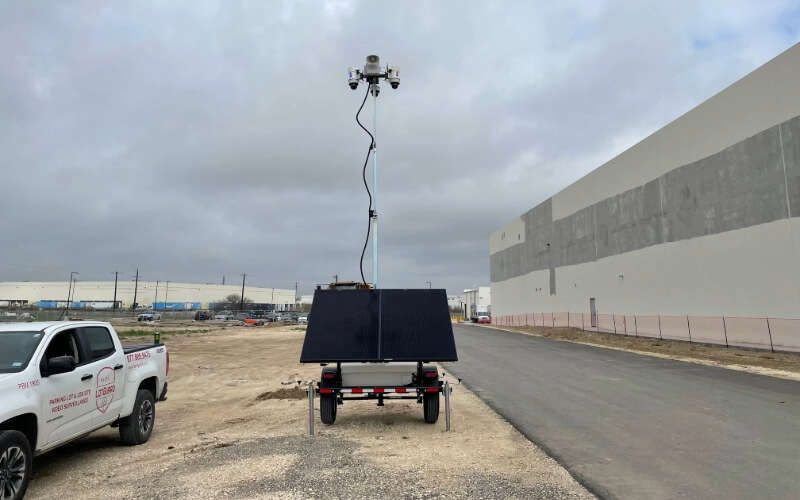
Standard fixed cameras and hardwired alarm systems are not a viable option where mains power and a stable internet connection are unavailable. Our Solar Surveillance Trailers remove that dependency entirely, running on solar power with battery backup and connecting via cellular networks.
For basic setups, our systems can be fully operational in under 20 minutes with no trenching or wiring required. Each trailer's elevated PTZ camera delivers near-360° coverage, paired with visible deterrence signage that signals active monitoring, while integrated lighting and loudspeakers extend the deterrent effect after dark.
As work zones change, our trailers can be repositioned with them. Surveillance Trailer rental also gives contractors the flexibility to scale their coverage up or down without a capital commitment at every stage.
Read more:
2. Wide perimeters and intermittent crew presence
Even well-placed cameras won't prevent incidents if nobody is watching the feeds. Our solutions come with a fully-managed Live Video Monitoring service, connecting jobsite cameras to professional monitoring operators who verify activity in real-time.
When a genuine threat is confirmed, trained operators can broadcast a live audio warning directly through the system's speakers, contact the relevant response teams, or escalate incidents to law enforcement.
Passive recording captures what happened, while live monitoring enables additional deterrence and intervention before an incident occurs.
Read more:
3. Constant movement across large jobsites
This level of activity makes it difficult to separate genuine security threats from routine movement. Our Smart Detection Systems use AI-video analytics to filter alerts intelligently, flagging only the activity that warrants attention.
Intrusion Detection identifies unauthorized access to restricted zones after hours without generating excessive false alerts from passing vehicles or wildlife. Additionally, PPE Detection and Monitoring tracks compliance across wide jobsites without requiring a supervisor in every zone.
Smoke and Fire Detection delivers early warning on jobsites where fuel storage, welding, dry conditions, or other operations raise the risk of fire, allowing a faster response before damage can spread.
4. Multiple access points on one jobsite
Knowing exactly who and what is entering or exiting becomes harder to track as access points multiply. Our add-on License Plate Recognition (LPR) solutions integrate with surveillance trailers, automatically reading and logging license plates at entry and exit points.
This creates an accurate access record, supports investigations when equipment goes missing, and strengthens insurance claims, while providing a deterrent to opportunistic vehicle theft. It also flags unauthorized vehicles before they reach restricted areas, helping to protect worker safety without adding manual oversight requirements to jobsite staff.
5. Construction near residential or environmentally sensitive areas
Sites like these carry compliance obligations that need to be documented consistently, not just checked periodically. Our Environmental Monitoring solutions provide the on-site data you need to meet compliance obligations consistently and thoroughly.
Air Quality sensors track dust and particulate levels in real-time, while Noise Monitoring sensors record decibel readings against permitted thresholds and issue alerts as levels approach or exceed permitted limits.
Weather Monitoring stations capture on-site conditions to support scheduling decisions and incident documentation, giving jobsite operators a continuous compliance record rather than periodic manual checks.
6. Phases that carry concentrated risk for a short time
A material delivery or equipment handover, or even the gap between jobsite clearance and the next phase beginning, can all create exposure.
Temporary security cameras provide fast deployment for these moments, offering visible deterrence and active monitoring without a long-term financial commitment. Our systems can be configured quickly to the specific risk profile of the moment and removed just as easily when the risk window closes.
All of our solutions can be connected to our cloud-based management platform, which gives jobsite operators and project teams centralised visibility of cameras and alerts across multiple sites from a single login. Accessible remotely from any device, the platform means high-risk zones can be monitored without the need for on-site personnel.
As Florida's construction and infrastructure industries continue to grow, that kind of unified oversight becomes more valuable than ever.
Keeping Pace with Florida's Infrastructure Boom
Florida's infrastructure pipeline is one of the most active in the country, and the pressure it places on contractors, developers, jobsite operators, and infrastructure managers is real. Larger footprints and higher asset concentrations all increase the complexity of jobsite security and the risk exposure that comes with getting it wrong.
Our mobile infrastructure solutions are built specifically for this environment. They're fast to deploy, independent of jobsite utilities, scalable across multiple work zones, and backed by live monitoring that turns footage into active protection.
Whether you're working on a highway expansion or an environmental restoration jobsite, we can help you maintain security and oversight from the first day of ground preparation to the final handover.
Talk to one of our specialists today to discuss your project's security requirements.

