
Florida was the second-highest state in the country for single-family building permits in 2025, and multifamily permits rose by nearly 30%. Even with single-family permitting cooling from 2024, this level of activity puts more active jobsites, more valuable equipment, and more temporary locations into Florida's crime statistics each year.
However, this statistic only covers residential permits over one year, and doesn't account for the hundreds of thousands of other commercial, industrial, infrastructure, and institutional permits the Sunshine State issues year after year. Every new permit becomes a site that, for months at a time, sits with materials and machinery that are exposed before permanent security measures are ever in place.
This article breaks down what the crime data shows, how and when jobsites get targeted, what Florida's growth means for the number of active sites at risk, and the safety statistics contractors need to know. We'll also discuss how mobile surveillance technology directly addresses each of these pressures.
Where Florida Ranks Nationally for Construction Site Theft
California, Texas, and Florida have historically ranked among the states with the highest volumes of construction equipment theft, according to the National Insurance Crime Bureau and National Equipment Register.
No state-by-state ranking has been published since, but the conditions behind it haven't stood still. High construction volume, dense metro areas, and easy port access for moving stolen machinery out of state remain, and the scope of the risk has widened as building activity spreads into new counties and property types, such as warehouse, industrial, and multifamily sites.
Theft is usually the crime that gets the most attention, but it's rarely the only risk a jobsite carries. Open perimeters and long stretches of downtime also leave the sites exposed to vandalism, trespass, and, in rarer cases, arson, particularly where flammable materials are stored on-site.
Nationally, equipment theft costs the construction industry an estimated $300 million to $1 billion annually, and fewer than 1 in 5 stolen items are ever recovered. The average single equipment theft runs around $30,000, although this figure rarely accounts for the replacement delays, rental gaps, and idle labor that follow, let alone the cost of repairing vandalized structures or equipment.
Materials theft compounds the problem even further. For example, copper prices climbed to record highs through 2025 and passed $6 per pound in January 2026, which makes the wire, tubing, and grounding material staged on a jobsite far more valuable to thieves than it was even a year ago.
Those same materials cost more to replace, so a stolen or damaged material order is often harder and pricier to replace than it would have been the year before.
The role of organized crime
Florida's statistics back this up, and in September 2025, a joint investigation led by the Collier and Charlotte County Sheriff's Offices tied a group of suspects to 45 felony cases spanning 17 Florida jurisdictions.
Investigators recovered approximately $1,097,500 in stolen property, and 7 men were arrested in connection with a ring allegedly responsible for stealing more than $2 million in construction equipment, trailers, and utility vehicles over 4 years. This is a clear example of how organized crime targets multiple jobsites across county lines rather than a single site.
Read more:
- Crime in Florida: The Trends Construction Projects Need to Know About
- Why Theft and Burglary Continue to Target Florida Jobsites
- The Most Common Thefts from Construction Sites
The Timing and Nature of Jobsite Security Incidents in Florida
Jobsite crime follows a predictable pattern, whether it's theft, vandalism, or unauthorized entry. Sites are most exposed overnight and across weekends and holidays, since they sit unattended and can go unchecked for days at a time.
Throughout the industry, it's well-known that the main vulnerability for a piece of equipment or a jobsite itself is an open, minimally supervised environment outside of working hours.
What gets targeted, and what it costs
Certain materials draw the most attention from thieves. Copper wiring, lumber, hand and power tools, and heavy machinery are the most commonly targeted items on active jobsites, since they're easy to resell and hard to trace once removed.
Vandalism has a different, but related, cost, since damaged structures, defaced equipment, and broken windows or fencing all need repair before construction work can safely continue. Repeated incidents can delay a project just as effectively as a theft.
Either way, a single incident rarely stays contained to the immediate cost. It stalls a crew, pushes back a project timeline, and often leads to an insurance claim that raises premiums on future coverage and puts strain on project budgets. That risk compounds further considering that general liability insurance costs for Florida contractors already run about 20% higher than the national average, leaving little room for repeated claims before a project's insurance becomes a serious budget problem.
Access control, durable perimeter fencing, mobile surveillance, and high-intensity lighting each close off part of that vulnerability window, regardless of the type of threat. However, these measures work best when they're layered together, rather than used as standalone fixes.
Florida's Construction Growth Is Expanding the Target
Construction contributed $97 billion, or 5.7%, to Florida's $1.7 trillion economy, according to the Associated General Contractors of America, with 85,600 construction establishments operating across the state as of early 2024. This kind of growth is exactly what puts more active jobsites, equipment, and temporary locations at risk every year.
A growing construction workforce
Construction employment in Florida reached 667,700 workers in August 2024, up 5.7% year-over-year and 16% above pre-pandemic levels. This pace of hiring reflects just how much active work is underway across the state at any given time.
The Miami-Fort-Lauderdale-West Palm Beach metro area alone employs over 150,000 construction workers, which concentrates a large share of the state's active sites into a handful of counties.
More residents means more permits and sites
That work is being driven, in large part, by people moving into the state. Florida gained 196,700 residents between 2024 and 2025, which was the second-largest increase of any state, and was primarily due to migration rather than natural population growth. In fact, the state continues to rank #1 in the U.S. for net migration.
Florida was also the second-highest state for single-family building permits in 2025, following closely behind Texas, even as permit activity slowed down slightly from 2024's pace.
On top of this, warehouse and industrial construction grew by 18% due to rising e-commerce demand, adding another category of high-value, often remote sites to the mix. It's also a category that's frequently targeted for both cargo theft and vandalism given how far these sites can sit from populated areas.
Every one of these permitted projects becomes a site that will sit exposed before permanent security infrastructure is in place. As a result, construction companies operating across multiple counties face a widening gap between the number of active sites and the resources available to secure each one individually.
Read more:
- Why Construction Growth in Florida Is Increasing Security Risks
- Florida’s Construction Expansion: Security Challenges for Large-Scale Projects
- Florida’s Construction Growth Boom: What It Means for Site Security
Safety and Risk Trends in Florida
According to the Bureau of Labor Statistics, construction was the industry with the highest number of workplace fatalities in Florida in 2024, recording 88 deaths, with falls, slips, and trips responsible for 39 of them. Looking at it by occupation rather than industry, the construction and extraction occupational group specifically recorded 82 fatal workplace injuries, 34 of which involved slips, falls, and trips.
However it's measured, falls remain the single largest safety hazard construction workers face on Florida jobsites.
Fall protection and site access
This aligns with regulatory data showing that 35% of Florida construction violations are related to fall protection, while OSHA inspections of Florida construction sites increased by 15% in 2023, suggesting that enforcement is tightening alongside the risk.
Unauthorized access adds another layer of risk, since a site with weak perimeter control isn't just vulnerable to theft; it's also exposed to trespassers who can be injured on unfinished structures, around unguarded equipment, or near excavation and trenching work. This creates a liability risk on top of any direct loss.
Hurricane season and site vulnerability
Florida's hurricane season carries its own unique security risk. A storm evacuation can leave a jobsite unattended for days with no one on hand to secure equipment or materials, and storm damage to fencing, lighting, or existing cameras can leave a site exposed right when it's hardest to get someone out to fix it.
Natural disaster response surveillance systems are built for fast deployment, whether ahead of a storm or once conditions are safe enough to return. They give contractors a way to keep watch over equipment and materials through the recovery period, when sites are often most exposed, and to check on conditions remotely without sending anyone back before it's safe.
A comprehensive jobsite security plan increasingly needs to account for these conditions alongside criminal activity, since both determine how exposed a site really is at any given moment.
How Mobile Surveillance Technology Responds to Florida's Construction Security Trends
Addressing theft, vandalism, unauthorized access, safety, and environmental risk on the same site calls for security services and solutions that adapt as a project moves through its lifecycle, rather than a single fixed camera pointed at a gate.
Establishing the perimeter
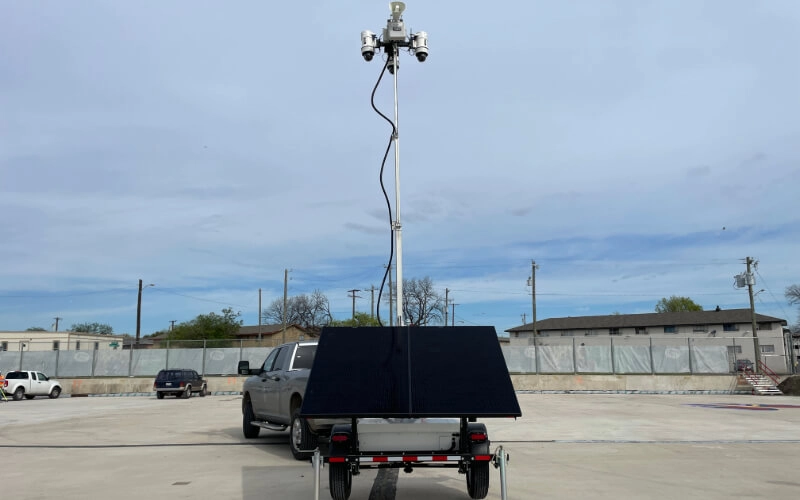
Solar-powered surveillance trailers are typically the starting point for a new Florida jobsite, since they operate without fixed utilities and can be deployed before permanent power or fencing is in place.
Mobile surveillance trailer rental gives Florida contractors a flexible way to secure a site early and adapt coverage as the project changes, whether that means adding units as the footprint grows or relocating one as work moves into a new phase.
This suits the temporary, project-by-project nature of construction far better than a permanent installation would. With solar power and cellular connectivity built in, units can be set up quickly (within 20 minutes for basic setups), giving a site visible deterrence against trespass and vandalism from the first day equipment arrives.
Monitoring and responding in real time
Once trailers are on site, live video monitoring puts a trained operator on the footage 24/7, rather than leaving footage review for after an incident has already happened. Operators can step in the moment they spot suspicious activity on any camera feed, issuing live audio warnings through on-site speakers and contacting police while the incident is still underway.
That active response is what gives a monitored site its deterrent value, since an intervention in the moment can stop a theft or trespass before materials or equipment leave the perimeter.
Extended coverage beyond security
Given Florida's climate, environmental monitoring is a natural extension of the same infrastructure. Florida has no statewide heat standard, and state law bars local governments from setting their own, but contractors are still bound by OSHA's general duty clause to protect workers from recognized hazards.
Our Air Quality Sensors track dust and particulate levels, and Noise Sensors monitor sound levels, which supports compliance with OSHA's construction noise and silica requirements and with local noise ordinances.
PPE Detection supports OSHA compliance by flagging missing protective equipment, which matters on a state where fall protection accounts for 35% of construction violations.
Smoke and Fire Detection round out the safety side of a comprehensive security setup, flagging missing protective equipment or early signs of fire, whether accidental or the result of arson, before either becomes a serious incident.
Adding access control to the site
Intrusion Detection strengthens monitoring by using AI-video analytics built into the trailers and pole cameras to watch designated zones, such as the perimeter or material storage areas, and alert operators as soon as activity occurs in them.
Operators then verify each alert and decide on the right response, so the analytics point attention to the areas that matter most while trained people determine what's a genuine threat.
License plate recognition (LPR) works as an add-on to a comprehensive security setup, logging vehicles that enter and exit a site. It also captures details like make, model, color, speed, and direction of travel.
With whitelists for authorized vehicles and alerts for flagged ones, LPR helps identify suspicious or unfamiliar vehicles, repeat visitors, and unusual driving behavior around the perimeter, such as repeated passes or arrivals outside working hours.
Together, these tools turn a camera feed into a searchable record that supports day-to-day access control, as well as any investigation that follows a security incident.
Video, LPR data, and sensor readings also feed into our single cloud-based management platform, giving construction managers one dashboard to check every active site rather than juggling separate systems for security, safety, and environment data.
That record also matters in the fight against organized crime. Because theft rings target multiple jobsites across county lines, as in the Collier and Charlotte County case, tracking movement is as important as logging entry. Vehicle records showing when a vehicle arrived, which way it travelled, and whether it has returned can help investigators connect incidents across sites.
For companies managing multiple Florida projects at once, that consolidated view is often what turns a preventable incident into one caught in time.
Turning Florida Statistics Into a Construction Site Security Plan
Florida's construction industry is growing quickly, and that growth is expanding the number of active sites, the value of equipment sitting on them, and the range of security risks a project can face, from organized theft rings to opportunistic vandalism and unauthorized access.
A single incident, whatever form it takes, rarely stays contained to its immediate cost. Project delays ripple into subcontractor schedules, insurance premiums climb after a claim, and a company's reputation with clients can take longer to repair than the property itself.
Because of this, the statistics make a clear case for treating jobsite security as part of project planning from the outset, rather than a response to an incident that's already happened. Contact us to discuss which combination of mobile surveillance technology fits your Florida projects.

