
Florida's population grew by 196,700 between 2024 and 2025, the second-highest amongst all states, and 16.5% in total in the last decade. For anyone responsible for a site in Florida, growth on that scale means security around buildings and valuable equipment sitting out in the open needs to be strengthened.
But this growth doesn't cause crime on its own. The FBI reported that violent crime fell an estimated 9.3% nationwide in 2025, which was the largest annual drop since 1936.
Even so, national and statewide averages only show the broad picture. City-level figures often tell a very different story, and no statistic can reflect the risk facing an individual jobsite, commercial property, public works project, or new development, which is why each one needs its own security plan from groundbreaking.
In this article, we'll cover what's driving urban security challenges in Florida and the 7 main challenges to plan around. We'll also discuss how state and local officials are responding and how mobile surveillance can help.
What Florida's Growth Means for Security
Population growth, construction, commercial expansion, tourism, infrastructure investment, and the increased movement of people and assets can all determine local risk profiles. Each one puts more people, vehicles, inventory, and equipment into urban environments that didn't have them before. Plus, each one also changes which security threats a site must plan for.
This is a global pattern. Around 4.4 billion people, which is more than half of the world's population, now live in cities, and as the urban population grows, density is a major contributor to why crime rates rise with it.
When more people, vehicles, and property are packed into the same few blocks, more targets are within reach of an opportunistic offender. The data confirms this, with households in urban areas experiencing 181.6 property victimizations per 1,000 in 2024, nearly 4X the rural rate of 48.3.
That gap is why crime hotspots and quieter blocks can sit side by side in the same city, and why security threats are concentrated where growth is putting real pressure on growing cities across the state.
Read more:
- Top 10 Cities with the Highest Crime Rates in Florida
- Florida Crime Trends: What the Latest Data Shows
7 Urban Security Challenges for Florida's Growing Cities
Florida's fastest-growing cities are facing the same security challenges, with each one putting pressure on different kinds of sites.
Below, we look at what's driving each challenge, what it means for construction jobsites, commercial properties, and public agencies, and how the risk varies across cities.
1. Population growth is putting pressure on public infrastructure
Population growth puts steady pressure on the roads, utilities, water systems, and public services that Florida's urban centers rely on. As mentioned, the Sunshine State added 196,700 residents between 2024 and 2025, which was the second-largest increase of any state.
That pressure also reaches public safety. Every new subdivision and commercial corridor adds ground for police and emergency teams to cover.
In the National Retail Federation's latest study, 63% of retailers said they reported fewer than half of their store-related theft incidents to law enforcement, with lack of response being the main reason.
Patrols alone can't close this gap, which is why visible perimeter security gives property owners and local leaders a practical way to protect expansion areas and public works projects that sit unwatched for hours between police patrols.
Read more:
- Security Considerations for Florida’s High-Traffic Destinations
- The Projects Transforming Florida’s Cities and Infrastructure
2. Continuous building leaves valuable equipment exposed
More building activity leaves valuable equipment exposed on jobsites, because much of the machinery, tools, copper, and building materials can sit on open sites that are unguarded and unmonitored after hours.
In 2025, Florida issued the 2nd-highest number of both single-family and multifamily building permits in the country, and its multifamily permits grew by 29.6%. Permitting has slowed in 2026, with multifamily permits down 3.3% from July last year (2025), but projects that are already underway still need protecting.
Seasoned thieves also know where to look for security gaps. In May 2026, Florida officials announced 14 arrests in Operation D-Fence, which found that a theft ring targeting Home Depot stores and construction jobsites had processed more than $7.6 million in gross transactions between January 2025 and February 2026.
For a contractor, a theft like that means more than the replacement cost. It also means idle crews and expensive rental equipment while replacements are sourced, plus a project schedule that is delayed before the insurance claim is settled.
Construction jobsites tend to change layout as a project moves through phases, and camera coverage has to change with them in order to protect high-value assets and equipment on growing sites.
Read more:
- Crime in Florida: The Trends Construction Projects Need to Know About
- Why Theft and Burglary Continue to Target Florida Jobsites
3. Tourism spikes are creating more openings for opportunistic crime
Tourism surges bring large, constantly changing crowds into busy hospitality and entertainment districts. In turn, this creates more openings for opportunistic crime.
Florida welcomed a record 143.3 million visitors in 2025, and busy visitor areas are a prime target for the kind of theft that dominates the state's crime figures. In particular, larceny-theft made up 80.6% of Florida's total property crimes in 2024.
Major events and nightlife districts compress that activity into short, high-risk windows, which puts heavy demands on event security planning and crowd control as well.
Read more:
- Tourism Growth in Florida: The Security Challenges for Cities and Businesses
- How Florida Cities' Nightlife Districts Influence Crime Trends
4. Organized crime is targeting supply chains
Organized crime is targeting the supply chains that keep Florida's growing cities stocked. The additional growth also means that there's more freight moving through the same ports, highways, airports, and distribution hubs.
The National Insurance Crime Bureau (NICB) lists Florida among the 5 states most impacted by cargo theft and names distribution centers, warehouses, ports, and rail yards among the most common targets for this crime.
CargoNet found that organized criminal groups are targeting extremely high-value shipments, with U.S. cargo theft losses reaching nearly $725 million in 2025. This is a 60% increase from 2024, and the average theft was valued at $273,990.
Trucks and cargo are most vulnerable when sitting idle, and holiday weekends and the Q4 shipping season are among the most frequent theft periods. For port authorities and logistics operators, this places the focus on large, open yards where loaded trailers wait overnight.
5. Commercial expansion is creating new targets for theft
Commercial expansion adds stores, offices, warehouses, and industrial sites faster than permanent security can follow. And each new site is another target for theft. In South Florida, more industrial space was built than tenants needed, so vacancy rose to 5.8% in early 2026, and large warehouses are taking even longer to fill.
Although the National Retail Federation reported a 12.4% decrease in the average number of shoplifting incidents reported by retailers in 2026 compared with 2024, shoplifting remains a concern, with 40% of retailers seeing more organized retail crime incidents. This means retailers should continue to invest in effective security measures to deter theft and protect their stores, staff, and stock.
The riskiest window for any new commercial site is before tenants move in, when fit-out crews leave materials on-site and permanent security measures aren't in place. Mobile surveillance covers that gap without waiting on wiring or fixed infrastructure, and it supports the push against organized retail crime.
6. Housing pressure is changing downtown public spaces
Housing pressure is changing how residents and visitors experience downtown public spaces. The National Low Income Housing Coalition's summary of HUD's 2025 count found 745,652 people experiencing homelessness on a single night in 2025. This is a 3.4% decrease from 2024 and the first year-over-year drop since 2016, with 36% staying in unsheltered locations.
For downtown businesses, this means the issue overlaps with public health, housing affordability, the real estate market, and public safety, so no single agency or business can solve it on its own. Vacant buildings add to the challenge as well, making constant, reliable security essential.
7. Infrastructure investment is opening new worksites across the state
Infrastructure investment is opening new worksites across Florida, from road and bridge projects to water systems, ports, and airports. Florida is expected to receive about $13.3 billion over 5 years for highways and bridges under the Bipartisan Infrastructure Law, and in July 2026, the U.S. Department of Transportation awarded $1.73 billion in BUILD grants to 127 projects nationwide, including $136.8 million for ports.
Every one of those projects creates a security problem. Infrastructure sites stretch across miles of open road or open ground, hold copper wiring, cable, tools, and heavy equipment, and sit unattended overnight. On Fort Myers Beach, workers installing new streetlights found that about 15,000 feet of copper wire had been stolen from multiple locations, valued at about $20,000 and costing about $40,000 to replace and repair.
In Sarasota County, thieves pulled more than 3 miles of wiring for street lights and traffic signals out of the ground, with repairs costing nearly $55,000.
For heavy and civil engineering crews and water districts, a single night's theft means taxpayer-funded repairs, safety exposure, and rework. Sites like these also often have no power or internet, so fixed cameras aren't practical.
What Florida Cities Are Doing About It
Florida cities are giving officers better visibility over areas they can’t patrol constantly. They’re linking camera networks to real-time crime centers, where analysts watch live footage and share what they see with officers who are responding to calls.
Cities are leaning on cameras because visible surveillance changes how offenders weigh the risk of getting caught. In a 2022 review of surveillance research, criminologists describe cameras as working to “trigger a perceptual mechanism in a potential offender.” When someone notices a camera, being identified feels more likely, so the crime starts to look less worth the risk.
That change is also evident in the data. The review’s meta-analysis of 80 camera studies across 9 countries found that crime fell by around 10% in camera-covered areas compared to similar areas without them, and the US was 1 of only 3 countries where cameras produced a clear drop in crime.
Actively monitored systems had a bigger effect than passive ones, which matches the approach local cities are taking with live monitoring in real-time crime centers.
However, public camera networks only cover public streets and buildings. That leaves jobsites, distribution yards, vacant buildings, and public works projects responsible for their own coverage. Footage from a site’s own cameras also gives law enforcement far more to work with when an incident does happen.
Mobile Surveillance for Florida's Growing Urban Areas
Mobile surveillance puts coverage where the risk is and moves it when priorities change. The right setup depends on the type of site, how long it needs protecting, and whether power and internet are available, so below we’ve matched our solutions to the sites facing the most pressure across Florida.
Construction Jobsites
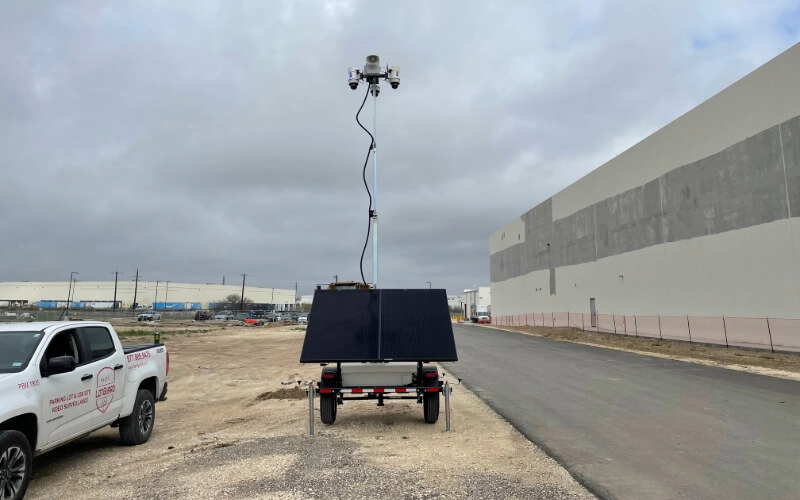
Florida’s construction jobsites hold tools, copper, fuel, and equipment that become easy targets once crews leave for the night. Our Solar Surveillance Trailers give these sites a visible deterrent from day one. Units stand up to 20 ft tall with infrared PTZ cameras that provide near-360° coverage, while solar panels and battery storage keep them running without mains power or internet.
Basic setups are operational within 20-minutes, and they can be easily repositioned by on-site crew as the build moves from phase to phase. For construction managers with multi-site portfolios, our trailers are available to rent throughout Florida, meaning all of your projects benefit from the same comprehensive coverage, no matter where they're located.
Intrusion Detection runs directly on our cameras, so no extra sensors or servers are needed. Your site teams can also set custom zones around laydown yards, site cabins, equipment compounds, and perimeter lines, and schedule them to activate outside working hours. Additionally, the AI-video analytics focus on people and vehicles while ignoring machinery, wildlife, shadows, and weather, so alerts only go out for genuine intrusions.
Each one comes with a timestamp, location, image snapshot, and video clip. However, live video monitoring operators then verify the activity, trigger lights, issue live audio warnings, and escalate confirmed incidents to law enforcement in real-time.
Because every incident is checked by a trained operator first, action is only taken when activity is confirmed, which helps determine how urgent a police dispatch may be needed and gives your team a clear record of what happened and the response taken.
Infrastructure and Public Works Projects
In Florida’s growing cities, road widening, intersection upgrades, utility replacements, and streetscape works run straight through busy corridors. Crews often leave equipment and copper wiring beside open roads and occupied neighborhoods overnight.
Our Pole Cameras mount to existing utility poles, buildings, walls, and columns along these corridors and run on mains or streetlight power. They stream over cellular networks with no trenching or cabling, so coverage goes up without closing extra lanes or adding to the roadworks. Where new roads and utility corridors on a city’s edge have no power at all, our trailers fill the gap.
On-site personnel can relocate both solutions as crews move block by block, which suits construction, traffic and highway projects and heavy and civil engineering crews working across a city. Intrusion Detection also helps water developments spot unauthorized access at pump stations and treatment compounds inside city limits before service is disrupted.
Downtown Corridors and Public Spaces
For city agencies, pole cameras offer a lower-profile option for streets, parks, and public buildings. Each unit combines HD PTZ video, onboard recording, AI analytics, and cellular connectivity in a compact build.
It mounts to existing poles or buildings and runs on mains or streetlight power, with no trenching or cabling. Built-in analytics flag loitering and perimeter breaches as they happen, and a high-output horn speaker can be added for live audio deterrence. Because units are fully relocatable, coverage can follow hotspots as they shift from block to block.
Where a location needs a stronger, more visible presence, solar surveillance trailers make it clear that an area is being watched. Live video monitoring operators verify activity, then trigger lights and live audio warnings to move offenders on before incidents escalate.
This makes trailers a high-impact deterrent for crime hotspots, illegal dumping sites, vandalized parks, and streets affected by quality-of-life crimes such as anti-social behavior.
Distribution Yards and Vacant Commercial Properties
Distribution yards and new commercial buildings waiting on tenants face long, quiet stretches with valuable stock or fit-out materials on-site.
Solar surveillance trailers protect vacant properties and yard perimeters without relying on the building’s power or internet, which are often disconnected between tenants. Solar panels and battery storage keep each unit running for weeks. From a single unit, remotely controlled PTZ cameras can watch fence lines, loading docks, entrances, and storage areas, even in low light or poor weather.
Intrusion Detection zones are drawn around these entry points and scheduled to arm after hours, so an alert only goes out when a person or vehicle enters a protected area. Operators then respond in real-time to stop trespass, theft, vandalism, and illegal occupation before an empty building turns into a costly repair bill.
For sites with regular vehicle traffic, License Plate Recognition (LPR) can be added to our trailers and pole cameras to log commercial traffic at entrances and capture each vehicle’s plate, make, model, color, and speed, day or night.
Video and plate data are also stored together, so operators can search by plate, manage watchlists, and identify repeat visitors who may be scouting a site.
Over time, that plate history helps teams recognize vehicles tied to organized theft groups and get ahead of emerging crime trends, such as the same vehicle appearing across several sites before a break-in. Blacklist and whitelist management also tightens access control, with real-time alerts when a flagged or unauthorized vehicle arrives at a gate.
Our cloud-based management platform ties every deployment together from a single login. Teams overseeing multiple Florida sites can review live footage, alerts, intrusion logs, and audit-ready reports from one dashboard.
Protecting Your Florida Site Starts With Knowing Local Risk
The stakes of poor or lacking security reach well beyond a single site. Homeland Security Investigations estimates that cargo theft alone costs the U.S. up to $35 billion a year, and NICB notes that manufacturers pass those losses along to consumers. At the level of a single site, the cost shows up as stolen equipment, delayed schedules, rising insurance costs, and lost trust with tenants and clients.
Growth changes where risk sits as well, so outdated security plans will need to be refreshed for sites in high-risk areas. Sites in booming corridors and busy tourist districts face different threats, so it's important to start with the challenges that most closely match your specific site.
To plan coverage for a growing Florida site, talk to our team today about mobile surveillance built for the way Florida's cities are changing and expanding.

